Hospital Outsourcing Market Outlook: Facilities Management, Revenue Cycle Automation, Managed Services, and Healthcare Operational Efficiency
Hospital Outsourcing Market: 6 Strategic Decisions Companies Should Make to Capture Growth and Improve Operational Efficiency
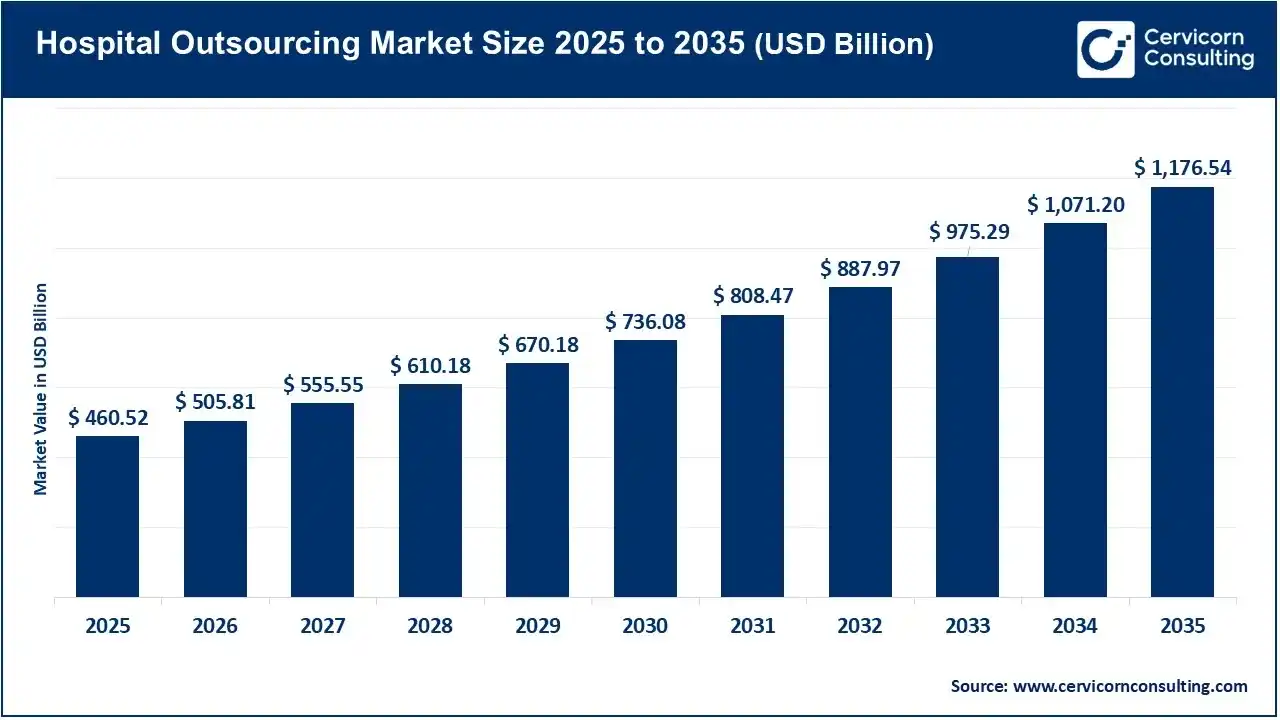
The global hospital outsourcing market was valued at USD 460.52 billion in 2025 and is projected to reach approximately USD 1,176.54 billion by 2035, expanding at a compound annual growth rate (CAGR) of 9.8% from 2026 to 2035. Growth is being driven by rising hospital operating costs, shortages of specialized healthcare professionals, increasing administrative complexity, and the growing adoption of digital healthcare infrastructure. As hospitals face pressure to improve financial performance without compromising patient care, outsourcing is evolving from a support function into a strategic component of healthcare operations.
The shift is also changing the competitive landscape. Facilities management remains the largest service category, while information technology and revenue cycle management are emerging as important growth opportunities. Hospitals are increasingly evaluating external providers for medical billing, coding, diagnostic services, electronic health record (EHR) management, cybersecurity, procurement, and clinical support.
For outsourcing companies, healthcare technology providers, and hospital management groups, the opportunity is not simply to expand service portfolios. It is to identify which functions can be outsourced profitably, demonstrate measurable operational improvements, and establish service models that meet healthcare quality and compliance requirements.
6 Strategic Decisions Companies Should Make in the Hospital Outsourcing Market
1. Should Companies Prioritize Facilities Management or Technology-Enabled Services?
Facilities management accounted for the largest share of the hospital outsourcing market in 2025. Hospitals continue to outsource housekeeping, sanitation, maintenance, security, waste management, and other nonclinical activities because these functions require continuous operational oversight and dedicated resources.
However, the competitive opportunity is gradually expanding beyond traditional facilities management. Information technology and revenue cycle management are expected to experience faster growth as hospitals modernize administrative operations and adopt digital platforms.
Companies should evaluate whether their growth strategy should focus on expanding traditional facilities contracts or developing higher-value technology-enabled services. Providers specializing in automated billing, medical coding, claims management, EHR administration, and healthcare cybersecurity may benefit from increasing hospital demand for digital transformation.
Business decision: Facilities management providers should consider integrating technology, predictive maintenance, energy optimization, and performance monitoring into existing contracts. Technology-focused outsourcing companies should prioritize solutions that directly improve billing accuracy, administrative productivity, and hospital financial performance.
Get a Free Sample: https://www.cervicornconsulting.com/sample/3076
2. How Should Outsourcing Providers Position Their Services for Private and Public Hospitals?
Private hospitals accounted for approximately 42% of the hospital outsourcing market in 2025, making them the leading hospital category. Their outsourcing requirements are closely associated with operational efficiency, service quality, cost management, and technology adoption.
Public hospitals, meanwhile, are expected to register the fastest growth during the forecast period. Budget constraints, increasing patient volumes, infrastructure requirements, and shortages of specialized personnel are encouraging public healthcare institutions to explore external service partnerships.
These two customer groups require different commercial approaches.
- Private hospitals: Prioritize solutions that improve revenue cycle performance, reduce administrative expenses, strengthen patient experience, and support service quality.
- Public hospitals: Focus on scalable service delivery, transparent procurement, predictable operating costs, diagnostic infrastructure, and workforce availability.
- Specialty hospitals: Develop targeted outsourcing solutions for pathology, radiology, dialysis, specialized clinical support, and advanced equipment management.
- Academic and teaching hospitals: Explore partnerships involving research administration, laboratory operations, clinical data management, and specialized infrastructure.
Business decision: Outsourcing providers should avoid using a single service proposition across all hospital categories. Segment-specific pricing, service-level agreements, implementation models, and performance indicators can improve customer acquisition and contract retention.
3. Should Companies Expand Through Partial Outsourcing or Integrated Managed Services?
Partial or functional outsourcing represented approximately 34% of the hospital outsourcing market in 2025, reflecting hospitals’ preference for transferring selected functions to external providers while retaining control over core operations.
This model is particularly attractive to hospitals that want to outsource administrative, technical, or support activities without changing their entire operating structure.
However, managed services are emerging as an important growth opportunity. Hospitals increasingly require integrated service delivery, continuous monitoring, predictable operating expenses, and measurable performance outcomes.
The choice between these models has direct implications for outsourcing companies’ revenue structures and operational requirements.
- Partial outsourcing: Offers opportunities to secure specialized contracts with relatively focused service responsibilities.
- Managed services: Creates opportunities for longer-term relationships through continuous service delivery and performance-based agreements.
- Full-service outsourcing: Allows providers to manage multiple functions under consolidated contracts but requires greater operational capabilities and implementation resources.
- Business process outsourcing: Provides opportunities to scale standardized administrative, billing, coding, and claims-processing operations.
Business decision: Companies should assess their existing infrastructure, workforce capabilities, technology investments, and financial capacity before expanding into integrated managed services. Providers with established operational expertise may benefit from gradually converting individual service contracts into broader, multi-year partnerships.
4. How Can AI and Automation Improve Revenue Cycle Management and Administrative Outsourcing?
Revenue cycle management is becoming an increasingly important opportunity as hospitals face complex reimbursement structures, claim denials, coding requirements, and payment delays.
Manual administrative processes can increase operational costs and create inconsistencies in billing and collections. This is encouraging hospitals to evaluate external providers with advanced automation and specialized healthcare administration capabilities.
AI-powered solutions can support:
- Automated medical coding and documentation review.
- Insurance eligibility verification and claims processing.
- Predictive identification of claim denials.
- Accounts receivable monitoring and follow-up.
- Automated patient billing inquiries.
- Revenue leakage identification and financial reporting.
The October 2026 acquisition of Richter Healthcare Consultants by Sunbound, alongside Sunbound’s USD 24 million Series A funding round, illustrates the growing commercial interest in combining AI-driven revenue operations with established healthcare outsourcing expertise.
For outsourcing providers, this creates opportunities to differentiate through measurable improvements rather than competing exclusively on labor costs.
Business decision: Companies should prioritize automation investments based on their ability to improve first-pass claim acceptance, reduce days in accounts receivable, minimize coding errors, and lower administrative costs. AI adoption should also include human review, data governance, and integration with existing hospital information systems.
5. What Should Companies Consider Before Expanding into Asia Pacific?
North America accounted for approximately 39% of global hospital outsourcing revenue in 2025, supported by established outsourcing providers, advanced healthcare infrastructure, and demand for outsourced administrative and operational services.
However, Asia Pacific is expected to be the fastest-growing regional market. Its hospital outsourcing market was valued at approximately USD 115.13 billion in 2025 and is projected to reach USD 294.14 billion by 2035.
Healthcare infrastructure expansion, increasing patient volumes, aging populations, and the adoption of digital hospital systems are creating opportunities for external service providers.
Companies considering regional expansion should evaluate several factors:
- China: Assess opportunities in healthcare technology, clinical workflow support, diagnostics, and administrative outsourcing while accounting for domestic data localization and regulatory requirements.
- Japan: Evaluate demand for hospital administration technology, scheduling systems, inventory management, and support services addressing an aging population.
- India: Consider opportunities in hospital operations, medical billing, diagnostics, healthcare IT, and scalable administrative outsourcing.
- Southeast Asia: Assess partnerships with private hospital groups, healthcare networks, and emerging medical infrastructure providers.
Business decision: Companies should prioritize markets based on hospital infrastructure investment, outsourcing maturity, regulatory requirements, local partner availability, and the ability to deliver services at competitive costs. Establishing regional partnerships may provide a more practical entry strategy than building complete local operations immediately.
6. How Can Companies Differentiate Through Data Security, Compliance, and Service Quality?
Healthcare outsourcing involves access to sensitive patient records, clinical information, financial transactions, and hospital operating systems. Consequently, data protection and regulatory compliance are becoming important competitive requirements.
Hospitals must consider the risks associated with third-party access, including cybersecurity incidents, unauthorized data transfers, system integration problems, and inconsistent service quality.
Outsourcing providers that cannot demonstrate reliable security and operational controls may struggle to secure contracts, particularly with large hospital networks and public healthcare institutions.
Companies should strengthen their competitive positioning through:
- Healthcare-specific cybersecurity frameworks and access controls.
- Compliance with applicable data protection and healthcare regulations.
- Secure cloud infrastructure and encrypted patient information.
- Standardized service-level agreements and quality monitoring.
- Integration capabilities across EHR, billing, and hospital management systems.
- Business continuity planning and incident response procedures.
- Transparent reporting of operational and financial performance.
Providers operating across international markets must also account for differences in healthcare privacy and data protection requirements, including HIPAA in the United States and applicable national and regional data protection laws.
Business decision: Companies should treat compliance, cybersecurity, and service quality as core commercial capabilities rather than back-office expenses. Demonstrable security standards, transparent reporting, and consistent service delivery can strengthen contract competitiveness and long-term customer relationships.
Hospital Outsourcing Market: Competitive Landscape and Industry Positioning
The competitive environment includes facilities management specialists, healthcare business process outsourcing companies, technology providers, and diversified service organizations. Companies are increasingly competing through service integration, technology adoption, geographic reach, and their ability to manage complex hospital operations.
Key companies operating in the market include:
- Sodexo: Provides healthcare facilities management, food services, workplace services, and integrated hospital support solutions. Its positioning is supported by experience in managing large institutional environments and nonclinical hospital operations.
- ABM Industries: Specializes in facility services, building maintenance, engineering, janitorial services, and infrastructure support. Healthcare facilities provide an important application area for its operational service capabilities.
- Access Healthcare: Focuses on healthcare revenue cycle management, medical billing, coding, claims processing, and technology-enabled administrative services. Its capabilities position it within the growing healthcare BPO segment.
- FinThrive Global Solutions: Concentrates on healthcare financial management, revenue cycle optimization, and technology-enabled financial operations. Its service positioning aligns with hospitals seeking better reimbursement and revenue performance.
- Compass Group: Provides food services, facilities management, and other support operations for healthcare institutions. Its competitive positioning is associated with large-scale service delivery and operational management.
- Cognizant: Offers healthcare IT, digital transformation, application management, data services, and business process outsourcing. Its capabilities are relevant to hospitals modernizing technology infrastructure and administrative workflows.
- Genpact: Provides business process management, finance and accounting services, analytics, and automation solutions. Its expertise is relevant to outsourced healthcare administration and revenue operations.
- WNS Global Services: Specializes in business process management, analytics, finance operations, and technology-enabled services, creating opportunities in healthcare administrative outsourcing.
- Tata Consultancy Services (TCS): Provides healthcare technology, enterprise IT, digital transformation, data management, and application services. Its capabilities support hospital technology modernization and integrated digital operations.
- Medphine: Focuses on healthcare business process outsourcing, including revenue cycle management, medical billing, coding, and related administrative services.
For established providers, the competitive challenge is to protect existing contracts while expanding into higher-value technology-enabled services. Smaller outsourcing companies may find opportunities in specialized administrative functions, regional hospital partnerships, and services requiring domain-specific expertise.
Future Opportunities in the Hospital Outsourcing Market
Several developments are expected to influence outsourcing strategies over the next decade.
AI-powered healthcare administration: Automation of medical coding, claims processing, documentation, and revenue cycle operations will create opportunities for providers with healthcare-specific AI capabilities.
Specialized clinical outsourcing: Growing demand for diagnostics, laboratory testing, radiology, pharmacy management, and specialized clinical support may encourage hospitals to work with dedicated external providers.
Integrated hospital operations: Hospitals seeking fewer vendor relationships may increasingly evaluate providers capable of managing multiple operational functions through consolidated contracts.
Remote patient monitoring and virtual support: Aging populations and rising chronic disease prevalence may create opportunities for outsourced remote monitoring, patient coordination, virtual nursing, and telehealth support.
Sustainable hospital infrastructure: Energy management, medical waste disposal, resource optimization, and environmentally responsible facilities management may become additional service differentiation opportunities.
Public-private healthcare partnerships: Governments and healthcare institutions seeking to expand service capacity without undertaking all infrastructure and staffing investments internally may create opportunities for specialized outsourcing partnerships.
Conclusion: What Will Determine Long-Term Competitiveness?
The hospital outsourcing market is moving beyond traditional cost-saving arrangements toward technology-enabled, specialized, and performance-oriented service delivery.
With the global market projected to reach USD 1,176.54 billion by 2035, companies have opportunities across facilities management, revenue cycle management, healthcare IT, clinical support, procurement, and integrated hospital operations.
However, market expansion alone will not determine commercial success. Providers must identify the right hospital segments, choose sustainable outsourcing models, invest in automation, strengthen regional capabilities, and demonstrate measurable improvements in service quality and financial performance.
For hospital groups, the priority is to determine which functions should remain internal and which can be managed more effectively by external specialists. For outsourcing providers, the opportunity lies in developing capabilities that solve specific operational problems while meeting increasingly demanding healthcare standards.
Ultimately, the companies best positioned to capture growth will be those that connect outsourcing decisions with measurable improvements in hospital efficiency, financial performance, and patient service delivery.
To Get Detailed Overview, Contact Us: https://www.cervicornconsulting.com/contact-us