Food Containers Market Revenue, Trends, and Strategic Insights by 2035
Food Containers Market Size
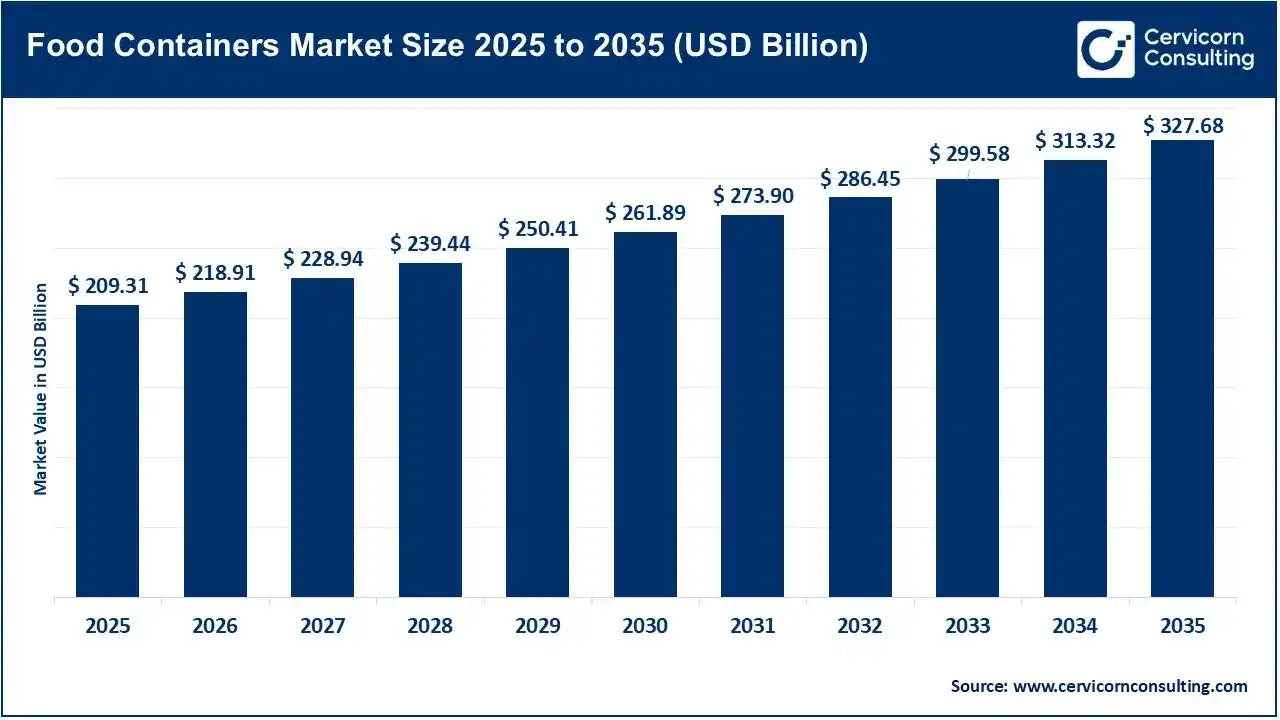
The global food containers market was valued at approximately USD 209.31 billion in 2025 and is projected to reach USD 327.68 billion by 2035, expanding at a CAGR of 4.6% during the forecast period.
Food Containers Market Growth Factors
The global food containers market is being driven by the expanding consumption of packaged, ready-to-eat, frozen, chilled, takeaway, and convenience foods; rapid growth of food delivery and e-commerce; increasing urbanization and changing consumer lifestyles; rising demand for lightweight, durable, resealable, and portable packaging; growing food-safety requirements; expansion of organized retail and supermarkets; greater adoption of portion-controlled products; and increasing pressure on food manufacturers to reduce food waste and extend shelf life.
Sustainability is becoming an equally important growth factor as brands, retailers, regulators, and consumers increasingly demand recyclable, reusable, lightweight, recycled-content, and lower-material packaging. The shift toward circular packaging is encouraging manufacturers to invest in advanced recycling, mono-material structures, recycled plastics, aluminum, paper-based solutions, and reusable formats. At the same time, technological advances in barrier materials, thermoforming, blow molding, injection molding, intelligent packaging, and modified-atmosphere packaging are allowing food containers to provide stronger protection while using less material.
What Is the Food Containers Market?
The food containers market refers to the global industry involved in the manufacturing, distribution, and use of containers designed to store, protect, transport, display, and serve food products. These containers are used throughout the food supply chain, from food processing and manufacturing to retail, foodservice, restaurants, catering, takeaway, delivery, and household consumption.
Food containers can be manufactured from a broad range of materials, including plastic, glass, metal, paperboard, aluminum, and biodegradable or compostable materials. Plastic remains important because of its low weight, versatility, impact resistance, and ability to be molded into different shapes and sizes. Glass is valued for its inertness, transparency, and premium appearance, while metal and aluminum provide durability and strong barrier properties. Paper-based containers are gaining attention because of increasing demand for renewable and recyclable packaging alternatives.
The market includes products such as tubs, trays, bowls, cups, bottles, jars, cans, clamshells, takeaway boxes, meal containers, ready-meal packaging, frozen-food containers, dairy containers, and containers for snacks, sauces, fruits, vegetables, meat, and other processed foods.
Get a Free Sample: https://www.cervicornconsulting.com/sample/3010
Why Is the Food Containers Market Important?
Food containers play a critical role in maintaining food quality, safety, shelf life, and convenience. Effective packaging protects products from moisture, oxygen, contamination, physical damage, and temperature fluctuations. This is particularly important for perishable foods such as meat, seafood, dairy products, fruits, vegetables, and prepared meals.
Containers also contribute to the reduction of food waste by extending product shelf life and protecting food during transportation and storage. In addition, packaging supports portion control, product identification, branding, traceability, and consumer convenience.
The market is becoming increasingly important from a sustainability perspective. Governments are introducing regulations aimed at improving recyclability, reducing unnecessary packaging, increasing recycled content, and encouraging reuse. The European Union’s Packaging and Packaging Waste Regulation, for example, applies to packaging across its life cycle and seeks to increase recyclability, reduce virgin material use, and support a circular economy.
Leading Companies in the Food Containers Market
| Company | Specialization | Key Focus Areas | Notable Features | 2025 Revenue | Market Share | Global Presence |
|---|---|---|---|---|---|---|
| Graham Packaging Company | Rigid plastic packaging | Food, beverage, household and consumer packaging | Blow molding, lightweight packaging, customized designs | Not publicly disclosed | Not separately disclosed | North America, Europe, Latin America and other international markets |
| Amcor plc | Flexible and rigid packaging | Food, beverage, healthcare and consumer products | Large global packaging portfolio, recyclable and lightweight solutions | Approximately USD 16.0 billion in FY2025 | Not separately disclosed | More than 40 countries |
| Bemis Company Inc. | Flexible packaging | Food, healthcare and consumer products | Strong flexible packaging heritage; integrated into Amcor | Standalone revenue not applicable after acquisition | Not separately disclosed | Formerly global; operations integrated into Amcor |
| Plastipak Holdings, Inc. | Rigid plastic packaging and recycling | Food, beverage and consumer packaging | PET packaging, preforms, recycling and sustainability technologies | Not publicly disclosed | Not separately disclosed | North America, Europe, Latin America and other markets |
| Ball Corporation | Aluminum packaging | Beverage and consumer packaging | Large-scale aluminum packaging capabilities and recyclable packaging | USD 13.16 billion | Not separately disclosed for food containers | North/Central America, EMEA and South America |
Graham Packaging Company
Graham Packaging Company is a major producer of rigid plastic packaging and serves food, beverage, household, and consumer-product manufacturers. Its capabilities include blow molding and customized rigid packaging formats.
For the food containers market, Graham’s competitive positioning is associated with lightweighting, container design, material efficiency, functionality, and customized packaging. As food producers seek containers that provide durability without excessive material use, technologies that reduce packaging weight while maintaining performance can create significant commercial value.
Graham is privately held, and a standalone 2025 revenue figure and food-container-specific market share are not publicly disclosed. Its international operations provide exposure to major food and consumer packaging markets.
Amcor plc
Amcor plc is one of the world’s largest packaging companies, with operations spanning flexible and rigid packaging. Its portfolio serves food, beverage, healthcare, personal care, and other consumer markets.
The acquisition of Bemis significantly expanded Amcor’s flexible packaging capabilities and geographic reach. The transaction was completed in June 2019, creating a larger global packaging company with increased scale across North America, Latin America, Europe, and Asia-Pacific.
Amcor’s food-container strategy is increasingly connected with recyclability, lightweighting, material reduction, barrier performance, and circular packaging. Its scale allows it to work with large multinational food manufacturers that require consistent packaging solutions across multiple markets.
Amcor’s FY2025 revenue was approximately USD 16 billion on a consolidated basis. This figure represents the entire company rather than food containers specifically.
Bemis Company Inc.
Bemis Company Inc. was historically a major U.S.-based manufacturer of flexible packaging products, serving food, healthcare, and consumer industries. Its products included films, flexible packaging structures, and other packaging technologies.
Bemis is particularly important to the history of the food containers market because its flexible packaging expertise became part of Amcor’s global portfolio. Amcor completed its acquisition of Bemis in 2019 for an equity consideration of approximately USD 5.23 billion.
Consequently, Bemis does not have a separate 2025 revenue or market share as an independent company. Its capabilities and assets are incorporated into Amcor’s operations.
Plastipak Holdings, Inc.
Plastipak Holdings, Inc. specializes in rigid plastic packaging, particularly PET containers and preforms, and also has capabilities in recycling and packaging sustainability.
Its position in food and beverage packaging is supported by PET’s combination of lightweighting potential, durability, transparency, and recyclability. Plastipak’s integration of packaging manufacturing and recycling capabilities also aligns with the industry’s movement toward circular material systems.
As a privately held company, Plastipak does not publicly disclose a standalone 2025 revenue figure or food-container-specific market share comparable to publicly listed packaging companies.
Ball Corporation
Ball Corporation is a major global supplier of aluminum packaging. Although beverage cans represent its largest product line, aluminum packaging technologies also demonstrate the broader movement toward recyclable metal containers.
Ball reported USD 13.161 billion in consolidated net sales in 2025, compared with USD 11.795 billion in 2024. Its 2025 sales included USD 6.286 billion from Beverage Packaging, North and Central America, USD 3.983 billion from EMEA, and USD 2.162 billion from South America.
Ball’s extensive manufacturing footprint demonstrates the importance of regional production networks in packaging. Aluminum’s recyclability and established collection infrastructure also position metal as an important alternative to some single-use plastic formats.
Leading Trends in the Food Containers Market and Their Impact
1. Sustainable and Recyclable Containers
Sustainability is one of the most influential trends in food packaging. Food manufacturers are moving toward containers that use less material, contain recycled content, are easier to recycle, or can be reused.
Impact: Packaging manufacturers are investing in mono-material designs, recycled plastics, aluminum, fiber-based packaging, and improved recycling technologies. Regulatory requirements are accelerating this transition.
2. Lightweighting
Lightweighting involves reducing the amount of material used to manufacture a container without compromising strength, safety, or functionality.
Impact: Lightweight containers can reduce material consumption, transportation weight, logistics costs, and potentially carbon emissions. Manufacturers are therefore investing in advanced molding, material engineering, and structural designs.
3. Growth of Ready-to-Eat and Convenience Foods
Busy lifestyles have increased demand for ready meals, frozen foods, snacks, prepared salads, meal kits, and takeaway products.
Impact: Containers increasingly need to provide microwaveability, resealability, portion control, stackability, leak resistance, and easy opening.
4. Food Delivery and Takeaway Packaging
Food delivery has created demand for containers that can withstand transportation while maintaining food temperature and preventing leaks.
Impact: Producers are developing stronger lids, leak-resistant seals, compartmentalized designs, tamper-evident solutions, and more sustainable alternatives to conventional single-use packaging.
5. Smart and Functional Packaging
Packaging is becoming more functional through improved barrier technologies, freshness indicators, tamper-evident systems, QR codes, and traceability technologies.
Impact: Food companies can improve product information, traceability, consumer engagement, and supply-chain visibility.
6. Reusable Packaging
Reusable containers are receiving greater attention as governments and consumers seek to reduce single-use packaging.
Impact: Reuse creates opportunities for durable container designs, return logistics, cleaning systems, refill models, and packaging-as-a-service models.
7. Circular Economy Packaging
Companies are increasingly attempting to keep packaging materials in productive use for longer through collection, recycling, reuse, and recycled-content applications.
Impact: Packaging manufacturers are moving beyond the traditional linear model of producing and disposing of containers toward systems that integrate collection and recycling into packaging design.
Successful Examples of the Food Containers Market Around the World
Europe: Reusable and Circular Packaging Models
Europe has become a major testing ground for reusable and recyclable packaging systems. The EU’s PPWR entered into force on 11 February 2025 and generally applies from 12 August 2026. The regulation establishes requirements covering packaging design, composition, reuse, recyclability, waste prevention, and recycled content.
The regulation also introduces restrictions on certain single-use packaging formats and encourages reusable solutions. Takeaway businesses are required to move toward systems that allow consumers to use their own containers, while broader reuse targets are being established.
This regulatory environment is encouraging European food companies and packaging manufacturers to redesign containers around recyclability and reuse rather than simply replacing one disposable material with another.
India: Sustainable Food Packaging Initiatives
India represents a significant growth market because of its large population, expanding food-processing sector, urbanization, and growing delivery economy.
The Food Safety and Standards Authority of India has promoted safe and sustainable packaging through packaging regulations, awareness initiatives, and efforts to reduce the plastic footprint of the food and beverage industry.
In April 2025, FSSAI conducted a national stakeholder consultation on sustainable food packaging involving food businesses, packaging companies, recycling associations, regulators, consumer groups, and other stakeholders. Discussions included eco-friendly packaging, lightweighting, recyclability, plastic recovery, and circular-economy approaches.
India’s plastic packaging EPR framework also establishes recycling and reuse obligations. Government guidance specifies progressively increasing recycling targets, including 40–60% for 2025–26, 50–70% for 2026–27, and 60–80% from 2027–28 onward, depending on applicable packaging categories.
North America: Lightweighting and Recyclability
North America remains a major food packaging market because of its sophisticated food-processing industry, strong supermarket networks, high consumption of packaged foods, and mature packaging manufacturing infrastructure.
Companies are increasingly emphasizing lightweight plastic containers, recyclable PET, aluminum packaging, recycled-content materials, and packaging designs optimized for modern retail and foodservice channels.
The region also provides a strong environment for innovation because major food companies frequently work directly with packaging suppliers to develop customized containers for individual product categories.
Asia-Pacific: Rapid Expansion and Convenience
Asia-Pacific is experiencing strong demand for food containers due to urbanization, expanding middle-class populations, increasing packaged-food consumption, and rapid growth in food delivery.
Countries such as China, India, Japan, South Korea, Indonesia, and other Southeast Asian markets have growing requirements for packaged meals, beverages, processed foods, dairy products, snacks, and convenience foods.
Impact: Packaging companies are expanding local production capabilities and developing affordable, lightweight, and increasingly recyclable containers suited to high-volume consumer markets.
Latin America: Growth Through Packaged Foods and Retail Modernization
Latin America is benefiting from growth in organized retail, packaged food consumption, urbanization, and modern foodservice channels.
Brazil and Mexico are particularly important markets because of their large consumer populations and established food-processing sectors. Demand is increasing for plastic containers, flexible packaging, cans, jars, and foodservice containers.
At the same time, sustainability requirements are encouraging producers to increase recycling and explore lower-material packaging formats.
Middle East and Africa: Infrastructure and Food-Security Demand
The Middle East and Africa represent developing opportunities for food-container manufacturers. Rising urbanization, changing dietary patterns, modern retail development, and investments in food processing are supporting packaging demand.
Food security initiatives are also increasing the importance of packaging that can extend shelf life and reduce food losses during transportation and storage. In hot climates, containers with strong barrier and thermal-performance characteristics can be particularly valuable.
Global Regional Analysis and Government Initiatives Shaping the Market
North America
North America remains one of the most established food-container markets. Demand is supported by packaged foods, frozen meals, beverages, restaurant chains, grocery retail, and e-commerce.
Government and state-level sustainability policies are encouraging greater recycling, producer responsibility, recycled-content usage, and reduction of packaging waste. These measures are pushing manufacturers toward material-efficient and recyclable container designs.
Europe
Europe is at the forefront of packaging regulation. The Packaging and Packaging Waste Regulation (EU) 2025/40 establishes requirements covering packaging throughout its life cycle. The European Commission states that the framework aims to make packaging recyclable by 2030, increase the use of recycled plastics, reduce virgin material use, and support climate-neutrality objectives.
The EU also maintains extended producer responsibility requirements for single-use plastic products, including food containers. Businesses may be required to participate in national EPR schemes covering waste collection, recycling, and litter-management costs.
These regulations are accelerating investment in recyclable, reusable, lightweight, and low-waste food containers.
Asia-Pacific
Asia-Pacific is combining market expansion with increasing packaging regulation. Governments are strengthening plastic-waste management systems, recycling infrastructure, and producer responsibility programs.
In India, EPR requirements under the Plastic Waste Management framework are increasing obligations for producers, importers, and brand owners. The policy framework includes targets for recycling, reuse, and recycled content, creating incentives for more circular packaging systems.
For food-container manufacturers, this creates opportunities for recycled PET, reusable rigid packaging, fiber-based alternatives, and technologies that improve collection and recycling.
Latin America
Latin American countries are increasingly adopting policies addressing plastic waste, recycling, and producer responsibility. The market impact is particularly visible in urban centers, where municipalities and national governments are working to improve waste collection and recycling.
These initiatives encourage packaging manufacturers to design containers that are compatible with available recycling infrastructure while reducing unnecessary material consumption.
Middle East and Africa
Governments across the Middle East and Africa are increasingly focused on waste reduction, recycling, food security, and sustainable development. Packaging is an important part of these objectives because effective containers can reduce food losses while improved waste systems can reduce environmental impacts.
Investment in food-processing facilities, cold chains, modern retail, and logistics infrastructure is expected to support demand for higher-performance food containers.
The Strategic Direction of the Food Containers Market
The food containers industry is moving from a traditional focus on containment and protection toward a broader model combining food safety, convenience, sustainability, circularity, branding, and supply-chain efficiency.
Manufacturers that can balance these requirements are likely to gain an advantage. A container must increasingly be lightweight but strong, recyclable but cost-effective, sustainable but food-safe, convenient but durable, and attractive while remaining compatible with high-speed filling and distribution systems.
The competitive environment will therefore depend increasingly on material science, recycling technology, manufacturing efficiency, regulatory compliance, design innovation, and partnerships with food brands.
As governments strengthen packaging regulations and consumers become more conscious of environmental impacts, the market is expected to see continued investment in recycled-content materials, reusable containers, mono-material structures, advanced barrier technologies, and circular packaging infrastructure. The companies able to combine large-scale manufacturing with sustainable innovation will be well positioned to capture opportunities across mature and emerging food markets.
To Get Detailed Overview, Contact Us: https://www.cervicornconsulting.com/contact-us
Read Report: Server CPU Market Revenue, Trends, and Strategic Insights by 2035