Generative AI in the Automotive Market Growth Drivers, Trends, Key Players and Regional Insights by 2035
Generative AI in the Automotive Market Size
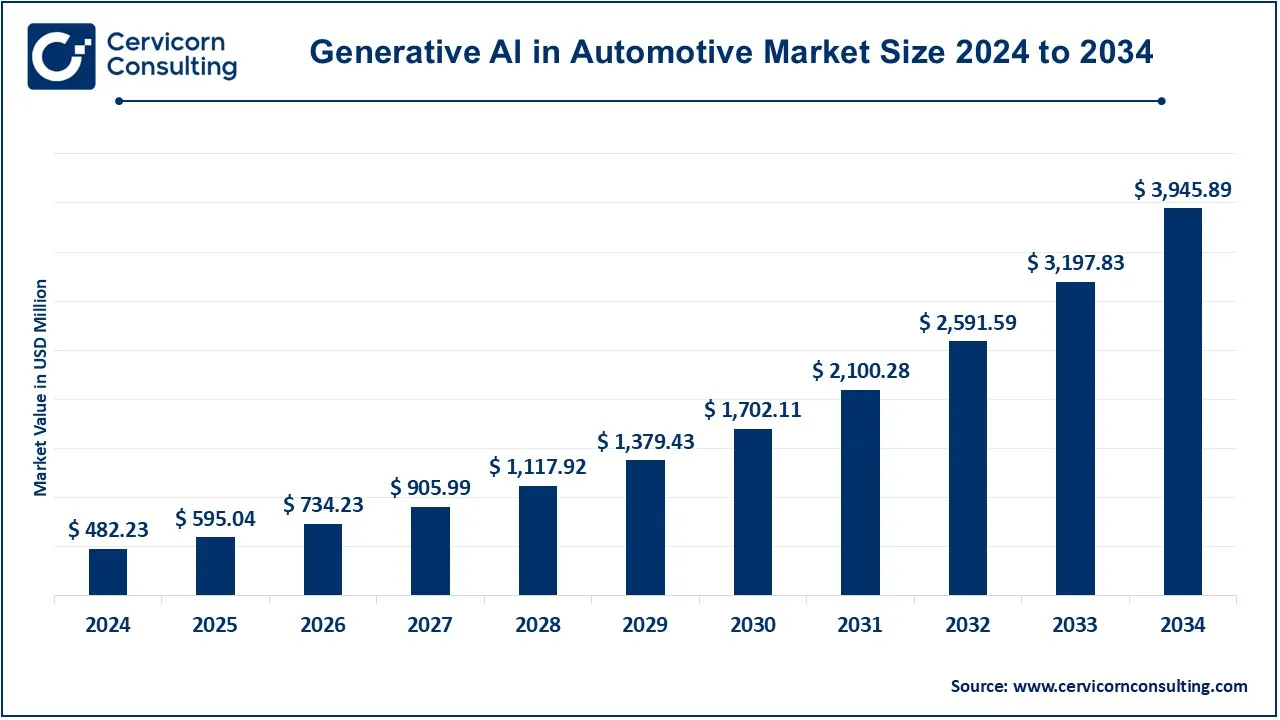
The global generative Al in automotive market size was worth USD 482.23 million in 2024 and is anticipated to expand to around USD 3,945.89 million by 2034, registering a compound annual growth rate (CAGR) of 25.65% from 2026 to 2035.
What Is Generative AI in the Automotive Market?
Generative AI in the automotive market refers to the application of AI models that can autonomously generate new content, designs, predictions, or decision pathways relevant to vehicles and mobility systems. Unlike traditional AI systems that focus primarily on classification, detection, or prediction, generative AI can create entirely new outputs based on patterns learned from vast datasets.
In automotive applications, generative AI is used to produce optimized vehicle component designs, simulate millions of driving scenarios for autonomous systems, generate software code for vehicle control units, create realistic synthetic sensor data, and power intelligent conversational assistants within vehicles. These models include large language models, generative adversarial networks, diffusion models, and reinforcement learning frameworks, all of which learn from real-world vehicle data, sensor feeds, and operational histories.
By enabling machines to generate solutions rather than simply execute predefined rules, generative AI allows automakers and mobility providers to solve highly complex engineering, safety, and operational challenges that were previously time-consuming, expensive, or technically infeasible.
Get a Free Sample: https://www.cervicornconsulting.com/sample/2476
Why Is Generative AI Important for the Automotive Market?
Generative AI has become critically important to the automotive market because it directly addresses the industry’s growing complexity and competitive pressure. Modern vehicles are no longer purely mechanical products; they are intelligent, connected platforms that rely heavily on software and data. Generative AI accelerates innovation by reducing development timelines through automated design and simulation, allowing engineers to explore thousands of design alternatives in a fraction of the time required by traditional methods.
Safety and reliability are also significantly enhanced through generative AI-powered simulations that allow autonomous driving systems to be trained and validated against rare, dangerous, or edge-case scenarios without risking human lives. In manufacturing and supply chain operations, generative AI improves efficiency by forecasting demand, identifying bottlenecks, optimizing production schedules, and predicting equipment failures before they occur. From a consumer perspective, generative AI enables personalized in-vehicle experiences, including natural language voice assistants, adaptive infotainment systems, and intelligent route planning. Ultimately, generative AI has become a strategic differentiator, allowing automotive companies to compete on innovation speed, safety performance, user experience, and operational efficiency.
Key Companies Shaping the Generative AI in Automotive Market
Microsoft
Company: Microsoft
Specialization: Cloud computing, enterprise AI platforms, and software ecosystems
Key Focus Areas: Cloud-based generative AI for automotive design, simulation, manufacturing analytics, connected vehicles, and in-vehicle digital assistants
Notable Features: Microsoft provides scalable AI infrastructure and development tools that enable automakers to deploy generative design workflows, predictive maintenance systems, and AI-driven mobility services. Its platforms support real-time analytics, digital twins, and software-defined vehicle development.
2024 Revenue: Over USD 200 billion (company-wide)
Market Share: Significant influence as a technology enabler rather than a vehicle manufacturer
Global Presence: Strong worldwide footprint across North America, Europe, Asia-Pacific, and emerging markets
AUDI AG
Company: AUDI AG
Specialization: Premium automobile manufacturing and advanced vehicle engineering
Key Focus Areas: AI-assisted vehicle design, lightweight materials, intelligent manufacturing, and autonomous driving research
Notable Features: Audi applies generative AI to optimize component designs, reduce material usage, and improve structural performance. The company is also integrating AI into smart manufacturing and vehicle intelligence systems.
2024 Revenue: Over EUR 60 billion
Market Share: Strong presence in the global premium automotive segment
Global Presence: Europe, North America, China, and other key automotive markets
Intel Corporation
Company: Intel Corporation
Specialization: Semiconductors and AI computing platforms
Key Focus Areas: Automotive AI hardware, ADAS, autonomous driving perception systems, and edge computing
Notable Features: Through its automotive-focused technologies, Intel supports generative AI workloads for real-time perception, sensor fusion, and decision-making in vehicles. Its platforms are widely used in safety-critical automotive systems.
2024 Revenue: Over USD 60 billion
Market Share: Major supplier of automotive AI computing solutions
Global Presence: North America, Europe, and Asia-Pacific
Tesla, Inc.
Company: Tesla, Inc.
Specialization: Electric vehicles and AI-driven autonomous systems
Key Focus Areas: Autonomous driving, neural network training, fleet data analytics, battery optimization
Notable Features: Tesla leverages generative AI and deep learning to continuously improve its driver-assistance and self-driving capabilities using real-world data collected from millions of vehicles. Over-the-air updates allow AI models to evolve rapidly.
2024 Revenue: Approximately USD 90 billion
Market Share: Leading position in the electric vehicle and autonomous innovation segments
Global Presence: North America, Europe, China, and expanding global markets
Uber Technologies
Company: Uber Technologies
Specialization: Mobility-as-a-service and transportation platforms
Key Focus Areas: AI-driven route optimization, demand forecasting, fleet intelligence, and autonomous mobility research
Notable Features: Uber uses generative AI models to optimize routing, pricing, and fleet utilization while improving safety and efficiency across large-scale mobility networks.
2024 Revenue: Approximately USD 37 billion
Market Share: Global leader in ride-hailing and urban mobility services
Global Presence: Operations in over 70 countries worldwide
Leading Trends and Their Impact on the Market
One of the most significant trends in the generative AI automotive market is the acceleration of autonomous driving development. Generative AI enables the creation of highly realistic virtual driving environments where autonomous systems can be trained, tested, and validated across millions of scenarios. This dramatically reduces development costs and improves safety outcomes.
Another major trend is the adoption of generative design in automotive engineering. AI-generated designs help reduce vehicle weight, improve aerodynamics, and enhance structural strength, contributing directly to better fuel efficiency and extended EV range. Predictive maintenance powered by generative models is also gaining traction, allowing manufacturers and fleet operators to anticipate failures and optimize service schedules.
Human-machine interaction is evolving through generative AI-driven conversational interfaces that allow drivers to interact naturally with vehicles using voice commands. In electric vehicles, generative AI is increasingly used to optimize energy consumption, battery health, and thermal management. Additionally, digital twins and AI-generated simulations are transforming manufacturing by enabling virtual optimization of production lines and factory layouts before physical deployment.
Successful Examples of Generative AI in the Automotive Market
Several real-world implementations highlight the effectiveness of generative AI in automotive applications. Tesla’s autonomous driving systems demonstrate how generative AI models trained on large-scale fleet data can continuously improve vehicle perception and decision-making. Audi’s use of AI-assisted design showcases how generative models can create lighter, stronger vehicle components while reducing development time.
Intel’s automotive AI platforms are widely used in advanced driver-assistance systems, improving vehicle safety and perception accuracy. Microsoft’s collaborations with automakers enable AI-driven predictive maintenance, digital twins, and intelligent manufacturing systems. Uber’s AI-powered routing and fleet management solutions demonstrate how generative models can optimize large-scale mobility operations in real time.
Global Regional Analysis Including Government Initiatives and Policies
North America
North America represents one of the most mature markets for generative AI in automotive due to strong technology ecosystems, high R&D investment, and early adoption of autonomous and electric vehicles. Government agencies in the region support AI innovation through funding programs, autonomous vehicle testing frameworks, and evolving safety regulations. These initiatives encourage collaboration between automakers, technology companies, and research institutions.
Europe
Europe’s automotive AI market is shaped by a strong focus on safety, sustainability, and regulatory compliance. Governments across the region support AI research and development through public-private partnerships, while regulatory frameworks emphasize ethical AI use, transparency, and risk management. Germany, France, and the United Kingdom are leading hubs for automotive AI innovation.
Asia-Pacific
Asia-Pacific is one of the fastest-growing regions for generative AI in automotive, driven by large-scale vehicle production, rapid urbanization, and strong government support for smart mobility initiatives. Countries such as China, Japan, South Korea, and India are investing heavily in intelligent transportation systems, autonomous vehicle testing zones, and AI research programs.
Latin America, Middle East, and Africa
These regions are emerging markets for generative AI in automotive. Adoption is gradually increasing through smart city initiatives, connected mobility projects, and investments in digital infrastructure. Governments in select countries are beginning to explore regulatory frameworks to support autonomous and AI-enabled transportation.
To Get Detailed Overview, Contact Us: https://www.cervicornconsulting.com/contact-us
Read Report: Electronic Components Market Growth Drivers, Trends, Key Players and Regional Insights by 2034