Small Molecule API Market: How Should Pharmaceutical Companies Balance Manufacturing Costs, Supply Security and Regulatory Compliance?
Small Molecule API Market: How Should Pharmaceutical Companies Balance Manufacturing Costs, Supply Security and Regulatory Compliance?
Active pharmaceutical ingredients (APIs) determine the therapeutic effectiveness of medicines, making their availability, quality and manufacturing consistency critical to pharmaceutical operations. Small molecule APIs remain essential to generic drugs, branded medicines and treatments across oncology, cardiovascular disease, infectious diseases and other major therapeutic areas.
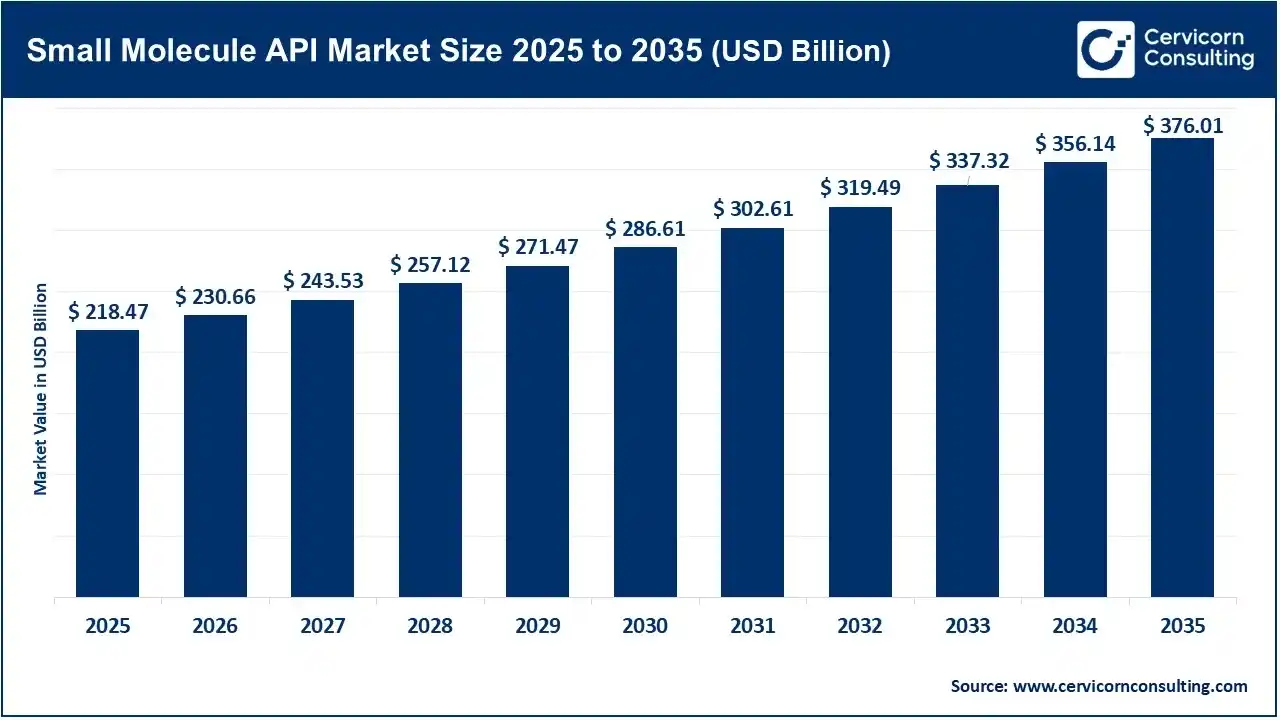
The global small molecule API market was valued at USD 218.47 billion in 2025 and is projected to grow from USD 230.66 billion in 2026 to nearly USD 376.01 billion by 2035, registering a compound annual growth rate (CAGR) of 5.6%. However, for pharmaceutical manufacturers, market expansion is only one part of the investment equation. The more immediate challenge is deciding where to manufacture, which suppliers to prioritise and how to maintain cost competitiveness without compromising quality or supply continuity.
1. Should Pharmaceutical Companies Prioritise In-House Manufacturing or Outsourcing?
The decision to manufacture APIs internally or partner with a contract development and manufacturing organisation (CDMO) depends on production volumes, technical capabilities, capital availability and long-term demand visibility.
In-house manufacturing can provide greater control over production schedules, quality systems and supply planning. However, it requires substantial investment in facilities, equipment, skilled personnel, environmental controls and regulatory compliance. These costs can become difficult to justify when demand is uncertain or production volumes fluctuate.
Outsourcing allows pharmaceutical companies to access established manufacturing infrastructure and specialised expertise without committing the same level of capital. It can be particularly useful when entering new therapeutic categories, scaling production or managing multiple product launches.
The decision should therefore extend beyond comparing manufacturing costs per unit. Companies should assess total production costs, technology transfer requirements, minimum order quantities, supplier capacity, quality history and the ability to increase output when demand rises.
Business implication: Manufacturers with stable, high-volume requirements may benefit from evaluating captive production, while companies facing uncertain demand or specialised manufacturing needs may find outsourcing more flexible. A hybrid model can also help balance cost control with supply resilience.
Get a Free Sample: https://www.cervicornconsulting.com/sample/3056
2. How Can Companies Reduce API Sourcing Risks Without Increasing Costs Excessively?
API procurement decisions increasingly involve a trade-off between purchasing at the lowest available price and maintaining reliable access to critical pharmaceutical ingredients.
Dependence on a single supplier or manufacturing geography can expose companies to production interruptions, logistics constraints, geopolitical developments and changes in regulatory status. Qualifying alternative suppliers can reduce these risks, although additional supplier audits, analytical testing, documentation and regulatory approvals may increase short-term costs.
A practical sourcing strategy begins with classifying APIs according to their commercial and operational importance. Ingredients used in high-volume medicines, products with limited alternative suppliers or therapies with strict continuity requirements may warrant stronger supply protections than ingredients available from several qualified manufacturers.
Procurement teams should evaluate suppliers against a consistent set of criteria:
- Supply reliability: Production capacity, delivery performance and contingency arrangements.
- Quality and compliance: Inspection history, documentation standards, change-control procedures and batch consistency.
- Commercial competitiveness: Pricing, payment terms, logistics expenses and the cost of maintaining alternative sources.
- Scalability: Ability to support higher volumes without compromising manufacturing quality.
- Geographic exposure: Concentration of sourcing across countries, production sites and critical starting materials.
India’s pharmaceutical manufacturing ecosystem presents opportunities for domestic production and international sourcing diversification. Government initiatives supporting bulk drug manufacturing and common industrial infrastructure are also relevant when evaluating the longer-term competitiveness of Indian API suppliers.
Business implication: The lowest-cost supplier is not necessarily the lowest-cost option over the full product lifecycle. Procurement decisions should account for the financial consequences of supply interruptions, emergency sourcing and delayed product deliveries.
3. Are Complex and High-Potency APIs Changing Manufacturing Investment Priorities?
Demand for established generic medicines continues to support conventional small molecule API production. At the same time, increasingly specialised therapies are creating demand for manufacturers with more advanced synthesis, containment and process-development capabilities.
High-potency APIs, particularly those used in oncology and targeted treatments, require specialised handling, exposure controls and validated manufacturing processes. Other complex molecules may demand advanced analytical capabilities, process optimisation and greater technical expertise.
These requirements can create opportunities for manufacturers willing to invest in specialised infrastructure. However, capacity expansion should be supported by a realistic assessment of customer demand, product pipelines, qualification timelines and the competitive landscape.
For CDMOs, the strategic question is whether additional technical capabilities can secure sufficiently durable customer relationships and improve the value of their service offering. For pharmaceutical companies, it is whether an external manufacturing partner has the equipment, expertise and compliance systems needed for the specific molecule.
Companies evaluating investments in complex API production should consider:
- The number and commercial stage of relevant drug-development programmes.
- The cost of specialised equipment, containment and quality-control systems.
- The availability of trained technical personnel.
- Expected utilisation rates and the time required to qualify new facilities.
- The ability to transfer processes from development to commercial-scale production.
Business implication: Specialised manufacturing can create differentiation, but capacity investment should follow evidence of commercially addressable demand rather than relying on broad market growth forecasts alone.
4. How Should Manufacturers Evaluate Regulatory Compliance and Production Costs Together?
Regulatory compliance is not simply an operational requirement; it directly affects production continuity, customer qualification and market access.
API manufacturers supplying regulated pharmaceutical markets must maintain appropriate quality management systems, validated processes, traceable documentation and effective controls over raw materials and manufacturing changes. Weaknesses in these areas can result in remediation expenses, delayed customer approvals or interruptions to commercial supply.
At the same time, rising investment in quality systems and modern manufacturing infrastructure can increase operating costs. Companies therefore need to distinguish between expenses that improve long-term productivity and those required to correct recurring operational weaknesses.
Process automation, improved yield management, solvent recovery, energy efficiency and better production scheduling may help reduce manufacturing costs while maintaining product quality. Their financial benefits depend on the molecule, process complexity, plant configuration and scale of operations.
Manufacturers should assess investment proposals using measures such as cost per kilogram of API, batch success rates, production yield, energy and solvent consumption, deviation frequency and capacity utilisation. These indicators provide a more useful basis for comparing operational performance than headline selling prices alone.
Business implication: Cost reduction initiatives should strengthen process consistency and compliance rather than create additional quality risks. The most competitive manufacturers are those able to combine reliable production with disciplined cost management.
5. Which Market Signals Should Influence Capacity Expansion Decisions?
With the global small molecule API market projected to reach USD 376.01 billion by 2035, manufacturers may see opportunities to expand production, enter new therapeutic categories or strengthen their presence in international markets.
Nevertheless, a growing market does not guarantee attractive returns for every API producer. Competitive intensity, product pricing, customer concentration, manufacturing costs and the availability of qualified suppliers can vary substantially by molecule and therapeutic application.
Before committing capital, companies should examine demand at the product and customer level, rather than relying exclusively on overall market growth. Generic API manufacturers may need to assess price erosion, customer purchasing volumes and competition from established production hubs. CDMOs may place greater emphasis on outsourcing trends, technical differentiation and the development pipelines of prospective clients.
Regional analysis is equally important. Differences in regulatory requirements, logistics costs, domestic manufacturing incentives and access to pharmaceutical customers can influence the commercial viability of an expansion project.
A robust investment assessment should combine demand forecasts with competitor capacity, pricing trends, supplier concentration, regulatory conditions and projected facility utilisation. Scenario analysis can then test whether a project remains viable under lower selling prices, delayed customer approvals or slower-than-expected demand growth.
Conclusion
The small molecule API market offers opportunities across generic medicines, innovative therapies and specialised contract manufacturing. However, sustainable competitiveness will depend on how effectively pharmaceutical companies balance production economics, supply-chain resilience, technical capabilities and regulatory compliance.
For manufacturers, the central decision is not simply how much additional capacity to build, but which products and customers justify that investment. For procurement teams, it is how to secure reliable supply without allowing sourcing diversification to undermine cost efficiency. For CDMOs, it is how to develop capabilities that meet genuine customer requirements while maintaining commercially viable utilisation.
These decisions require a more detailed understanding of market demand, competitive positioning, regional manufacturing conditions and the economics of individual API categories.
To Get Detailed Overview, Contact Us: https://www.cervicornconsulting.com/contact-us
Read Report: Blockchain in Healthcare Market: Which Applications and Regions Will Attract the Next Wave of Investment?