Plug-in Hybrid Electric Vehicles Market: Where Should Automakers Prioritise Investment to Balance Battery Costs, Consumer Demand and Regional Regulations?
Plug-in Hybrid Electric Vehicles Market: How Should Automakers Balance Battery Investment, Affordability and Regional Demand?
The transition toward electrified mobility is creating a strategic challenge for automotive manufacturers: how quickly should they shift toward fully electric vehicles while maintaining products that meet consumers’ expectations for affordability, driving range and convenience?
Plug-in hybrid electric vehicles (PHEVs) offer one approach. By combining an electric motor and rechargeable battery with an internal combustion engine, these vehicles enable electric driving for shorter journeys while retaining fuel-powered flexibility for longer trips. However, their commercial success depends on more than vehicle technology. Battery costs, charging access, fuel prices, emissions regulations and consumer driving patterns all influence purchasing decisions.
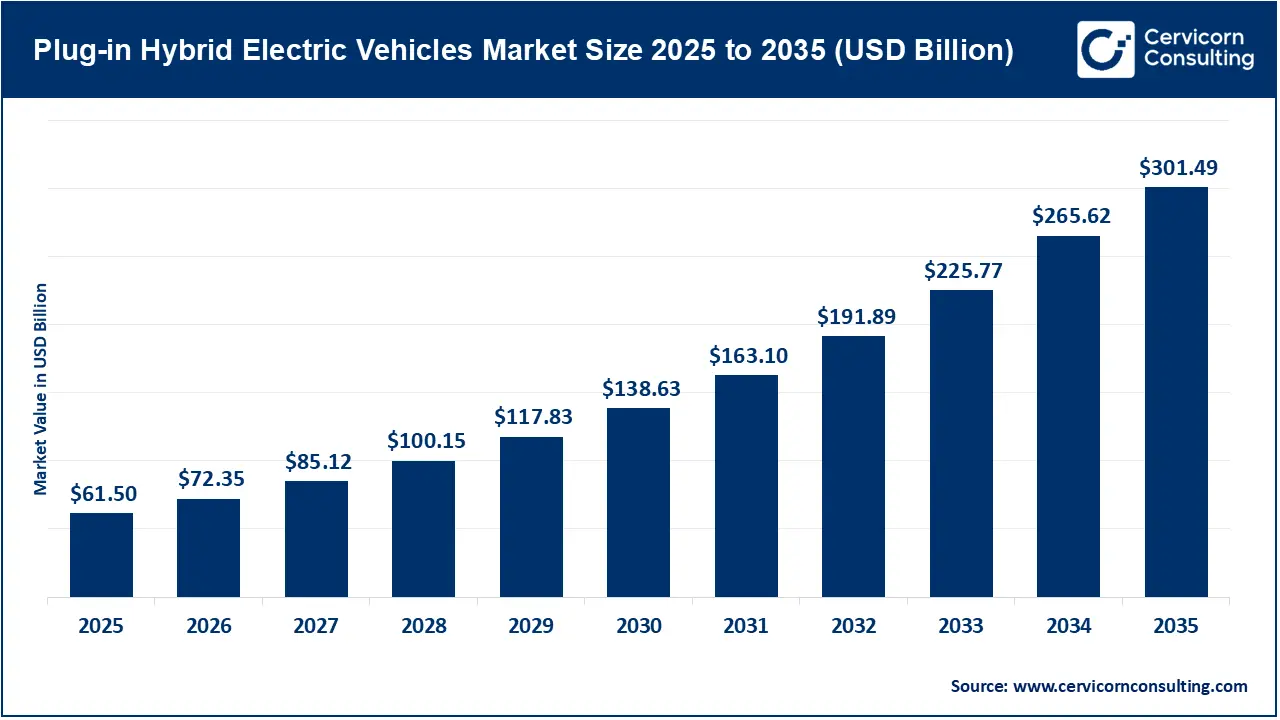
The global plug-in hybrid electric vehicles market was valued at USD 61.50 billion in 2025 and is projected to reach USD 301.49 billion by 2035, representing a compound annual growth rate (CAGR) of 17.23% from 2026 to 2035. This growth outlook raises an important question for automotive businesses: where should investment be concentrated to capture demand without increasing product costs or exposure to changing regulations?
Battery Capacity: Finding the Right Balance Between Cost and Electric Range
Battery sizing is a critical product-development decision for PHEV manufacturers. A larger battery can increase electric-only driving range, potentially reducing fuel consumption for customers who charge regularly. However, it also adds material costs, weight and packaging requirements.
A smaller battery can support a lower vehicle price, but its limited electric range may reduce the practical benefits of electrification for some buyers.
Manufacturers therefore need to evaluate battery capacity against actual driving behaviour rather than relying exclusively on maximum electric range as a product differentiator. Urban commuters with predictable daily journeys may value a different battery configuration from customers who regularly undertake long-distance travel.
The choice also affects procurement strategies. Automakers must assess battery-cell availability, supplier concentration, thermal management requirements and the potential for future battery-cost reductions before committing to high-volume platforms.
For battery suppliers and component manufacturers, this creates opportunities to develop scalable battery systems, more efficient power electronics and thermal-management solutions that help automakers control costs without compromising performance.
Get a Free Sample: https://www.cervicornconsulting.com/sample/2791
Charging Access and Customer Behaviour Will Shape PHEV Economics
PHEVs are often positioned as an intermediate option for consumers who want electric driving without depending entirely on public charging infrastructure. Yet their economic and environmental benefits depend significantly on how frequently owners recharge their vehicles.
A vehicle driven primarily on petrol or diesel may deliver a different ownership-cost and emissions profile from one charged consistently and used for short electric journeys.
This distinction has implications for manufacturers, fleet operators and charging-service providers. Vehicle specifications alone cannot determine whether a PHEV will deliver the expected savings. Electricity tariffs, fuel prices, residential charging access, workplace facilities and daily travel distances must also be considered.
Automakers targeting apartment residents, corporate fleets or customers without dedicated parking may need to address charging convenience differently from manufacturers serving households with private garages.
Fleet operators, meanwhile, can compare vehicle options using route data, average daily mileage, charging availability and total cost of ownership. These assessments can help determine which vehicle categories are suitable for electrification and where conventional hybrids or battery-electric vehicles may be more practical.
Regional Market Differences Require Different Investment Strategies
PHEV demand is not uniform across markets. Regulatory frameworks, charging infrastructure, vehicle preferences, local manufacturing capabilities and household purchasing power influence which products are commercially viable.
Cervicorn Consulting estimates that Asia-Pacific accounted for 38.9% of global PHEV market revenue in 2025, followed by Europe at 31.5% and North America at 22.4%. These differences highlight the importance of aligning product portfolios with regional demand rather than applying a single global strategy.
In Asia-Pacific, manufacturers need to evaluate competition from established domestic producers, regional price expectations and the availability of locally competitive supply chains. Product affordability and manufacturing scale can be particularly important when expanding into price-sensitive segments.
In Europe, emissions requirements, consumer preferences and competition across electrified powertrains influence vehicle-development priorities. Manufacturers must also monitor trade measures and localisation requirements when planning cross-border production and exports.
North America presents a different set of considerations, including long-distance driving patterns, demand for SUVs and pickups, fuel economics and changing policy incentives. PHEVs may appeal to specific customer groups, but the business case needs to be assessed by vehicle category and geography.
For companies considering expansion, regional market sizing should therefore be combined with competitive benchmarking, regulatory assessment and manufacturing-cost analysis.
SUV and Fleet Applications Could Influence Product Portfolio Decisions
Vehicle design and intended use affect the commercial potential of PHEVs. SUVs accounted for an estimated 38.7% of global PHEV market revenue in 2025, according to Cervicorn Consulting.
The segment’s appeal reflects the combination of passenger space, utility and the flexibility of electric and combustion-engine powertrains. However, larger vehicles can also create greater battery, weight and efficiency challenges, making powertrain optimisation particularly important.
Manufacturers must decide whether to prioritise SUVs, sedans, compact vehicles or fleet-oriented platforms based on expected sales volumes, development costs and achievable margins.
Commercial fleets introduce another set of opportunities. Organisations with predictable routes and regular overnight parking may be able to use electric driving for a substantial portion of daily operations. Businesses with irregular routes or limited charging access may achieve different results.
Fleet-focused PHEV strategies should account for acquisition costs, maintenance, fuel and electricity expenditure, vehicle utilisation, residual values and charging-related downtime. This broader assessment provides a stronger basis for procurement decisions than comparing purchase prices alone.
Competitive Positioning Will Depend on More Than Powertrain Technology
Automotive manufacturers face a complex portfolio decision as battery-electric vehicles, conventional hybrids and PHEVs compete for investment and customer demand.
Companies with established engineering capabilities may seek to reuse vehicle platforms and powertrain components to reduce development costs. Others may prioritise battery-electric platforms or regional partnerships where their expected scale and regulatory exposure justify the investment.
The competitive landscape includes companies such as BYD, BMW Group, Mercedes-Benz Group, Ford Motor Company, Volkswagen Group, Toyota Motor Corporation and Kia Corporation. Their relative positioning depends on product availability, manufacturing economics, regional presence, technology development and the ability to respond to changing consumer preferences.
Automotive suppliers should also assess where PHEV development creates demand for power semiconductors, electric motors, battery-management systems, charging equipment and vehicle-control software. The most attractive opportunities may lie in components that can serve multiple electrified powertrain categories rather than a single vehicle platform.
For decision-makers, the key question is not simply which manufacturer offers the most advanced PHEV. It is which combination of vehicle architecture, component sourcing, target market and production scale can generate sustainable returns.
Policy and Regulatory Changes Can Alter the Investment Case
Government incentives and emissions regulations can influence the relative economics of PHEVs and battery-electric vehicles. However, these policies vary across countries and can change over time.
Automakers planning investments through 2030 and beyond need to distinguish between temporary incentives and durable demand drivers. Changes in tax treatment, emissions rules, import restrictions or local manufacturing requirements can affect vehicle pricing, market access and investment returns.
Trade developments also deserve attention. On October 12, 2026, Reuters reported that a proposed China–European Union arrangement would place limits on Chinese hybrid-vehicle exports to Europe, potentially affecting manufacturers’ export strategies and encouraging greater consideration of local production. The precise implications depend on implementation and subsequent policy decisions.
For businesses planning regional expansion, scenario analysis can help evaluate the effects of tariff changes, localisation requirements, subsidy reductions and shifts in emissions standards. Production and sourcing decisions should remain flexible enough to respond to these developments.
What Automotive Businesses Should Evaluate Before Expanding in the PHEV Market
A disciplined investment assessment should bring together several commercial considerations:
- Market attractiveness: Identify vehicle segments and regions with sufficient demand, realistic growth prospects and attractive margins.
- Product economics: Compare battery capacity, electric range, powertrain complexity and manufacturing costs against customer willingness to pay.
- Customer suitability: Evaluate charging access, daily driving distances, fleet utilisation and total cost of ownership.
- Competitive positioning: Benchmark vehicle pricing, model availability, technology capabilities, supplier relationships and production scale.
- Regulatory exposure: Assess emissions requirements, incentives, trade measures and local manufacturing rules across target markets.
- Investment flexibility: Determine whether platforms, battery systems and supplier agreements can support multiple electrified vehicle categories as demand evolves.
These factors help manufacturers distinguish between market growth and commercially attractive opportunities. A rapidly expanding segment does not automatically offer strong returns if development costs, price competition or regulatory uncertainty erode margins.
Outlook: A More Selective Approach to PHEV Investment
The plug-in hybrid electric vehicles market is positioned for substantial expansion, but growth will not benefit every manufacturer, supplier or vehicle segment equally. Product affordability, battery efficiency, charging behaviour, regional competition and policy developments will influence which strategies prove commercially sustainable.
For automotive manufacturers, the priority is to match powertrain investments with clearly defined customer needs and regional economics. For suppliers, opportunities will depend on cost competitiveness, technological differentiation and the ability to serve multiple vehicle platforms. For fleet operators, purchasing decisions should be based on real-world operating costs rather than electrification targets alone.
As the mobility industry continues to evolve, companies that combine market-demand assessment with product economics, competitor analysis and regulatory monitoring will be better positioned to allocate capital and manage uncertainty.
To Get Detailed Overview, Contact Us: https://www.cervicornconsulting.com/contact-us
Read Report: Electric Mobility Market: Which Segments and Regions Will Attract the Next Wave of EV Investment?