EV Truck Battery Swapping Market Revenue, Trends, and Strategic Insights by 2035
EV Truck Battery Swapping Market Size
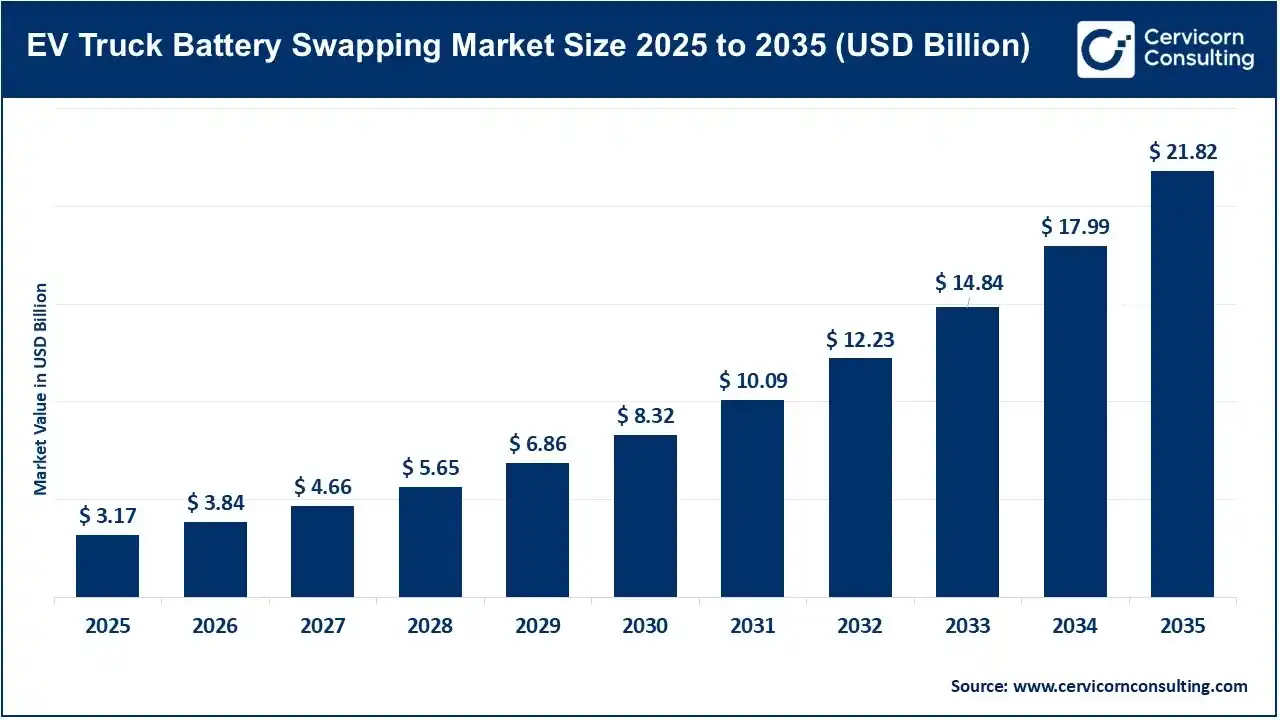
The global EV truck battery swapping market was valued at approximately USD 3.17 billion in 2025 and is projected to reach USD 21.82 billion by 2035, expanding at a CAGR of 21.3% during the forecast period.
EV Truck Battery Swapping Market Growth Factors
The EV truck battery swapping market is gaining momentum as commercial fleet operators, logistics companies, ports, mining operators, and governments look for faster and more economical ways to electrify heavy-duty transportation. Unlike conventional plug-in charging, battery swapping allows a depleted battery pack to be replaced with a charged pack, potentially restoring vehicle range within minutes and reducing vehicle downtime. The growth of the market is being supported by rising electric truck adoption, increasing pressure to decarbonize freight transportation, high utilization rates of commercial vehicles, improvements in battery energy density, falling battery costs, fleet electrification mandates, government incentives, and the development of standardized battery architectures. China is currently the leading market, particularly for predictable heavy-duty routes connecting ports, mines, industrial parks, and logistics hubs.
The International Energy Agency reported that battery-swap-capable trucks represented around 15% of China’s electric truck sales in 2025, while electric heavy freight truck sales reached a 28% share of total heavy freight truck sales. Battery swapping also reduces the need for fleets to wait for large battery packs to recharge, improves vehicle utilization, and can separate battery ownership from vehicle ownership, lowering the initial cost of an electric truck. India’s experience is also becoming increasingly relevant, with the country’s first fleet of electric heavy trucks using swappable batteries launched at Jawaharlal Nehru Port Authority in 2025.
At the same time, major battery and mobility companies are investing in swapping ecosystems, standardization, battery-as-a-service models, automated stations, digital fleet management, and energy storage integration, creating a stronger commercial foundation for market expansion.
Get a Free Sample: https://www.cervicornconsulting.com/sample/3014
What Is the EV Truck Battery Swapping Market?
The EV truck battery swapping market refers to the ecosystem of technologies, infrastructure, services, batteries, software, and business models that enable electric trucks to replace depleted battery packs with fully charged ones at dedicated swapping stations.
In a conventional charging model, an electric truck may need to remain stationary for an extended period while its large battery pack receives electricity. This can be particularly challenging for heavy-duty trucks that operate continuously, because every hour spent charging can reduce vehicle utilization and affect fleet economics.
Battery swapping changes this operating model. Instead of waiting for the battery to recharge inside the vehicle, the truck enters a swapping facility, where specialized equipment removes the depleted battery and installs a charged unit. The removed battery is then recharged separately and made available for another vehicle.
The model can be particularly attractive for high-mileage commercial fleets, where predictable routes and frequent energy replenishment create high station utilization. China’s experience demonstrates this advantage: most early battery-swapping heavy trucks were deployed on closed-loop routes such as ports and industrial areas, where operating patterns are predictable.
Why Is EV Truck Battery Swapping Important?
Battery swapping addresses several of the biggest challenges associated with heavy-duty truck electrification.
Faster Energy Replenishment
Large electric trucks require substantially more energy than passenger cars. Conventional high-power charging can take considerable time and requires significant grid capacity. Battery swapping can restore usable range in minutes. China’s early battery-swapping heavy trucks demonstrated replenishment times of less than six minutes.
Higher Fleet Utilization
For logistics operators, truck downtime directly affects revenue. A swapping station can enable the truck to return to operation quickly, making the technology particularly useful for trucks operating multiple shifts.
Lower Upfront Vehicle Costs
A battery-as-a-service model can separate battery ownership from vehicle ownership. Fleet operators can purchase a truck without bearing the entire upfront cost of the battery, while the swapping operator manages battery maintenance, charging, replacement, and lifecycle management.
Better Grid Management
Instead of charging a truck’s very large battery at extremely high power during a short period, swapping stations can charge batteries gradually while they are stored. This can reduce peak grid demand and improve energy-management opportunities. The European Commission has also recognized that battery swapping can provide flexibility to electricity systems because batteries can be charged over longer periods.
Improved Battery Lifecycle Management
Centralized battery ownership allows operators to monitor battery health, temperature, charging cycles, degradation, and utilization. This creates opportunities for predictive maintenance, second-life applications, and recycling.
Major Companies in the EV Truck Battery Swapping Market
| Company | Specialization | Key Focus Areas | Notable Features | 2025 Revenue | Market Share | Global Presence |
|---|---|---|---|---|---|---|
| Contemporary Amperex Technology Co., Ltd. (CATL) | Batteries, energy storage and battery swapping | Heavy trucks, standardized batteries, battery-as-a-service, energy infrastructure | QIJI heavy-truck swapping, standardized 75# battery block, large-scale network strategy | RMB 423.7 billion | 39.2% global power-battery share; truck-swapping share not separately disclosed | China and expanding international markets |
| Aulton New Energy Automotive Technology Co., Ltd. | Battery-swapping infrastructure and energy services | Multi-brand swapping, commercial vehicles, station operations | 20-second swapping, 4,000+ patents/patent applications, multi-OEM compatibility | RMB 677 million | Truck-specific share not publicly disclosed | Primarily China; international expansion |
| SUN Mobility | Battery-as-a-Service and modular swapping | Commercial fleets, 2W/3W, light commercial vehicles | Modular batteries, interoperable stations, pay-per-use | Not publicly disclosed | Not publicly disclosed | India |
| Ample Inc. | Modular battery swapping | Fleet electrification, commercial vehicles, urban mobility | Five-minute swaps, modular batteries, rapidly deployable stations | Not publicly disclosed | Not publicly disclosed | United States, Japan, Spain and other markets |
| NIO Inc. | Smart EVs and automated battery swapping | Passenger EVs, battery-as-a-service, automated swapping | Automated Power Swap Stations, extensive network, battery leasing | RMB 87.49 billion | Company-specific swapping share not publicly disclosed | China and selected European markets |
Contemporary Amperex Technology Co., Ltd. (CATL)
CATL is one of the most influential companies in the EV truck battery swapping ecosystem because of its position as a major battery manufacturer and its growing investment in standardized swapping infrastructure.
In 2025, CATL reported revenue of RMB 423.7 billion, while lithium-ion battery sales reached 661 GWh. The company reported a 39.2% global power battery market share for 2025. This figure represents the broader power-battery market rather than the EV truck battery-swapping segment, for which CATL does not publicly disclose a separate market share.
CATL’s QIJI Energy platform is particularly relevant to heavy-duty trucks. By the end of 2025, QIJI Energy operated more than 300 heavy-truck battery-swapping stations across 26 provinces, covering approximately 78,000 km of green logistics routes.
In May 2025, CATL introduced its standardized 75# battery swap block and announced an “Eight Horizontal and Ten Vertical” green battery-swapping network intended to cover 80% of China’s national trunk transportation capacity by 2030.
Aulton New Energy Automotive Technology Co., Ltd.
Aulton is a major Chinese battery-swapping specialist focusing on shared energy infrastructure. Its technology supports multiple vehicle brands and models, including commercial vehicles.
Aulton states that it has more than 4,000 global battery-swapping patents and patent applications and operates more than 800 stations, including stations under construction, across 60 Chinese cities. Its technology can complete a battery swap in as little as 20 seconds for certain compatible models.
Aulton has also worked with more than 16 major OEMs and developed approximately 30 battery-swapping-enabled vehicles. Its commercial strategy includes battery swapping, battery lifecycle management, energy storage, electricity trading, and carbon-credit opportunities.
According to its latest reported financial information, Aulton’s 2025 revenue was approximately RMB 677 million. Battery-swapping service revenue from its self-owned stations reached RMB 440 million, while operational services for third-party stations generated higher margins.
SUN Mobility
India-based SUN Mobility specializes in modular battery swapping and the Battery-as-a-Service model. Its technology separates the battery from the vehicle, allowing users to pay for energy without purchasing and maintaining the entire battery.
The company supports two-wheelers, three-wheelers and commercial mobility applications. SUN Mobility’s network includes more than 630 stations and supports more than 25,000 EVs across 20 Indian cities, with more than 50,000 smart batteries and more than one million swaps per month, according to company information.
A major development is its partnership with Indian Oil through Indofast Energy. The joint venture is targeting 10,000 battery-swapping stations nationwide and intends to leverage Indian Oil’s extensive fuel-station network.
SUN Mobility’s 2025 revenue and truck-specific market share are not publicly disclosed. Its direct truck exposure is currently more focused on smaller commercial vehicles than China’s heavy-truck-focused swapping ecosystem.
Ample Inc.
Ample is a U.S.-based battery-swapping company that uses modular battery architecture. Its technology is designed to allow vehicles to receive a full charge through battery replacement in under five minutes.
The company has expanded beyond the United States through partnerships with automotive and energy companies. In Japan, Ample worked with Mitsubishi Fuso and Mitsubishi Motors to deploy swapping infrastructure for commercial fleets. In 2025, it expanded into Tokyo after an earlier deployment in Kyoto.
Ample also entered Madrid, where its swapping stations were supported by approximately €9.76 million from Spain’s IDAE through the Moves Singulares program.
Because Ample is privately held and does not provide a public annual revenue breakdown, its 2025 revenue and global market share are not publicly disclosed. Its experience is nevertheless important because it demonstrates how modular swapping can be applied to commercial vehicles outside China.
NIO Inc.
NIO is best known for passenger electric vehicles rather than heavy trucks, but its battery-swapping platform is important to the global development of swapping standards, automation and battery-as-a-service models.
NIO reported RMB 87.49 billion in total revenue for 2025, up 33.1% year over year.
As of December 31, 2025, NIO had 3,737 Power Swap Stations globally and had completed more than 96 million cumulative battery swaps.
Its partnership with CATL in 2025 is particularly significant because the companies agreed to cooperate on battery-swapping standards, network development, battery lifecycle management and broader compatibility.
Leading Trends and Their Impact
1. Standardization of Heavy-Truck Batteries
Battery standardization is becoming one of the most important trends in the sector. Swapping only works efficiently when batteries, interfaces, vehicle architecture and station equipment are compatible.
CATL’s standardized 75# battery block and its planned national network illustrate the movement toward common technical architectures. Standardization can increase station utilization and reduce infrastructure fragmentation.
2. Battery-as-a-Service
The Battery-as-a-Service model is shifting the economics of electric trucks. Instead of purchasing a vehicle and battery together, fleet operators can pay for battery usage or energy separately.
This reduces upfront capital requirements and transfers battery lifecycle management to specialized operators.
3. Integration With Renewable Energy
Swapping stations can function as distributed energy assets. Batteries waiting to be installed can be charged when electricity is cheaper or renewable generation is abundant.
This creates potential synergies between battery swapping, solar power, grid storage and energy trading.
4. Automated Swapping
Automation is becoming increasingly important for heavy vehicles because truck batteries can be extremely large and heavy. Automated systems can reduce manual handling, improve safety and standardize the swapping process.
5. Expansion Beyond Passenger Vehicles
Battery swapping is increasingly moving toward commercial fleets. China’s growth in heavy trucks is the clearest example, while Japan and India are developing commercial-fleet applications.
6. Fleet-Specific Infrastructure
Rather than immediately building nationwide swapping networks, many operators are focusing on predictable routes such as ports, mines, logistics parks and industrial corridors.
This approach improves station utilization because operators can predict truck movements and battery demand.
Successful Examples of EV Truck Battery Swapping Around the World
China: Heavy-Truck Logistics Corridors
China represents the strongest real-world example of battery swapping for heavy trucks. Battery-swap-capable trucks represented about 15% of China’s electric truck sales in 2025, according to the IEA.
CATL’s QIJI Energy network had more than 300 heavy-truck swapping stations across 26 provinces by the end of 2025.
The model has been particularly successful around ports, mines, steel facilities and industrial logistics hubs because trucks follow repetitive routes and return frequently to designated areas.
India: Jawaharlal Nehru Port
India achieved an important milestone in September 2025 when the first fleet of electric heavy trucks using swappable batteries was launched at Jawaharlal Nehru Port Authority.
The initiative is especially relevant because ports are ideal environments for battery swapping: vehicles follow defined routes, operate intensively and can return to specific energy-replenishment locations. JNPA also announced an objective of converting 90% of its 600-truck fleet to EVs by 2026.
Japan: Mitsubishi Fuso and Ample
Ample’s partnership with Mitsubishi Fuso demonstrated the potential for swapping in urban commercial fleets. The companies launched a deployment in Kyoto and subsequently expanded the concept to Tokyo.
The Tokyo program targets delivery vehicles, light-duty trucks and taxis, with stations capable of supporting more than 100 vehicles.
Europe: Madrid
Madrid represents an emerging European model. Ample deployed modular battery swapping infrastructure with financial support from Spain’s IDAE program.
The Madrid deployment demonstrates that battery swapping can be integrated into existing energy infrastructure and potentially co-located with conventional fuel stations. Ample later announced a partnership with Repsol to install additional swapping stations at gas-station sites.
Global Regional Analysis Including Government Initiatives and Policies
Asia Pacific
Asia Pacific is the leading region for EV truck battery swapping, with China driving the majority of commercial-scale deployment.
China’s government has supported battery swapping through demonstration programs, subsidies and standardization initiatives. In 2021, China’s Ministry of Industry and Information Technology announced battery-swapping pilots, including heavy-duty vehicle applications. By 2022, more than 12,000 battery-swapping-enabled electric trucks were sold in China.
Government support is now moving toward infrastructure and standards. In April 2025, CATL and China’s Ministry of Transport Highway Research Institute signed a cooperation agreement covering battery-swapping R&D, policy studies, standards and scenario-based applications. The partnership aims to develop battery-swapping infrastructure along key freight corridors.
CATL and Sinopec also announced plans in 2025 to build 10,000 battery-swapping stations, including heavy-truck applications through CATL’s QIJI system.
India is another important emerging market. Government-backed EV policies, the FAME/PM E-DRIVE policy environment, logistics electrification programs and increasing attention to battery-swapping standards are creating opportunities for commercial applications. The JNPA heavy-truck deployment demonstrates how ports can become early adoption centers.
SUN Mobility and Indian Oil’s Indofast initiative could further expand the national ecosystem by using existing fuel-station infrastructure for battery swapping.
Japan is emerging as a test market for commercial battery swapping through partnerships involving Ample and Mitsubishi Fuso. Government-backed urban decarbonization initiatives are supporting the development of alternative energy-replenishment models.
Europe
Europe is developing a more cautious approach to battery swapping for heavy trucks.
The European Union has introduced increasingly stringent heavy-duty vehicle CO2 standards, with a 15% emissions-reduction target for heavy-duty vehicles from 2019 levels beginning in 2025. The EU is also supporting zero-emission freight through road-toll policies and charging infrastructure initiatives.
However, battery swapping remains less mature than in China. The European Commission has recognized the potential benefits of swapping but also noted the technical challenges created by integrated battery designs and the limited interest from European HDV manufacturers so far.
Germany, Europe’s largest electric-truck market, is expanding charging infrastructure and approved €1.6 billion in funding for electric truck charging. This indicates that conventional high-power charging will remain a major part of Europe’s truck electrification strategy, while battery swapping may develop as a complementary solution for high-utilization fleets.
Spain is becoming one of the most visible European battery-swapping test markets because of Ample’s Madrid deployment. Public funding through the Moves Singulares program has helped support the deployment of modular swapping infrastructure.
North America
North America remains at an earlier stage of heavy-truck battery swapping. The region has significant electric truck adoption potential because of its large freight market, but manufacturers and fleet operators have generally focused more heavily on megawatt-scale charging.
The primary opportunity for battery swapping is likely to emerge in high-frequency fleet applications, including delivery fleets, ports, warehouses, drayage operations and fixed-route logistics.
Ample provides one of the region’s most notable swapping examples. Its modular technology is designed to support rapid energy replenishment without requiring extensive construction. The company’s commercial partnerships demonstrate how battery swapping can be positioned as an infrastructure-as-a-service model.
Policy support for zero-emission trucks, fleet decarbonization and charging infrastructure can indirectly create opportunities for swapping, although dedicated heavy-truck swapping standards and large-scale networks remain less developed than in China.
Latin America
Latin America represents an emerging opportunity, particularly in urban delivery, mining and port operations.
Countries with significant mining and logistics industries may benefit from swapping because heavy vehicles often operate on predictable routes. Chile, Brazil, Mexico and other markets are increasingly exploring electric commercial transportation, although the region currently lacks the mature swapping ecosystem seen in China.
The strongest near-term opportunity is likely to come from closed-loop commercial applications, where fleet operators can control the vehicle route, battery type and energy infrastructure.
Middle East & Africa
The Middle East and Africa represent longer-term opportunities for EV truck battery swapping. Mining, logistics hubs, ports and industrial zones provide suitable operating conditions because trucks often travel predictable routes.
The development of renewable energy, particularly solar power, could strengthen the economics of swapping by allowing stations to charge batteries using locally generated electricity.
However, high infrastructure costs, limited EV manufacturing ecosystems, financing challenges and the absence of widespread standardization remain barriers. Initial adoption is therefore more likely to occur through large corporate fleets, ports, mines and government-backed demonstration projects rather than broad consumer-oriented networks.
Market Outlook
The EV truck battery swapping market is moving from experimental deployments toward commercial fleet infrastructure, with China currently providing the strongest evidence of scalability. The IEA’s finding that approximately 15% of China’s electric truck sales in 2025 were battery-swap capable indicates that swapping has moved beyond a niche technology in several heavy-duty applications.
The next phase of market development will depend heavily on battery standardization, station utilization, interoperability, battery-as-a-service financing, OEM cooperation and government-supported freight corridors. CATL’s national network strategy, Aulton’s multi-brand approach, SUN Mobility’s Indian Battery-as-a-Service ecosystem, Ample’s modular deployments and NIO’s large automated network demonstrate different pathways through which battery swapping can develop.
For heavy-duty transportation, the most compelling applications are likely to remain those where time equals money: ports, mining, industrial logistics, distribution centers, urban freight and high-frequency regional routes. As battery technology improves and governments establish stronger zero-emission freight policies, battery swapping is increasingly positioned not as a replacement for charging in every application, but as a complementary energy-replenishment model designed for fleets that cannot afford long charging downtime.
To Get Detailed Overview, Contact Us: https://www.cervicornconsulting.com/contact-us
Read Report: Electric Truck Charging Station Market Revenue, Trends, and Strategic Insights by 2035