AI in Oncology Market Revenue, Trends, and Strategic Insights by 2035
AI in Oncology Market Size
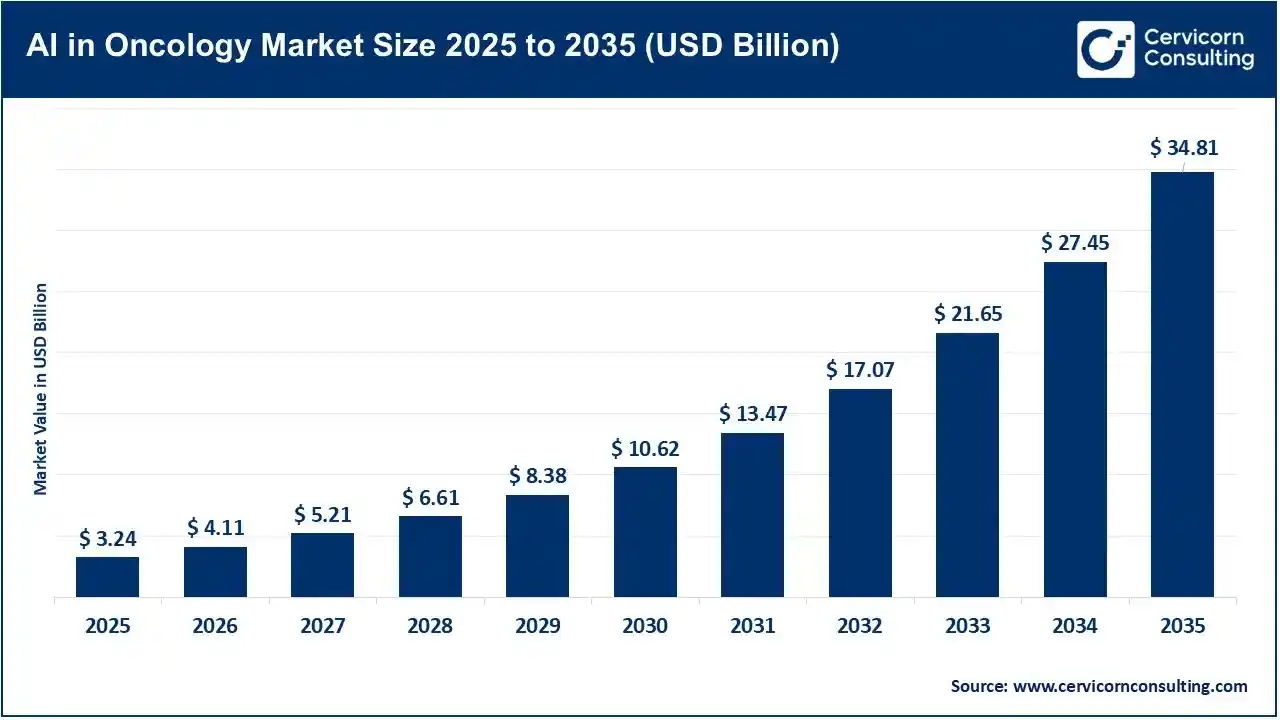
The global AI in oncology market was valued at approximately USD 3.24 billion in 2025 and is projected to reach USD 34.81 billion by 2035, expanding at a CAGR of 26.8% during the forecast period.
AI in Oncology Market Growth Factors
The AI in oncology market is experiencing remarkable growth due to increasing global cancer incidence, expanding adoption of precision medicine, rapid advancements in machine learning and deep learning technologies, rising investments in healthcare AI solutions, growing availability of digital pathology and genomic datasets, increasing demand for personalized cancer therapies, expanding use of AI-powered medical imaging, greater integration of electronic health records with AI platforms, continuous innovations in biomarker discovery, increasing collaborations between pharmaceutical companies and AI developers, supportive government initiatives promoting digital healthcare, improved cloud computing infrastructure, growing demand for faster clinical decision-making, rising adoption of companion diagnostics, and increasing utilization of AI throughout oncology research, clinical trials, treatment optimization, and patient monitoring.
What is the AI in Oncology Market?
The AI in oncology market refers to the global ecosystem of artificial intelligence technologies developed specifically for cancer diagnosis, treatment planning, research, monitoring, and drug development. These solutions leverage advanced technologies such as machine learning, deep learning, natural language processing (NLP), computer vision, predictive analytics, and generative AI to assist healthcare professionals throughout the oncology workflow.
AI systems analyze multiple healthcare datasets including:
- Medical imaging (MRI, CT, PET, mammography)
- Digital pathology slides
- Genomic sequencing data
- Electronic Health Records (EHRs)
- Laboratory reports
- Clinical trial databases
- Real-world evidence
- Biomarker information
The objective is to support oncologists with faster, more accurate, and personalized clinical decisions while reducing diagnostic variability and improving treatment outcomes.
Today, AI applications extend across nearly every stage of cancer management, including:
- Early cancer screening
- Risk prediction
- Tumor classification
- Precision medicine
- Radiation therapy planning
- Drug discovery
- Clinical trial matching
- Remote patient monitoring
- Recurrence prediction
- Survival analysis
Get a Free Sample: https://www.cervicornconsulting.com/sample/2998
Why is AI in Oncology Important?
Cancer treatment has become increasingly complex due to the vast amount of clinical, imaging, molecular, and genomic information generated for each patient. AI enables healthcare professionals to process this information rapidly and identify clinically meaningful patterns that may not be immediately apparent through traditional analysis.
One of the most significant advantages of AI is its ability to detect cancers at earlier stages by recognizing subtle abnormalities in radiological and pathological images. Early diagnosis greatly increases treatment success rates while reducing healthcare costs associated with advanced disease management.
AI also accelerates precision oncology by matching patients with targeted therapies based on genetic mutations, molecular biomarkers, and tumor characteristics. Pharmaceutical companies increasingly rely on AI to identify novel drug targets, optimize clinical trial design, and shorten drug development timelines.
For healthcare providers, AI reduces diagnostic workload, improves consistency, minimizes human error, and supports evidence-based treatment planning. Patients benefit through personalized care pathways, improved survival rates, and more efficient access to innovative therapies.
As healthcare continues transitioning toward value-based care, AI has become an essential tool for improving both clinical outcomes and operational efficiency.
Leading Trends Transforming the AI in Oncology Market
Expansion of Precision Oncology
Healthcare providers increasingly utilize AI to integrate genomic sequencing, biomarker analysis, and molecular profiling into personalized treatment decisions. AI helps identify optimal therapies for individual patients while predicting treatment response and resistance.
Impact
- Improved treatment effectiveness
- Reduced adverse drug reactions
- Enhanced patient survival
- Greater adoption of targeted therapies
AI-Powered Digital Pathology
Digital pathology platforms are rapidly replacing conventional microscope-based workflows. AI algorithms analyze pathology slides within minutes while identifying cancer subtypes, grading tumors, and detecting microscopic abnormalities with high precision.
Impact
- Faster diagnosis
- Reduced pathologist workload
- Improved diagnostic consistency
- Enhanced laboratory efficiency
Integration of Multi-Omics Data
Modern oncology increasingly combines genomics, proteomics, metabolomics, transcriptomics, and clinical data. AI platforms integrate these diverse datasets to generate comprehensive insights into tumor biology.
Impact
- Better biomarker discovery
- More accurate disease prediction
- Accelerated precision medicine
- Improved clinical research
AI-Driven Drug Discovery
Pharmaceutical companies are increasingly using AI to identify therapeutic targets, predict molecular interactions, optimize drug candidates, and prioritize compounds before laboratory testing.
Impact
- Reduced R&D costs
- Faster drug development
- Higher clinical trial success rates
- Increased oncology innovation
Real-World Evidence Analytics
Healthcare organizations increasingly analyze electronic health records, insurance claims, cancer registries, and patient outcomes using AI to improve treatment strategies.
Impact
- Better clinical decision-making
- Enhanced population health management
- Improved reimbursement planning
- Stronger healthcare policies
AI-Assisted Medical Imaging
Computer vision algorithms continue improving detection accuracy across CT, MRI, PET, mammography, and ultrasound imaging.
Impact
- Earlier cancer detection
- Reduced false positives
- Better tumor segmentation
- More accurate treatment planning
Major Companies Driving the AI in Oncology Market
| Company | Specialization | Key Focus Areas | Notable Features | Approx. 2025 Revenue* | Estimated Market Position* | Global Presence |
|---|---|---|---|---|---|---|
| Tempus AI, Inc. | Precision oncology AI | Clinical decision support, genomics, diagnostics | Large multimodal oncology data platform integrating genomic and clinical information | ~USD 1 billion | Leading commercial AI-enabled precision oncology platform | North America, Europe, partnerships across Asia |
| PathAI, Inc. | Digital pathology | AI pathology, biomarker discovery, pharmaceutical research | Deep learning-based pathology image analysis for diagnostics and drug development | Private company (revenue not publicly disclosed) | Strong presence in AI pathology | North America, Europe, global pharma collaborations |
| SOPHiA GENETICS SA | Genomic analytics | Cloud-based genomic interpretation, precision medicine | AI-powered platform supporting genomic and radiomic analysis | ~USD 70–80 million | Recognized leader in genomic analytics | Operations in over 70 countries |
| Guardant Health, Inc. | Liquid biopsy | Precision oncology, companion diagnostics, cancer screening | AI-enhanced liquid biopsy solutions for early detection and treatment monitoring | ~USD 900 million | Major player in liquid biopsy and oncology diagnostics | North America, Europe, Asia-Pacific |
| ConcertAI LLC | Real-world oncology data | Clinical research, predictive analytics, AI insights | Extensive oncology real-world evidence platform supporting life sciences companies | Private company (revenue not publicly disclosed) | Strong position in oncology analytics | North America, Europe, expanding global partnerships |
Tempus AI, Inc.
Tempus AI has emerged as one of the world’s leading AI-powered precision oncology companies. Its platform integrates genomic sequencing, clinical records, pathology, imaging, and molecular data to help physicians personalize cancer treatment decisions. The company collaborates extensively with hospitals, pharmaceutical firms, and research organizations to accelerate precision medicine and clinical trial recruitment.
PathAI, Inc.
PathAI specializes in artificial intelligence solutions for digital pathology. Its advanced deep learning algorithms assist pathologists in identifying cancerous tissues, quantifying biomarkers, and improving diagnostic consistency. The company has established strategic collaborations with pharmaceutical companies to support companion diagnostics and oncology drug development.
SOPHiA GENETICS SA
SOPHiA GENETICS provides cloud-native AI solutions that enable healthcare providers to interpret complex genomic and radiomic data efficiently. Its platform supports precision oncology by helping clinicians identify clinically actionable genetic variants and recommend personalized treatment strategies.
Guardant Health, Inc.
Guardant Health is recognized globally for its AI-supported liquid biopsy technologies. Its non-invasive blood-based cancer tests enable earlier cancer detection, therapy selection, and continuous monitoring of treatment response. The company’s advanced analytics enhance the interpretation of circulating tumor DNA, supporting precision oncology across multiple cancer types.
ConcertAI LLC
ConcertAI focuses on leveraging artificial intelligence and real-world oncology data to improve clinical research, healthcare analytics, and pharmaceutical decision-making. By combining extensive patient datasets with predictive AI models, the company helps accelerate drug development, optimize clinical trials, and generate actionable insights for cancer care.
To Get Detailed Overview, Contact Us: https://www.cervicornconsulting.com/contact-us
Read Report: AI Supercomputer Market Revenue, Trends, and Strategic Insights by 2035