Cell Therapy Technologies Market Outlook: Automated Manufacturing, Process Standardization, Quality Control, and Commercial Scale-Up
Cell Therapy Technologies Market: 6 Strategic Decisions Companies Must Make to Scale Manufacturing and Accelerate Commercialization
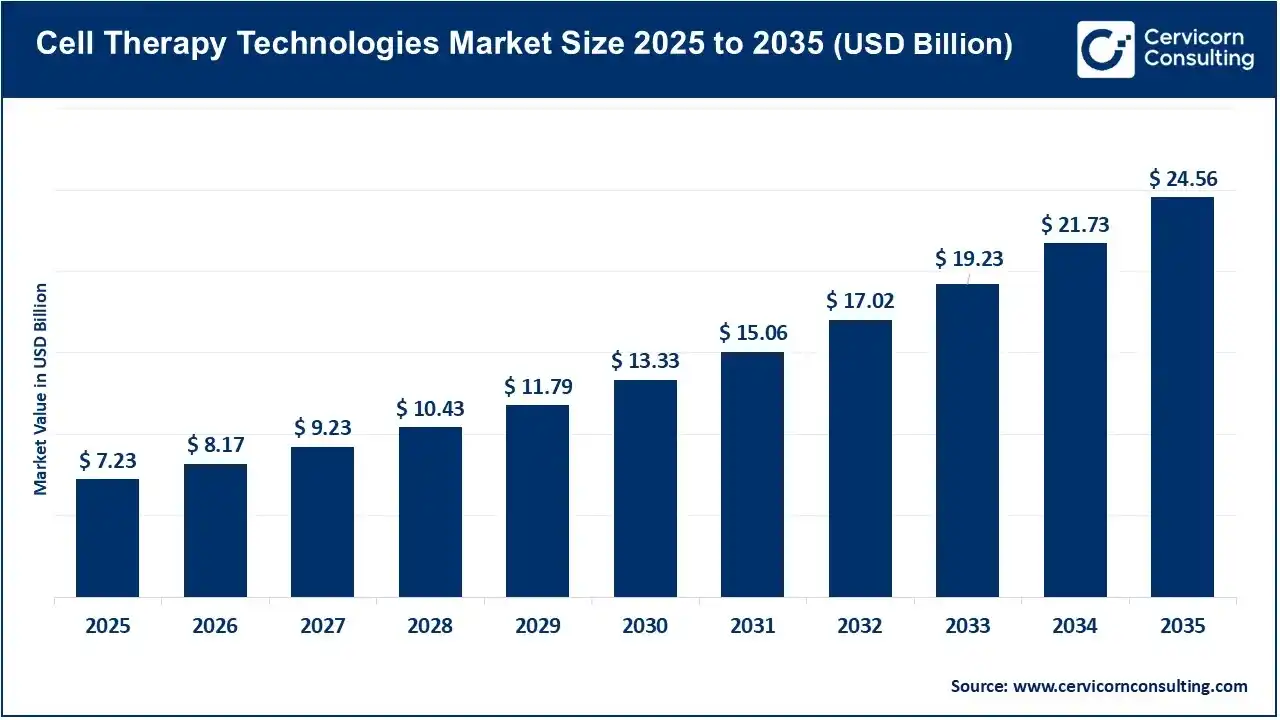
The global cell therapy technologies market was valued at USD 7.23 billion in 2025 and is projected to reach approximately USD 24.56 billion by 2035, expanding at a CAGR of 13.1% from 2026 to 2035. Growth is being driven by the expanding pipeline of cell and gene therapies, increasing investments in advanced manufacturing infrastructure, and the adoption of automation, gene-editing technologies, and sophisticated quality-control systems.
However, market expansion does not automatically translate into commercial success. Cell therapy developers, pharmaceutical companies, biotechnology firms, equipment manufacturers, and contract development and manufacturing organizations (CDMOs) face a more complex challenge: developing manufacturing capabilities that can deliver consistent product quality, manage production costs, meet regulatory expectations, and support increasing clinical and commercial demand.
The competitive landscape is also changing. Media and reagents remain essential recurring inputs, while instruments and automation technologies are gaining importance as manufacturers move toward standardized and closed processing environments. At the same time, advances in CAR-T, natural killer (NK) cells, and induced pluripotent stem cell (iPSC)-derived therapies are creating new requirements for specialized production technologies.
For companies operating across this ecosystem, the next phase of growth will depend on six strategic decisions involving manufacturing investments, technology selection, process standardization, quality management, supply-chain resilience, and regional expansion.
1. Should Companies Invest in Closed and Automated Manufacturing Systems?
Manufacturing infrastructure is becoming a major competitive differentiator in the cell therapy industry. Traditional production methods often involve multiple manual interventions, open processing steps, specialized cleanroom environments, and extensive operator involvement. These requirements can increase production costs, create contamination risks, and make consistent large-scale manufacturing difficult.
The shift toward automated and closed manufacturing systems is changing how companies approach production capacity. Integrated platforms can support cell isolation, activation, expansion, harvesting, and other processing activities while reducing manual handling and improving process reproducibility.
Companies are increasingly evaluating technologies such as:
-
Automated cell processing and expansion systems.
-
Closed-system bioreactors and single-use assemblies.
-
Robotic cell handling and processing platforms.
-
Automated cryopreservation and cell storage systems.
-
Integrated monitoring and process-control technologies.
Strategic decision: Companies must determine whether to upgrade existing manufacturing facilities, invest in integrated automated platforms, or outsource selected production activities to specialized CDMOs.
The decision should consider production volumes, expected clinical pipeline requirements, facility utilization, technology transfer costs, and long-term operating expenses. Investing in automation without evaluating actual production requirements can create underutilized infrastructure, while delaying automation may increase labor dependency and limit commercial scalability.
Get a Free Sample: https://www.cervicornconsulting.com/sample/3075
2. How Should Companies Select Technologies for Different Cell Therapy Types?
Cell therapy manufacturing is not a uniform process. Different cell types require specialized technologies, processing conditions, and quality-control approaches.
For example, CAR-T and other engineered T-cell therapies require efficient cell selection, activation, genetic modification, expansion, and harvesting. NK-cell therapies introduce different requirements associated with cell sourcing, expansion, and functional characterization. Meanwhile, iPSC-derived therapies require technologies capable of supporting controlled differentiation, reproducible cell populations, and consistent product characteristics.
These differences influence equipment selection, consumable requirements, process design, and manufacturing economics.
Companies should evaluate technology platforms across the following areas:
-
T-cell manufacturing: Cell isolation, activation, transduction or gene editing, expansion, and harvesting capabilities.
-
NK-cell manufacturing: Scalable expansion, cell viability, functional characterization, and allogeneic production requirements.
-
iPSC manufacturing: Controlled differentiation, culture conditions, cell identity, purity, and batch reproducibility.
-
Stem cell manufacturing: Cell expansion, preservation, viability assessment, and specialized culture technologies.
-
TIL manufacturing: Tumor-derived cell isolation, expansion, and quality-control requirements.
Strategic decision: Should companies invest in specialized equipment for individual cell types or adopt flexible manufacturing platforms that can accommodate multiple therapeutic modalities?
The answer depends on pipeline composition, technology compatibility, expected production volumes, and the cost of adapting platforms to new therapies. Equipment flexibility may create advantages for CDMOs and technology providers serving multiple developers, but companies must validate that multi-product capabilities do not compromise process control or product quality.
3. Can Process Standardization Reduce Manufacturing Costs and Improve Scalability?
One of the most significant barriers to cell therapy commercialization is the difficulty of maintaining consistent manufacturing processes as production volumes increase.
Patient-specific autologous therapies involve individual patient materials and manufacturing cycles, making production planning and batch consistency particularly challenging. Allogeneic therapies offer opportunities for larger production batches, but they introduce additional requirements for donor selection, cell banking, product characterization, and consistency across manufacturing runs.
Process standardization can help address these challenges by reducing unnecessary manual interventions, improving repeatability, and establishing consistent operating procedures.
Companies should prioritize:
-
Standardized protocols for cell isolation, activation, and expansion.
-
Defined media and reagent specifications.
-
Consistent equipment configurations and operating parameters.
-
Automated monitoring of critical process parameters.
-
Reproducible cell harvesting and cryopreservation procedures.
-
Standardized technology transfer documentation.
The growing interest in modular and closed processing systems also reflects the industry’s need to establish repeatable manufacturing environments. ISPE’s 2025 discussion of advanced therapy medicinal product manufacturing highlights how process standardization creates the foundation for robotics-ready production and more scalable closed-system manufacturing.
Strategic decision: Companies must identify which manufacturing activities should be standardized across their pipeline and which require therapy-specific customization.
This distinction is particularly important for developers planning to transition from clinical manufacturing to commercial production. Standardization should begin during process development rather than being treated as a separate activity after clinical success.
4. How Should Companies Strengthen Quality Control and Regulatory Readiness?
Quality control is a critical investment area because cell therapies involve living biological materials that can exhibit variability across donors, batches, and manufacturing conditions.
Unlike conventional pharmaceutical manufacturing, where chemical composition can often be characterized through established analytical methods, cell therapy developers must evaluate several biological characteristics, including cell identity, viability, purity, potency, and functional activity.
Manufacturing technology investments must therefore be aligned with quality assurance and regulatory requirements from the beginning.
Key areas requiring attention include:
-
Real-time monitoring of critical process parameters.
-
Advanced cell characterization and analytical testing.
-
Automated in-process quality-control systems.
-
Sterility, endotoxin, and contamination monitoring.
-
Batch traceability and electronic documentation.
-
Data integrity and validated manufacturing software.
-
Potency assays and product-specific release testing.
The regulatory environment also influences technology investment decisions. The FDA’s Advanced Manufacturing Technologies Designation Program provides a relevant example of how regulators are encouraging manufacturing innovations that can improve product quality and manufacturing efficiency.
Strategic decision: Should companies prioritize conventional quality-control infrastructure or invest in integrated analytical platforms that connect manufacturing data, process monitoring, and product-release decisions?
Companies should evaluate technology providers based on analytical performance, validation requirements, regulatory compatibility, data integrity, and integration with existing manufacturing execution systems.
The objective is not simply to increase testing capacity. It is to identify process deviations earlier, reduce avoidable batch failures, and establish reliable evidence of product consistency.
5. Should Companies Build In-House Capabilities or Partner with Specialized CDMOs?
The expansion of cell therapy pipelines is increasing demand for specialized manufacturing infrastructure. However, building and operating dedicated facilities requires substantial capital expenditure, technical expertise, qualified personnel, and regulatory investment.
For early-stage biotechnology companies, developing complete in-house manufacturing capabilities may not always be economically practical. Outsourcing selected activities to CDMOs can provide access to specialized equipment, GMP manufacturing environments, process development expertise, and established quality systems.
However, outsourcing also introduces challenges involving technology transfer, intellectual property protection, production scheduling, supply-chain visibility, and manufacturing control.
Companies should compare three operating models:
In-house manufacturing
-
Greater control over manufacturing processes and proprietary technologies.
-
Direct oversight of production scheduling and quality systems.
-
Higher infrastructure, staffing, and maintenance investments.
CDMO partnerships
-
Access to specialized manufacturing infrastructure.
-
Lower initial capital requirements.
-
Potentially faster access to manufacturing expertise.
-
Greater dependency on external production capacity and technology transfer.
Hybrid manufacturing models
-
Internal control over critical development and process activities.
-
Outsourcing of selected manufacturing or analytical operations.
-
Greater flexibility in managing clinical and commercial production requirements.
Strategic decision: Companies must determine which manufacturing activities are strategically important enough to retain internally and which can be outsourced without creating excessive operational or intellectual property risks.
This decision should account for the number of therapies in development, expected clinical trial demand, projected commercial volumes, geographic requirements, and the long-term economics of manufacturing ownership.
6. Which Regional Markets and Technology Segments Should Companies Prioritize?
Regional expansion is becoming an important consideration as cell therapy development and manufacturing capabilities extend beyond established North American and European markets.
North America accounted for approximately 42% of the global cell therapy technologies market in 2025, supported by established biotechnology infrastructure, regulatory capabilities, research investments, and advanced manufacturing facilities.
Meanwhile, Asia Pacific is emerging as an important growth opportunity, supported by expanding biotechnology ecosystems, investments in biopharmaceutical manufacturing, and increasing clinical research activity.
The regional opportunity also varies by technology segment.
Companies should evaluate the following areas:
-
North America: Advanced manufacturing systems, analytical technologies, automated processing platforms, and specialized consumables.
-
Europe: GMP-compliant manufacturing infrastructure, cell processing technologies, and advanced bioprocessing solutions.
-
China: Cell and gene therapy development, domestic manufacturing capabilities, and specialized production technologies.
-
South Korea: Biopharmaceutical manufacturing infrastructure, CDMO capabilities, and advanced cell processing.
-
India: Emerging CAR-T development, biotechnology manufacturing, research infrastructure, and opportunities for cost-efficient production.
The market’s segment structure also offers important investment signals. Media and reagents represented the leading offering category in 2025, reflecting their recurring consumption throughout research and manufacturing. Cell expansion and culture accounted for 25% of the market, while T cells represented 38% of demand by cell type. Clinical manufacturing held a 27% share by scale of operation.
Cervicorn Consulting
Strategic decision: Should companies prioritize established markets with stronger manufacturing ecosystems or invest early in emerging regions where production infrastructure and biotechnology capabilities are expanding?
Regional selection should consider regulatory pathways, clinical trial activity, local manufacturing capabilities, availability of skilled personnel, supply-chain access, and the presence of potential technology partners.
A regional expansion strategy should also distinguish between establishing manufacturing facilities, supplying equipment and consumables, and forming partnerships with local biotechnology companies. Each approach has different capital requirements and commercial risks.
What Do These Decisions Mean for Cell Therapy Technology Providers?
The growth of the cell therapy technologies market creates opportunities beyond the development of new therapeutic products. Companies supplying manufacturing equipment, media, reagents, analytical instruments, software, and automation platforms can benefit from the increasing complexity of cell therapy production.
However, purchasing decisions are becoming more closely linked to measurable manufacturing outcomes.
| Technology category | What buyers increasingly need to evaluate |
|---|---|
| Instruments and automation | Throughput, reproducibility, integration, and operating costs |
| Single-use assemblies | Compatibility, sterility assurance, supply continuity, and cost per batch |
| Media and reagents | GMP compliance, consistency, formulation performance, and availability |
| Quality control and analytics | Sensitivity, testing turnaround, validation, and release requirements |
| Software and digital platforms | Data integrity, traceability, interoperability, and process monitoring |
Technology providers must understand not only which products manufacturers are purchasing but also the operational problems influencing those purchases.
For example, a company selling automated cell expansion equipment should understand whether its prospective customers are prioritizing higher throughput, reduced manual intervention, lower batch failure rates, or compatibility with multiple therapeutic modalities.
Similarly, suppliers of media and reagents need to understand how manufacturers are evaluating defined formulations, GMP-grade inputs, supplier qualification, and long-term material availability.
This creates opportunities for companies that can align their technology development and commercial strategies with the evolving requirements of cell therapy manufacturers.
Conclusion: Manufacturing Strategy Will Determine the Next Phase of Market Competition
The cell therapy technologies market is moving toward a manufacturing model built around automation, process standardization, advanced analytics, and scalable production infrastructure.
For biotechnology companies and pharmaceutical manufacturers, the priority is to establish production capabilities that can support increasingly diverse therapeutic pipelines without creating unsustainable manufacturing costs. For technology suppliers, the opportunity lies in developing solutions that address specific production bottlenecks rather than competing exclusively on equipment specifications or product availability.
Over the next decade, competitive positioning will increasingly depend on how effectively companies address six interconnected priorities:
-
Investing in scalable and automated manufacturing infrastructure.
-
Selecting technologies suited to specific cell therapy modalities.
-
Standardizing processes to improve manufacturing consistency.
-
Strengthening quality control and regulatory readiness.
-
Balancing in-house manufacturing with CDMO partnerships.
-
Identifying attractive regional and technology-segment opportunities.
Companies that evaluate these priorities together will be better positioned to make informed investments, reduce operational risks, and build sustainable capabilities as cell therapies move from clinical development toward broader commercialization.
To Get Detailed Overview, Contact Us: https://www.cervicornconsulting.com/contact-us