Smart Gas Meter Market: 6 Strategic Decisions to Optimize Deployment Costs, Improve Efficiency, and Maximize Returns
Smart Gas Meter Market: 6 Decisions That Can Help Businesses Improve Metering Efficiency and Deployment Returns
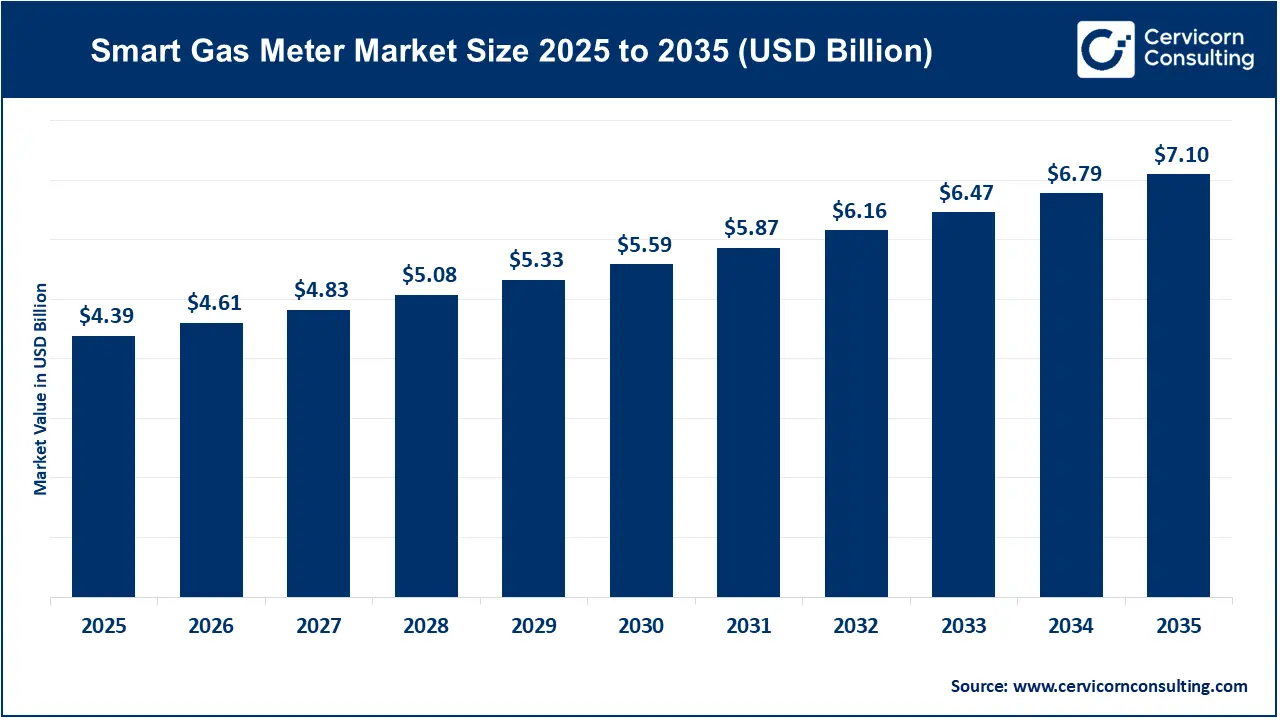
The global smart gas meter market was valued at USD 4.39 billion in 2025 and is projected to reach USD 7.10 billion by 2035, growing at a compound annual growth rate (CAGR) of 4.93% from 2026 to 2035. This growth reflects increasing interest in automated meter reading, remote consumption monitoring, and digital management of gas distribution networks.
For gas utilities, meter manufacturers, technology providers, and infrastructure investors, however, market growth alone does not guarantee commercial returns. The business case depends on installation costs, communication reliability, system integration, maintenance requirements, and the ability to convert consumption data into measurable operational improvements.
As utilities modernize their infrastructure, the key question is not simply whether to adopt smart gas meters, but which technologies, customer segments, and deployment strategies can deliver the greatest long-term value.
Here are six decisions worth evaluating before committing to a smart gas metering investment.
1. Should the Business Prioritize AMI or Automatic Meter Reading?
The choice between Advanced Metering Infrastructure (AMI) and Automatic Meter Reading (AMR) influences the cost, capabilities, and scalability of a smart gas metering deployment.
AMI supports two-way communication between meters and utility systems, enabling remote monitoring, more frequent data collection, and selected remote operational functions where the equipment and regulations permit them. AMR primarily automates meter reading and generally requires less extensive communication infrastructure.
Businesses should assess the operational problems they need to solve before selecting a technology.
- Choose AMI when: Frequent consumption data, two-way communication, remote diagnostics, and integration with advanced utility management systems justify the additional investment.
- Consider AMR when: The immediate priority is reducing manual meter reading, improving billing processes, and collecting consumption data without implementing a more comprehensive digital infrastructure.
- Evaluate migration costs: Existing meters, communication networks, billing platforms, and customer databases can influence the total cost of upgrading.
The decision should account for the full lifecycle cost rather than the purchase price of the meter alone. A lower-cost solution may be appropriate for a limited deployment, while a more advanced system could deliver greater value across a large network with complex operational requirements.
Get a Free Sample: https://www.cervicornconsulting.com/sample/2802
2. Which Customer Segments Offer the Strongest Business Case?
Residential, commercial, and industrial customers have different consumption patterns, service requirements, and economic priorities. A single deployment strategy may not deliver equivalent returns across all three segments.
Residential customers accounted for approximately 48.9% of smart gas meter market revenue in 2025, according to the market estimates published by Cervicorn Consulting. This makes the residential segment an important reference point for manufacturers and utilities evaluating demand.
However, the largest segment is not necessarily the most profitable target for every supplier.
- Residential: Standardized equipment, high deployment volumes, efficient installation processes, and reliable billing data can support scale-driven economics.
- Commercial: Hotels, offices, hospitals, and other facilities may value remote consumption monitoring, more frequent usage information, and improved visibility into operating expenses.
- Industrial: High-volume gas users may prioritize measurement accuracy, system compatibility, operational continuity, and integration with existing monitoring infrastructure.
Manufacturers should evaluate the requirements of each segment against their product capabilities and service costs. Utilities, meanwhile, should compare expected benefits across customer groups before deciding where to begin deployment.
Decision point: Identify the segment where customer demand, technical suitability, deployment scale, and expected financial returns are best aligned.
3. Which Communication Technology Fits the Deployment Environment?
A smart gas meter creates limited operational value if it cannot transmit dependable data to the systems responsible for billing, monitoring, and maintenance.
Wireless communication technologies accounted for approximately 55.7% of smart gas meter market revenue in 2025, based on Cervicorn Consulting’s market estimates. Technologies such as NB-IoT, LoRaWAN, and Zigbee offer different capabilities, and their suitability depends on the application and network architecture.
Businesses should compare communication options against the conditions in which meters will operate.
- Coverage and signal reliability: Buildings, underground installations, remote locations, and dense urban environments can present different connectivity challenges.
- Power consumption: Battery-operated meters need communication strategies that balance reporting frequency with battery life.
- Network ownership and operating costs: Businesses should consider connectivity fees, gateway requirements, maintenance responsibilities, and long-term provider availability.
- Interoperability: Communication systems should work with the selected meters, data platforms, and existing utility infrastructure.
- Scalability: The network should support additional installations without creating disproportionate increases in operating costs.
A technology that performs well in a pilot project may face different economics when deployed across thousands of geographically dispersed locations.
Before selecting a communication standard, businesses should test representative environments, estimate recurring connectivity expenses, and establish minimum performance requirements for data delivery and system availability.
4. How Can Companies Justify the Total Cost of Deployment?
Smart gas metering projects involve more than hardware procurement. Installation, communication infrastructure, software integration, commissioning, maintenance, cybersecurity, and eventual replacement can significantly influence total expenditure.
The financial case should compare these costs with realistic operational benefits over the expected service life of the system.
Potential benefits include:
- Lower expenditure on manual meter reading and associated field operations.
- Fewer estimated bills and improved access to consumption information.
- Faster identification of abnormal consumption patterns or potential equipment issues.
- More efficient scheduling of inspections and maintenance.
- Improved customer service through better access to usage data.
These benefits should be measured rather than assumed. For example, remote monitoring may help identify unusual consumption patterns, but it does not automatically confirm a gas leak or eliminate the need for physical inspection and established safety procedures.
A practical investment assessment should include three scenarios:
Conservative scenario: Lower-than-expected operational savings, higher installation costs, and slower deployment.
Expected scenario: Benefits and costs based on pilot results, supplier quotations, and realistic rollout assumptions.
Upside scenario: Greater deployment efficiency, higher adoption, and additional savings supported by demonstrated operational improvements.
Comparing these scenarios helps decision-makers understand how sensitive the investment is to cost overruns, equipment performance, and the pace of adoption.
The most useful financial indicators include payback period, net present value, total cost of ownership, and the cost per successfully connected meter. These metrics can help businesses distinguish attractive long-term investments from projects that depend on overly optimistic assumptions.
5. Is the Data Infrastructure Ready for Scalable Deployment?
Smart gas meters generate information that must move reliably through communication networks into systems that can store, process, and use it. Weak integration can limit the value of an otherwise effective metering device.
Utilities and technology providers should assess the entire data architecture before expanding deployment.
- Billing integration: Consumption records should flow accurately into billing systems, with appropriate checks for missing, duplicated, or inconsistent readings.
- Analytics and alerts: Monitoring tools should identify relevant exceptions without overwhelming operators with false alarms.
- Cybersecurity: Device authentication, encryption, access controls, secure software updates, and incident-response procedures should be incorporated into system design.
- Data governance: Businesses need clear policies covering data retention, access permissions, customer privacy, and regulatory compliance.
- Operational continuity: Systems should define how to handle communication outages, delayed readings, and the restoration of service after technical failures.
Artificial intelligence and predictive analytics may support anomaly detection, maintenance planning, and consumption forecasting. However, their effectiveness depends on data quality, model validation, and the availability of appropriate operational responses.
For manufacturers, interoperability and cybersecurity can also become important product differentiators when utilities compare competing solutions.
Decision point: Assess software, connectivity, data governance, and security requirements as part of the initial investment rather than treating them as later-stage additions.
6. Should Companies Invest in Hydrogen-Ready and Future-Compatible Meters?
Changes in gas composition, renewable gas development, and infrastructure modernization may influence future metering requirements. For manufacturers and utilities planning long-lived assets, compatibility with evolving fuel specifications deserves consideration.
Hydrogen-ready systems represented approximately 13.2% of smart gas meter market revenue in 2025, according to Cervicorn Consulting’s estimates. This segment provides an indication of interest in equipment designed for potential future applications, but it should not be interpreted as evidence that every gas network will adopt hydrogen or that every existing meter can accommodate hydrogen blends.
Before investing in future-compatible equipment, companies should consider:
- Technical certification: Verify suitability for the intended gas composition, pressure range, flow conditions, and applicable measurement standards.
- Infrastructure readiness: Assess whether pipelines, regulators, seals, valves, appliances, and other connected equipment are compatible with the intended fuel.
- Regional demand: Evaluate announced projects, local energy policies, infrastructure investment, and realistic deployment timelines.
- Lifecycle economics: Compare the incremental cost of future-compatible equipment with the potential cost of replacement or retrofitting.
- Product flexibility: Consider modular designs, upgrade pathways, component availability, and long-term technical support.
The objective is not to invest in speculative future requirements at any cost. It is to identify where flexibility offers a defensible commercial advantage and where conventional equipment remains the more economical choice.
What These Decisions Mean for Smart Gas Meter Market Participants
The smart gas meter market is evolving through the combination of automated measurement, digital connectivity, and changing infrastructure requirements. Yet the commercial opportunities differ across the value chain.
For meter manufacturers, product differentiation may depend on measurement accuracy, battery life, communication performance, interoperability, certification, and lifecycle support.
For gas utilities, investment priorities include deployment economics, billing accuracy, network reliability, data security, and the ability to demonstrate measurable operating improvements.
For software and connectivity providers, opportunities depend on reliable data transmission, integration with established utility systems, scalable analytics, and manageable recurring costs.
For infrastructure investors, the central considerations are deployment pipelines, procurement cycles, regulatory requirements, customer concentration, and the long-term economics of connected metering assets.
Geographic strategy also matters. Cervicorn Consulting estimates that Asia-Pacific accounted for approximately 37.8% of global smart gas meter market revenue in 2025, supported by infrastructure modernization and demand across major economies. Europe and North America offer different market conditions shaped by their existing infrastructure, regulatory environments, and adoption priorities. Companies should evaluate individual countries and customer segments rather than treating an entire region as a uniform opportunity.
Conclusion
Smart gas metering is not simply a hardware replacement exercise. It is an infrastructure investment in which technology selection, connectivity, deployment economics, data management, and future compatibility jointly determine commercial performance.
Businesses that evaluate these factors together can make better-informed decisions about where to invest, which customers to target, and how to scale without allowing operating complexity to erode expected returns.
As deployment strategies evolve, the strongest opportunities are likely to emerge where smart metering addresses a clearly defined operational need and produces measurable value over the equipment’s lifecycle.
To Get Detailed Overview, Contact Us: https://www.cervicornconsulting.com/contact-us
Read Report: Ethanol 2.0 Market: 5 Decisions That Can Help Companies Maximize Returns on Intelligent Energy Management