India AI Data Center Market: Where Should Businesses Prioritise Investment as AI Infrastructure Expands?
India AI Data Center Market: Where Should Businesses Prioritise Investment as AI Infrastructure Expands?
India’s artificial intelligence (AI) infrastructure expansion is creating opportunities across data center development, GPU computing, advanced cooling, power management and high-speed networking. However, the commercial opportunity extends beyond building additional capacity. Businesses must determine which infrastructure segments offer sustainable demand, which locations can support long-term operations, and where investment risks could affect returns.
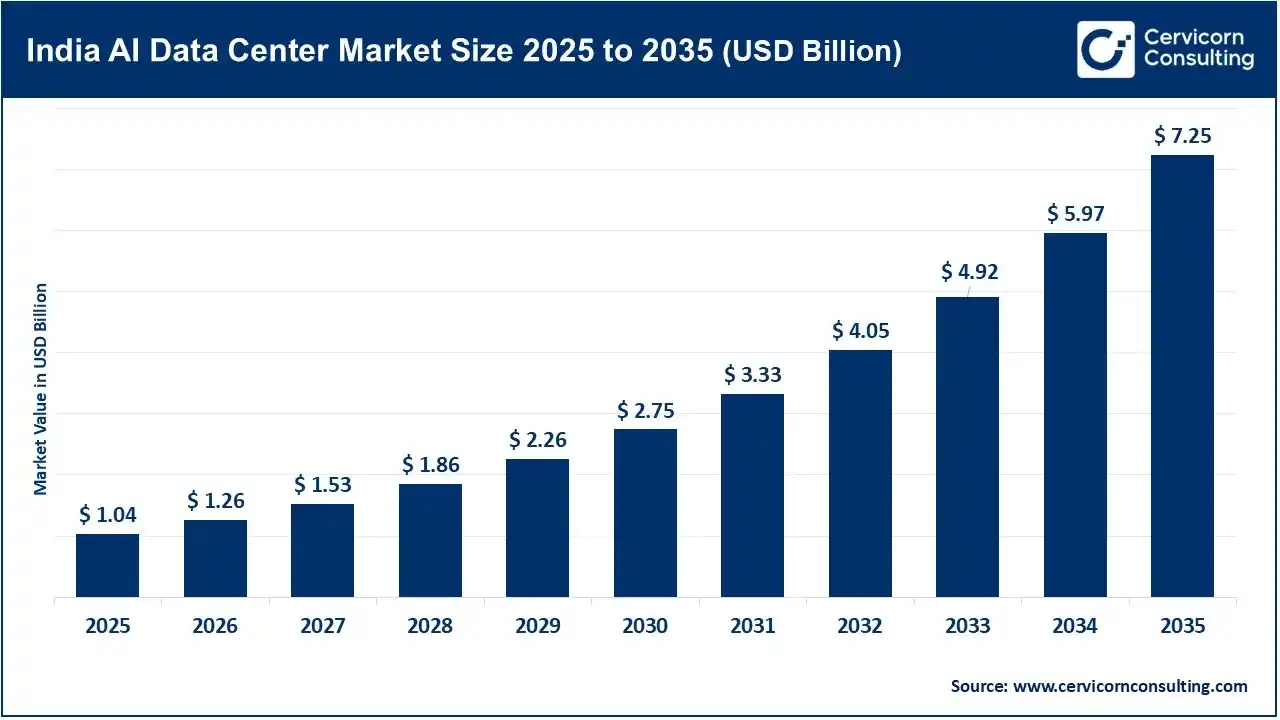
The India AI data center market was valued at USD 1.04 billion in 2025 and is projected to reach approximately USD 7.25 billion by 2035, growing at a CAGR of 21.5% between 2026 and 2035.
This expansion is taking place alongside a broader increase in India’s data center capacity. According to India’s Ministry of Electronics and Information Technology, installed data center capacity reached approximately 1,575 MW in 2026, compared with 375 MW in 2020. The growth reflects rising demand for digital services, cloud computing and high-performance computing.
For investors, infrastructure providers and technology companies, the central question is how to allocate capital across this expanding ecosystem without overlooking power constraints, cooling requirements or the time needed to secure customer demand.
AI Data Center Investment Is Becoming a Full-Infrastructure Decision
AI workloads require more than conventional server capacity. GPU clusters, high-speed networking, specialised storage and advanced thermal management must operate together to deliver computing performance at scale.
This changes the investment priorities for data center developers and infrastructure suppliers. Expanding floor space alone may not be sufficient if a facility cannot secure reliable electricity, support high-density racks or accommodate future cooling requirements.
The opportunity therefore extends across several interconnected areas: AI servers and accelerators, electrical infrastructure, cooling equipment, battery energy storage, renewable power integration and network connectivity.
Businesses supplying these systems should assess where demand is being converted into actual projects rather than relying exclusively on announced investment commitments. Procurement schedules, facility commissioning, equipment specifications and customer utilisation can provide a clearer indication of near-term commercial opportunities.
Get a Free Sample: https://www.cervicornconsulting.com/sample/3055
Which AI Data Center Segments Offer the Strongest Business Opportunities?
1. GPU Infrastructure and High-Performance Computing
GPU-based infrastructure remains central to AI model training, inference and other computationally intensive workloads. As businesses deploy generative AI applications and integrate AI into existing services, demand is increasing for computing systems capable of handling large volumes of data with predictable performance.
Cervicorn Consulting identifies GPU and AI accelerators as the leading infrastructure component in 2025. The market is also expected to see growing interest in custom application-specific integrated circuits (ASICs), which can be designed for specialised workloads.
For hardware suppliers, system integrators and computing service providers, the commercial decision is whether to focus on general-purpose GPU infrastructure or specialised solutions tailored to particular applications.
GPU capacity can address a broad range of AI workloads, while specialised accelerators may offer efficiency advantages in selected use cases. However, their commercial attractiveness depends on software compatibility, customer requirements, procurement costs and utilisation rates.
Businesses should also distinguish between demand for AI computing capacity and demand for individual hardware products. The long-term opportunity depends on whether customers can generate sufficient value from the computing resources they purchase or lease.
2. Liquid Cooling and High-Density Infrastructure
As AI servers become more computationally intensive, managing heat is increasingly important to data center performance. Conventional air cooling remains relevant across established facilities, but higher rack densities are creating opportunities for direct-to-chip liquid cooling, immersion cooling and other advanced thermal management technologies.
For cooling equipment manufacturers and engineering companies, the decision is not simply which technology offers the highest cooling performance. Compatibility with existing infrastructure, installation costs, maintenance requirements and operational efficiency also influence purchasing decisions.
Retrofitting an operational facility may require a different approach from designing a new AI-focused campus. Suppliers that can address both new-build projects and carefully selected retrofit requirements may have access to a broader range of opportunities.
Businesses evaluating this segment should examine planned rack densities, cooling specifications, project timelines and the ability of facility operators to support specialised systems. These factors help distinguish immediate procurement opportunities from longer-term technology adoption.
3. Power Infrastructure, Renewable Energy and Battery Storage
Reliable electricity is a fundamental requirement for AI data centers. GPU clusters, storage systems, networking equipment and cooling infrastructure create substantial and continuous power requirements, making grid connectivity and power availability important considerations in site selection.
The opportunity extends to transformers, switchgear, uninterruptible power supplies, backup systems, battery energy storage and renewable energy integration. However, demand for these solutions will vary according to facility design, grid conditions and the operator’s power procurement strategy.
For electrical equipment suppliers and energy companies, the key question is which projects are sufficiently advanced to generate actual orders. Announced capacity does not necessarily translate into immediate equipment demand, particularly when grid connections, construction approvals or power procurement arrangements remain unresolved.
Battery storage may support backup power, power quality and energy management, depending on system design. Renewable energy procurement can also contribute to sustainability objectives, although round-the-clock supply requirements may necessitate a combination of generation, storage and other power resources.
Businesses should therefore assess the complete power architecture rather than evaluating individual equipment categories in isolation.
4. Location Strategy: Should Expansion Remain Concentrated in Major Hubs?
Mumbai, Navi Mumbai, Chennai, Hyderabad, Bengaluru and Delhi-NCR are established data center locations, supported by varying combinations of connectivity, enterprise demand and digital infrastructure. Other locations, including parts of Andhra Pradesh and Gujarat, are also attracting investment interest.
The right location depends on the intended customer base and operating model. Proximity to enterprise customers and network infrastructure can support some workloads, while access to land, electricity and suitable cooling resources may be more important for large-scale AI campuses.
For developers and investors, a lower land acquisition cost does not necessarily indicate a more attractive project. Delays in obtaining reliable power, limited connectivity or infrastructure constraints can offset initial savings.
Location selection should consider:
- Power availability: Grid capacity, connection timelines, reliability and long-term electricity costs.
- Connectivity: Fibre availability, network redundancy and access to relevant customers.
- Cooling resources: Climate, water availability and the feasibility of alternative cooling technologies.
- Regulatory requirements: Land-use approvals, environmental considerations and applicable state policies.
- Commercial demand: Customer commitments, utilisation expectations and the potential to expand capacity in stages.
India’s data center expansion is also drawing greater attention to environmental and community considerations. In October 2026, Reuters reported concerns surrounding data center developments near Mumbai and in Andhra Pradesh, including potential pressure on local water and power resources. Such concerns reinforce the importance of assessing infrastructure availability and community impact alongside conventional financial considerations.
5. Government Initiatives and Sovereign AI Infrastructure
India’s AI infrastructure strategy includes efforts to expand access to computing resources and strengthen domestic capabilities. The IndiaAI Mission, approved with an outlay of ₹10,371.92 crore over five years, supports the development of the country’s AI ecosystem.
In August 2026, the Ministry of Electronics and IT reported that 15 compute service providers had been empanelled and that 237 projects had been approved for subsidised computing support, with approximately 93.18 lakh GPU hours sanctioned.
These developments are relevant to data center operators, cloud service providers, AI developers and companies supplying supporting infrastructure. Greater access to computing resources can help broaden AI adoption, while sovereign computing priorities may influence decisions concerning infrastructure location, service delivery and domestic technology capabilities.
However, government-supported computing initiatives should not automatically be interpreted as guaranteed demand for every infrastructure supplier. Businesses need to identify the procurement model, eligible customers, project requirements and commercial arrangements associated with specific opportunities.
For technology providers, understanding how public-sector initiatives interact with private-sector cloud demand can help identify realistic routes to market.
6. What Should Companies Monitor Before Committing Capital?
The growth outlook is significant, but infrastructure investment involves long development cycles and substantial upfront costs. A project may appear attractive based on projected demand while remaining exposed to delays, underutilisation or changes in technology requirements.
Investors and suppliers should examine four commercial indicators.
Customer commitments and utilisation: Capacity supported by credible customer contracts may have a different risk profile from speculative expansion. The timing of customer onboarding also affects cash flow and returns.
Capital and operating expenditure: Construction, computing hardware, electrical systems and cooling infrastructure create different cost structures. Businesses should assess how equipment replacement, maintenance and energy consumption affect the economics of each project.
Infrastructure readiness: Power connections, network availability, cooling design and regulatory approvals can determine when a facility becomes operational. Delays in any of these areas can affect commissioning schedules and revenue generation.
Technology flexibility: AI hardware and cooling requirements can evolve quickly. Infrastructure designed around a narrow set of specifications may face costly modifications if customer requirements change.
Monitoring these indicators can help companies prioritise projects with stronger commercial foundations rather than treating every capacity announcement as an equivalent investment opportunity.
7. Competitive Positioning: Where Can Suppliers Differentiate?
The expansion of AI data centers creates opportunities for established technology companies and specialised infrastructure suppliers. Yet increasing demand does not guarantee that every participant will benefit equally.
Equipment manufacturers may compete on efficiency, reliability and delivery timelines. Engineering and construction firms may differentiate through project execution and integration capabilities. Cloud and computing providers may focus on workload performance, service availability and the economics of AI compute.
Companies should identify where their capabilities align with the requirements of upcoming projects. For example, a supplier specialising in liquid cooling may benefit from facilities adopting high-density GPU systems, while an electrical equipment manufacturer may find opportunities across both conventional and AI-focused data center developments.
Competitive assessment should therefore extend beyond company announcements to examine product capabilities, project pipelines, partnerships, regional presence and the ability to deliver at scale.
Conclusion: Growth Potential Depends on Infrastructure Readiness and Commercial Execution
India’s AI data center market is expanding as AI adoption, cloud computing and high-performance computing increase demand for specialised digital infrastructure. The strongest commercial opportunities may emerge not only from building new facilities, but also from supplying the power, cooling, computing and connectivity systems needed to operate them reliably.
For investors, developers and technology suppliers, the priority is to determine where demand is translating into executable projects, which infrastructure constraints remain unresolved and how customer requirements may change over time.
A disciplined assessment of segment-level demand, location economics, competitive capabilities and project readiness can help businesses make better-informed investment and expansion decisions in India’s developing AI infrastructure ecosystem.
To Get Detailed Overview, Contact Us: https://www.cervicornconsulting.com/contact-us
Read Report: Microchips Market: Where Are the Next Investment Opportunities as AI and Semiconductor Localization Reshape Demand?