Hybrid Mesh Firewall Market: What Should Enterprises Evaluate Before Modernizing Distributed Network Security?
Hybrid Mesh Firewall Market: What Should Enterprises Evaluate Before Modernizing Distributed Network Security?
Enterprise network security is becoming harder to manage as applications, users, data, and workloads move across on-premises infrastructure, public and private clouds, branches, remote environments, and increasingly AI infrastructure.
For security leaders, the question is no longer simply whether to deploy another firewall. The more important question is how to maintain consistent security policies, visibility, segmentation, and threat prevention across increasingly distributed environments without creating another layer of operational complexity.
This is where the Hybrid Mesh Firewall (HMF) market is gaining relevance.
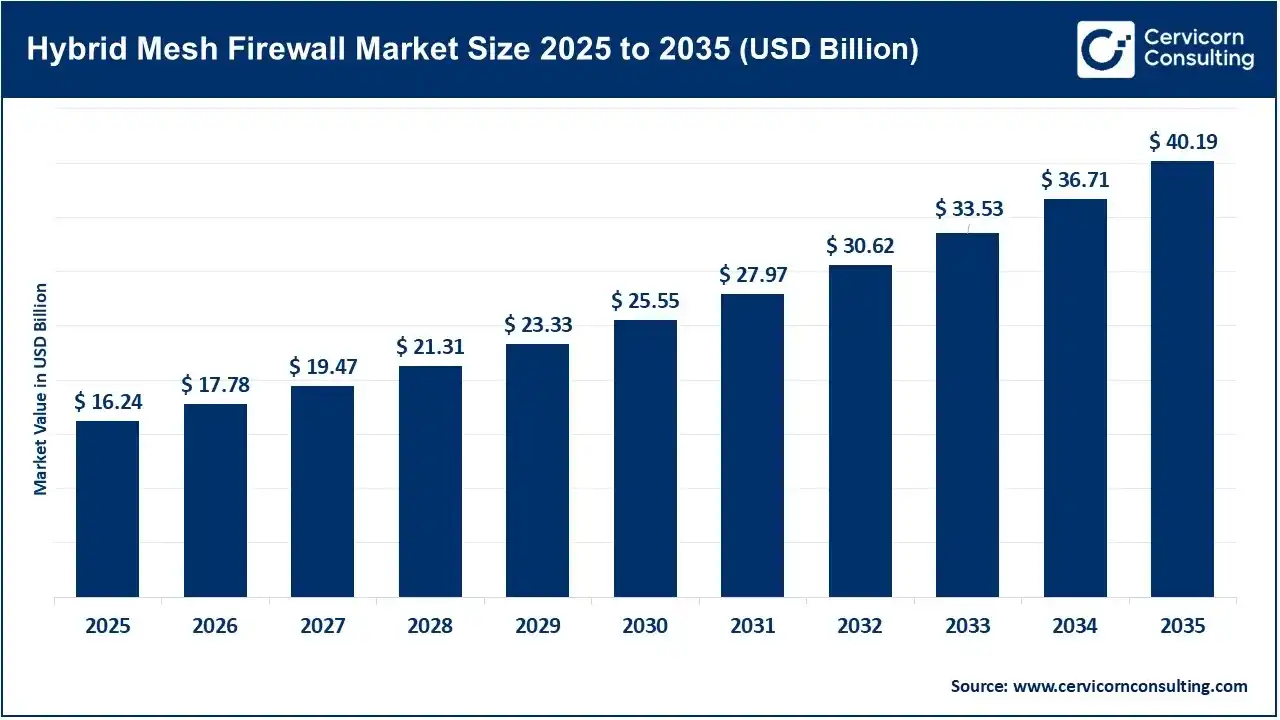
The global hybrid mesh firewall market was valued at approximately USD 16.24 billion in 2025 and is projected to reach USD 40.19 billion by 2035, representing a 9.5% CAGR from 2026 to 2035.
However, market growth alone does not determine whether an HMF investment makes sense for a particular enterprise. The business case depends on network architecture, cloud adoption, security-team capabilities, traffic volumes, existing firewall investments, compliance requirements, and the ability to manage security policies across multiple environments.
Why Hybrid Mesh Firewalls Are Becoming Relevant
Traditional firewall architectures were largely designed around defined network boundaries. Modern enterprises increasingly operate beyond those boundaries.
Organizations may simultaneously run:
- On-premises data centers
- Public and private clouds
- Multiple cloud providers
- Branch and remote offices
- Edge computing environments
- Virtual machines and containers
- SaaS applications
- AI and high-performance workloads
- Remote and hybrid workforces
This creates a management challenge: security policies that work effectively in one environment may not automatically translate to another.
A Hybrid Mesh Firewall architecture brings physical, virtual, cloud-native and Firewall-as-a-Service enforcement points under a more unified management framework. Gartner’s 2026 market overview highlights centralized unified management and advanced automation as important factors behind migration toward HMF platforms.
The architectural shift is therefore less about replacing every existing firewall and more about determining how different enforcement points can operate as part of a coordinated security framework.
Get a Free Sample: https://www.cervicornconsulting.com/sample/3052
The Investment Question: Should Enterprises Replace Existing Firewalls?
This is one of the most important decisions for security teams.
A large enterprise may already have substantial investment in hardware firewalls, virtual appliances, cloud security controls, identity platforms and security-management tools.
Replacing everything simultaneously can create unnecessary cost and migration risk.
Gartner’s earlier research on Hybrid Mesh Firewall platforms specifically recommended that organizations prioritize the firewall use cases they require in the short and long term rather than automatically refreshing existing firewalls.
For procurement teams, this means evaluating HMF as an architecture strategy, rather than simply as another firewall product.
A useful assessment should examine:
1. Where security enforcement currently occurs
Map enforcement points across data centers, branches, cloud environments, remote users, applications and edge locations.
2. Where policies are duplicated
If different teams maintain separate policies for physical, virtual and cloud firewalls, the organization should quantify the operational cost of maintaining those controls independently.
3. Where east-west traffic is increasing
Cloud workloads, containers and AI infrastructure can create substantial internal traffic. Security teams need to determine where conventional north-south firewall controls need to be complemented by segmentation and workload-level controls.
4. How much existing infrastructure can be retained
The ability to integrate existing hardware and virtual firewalls can significantly influence the economics of an HMF migration.
Hybrid Cloud Is Likely to Remain a Core Adoption Environment
Hybrid cloud represented approximately 27.8% of the Hybrid Mesh Firewall market in 2025, according to Cervicorn’s market analysis.
This is strategically important because hybrid environments create a combination of legacy infrastructure and newer cloud-native workloads.
Enterprises may need:
- Consistent access policies
- Centralized visibility
- Unified threat intelligence
- Cloud-aware inspection
- Secure connectivity between environments
- Segmentation of sensitive workloads
- Centralized policy orchestration
The objective is not necessarily to make every environment technically identical. Instead, organizations need a management architecture capable of applying appropriate controls across different infrastructure types.
This distinction matters when evaluating vendors. A platform that works well in a public cloud but has weak integration with existing enterprise infrastructure may not provide the expected operational value.
Microsegmentation Changes the Evaluation Criteria
Network security is still the largest security-function segment, representing approximately 24.7% of the market in 2025. However, network and microsegmentation is becoming strategically important as enterprises attempt to limit lateral movement between workloads.
Cervicorn’s analysis indicates that the microsegmentation segment is expected to expand at approximately a 21% five-year CAGR through 2030, reflecting growing requirements across hybrid-cloud and private-AI environments.
This creates an important architectural distinction.
Traditional perimeter security primarily controls traffic entering or leaving an environment. Distributed workloads require greater control over traffic moving between applications, workloads and services.
Consequently, organizations evaluating HMF platforms should examine how firewall capabilities interact with:
- Microsegmentation
- Identity-based policies
- Zero Trust Network Access
- Workload security
- Application-aware controls
- East-west traffic inspection
- Cloud-native security controls
The strongest architecture may therefore involve HMF controlling broader network traffic while specialized segmentation technologies provide more granular workload-level enforcement.
AI Infrastructure Is Creating a New Security Consideration
AI workloads are adding another layer of complexity to enterprise networks.
AI clusters, inference infrastructure, APIs, data pipelines and autonomous agents can create new communication patterns that differ from conventional enterprise applications.
Cervicorn’s market analysis identifies AI workload and agentic infrastructure security as an emerging opportunity for Hybrid Mesh Firewall vendors.
For organizations expanding AI infrastructure, firewall procurement should therefore consider more than conventional throughput and rule-management capabilities.
Security teams should ask:
- Can the platform identify and control AI-related traffic?
- Can policies be applied consistently across AI infrastructure and conventional enterprise networks?
- How does the platform handle high-volume east-west traffic?
- Can encrypted traffic be inspected without unacceptable latency?
- Can security policies be automated as workloads change?
- How easily can AI environments be segmented from sensitive enterprise data?
These questions could become increasingly important as AI infrastructure moves from isolated experimentation toward production deployment.
Performance Matters as Much as Security Coverage
One of the biggest risks in distributed security architectures is adding inspection without adequately considering performance.
Encrypted traffic volumes are increasing, while AI and cloud workloads can generate substantial amounts of high-throughput traffic.
An HMF platform therefore needs to balance:
Security depth → Inspection capability → Throughput → Latency → Cost
A platform with extensive security functionality may not deliver the best economic outcome if inspection significantly increases infrastructure requirements or affects application performance.
Procurement teams should benchmark performance under realistic conditions rather than relying exclusively on headline throughput.
Testing should include:
- TLS/SSL inspection
- Threat prevention
- Application identification
- Large numbers of concurrent sessions
- East-west traffic
- Cloud-to-cloud traffic
- AI workload traffic
- Failover scenarios
The relevant metric is not simply maximum firewall throughput. It is security performance under the organization’s actual traffic and inspection requirements.
The Management Layer May Become the Key Differentiator
As firewall environments become more distributed, managing policies across multiple enforcement points can become more difficult than deploying the individual appliances themselves.
Gartner’s 2026 research identifies centralized cloud management as a defining characteristic of Hybrid Mesh Firewall architecture.
This makes management capabilities an important part of vendor evaluation.
Enterprises should assess:
- Centralized policy management
- Automated policy deployment
- Configuration consistency
- Multi-cloud support
- API availability
- Integration with SIEM and SOAR platforms
- Identity integration
- Security analytics
- Compliance reporting
- Role-based administration
- Automated threat-response capabilities
A technically strong firewall with a fragmented management experience may ultimately increase operational workload.
Regional Investment Signals
North America remains the largest regional market, accounting for approximately 36.8% of global Hybrid Mesh Firewall revenue in 2025. The region’s market was valued at around USD 5.98 billion in 2025 and is projected to reach approximately USD 14.79 billion by 2035.
Asia-Pacific represents another important growth market. Cervicorn estimates the regional market at approximately USD 3.80 billion in 2025, with the potential to reach USD 9.40 billion by 2035.
India is particularly relevant because cloud and cybersecurity investment are expanding simultaneously. India’s information-security spending was forecast at USD 3.34 billion in 2025, while public-cloud spending is expected to reach approximately USD 17.5 billion in 2026, according to the data cited in Cervicorn’s market analysis.
For vendors, this creates opportunities beyond mature North American and European markets, particularly among organizations undergoing cloud migration and digital infrastructure modernization.
What Should Companies Compare Before Selecting an HMF Platform?
A practical evaluation framework should include five dimensions.
| Evaluation Area | Questions for Decision Makers |
|---|---|
| Architecture | Can the platform operate across hardware, virtual, cloud-native and FWaaS environments? |
| Security | Does it provide threat prevention, application security, segmentation and encrypted-traffic inspection? |
| Management | Can policies and enforcement points be centrally managed and automated? |
| Performance | Can inspection workloads be handled without unacceptable latency or infrastructure costs? |
| Integration | Can it integrate with existing firewalls, identity systems, cloud platforms, SIEM/SOAR and segmentation tools? |
The weighting of these criteria should vary according to the organization’s architecture.
For example, a large financial institution with extensive legacy infrastructure may prioritize interoperability and policy consistency, while a cloud-native technology company may place greater emphasis on automation, APIs, workload security and cloud-native enforcement.
Where the HMF Market Is Heading
The Hybrid Mesh Firewall market is moving toward a more integrated security architecture rather than a simple expansion of conventional firewall appliances.
Three developments are likely to shape the market:
Unified security management: Enterprises are looking to reduce fragmented policy administration across multiple enforcement points.
Security convergence: Firewalls are increasingly being evaluated alongside segmentation, Zero Trust, cloud security and workload protection rather than as isolated technologies.
AI-aware infrastructure protection: As AI workloads and agentic systems become part of enterprise infrastructure, security platforms will need to understand new traffic patterns, workload relationships and automated access requirements.
The competitive landscape is also becoming more defined. Gartner’s September 2026 Magic Quadrant for Hybrid Mesh Firewall evaluates vendors including Check Point, Cisco, Forcepoint, Fortinet, H3C, HPE, Huawei, Palo Alto Networks, Sangfor Technologies, SonicWall, Sophos and WatchGuard.
For technology vendors, this creates opportunities around differentiated cloud integration, automation, segmentation, AI security and centralized management.
For enterprise buyers, it increases the importance of comparing platforms according to architecture fit and operational economics rather than feature count alone.
Final Perspective
The growth of the Hybrid Mesh Firewall market reflects a broader change in enterprise infrastructure: security boundaries are becoming increasingly distributed.
The most effective investment will not necessarily be the platform with the largest number of security features. It will be the architecture that can provide the required protection across the organization’s actual infrastructure while minimizing policy fragmentation, operational overhead, performance impact and unnecessary technology replacement.
For security and infrastructure leaders, the immediate priority should therefore be to map the current environment, identify duplicated security controls, quantify operational complexity and determine where centralized management and distributed enforcement can produce measurable value.
To Get Detailed Overview, Contact Us: https://www.cervicornconsulting.com/contact-us
Read Report: Humanoid robot batteries are evolving: What manufacturers need to solve before scaling to commercial deployment