AI Automation Market Revenue, Trends, and Strategic Insights by 2035
Table of Contents
ToggleAI Automation Market Size
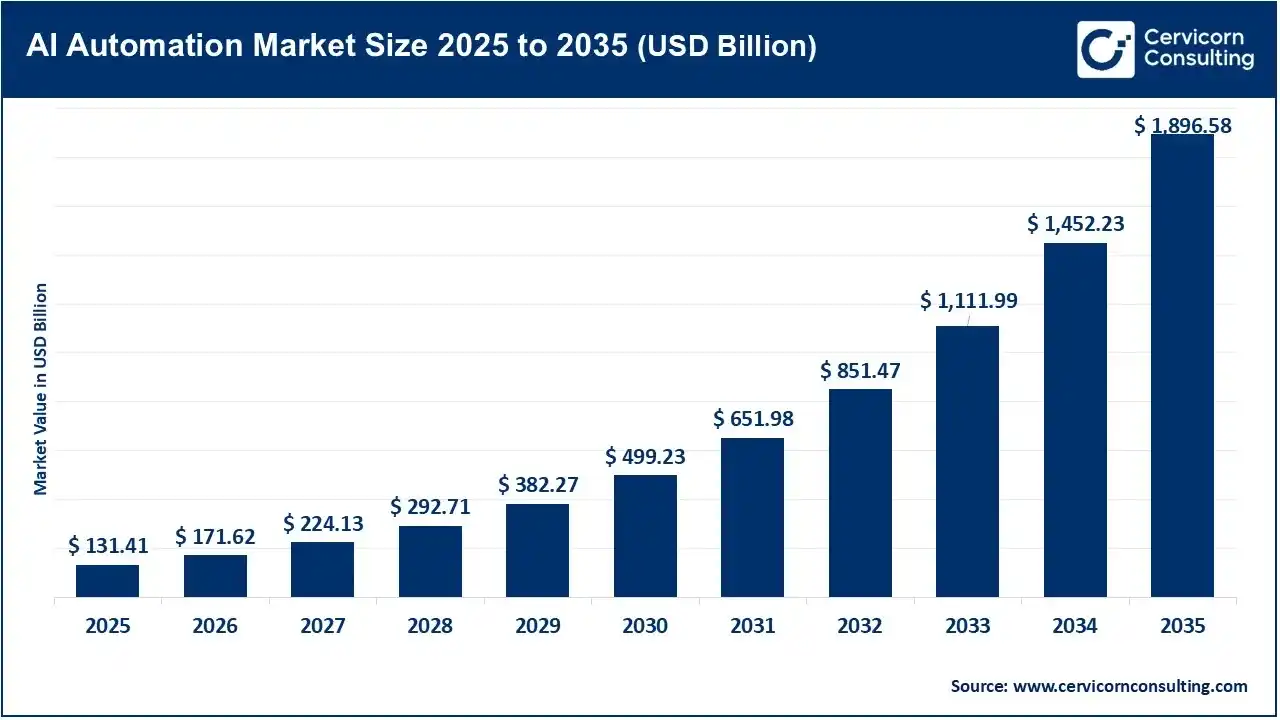
The global AI automation market was valued at approximately USD 131.41 billion in 2025 and is projected to reach around USD 1,896.58 billion by 2035, registering a 30.6% CAGR from 2026 to 2035. Major growth factors include the rising need to reduce operating costs, shortages of skilled workers, growing enterprise digitization, increasing adoption of cloud platforms, proliferation of unstructured data, demand for faster customer service, and the rapid development of generative and agentic AI.
Enterprises are moving beyond conventional rule-based automation toward systems capable of understanding documents, interpreting natural-language instructions, making recommendations, coordinating workflows, and executing actions across multiple applications. The proliferation of cloud-based applications is also creating fragmented technology environments that require intelligent orchestration, while AI-powered low-code and no-code tools are making automation accessible to nontechnical employees. UiPath notes that advances in AI are expanding automation into variable, uncertain, and unstructured processes that traditional RPA could not effectively handle.
At the same time, growing investments in AI infrastructure, increasing government support for AI innovation, demand for real-time decision-making, and the emergence of autonomous AI agents are broadening the addressable market for AI automation across BFSI, healthcare, manufacturing, retail, IT, telecommunications, logistics, government, and other sectors.
What Is the AI Automation Market?
The AI automation market comprises technologies, platforms, software, and services that use artificial intelligence to automate business processes, operational workflows, decision-making activities, customer interactions, and other tasks that traditionally require human intervention.
Traditional automation generally follows predefined rules. For example, an RPA bot may copy information from one application into another according to a fixed sequence of instructions. AI automation adds intelligence to this process. AI systems can interpret natural language, recognize patterns, classify documents, understand images, generate content, make predictions, and determine the next action.
AI automation therefore represents a broader evolution from RPA → intelligent automation → generative AI automation → agentic automation.
Modern platforms increasingly combine:
- Robotic process automation
- Machine learning
- Generative AI
- Natural language processing
- Computer vision
- Intelligent document processing
- Process mining
- Workflow orchestration
- AI agents
- Low-code/no-code development
- Predictive analytics
- API and application integration
This convergence enables organizations to automate complete business processes rather than isolated tasks. ServiceNow, for example, describes the role of its AI platform as connecting AI-generated insights to operational systems and workflows where actions actually occur.
Get a Free Sample: https://www.cervicornconsulting.com/sample/3024
Why Is AI Automation Important?
Improving operational efficiency
AI automation allows organizations to execute repetitive processes faster and more consistently. Activities such as invoice processing, customer onboarding, claims processing, employee onboarding, data entry, IT service management, compliance checks, and report generation can be automated with limited human intervention.
Reducing operating costs
Enterprises face continuing pressure to improve productivity while controlling labor and infrastructure costs. Automation allows employees to spend less time on repetitive administrative work and more time on analytical, creative, and customer-facing activities.
Addressing workforce shortages
Many industries face shortages of skilled employees. AI automation can help organizations supplement their workforce by automating high-volume activities while allowing employees to focus on tasks requiring judgment, relationship management, and domain expertise.
Enabling faster decision-making
AI automation can process large amounts of structured and unstructured data quickly. When connected with enterprise workflows, these capabilities can support faster decisions in areas such as fraud detection, supply-chain management, customer service, healthcare administration, and financial operations.
Expanding automation beyond rules
The biggest transformation is that AI allows organizations to automate processes involving unstructured information. Generative AI can interpret text, summarize documents, generate responses, extract information, and interact with users, while agentic AI can increasingly determine and execute sequences of actions.
Competitive Landscape of the AI Automation Market
| Company | Specialization | Key Focus Areas | Notable Features | 2025 Revenue | Market Share | Global Presence |
|---|---|---|---|---|---|---|
| UiPath | Enterprise automation and RPA | Agentic automation, RPA, process mining, AI | UiPath Platform, Autopilot, Agent Builder, Agentic Orchestration | USD 1.43B FY2025 | Broad AI automation share not separately disclosed; leading RPA vendor | Global enterprise presence |
| Microsoft | Cloud, enterprise software and workflow automation | Power Automate, Copilot, Azure AI, business process automation | Deep Microsoft 365 and Azure integration, low-code automation | USD 281.72B FY2025 | Broad AI automation share not separately disclosed; leading RPA vendor | Global |
| IBM | Enterprise AI, hybrid cloud and automation | IBM watsonx, automation, IT operations, business workflows | Hybrid-cloud integration, AI governance, enterprise automation | USD 67.54B | Broad AI automation share not separately disclosed | Global |
| Automation Anywhere | AI-powered enterprise automation | Agentic Process Automation, RPA, AI agents | Agentic Process Automation System, cloud-native platform | Not publicly disclosed | Broad AI automation share not separately disclosed; leading RPA vendor | Global |
| ServiceNow | Enterprise workflow and AI automation | IT, HR, customer service, security, AI agents | Now Platform, Now Assist, AI Agent Orchestrator | USD 13.28B | Broad AI automation share not separately disclosed | Global |
UiPath
UiPath remains one of the strongest pure-play enterprise automation companies. Its platform combines RPA with AI, process mining, document processing, orchestration, and agentic capabilities. UiPath reported USD 1.4297 billion in fiscal 2025 revenue, up 9% year over year, while ARR reached USD 1.6661 billion. Its strategic transition is increasingly focused on agentic automation, where AI agents can work alongside software robots to execute broader business processes.
Microsoft
Microsoft has a major competitive advantage because AI automation is embedded into its extensive enterprise ecosystem. Power Automate enables organizations to automate workflows across Microsoft 365, Dynamics, Azure, and third-party applications, while Copilot and Azure AI add generative AI capabilities.
Microsoft reported USD 281.724 billion in FY2025 revenue, with Microsoft Cloud revenue reaching USD 168.9 billion. Its global customer base and integration with existing enterprise applications give Microsoft significant opportunities to expand automation adoption.
IBM
IBM combines AI, hybrid cloud, consulting, and enterprise automation. Its automation portfolio addresses IT operations, business processes, infrastructure, data, and enterprise workflows. IBM generated USD 67.535 billion in 2025 revenue. Importantly for this market, IBM’s Automation software revenue reached USD 7.733 billion in 2025, growing 17.9% year over year.
IBM’s strength is particularly relevant to large organizations that need AI automation across complex hybrid-cloud and legacy environments.
Automation Anywhere
Automation Anywhere has evolved from an RPA-focused company toward Agentic Process Automation (APA). Its platform combines AI agents, automation, workflow orchestration, and enterprise process management.
The company’s FY2025 results highlighted strong demand for its APA offerings, including more than 150% year-over-year growth in million-dollar-plus deals and a 38% APA System attach rate within its installed base. Customers and partners had executed a cumulative 655,000 AI agents through the platform.
ServiceNow
ServiceNow approaches AI automation through enterprise workflows. Its platform connects departments, applications, data, and AI capabilities so that intelligent recommendations can translate into operational actions.
ServiceNow generated USD 13.278 billion in total revenue in 2025, while subscription revenue reached USD 12.883 billion. Its Now Assist AI business also showed strong momentum, with net-new annual contract value more than doubling year over year in Q4 2025.
Leading Trends and Their Impact
1. Shift from RPA to Agentic Automation
The AI automation industry is moving from bots that follow predefined instructions toward AI agents capable of planning and executing multi-step workflows.
Instead of simply extracting data from a document, an AI agent could read the document, determine the required action, verify information, update an enterprise system, request approval, and notify stakeholders.
Impact: This dramatically expands the number of processes that can be automated and increases the potential value of automation platforms.
2. Generative AI and Automation Convergence
Generative AI is making automation more flexible by allowing employees to describe desired processes using natural language.
For example, a business user could ask an automation platform to “review incoming invoices, identify exceptions, and route them to the appropriate finance manager.”
Impact: Automation development becomes faster and accessible to business users without extensive programming expertise.
3. Rise of AI-Powered Low-Code and No-Code Automation
Low-code and no-code technologies are becoming increasingly important because enterprises want to scale automation beyond centralized IT teams. AI assistants can help users create workflows, generate automation logic, identify process opportunities, and troubleshoot errors.
UiPath identifies AI-enhanced low-code/no-code automation as an important industry trend.
Impact: More departments can become automation consumers and creators, increasing enterprise-wide adoption.
4. Intelligent Document Processing
Businesses continue to handle large volumes of invoices, contracts, applications, medical records, insurance forms, purchase orders, and other documents.
AI automation can extract information from these documents, classify them, identify exceptions, and transfer information into enterprise systems.
Impact: Financial services, insurance, healthcare, logistics, and government agencies can automate processes that were previously dependent on manual data entry.
5. Automation Governance and Security
As AI systems receive greater authority to make decisions and execute transactions, governance is becoming critical.
Enterprises increasingly require:
- Access controls
- Human oversight
- Audit trails
- Data protection
- AI testing
- Model monitoring
- Explainability
- Compliance controls
Impact: Vendors that combine automation with enterprise-grade governance are better positioned for mission-critical applications.
6. AI Automation in IT Operations
AI automation is increasingly being used to monitor infrastructure, detect incidents, classify service requests, recommend remediation, and automatically execute routine IT operations.
Impact: Organizations can reduce incident resolution times and improve infrastructure availability while allowing IT teams to focus on higher-value activities.
7. Hyperautomation and End-to-End Process Orchestration
Organizations increasingly want to automate complete workflows rather than individual tasks. This is driving convergence between RPA, process mining, workflow management, AI, integration platforms, and business process management.
Impact: Vendors increasingly compete to become the central orchestration layer for enterprise operations.
Successful Examples of AI Automation Around the World
Banking and Financial Services
Financial institutions use AI automation for customer onboarding, KYC verification, fraud monitoring, document processing, loan administration, reconciliation, and compliance.
Automation platforms can combine OCR, machine learning, workflow rules, and AI agents to review documents and route exceptions to employees.
Healthcare
Healthcare organizations are applying AI automation to administrative processes such as appointment management, claims processing, patient documentation, insurance verification, and medical coding.
The combination of AI and automation can reduce administrative workloads and allow healthcare professionals to devote more time to patient care.
Manufacturing
Manufacturers are using AI automation across procurement, production planning, quality management, inventory, predictive maintenance, and supply-chain coordination.
AI can identify anomalies while automation platforms trigger corrective workflows.
Retail and E-Commerce
Retailers use AI automation for customer service, inventory management, product information, order processing, returns, marketing, and personalized recommendations.
AI agents can increasingly connect customer requests with backend systems and automatically execute routine transactions.
Government
Government organizations are exploring AI automation for citizen services, document processing, tax administration, benefits management, public-service workflows, and internal operations.
The combination of AI and automation can help public agencies process large volumes of requests while improving response times.
Global Regional Analysis
North America
North America remains one of the most advanced markets for AI automation because of its concentration of technology companies, cloud providers, enterprise software vendors, and large digital enterprises.
The United States is particularly important because major AI and automation companies—including Microsoft, IBM, UiPath, Automation Anywhere, and ServiceNow—have strong domestic operations.
Government policy is also increasingly focused on maintaining U.S. AI leadership. The 2025 America’s AI Action Plan introduced more than 90 federal policy actions across innovation, infrastructure, and international AI leadership.
The U.S. policy environment is generally focused on accelerating AI development, improving infrastructure, reducing regulatory barriers, and increasing adoption across government and industry.
Impact on AI automation: Strong cloud infrastructure, enterprise software adoption, venture investment, and government AI procurement are expected to support continued market expansion.
Europe
Europe represents a major market for AI automation, but its growth is being shaped strongly by regulation and responsible AI requirements.
The EU AI Act is establishing obligations around transparency, documentation, risk management, cybersecurity, and governance. Obligations for general-purpose AI models began applying on August 2, 2025, including technical documentation, copyright policies, and training-data summaries.
For AI automation vendors, this regulatory environment increases the importance of:
- Explainable AI
- Data governance
- Risk management
- Human oversight
- Compliance documentation
- Secure enterprise deployment
European enterprises are therefore likely to prioritize automation platforms that provide strong governance alongside productivity improvements.
Asia Pacific
Asia Pacific is emerging as one of the fastest-growing regions for AI automation due to rapid digitization, manufacturing automation, large technology ecosystems, expanding cloud infrastructure, and government-backed AI programs.
China, Japan, South Korea, India, and Singapore are particularly important markets.
China’s 2025 “AI Plus” initiative promotes deeper integration of artificial intelligence across economic and social sectors and aims to accelerate AI-enabled transformation. China has also promoted a Global AI Governance Action Plan emphasizing AI development, safety, controllability, fairness, inclusion, and international cooperation.
Japan’s highly automated manufacturing environment provides strong opportunities for AI-enabled industrial and business-process automation, while South Korea benefits from its semiconductor, electronics, robotics, and technology ecosystem.
India
India represents a major growth opportunity because of its large IT services sector, expanding digital economy, startup ecosystem, and increasing enterprise investment in AI.
The Government of India approved the IndiaAI Mission with an outlay of approximately INR 10,371.92 crore to democratize AI innovation and strengthen the country’s AI ecosystem.
The mission focuses on areas including:
- AI compute infrastructure
- Datasets
- Indigenous AI capabilities
- Future skills
- Startup financing
- Application development
- Safe and trusted AI
IndiaAI’s compute initiative is designed to make AI computing resources available at more affordable rates to researchers, startups, MSMEs, industry, and other users.
This policy direction can accelerate AI automation adoption across government, BFSI, healthcare, manufacturing, education, telecommunications, and IT services.
Latin America
Latin America is gradually increasing AI adoption as organizations modernize customer service, financial operations, telecommunications, logistics, and government services.
Brazil and Mexico represent important markets because of their large populations, expanding digital economies, and growing enterprise technology investments.
AI automation can be particularly valuable for organizations seeking productivity improvements without dramatically expanding administrative workforces.
Middle East and Africa
The Middle East is emerging as an important AI investment region, with governments and large enterprises investing in smart-city platforms, digital government, healthcare, financial services, energy, and advanced infrastructure.
The UAE and Saudi Arabia are particularly active in AI development and deployment.
In Africa, AI automation opportunities are developing around financial inclusion, telecommunications, agriculture, healthcare, public services, and business-process outsourcing.
Government Initiatives and Policies Shaping the AI Automation Market
Government policy is becoming a major factor in determining the pace and direction of AI automation adoption. The United States is emphasizing AI leadership, infrastructure, commercialization, and reduced regulatory barriers through its AI policy framework.
The European Union is emphasizing risk-based AI governance, documentation, transparency, cybersecurity, and accountability through the AI Act.
India is focusing on democratizing AI compute, datasets, skills, startup development, indigenous AI capabilities, and responsible AI through the IndiaAI Mission.
China is pursuing broad AI Plus adoption across industries while simultaneously developing AI governance and international cooperation mechanisms.
Together, these policies are creating two major market forces: government-supported AI investment and infrastructure expansion, and stronger requirements for secure, transparent, and responsible AI deployment. For AI automation providers, this means future competitiveness will depend not only on automation capabilities but also on governance, interoperability, cybersecurity, explainability, data protection, and the ability to operate across increasingly complex regulatory environments.
To Get Detailed Overview, Contact Us: https://www.cervicornconsulting.com/contact-us
Read Report: Power Management IC Market Revenue, Trends, and Strategic Insights by 2035