Infusion Pump Market Revenue, Trends, and Strategic Insights by 2035
Infusion Pump Market Size
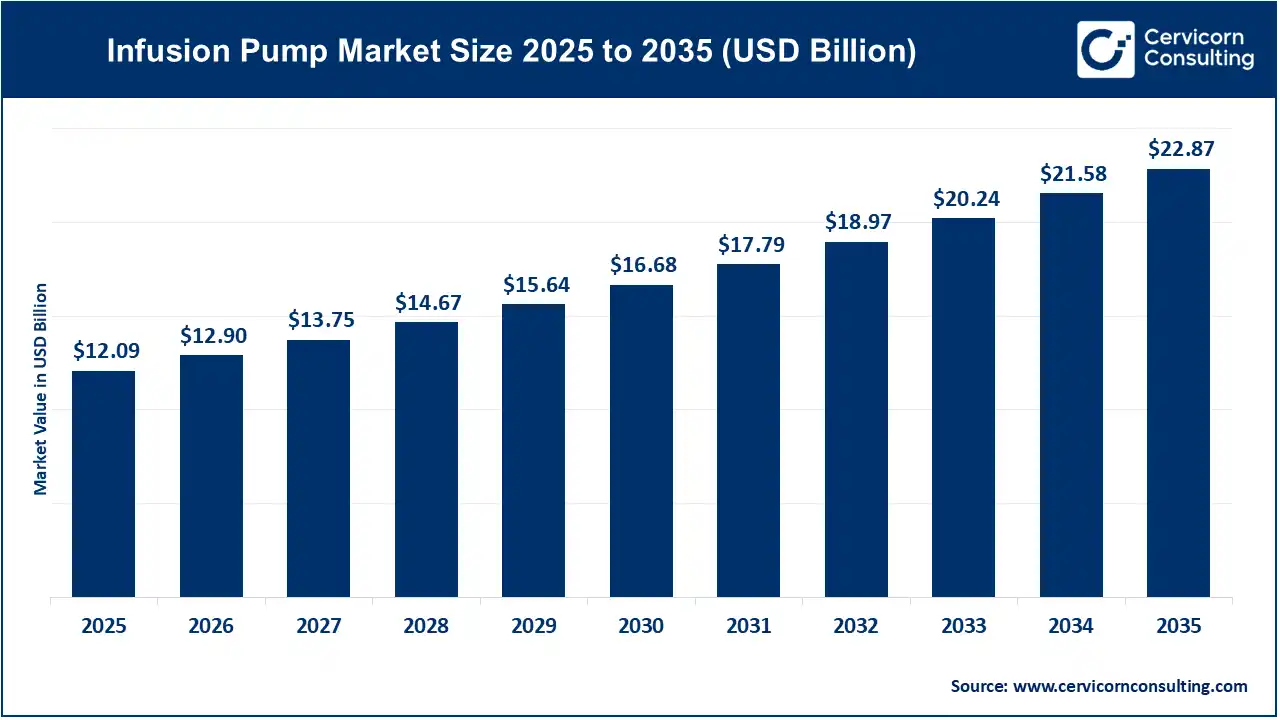
The global infusion pump market size was valued at USD 12.09 billion in 2025, projected to reach USD 22.87 billion by 2035 at a 6.58% CAGR, while broader infusion-pump definitions produce higher estimates.
What is the infusion pump market?
The infusion pump market comprises the global industry involved in developing, manufacturing, distributing, and servicing devices that administer fluids, medications, nutrients, and other therapeutic substances into patients at controlled rates. Infusion pumps are used extensively in hospitals, intensive-care units, oncology departments, emergency departments, neonatal and pediatric units, surgical centers, nursing facilities, and increasingly in home healthcare.
Major product categories include large-volume infusion pumps, syringe pumps, patient-controlled analgesia pumps, ambulatory pumps, elastomeric pumps, enteral pumps, insulin pumps, and implantable infusion systems. Large-volume pumps are generally used for continuous administration of fluids and medications, while syringe pumps provide highly precise delivery of relatively small volumes. Ambulatory and wearable pumps enable patients to receive treatment outside conventional hospital environments.
The technology landscape is also evolving from conventional electronic pumps toward smart infusion pumps. These devices can incorporate medication libraries, dose limits, alerts, wireless connectivity, interoperability with hospital information systems, and other safety functions. The U.S. FDA notes that smart pumps can alert clinicians when programmed parameters fall outside specified safety limits or when there is a potential medication-related risk.
Get a Free Sample: https://www.cervicornconsulting.com/sample/2776
Why is the infusion pump market important?
Infusion pumps are important because they provide a level of precision and consistency that can be difficult to achieve through manual administration. They are particularly valuable for therapies where dosing accuracy and delivery timing directly influence clinical outcomes. FDA describes infusion pumps as devices capable of delivering fluids at precisely programmed rates and in very small volumes.
Their importance becomes even greater in critical care, oncology, anesthesia, neonatal care, pain management, diabetes management, and parenteral nutrition, where inaccurate delivery can result in serious consequences. The increasing use of high-risk medications is therefore creating demand for systems capable of reducing programming and administration errors.
At the same time, safety has become a central market consideration. FDA has identified issues involving software defects, user-interface design, mechanical failures, battery failures, and other problems. From 2005 through 2009, FDA received approximately 56,000 infusion-pump adverse-event reports and manufacturers conducted 87 recalls. This history has encouraged manufacturers and healthcare institutions to prioritize safer design, testing, training, maintenance, and monitoring.
Leading companies in the infusion pump market
Becton, Dickinson and Company (BD)
Specialization: Medical technology, medication management, infusion systems, vascular access, diagnostics, and medical devices.
Key Focus Areas: BD’s infusion business is strongly associated with the BD Alaris™ platform, infusion pumps, medication delivery, interoperability, and hospital medication-management workflows.
Notable Features: BD focuses on integrating infusion technology with broader medication-management ecosystems and improving safety, connectivity, and clinical workflow. Its broader strategy also includes digital technologies and connected medical-device ecosystems.
2025 Revenue: BD reported USD 21.84 billion in worldwide fiscal 2025 revenue, up 8.2% from the previous year.
Market Share: Industry estimates vary considerably by product definition; one published estimate places BD’s share in the broader multi-therapy infusion-pump segment at approximately 22–25%, although this should not be interpreted as a universally accepted share for the entire infusion-pump market.
Global Presence: BD serves customers in more than 190 countries, supported by a large global manufacturing, research, sales, and distribution network.
Baxter International Inc.
Specialization: Infusion systems, injectable drugs, renal care, nutrition, surgical products, and hospital-focused healthcare technologies.
Key Focus Areas: Baxter’s infusion portfolio includes large-volume infusion systems, smart pump technologies, IV solutions, administration sets, and related medication-delivery infrastructure.
Notable Features: Baxter has historically been a major supplier of hospital infusion systems, with its technologies designed around continuous drug and fluid administration. Its infusion ecosystem combines pumps with dedicated administration sets and software-oriented safety functions.
2025 Revenue: Baxter reported USD 11.24 billion in global net sales in 2025, representing a 6% increase on a reported basis.
Market Share: Baxter remains one of the major global competitors in infusion systems, although precise company-level share varies significantly depending on whether the analysis includes only pumps or pumps plus consumables and related systems.
Global Presence: Baxter maintains a broad international commercial and manufacturing footprint serving hospitals and healthcare providers worldwide.
B. Braun Melsungen AG
Specialization: Infusion therapy, injectable drugs, vascular access, surgical technologies, anesthesia, and hospital medical technology.
Key Focus Areas: B. Braun concentrates on infusion pumps, infusion systems, consumables, medication delivery, and integrated hospital-care solutions.
Notable Features: Its portfolio includes the Infusomat® and Space® families and newer-generation systems designed around usability, reliability, and connected clinical workflows. B. Braun has also highlighted its Compactplus generation of infusion pumps as a solution designed around core requirements of modern infusion therapy.
2025 Revenue: B. Braun generated €9.4 billion in 2025 sales, compared with €9.1 billion in 2024.
Market Share: A published industry estimate places B. Braun’s share of the broader multi-therapy infusion-pump segment at approximately 15–18%.
Global Presence: B. Braun operates internationally across Europe, North America, Asia-Pacific, Latin America, Africa, and other healthcare markets, with particularly strong positioning in European hospital systems.
ICU Medical, Inc.
Specialization: Infusion systems, infusion consumables, vascular access, oncology products, and critical-care technologies.
Key Focus Areas: ICU Medical focuses heavily on infusion systems and dedicated consumables, supporting hospitals and healthcare organizations with integrated medication-delivery solutions.
Notable Features: Its portfolio includes Plum™ infusion systems, ambulatory infusion technologies, and dedicated administration sets. ICU Medical’s business model benefits from the recurring demand for consumables associated with installed infusion-pump systems.
2025 Revenue: ICU Medical reported USD 2.231 billion in total revenue in 2025. Infusion Systems generated USD 684.2 million, accounting for approximately 31% of total company revenue.
Market Share: One published estimate places ICU Medical’s share in the broader multi-therapy infusion-pump segment at approximately 18–20%, though this figure is segment-specific and market-share estimates differ by methodology.
Global Presence: In 2025, ICU Medical generated approximately 61% of its revenue in the United States and 39% internationally, with sales across Europe, the Middle East and Africa, Asia-Pacific, and other international markets.
Fresenius Kabi AG
Specialization: Infusion therapy, clinical nutrition, injectable pharmaceuticals, medical devices, and transfusion medicine.
Key Focus Areas: Fresenius Kabi focuses on infusion and nutrition pumps, infusion consumables, medication delivery, and software-based solutions supporting application safety and hospital workflows.
Notable Features: Its MedTech Infusion and Nutrition Systems portfolio includes infusion and nutrition pumps, dedicated disposables, and software-oriented solutions emphasizing application safety, workflow efficiency, and interoperability. Fresenius Kabi also expanded its U.S. infusion offering through the Ivenix portfolio.
2025 Revenue: Fresenius Kabi generated €8.612 billion in 2025 revenue, while its MedTech business generated €1.610 billion.
Market Share: A published estimate places Fresenius Kabi at approximately 8–10% of the broader multi-therapy infusion-pump segment.
Global Presence: Fresenius Kabi has extensive operations across Europe, North America, Asia-Pacific, Latin America, and other international markets. Its 2025 Kabi revenue was geographically distributed across multiple regions, with Europe representing the largest portion.
Leading trends and their impact on the infusion pump market
Smart infusion pumps are becoming the industry standard
One of the strongest trends is the shift from conventional pumps toward smart infusion pumps equipped with drug libraries, dose-error reduction systems, alarms, and software-based safety mechanisms. These technologies can help clinicians identify programming values outside predefined parameters and support standardized medication administration.
The impact is significant because hospitals are increasingly evaluating pumps not only on mechanical performance but also on clinical intelligence, interoperability, cybersecurity, and data capabilities.
Connectivity and interoperability are transforming hospital workflows
Connected infusion pumps can exchange information with electronic health records, pharmacy systems, medication-management platforms, and hospital networks. This creates opportunities to reduce manual data entry and improve visibility into medication administration.
Interoperability is therefore becoming an important purchasing criterion, particularly among large hospitals seeking integrated digital infrastructure.
Home healthcare is creating new demand
The shift toward outpatient and home-based treatment is expanding the addressable market for ambulatory, portable, and wearable infusion pumps. Patients receiving chemotherapy, antibiotics, parenteral nutrition, pain therapy, or other long-duration treatments can increasingly receive care outside traditional inpatient environments.
This trend can reduce hospital stays while increasing demand for compact, battery-operated, easy-to-use infusion systems.
Oncology remains a major application area
Cancer treatment frequently requires controlled administration of chemotherapy and supportive medications, making infusion pumps important components of oncology care. Growing cancer incidence, expansion of oncology infrastructure, and increasing outpatient treatment are supporting demand for accurate infusion technologies.
Pediatric and neonatal applications require greater precision
Neonatal and pediatric patients often require extremely small volumes and highly controlled infusion rates. Consequently, syringe pumps and advanced low-flow technologies are gaining importance in these settings.
The demand for precision is encouraging manufacturers to improve flow accuracy, occlusion detection, alarms, and usability at low infusion rates.
Cybersecurity is becoming increasingly important
As infusion pumps become connected medical devices, cybersecurity is becoming an integral part of product development. Network-connected pumps can potentially create vulnerabilities if software, authentication, firmware, or network security is inadequate.
Manufacturers are therefore investing more heavily in secure software architecture, device monitoring, vulnerability management, and controlled software updates.
Successful examples of infusion pump market adoption around the world
United States: smart pump integration in hospitals
The United States represents one of the most technologically advanced infusion-pump markets, with hospitals increasingly adopting smart pumps and integrating them with medication-management systems. The country’s sophisticated hospital infrastructure and strong regulatory emphasis on device safety have encouraged manufacturers to invest in improved software, drug libraries, alarms, and connectivity.
FDA’s Infusion Pump Improvement Initiative has specifically emphasized additional manufacturer requirements, proactive device improvements, and increased user awareness.
Europe: integrated infusion therapy ecosystems
European healthcare systems have increasingly emphasized integrated infusion therapy, standardized clinical workflows, and patient safety. Companies such as B. Braun and Fresenius Kabi have developed broad ecosystems combining pumps, disposables, medications, and digital technologies.
This integrated approach allows hospitals to standardize equipment and simplify procurement while supporting consistent clinical workflows.
Asia-Pacific: expanding hospital infrastructure
Countries including China, India, Japan, South Korea, and Australia are creating significant opportunities as healthcare infrastructure expands and advanced medical technologies become more accessible.
The region is particularly important because increasing healthcare expenditure, rising chronic-disease prevalence, expanding private hospitals, and growing demand for sophisticated critical-care equipment are accelerating technology adoption.
Home infusion in North America and Europe
Home infusion represents another successful application model. Portable and ambulatory infusion pumps allow selected patients to continue treatment without remaining in hospitals. This approach is particularly useful for long-duration therapies and supports healthcare systems attempting to reduce inpatient costs.
Global regional analysis
North America
North America remains one of the largest infusion-pump markets, supported by advanced healthcare infrastructure, high medical-device adoption, major manufacturers, and strong regulatory oversight. One recent estimate places North America at approximately 51% of the intravenous infusion-pump market in 2025.
The United States dominates regional demand because of its large hospital network, high adoption of smart medical technologies, extensive oncology and critical-care infrastructure, and growing home-infusion services.
Government and regulatory initiatives have had a particularly strong influence. FDA’s infusion-pump safety programs encourage manufacturers to improve device engineering, premarket testing, usability, and post-market surveillance.
Europe
Europe represents another mature market, supported by established healthcare systems, high medical-device standards, and strong demand for technologically advanced infusion systems. Germany, the UK, France, Italy, and other Western European countries have significant hospital and home-care demand.
The EU Medical Device Regulation (MDR) has increased requirements around device safety, clinical evidence, traceability, post-market surveillance, and manufacturer responsibilities. These requirements encourage manufacturers to develop products with stronger quality-management and lifecycle-monitoring capabilities.
European companies such as B. Braun and Fresenius Kabi also contribute substantially to regional innovation and manufacturing.
Asia-Pacific
Asia-Pacific is among the fastest-growing regions for infusion-pump adoption. Recent market research identifies the region as having the highest projected growth rate for intravenous infusion pumps, supported by healthcare infrastructure expansion and increasing demand for sophisticated drug-delivery technologies.
China is investing heavily in domestic medical-device manufacturing and hospital modernization, while Japan’s aging population creates sustained demand for chronic-disease treatment and advanced healthcare technologies. India is also expanding hospital infrastructure and domestic medical-device capabilities.
Government initiatives supporting domestic medical-device manufacturing can strengthen regional supply chains and reduce reliance on imports. India’s recent policy emphasis on medical-equipment testing infrastructure, including government funding for advanced testing laboratories, illustrates the broader push toward stronger domestic medical-device quality and manufacturing capabilities.
Latin America
Latin America offers long-term growth opportunities as healthcare infrastructure expands and access to advanced medical technologies improves. Brazil and Mexico represent important markets because of their large populations and healthcare systems.
However, procurement budgets, reimbursement structures, currency fluctuations, and uneven access to advanced medical technology can affect adoption. Manufacturers that offer cost-efficient pumps, durable designs, local service support, and scalable consumables programs are likely to have stronger opportunities.
Middle East and Africa
The Middle East and Africa represent emerging opportunities driven by hospital construction, healthcare modernization, medical-tourism initiatives, and increasing investment in advanced clinical infrastructure. Gulf countries are particularly important because of their investment in technologically advanced hospitals and specialty-care centers.
In Africa, adoption is more dependent on healthcare infrastructure, procurement budgets, reliable power supplies, technical training, and maintenance capabilities. Consequently, robust and relatively easy-to-maintain infusion systems can be particularly valuable.
Government initiatives and policies shaping the market
Government regulation is one of the most important forces influencing infusion-pump development because these devices directly affect medication safety.
In the United States, FDA’s Infusion Pump Improvement Initiative has focused on stronger manufacturer requirements, proactive device improvements, and greater user awareness. FDA continues to emphasize adverse-event monitoring and manufacturer inspections to identify safety issues.
In addition, FDA guidance and regulatory scrutiny encourage manufacturers to address software, human-factor, mechanical, electrical, and cybersecurity risks. Healthcare facilities are also encouraged to establish policies and procedures for reducing pump-related risks.
In Europe, the Medical Device Regulation strengthens requirements for clinical evaluation, quality systems, post-market surveillance, traceability, and safety documentation. This increases compliance responsibilities but also supports greater confidence in advanced infusion devices.
In India, initiatives supporting domestic medical-device manufacturing and testing infrastructure are strengthening the broader ecosystem for locally produced medical equipment. In 2026, the Indian government announced full funding for advanced medical-equipment testing laboratories through the Bureau of Indian Standards, with the objective of strengthening quality standards and domestic manufacturing capabilities.
Across Asia-Pacific, national healthcare modernization programs are supporting hospital expansion and adoption of advanced medical technologies. Meanwhile, policies encouraging domestic manufacturing, technology localization, and healthcare digitization are creating opportunities for both established multinational companies and emerging local manufacturers.
The overall direction of regulation is clear: the infusion pump market is moving toward safer, smarter, connected, interoperable, and increasingly patient-centric systems. Manufacturers able to combine precision hardware with software intelligence, cybersecurity, clinical interoperability, reliable consumables, and strong post-market support are positioned to capture a larger share of future demand.
To Get Detailed Overview, Contact Us: https://www.cervicornconsulting.com/contact-us
Read Report: Extended Reality Market Revenue, Trends, and Strategic Insights by 2035