Mosquito Drone Market Revenue, Trends, and Strategic Insights by 2035
Mosquito Drone Market Size
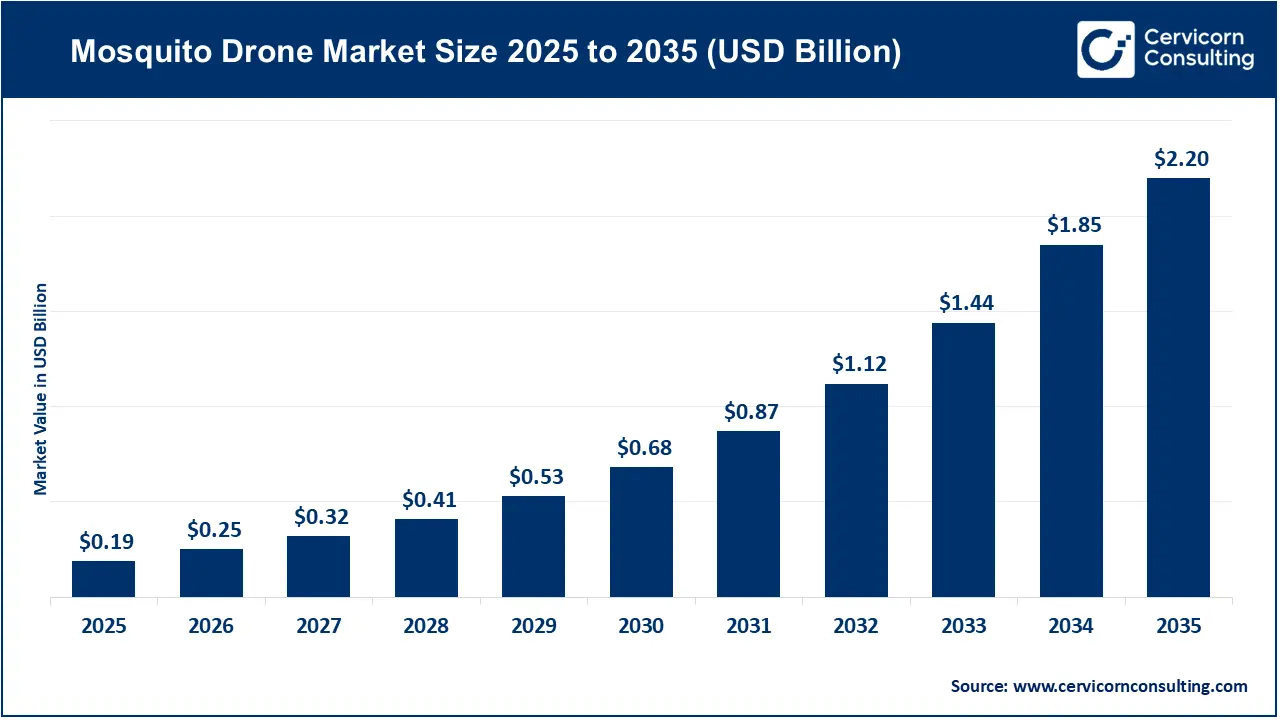
The global mosquito drone market was valued at approximately USD 0.19 billion in 2025 and is projected to reach around USD 2.20 billion by 2035, expanding at a CAGR of 27.75% from 2026 to 2035. North America currently represents the leading regional market, while Asia-Pacific is expected to record the fastest expansion. The market encompasses drone platforms and supporting technologies used for mosquito surveillance, breeding-site mapping, larvicide or adulticide application, biological-control deployment, environmental monitoring, and increasingly autonomous vector-control operations.
Mosquito Drone Market Growth Factors
The mosquito drone market is growing because of the rising incidence and geographic spread of mosquito-borne diseases such as malaria, dengue, Zika, chikungunya, yellow fever, and West Nile fever; increasing demand for faster and more precise mosquito surveillance; limitations associated with labor-intensive ground inspections; expansion of AI-powered image recognition and geospatial mapping; improvements in drone batteries, sensors, autonomous navigation, and payload systems; growing adoption of environmentally targeted pest-management techniques; increasing government investment in public-health surveillance; and the need to reach wetlands, forests, agricultural areas, construction sites, drainage networks, and other difficult-to-access mosquito habitats.
Drones can rapidly survey large areas, identify potential breeding locations, create high-resolution maps, and support targeted application of larvicides or other control agents, reducing the need for blanket treatment. Research has demonstrated that unmanned aircraft can support spraying, granular application, larvicide-tablet deployment, and adulticide operations, while their precision can potentially reduce chemical waste compared with conventional aerial application.
Get a Free Sample: https://www.cervicornconsulting.com/sample/2744
What Is the Mosquito Drone Market?
The term mosquito drone can describe two related technology concepts. The first, and the interpretation used in the Cervicorn Consulting market definition, refers to extremely small or micro unmanned aerial vehicles designed for discreet surveillance, reconnaissance, sensing, and data collection. The second, increasingly relevant to public health, refers to conventional or specialized UAVs used to detect mosquito habitats, monitor mosquito populations, apply vector-control products, or distribute biological-control agents.
For commercial mosquito-control programs, the second category is particularly important. These drones may carry multispectral or high-resolution cameras, thermal sensors, GPS modules, environmental sensors, spraying equipment, larvicide dispensers, or release mechanisms. AI and computer vision can then analyze aerial imagery to identify standing water, discarded containers, tires, vegetation patterns, drainage areas, and other environments favorable to mosquito breeding.
Academic research has already demonstrated the potential of UAVs for mosquito surveillance. One study using drone imagery and convolutional neural-network technology detected mosquito habitat associated with Aedes albopictus and classified properties according to potential larval habitat. Researchers have also identified applications involving environmental mapping, breeding-site detection, larvicide distribution, biological control, sterile-male release, and Wolbachia-carrying mosquito deployment.
The concept is therefore broader than a drone that physically kills mosquitoes. It represents an emerging technology ecosystem for aerial mosquito intelligence and intervention.
Why Is the Mosquito Drone Market Important?
Mosquito-borne diseases create a significant public-health burden, particularly in tropical and subtropical regions. Traditional vector-control programs commonly depend on ground teams, traps, manual inspections, fogging equipment, helicopters, and chemical treatment. These methods remain important, but they can become inefficient when mosquito habitats are geographically dispersed, hidden by vegetation, inaccessible, or rapidly changing.
Drones provide a way to shift mosquito management from reactive spraying toward data-driven intervention. Instead of treating an entire neighborhood or agricultural area uniformly, authorities can use aerial imagery and sensor information to identify likely hotspots and direct control teams or spraying drones toward those locations.
The technology is particularly useful for wetlands, forests, irrigation networks, abandoned properties, construction zones, rooftops, and large rural areas. It can also improve documentation by creating time-stamped geospatial records of surveillance and treatment activities.
Another important advantage is operational speed. Research on autonomous UAS mosquito-control systems demonstrated that drone platforms could be equipped with different modules for liquid larvicide spraying, larvicide-tablet delivery, granular application, and ultra-low-volume adulticide spraying.
Leading Companies in the Mosquito Drone Market
Because mosquito-specific drone sales are not generally reported as a separate business segment, 2025 revenue and mosquito-drone market-share figures are not publicly disclosed for most companies. It would therefore be misleading to assign fabricated company-specific market shares. The following comparison distinguishes overall company information from mosquito-drone-specific commercial data.
| Company | Specialization | Key Focus Areas | Notable Features | 2025 Revenue | Mosquito Drone Market Share | Global Presence |
|---|---|---|---|---|---|---|
| DJI Technology Co., Ltd. | Commercial, industrial and agricultural drones | Mapping, spraying, imaging, autonomous flight | Agras platforms, high-precision imaging, radar, automated spraying | Not publicly disclosed | Not publicly disclosed | Global |
| XAG Co., Ltd. | Agricultural robotics and autonomous drones | Precision spraying, spreading, farm automation | Autonomous agricultural ecosystem, aerial-ground robotics | Not publicly disclosed | Not publicly disclosed | 60+ countries and regions |
| PrecisionVision / Central UAS Technologies | UAV software, flight control and aerial application | Mosquito control, aerial spraying, mapping | PrecisionVision autopilot/GCS, MapVision and DropVision | Not publicly disclosed | Not publicly disclosed | Primarily North America, with international technology reach |
| VectorDrone | Drone-based vector-control solutions | Mosquito surveillance and intervention | Emerging specialized UAV/vector-control positioning | Not publicly disclosed | Not publicly disclosed | Publicly available financial/global data limited |
| Aerial Response Solutions | Specialized aerial/drone services | Aerial response and operational applications | Rapid deployment and drone-enabled field operations | Not publicly disclosed | Not publicly disclosed | Publicly available market data limited |
DJI Technology Co., Ltd.
DJI is one of the world’s best-known commercial drone manufacturers and has significant technological relevance to mosquito-drone applications because of its aircraft platforms, imaging systems, autonomous navigation technologies, and agricultural spraying capabilities. DJI Agriculture develops crop-protection drones capable of surveying, mapping, spraying, and spreading. Its technology has also been used in experimental mosquito-control applications.
In an anti-malaria experiment highlighted by DJI, an Agras MG-1S was modified to spray a biological agent over standing-water breeding areas. The trial reported more than a 90% reduction in emerging adult mosquitoes for more than one month compared with control fields.
DJI Agriculture states that its tools serve users in more than 30 countries and regions and that its agricultural technology has been deployed at significant scale.
XAG Co., Ltd.
XAG is a Chinese agricultural robotics company focused on autonomous aerial and ground-based agricultural systems. Its product ecosystem includes agricultural drones, ground robots, autopilot technologies, and smart agricultural management systems. XAG states that its products are sold in more than 60 countries and regions.
Although XAG is primarily an agricultural robotics company rather than a mosquito-control specialist, its precision spraying and autonomous flight technologies have potential applications in vector-control programs, particularly where large areas require targeted treatment.
PrecisionVision
PrecisionVision is particularly relevant because the technology is connected to aerial application and mosquito-control operations. Central UAS Technologies describes PrecisionVision software as supporting aerial inspections, flight planning, and applications, with autonomous capabilities incorporated into its flight-control and ground-control software. Its ecosystem includes PrecisionVision, MapVision, and DropVision.
The company has also been associated with mosquito-control applications. Its technology materials reference mosquito-control districts in Florida using its mapping and aerial-application solutions. Central UAS Technologies has also developed agricultural spraying platforms, demonstrating the convergence between mosquito-control and precision-agriculture drone technology.
VectorDrone
VectorDrone represents the specialized vector-control side of the market. The broader mosquito-drone ecosystem increasingly depends on integrating UAV hardware with mosquito surveillance, environmental sensing, geographic information systems, AI analytics, and targeted intervention.
Because detailed audited financial statements and independently verified mosquito-drone revenue figures are not readily available for VectorDrone, 2025 revenue and market share should be treated as not publicly disclosed rather than estimated.
Aerial Response Solutions
Aerial Response Solutions is positioned around specialized aerial drone operations and response capabilities. The opportunity for such providers lies in offering drone-as-a-service models to municipalities, mosquito-control districts, agricultural operators, environmental agencies, and public-health organizations.
The emergence of service providers is important because many government agencies do not need to purchase and maintain complete drone fleets. Instead, they can outsource surveillance, mapping, spraying, data processing, or emergency vector-control operations to specialized operators.
Leading Trends and Their Impact
1. AI-Powered Mosquito Habitat Detection
Artificial intelligence is becoming one of the most important technologies in the mosquito-drone ecosystem. Computer vision can analyze aerial images to identify standing water, containers, vegetation, tires, drainage areas, and other potential breeding sites.
A 2026 Stanford-led project in Indonesia demonstrated this potential by combining drones with AI to identify mosquito breeding locations. Researchers reported that AI identified nearly twice as many discarded tires—a significant mosquito habitat—as human analysts.
Impact: AI reduces manual image-analysis requirements and can help authorities prioritize interventions.
2. Precision Larvicide and Adulticide Application
Drones are increasingly being adapted for targeted spraying. Rather than treating broad areas indiscriminately, UAVs can apply products to specific areas identified through surveillance.
Research has demonstrated autonomous drone systems capable of liquid larvicide spraying, granular application, larvicide-tablet delivery, and adulticide spraying.
Impact: Targeted treatment can improve chemical efficiency and reduce unnecessary application.
3. Integration With IoT and Smart-City Platforms
Mosquito-control drones are increasingly being connected to sensors, dashboards, GIS platforms, weather information, hospital surveillance, and municipal databases.
Andhra Pradesh’s Smart Mosquito Surveillance System, for example, combines AI, IoT sensors, drones, mosquito monitoring, weather information, and centralized dashboards.
Impact: This transforms mosquito control into a continuous monitoring system rather than a periodic spraying activity.
4. Biological Control and Mosquito Release
Another important trend is the use of drones to release biological-control mosquitoes, including sterile males or mosquitoes carrying Wolbachia bacteria.
This approach is particularly useful in difficult terrain where ground-based release programs are expensive or logistically difficult.
Impact: UAV-based release could improve geographic coverage and precision while reducing dependence on helicopters or large ground teams.
5. Autonomous Operations
Autonomous flight planning, obstacle avoidance, terrain following, automated spraying, and AI-based mission planning are becoming increasingly important.
DJI’s agricultural systems, for example, incorporate technologies such as radar and automated spraying. Its Agras T10 supports autonomous agricultural operations and can cover substantial areas per hour under specified operating conditions.
Impact: Greater autonomy reduces operator workload and improves repeatability.
6. Ultra-Small Mosquito-Hunting Drones
A separate but emerging trend involves drones designed to physically detect and intercept individual mosquitoes. In 2026, San Francisco-based startup Tornyol attracted attention with an autonomous micro-drone that uses ultrasonic sensing, microphones, and AI to identify mosquitoes and intercept them in flight.
Impact: Although still an emerging commercial concept, mosquito-hunting micro-drones could create an entirely new residential and commercial pest-control category.
Successful Examples of the Mosquito Drone Market Around the World
United States: Mosquito Surveillance and Precision Mapping
Research programs in the United States have used UAVs to identify mosquito breeding habitats. A study involving suburban areas in New York used a DJI Mavic Pro and custom UAV systems to identify potential Aedes albopictus habitats. The AI system detected up to 67% of relevant habitat and classified properties for potential larval habitat with substantial accuracy.
This illustrates how drones can complement traditional entomological surveys rather than replacing them.
Africa: Drone-Based Anti-Malaria Applications
DJI has highlighted experimental anti-malaria work involving Agras drones. Modified agricultural UAVs were used to treat mosquito breeding environments, and the trial reported a greater than 90% reduction in emerging adult mosquitoes for more than one month.
The African market is particularly promising because remote landscapes, agricultural environments, wetlands, and limited field resources can make conventional mosquito-control operations difficult.
India: Andhra Pradesh Smart Mosquito Surveillance System
In 2025, Andhra Pradesh announced a pilot Smart Mosquito Surveillance System covering 66 locations across six municipal corporations: Visakhapatnam, Vijayawada, Kakinada, Rajamahendravaram, Nellore, and Kurnool.
The system combines AI-powered sensors, IoT, drones, mosquito-density monitoring, weather information, heat maps, traps, and a central dashboard. Drone-based spraying is intended to support more targeted intervention and reduce time, chemical use, and operating costs.
Indonesia: AI and Drone-Based Breeding-Site Detection
Researchers working in Indonesia have combined drone imagery with AI to locate mosquito habitats such as discarded tires. The approach is particularly relevant as changing environmental conditions and rising temperatures alter mosquito distributions.
The 2026 Stanford project demonstrates how drone-based mosquito surveillance can be applied in real-world communities rather than remaining solely within laboratory research.
Hawaii: Aerial Mosquito-Control Programs
Hawaii has become a major case study for innovative mosquito-control strategies because invasive mosquitoes contribute to the transmission of avian malaria threatening native bird populations. Wolbachia-infected male mosquitoes have been released over large areas of Maui and Kauai as part of conservation efforts.
Importantly, available documentation indicates that helicopters, rather than drones, were being used for the mass releases in the program, so this example should not be presented as a completed drone-release deployment. It nevertheless demonstrates the type of biological-control operation where future autonomous aerial release technology could potentially play a role.
Global Regional Analysis
North America
North America currently leads the mosquito drone market, accounting for approximately 36.5% of revenue share in 2024, according to Cervicorn Consulting. The region benefits from established mosquito-control districts, advanced drone infrastructure, high technology adoption, research institutions, and public-health funding.
The United States has numerous mosquito-control districts that already use aerial surveillance and specialized aircraft. Drone technology provides a lower-scale and potentially more precise alternative for difficult-to-access areas.
Regulation is an important market consideration. In the United States, commercial drone operations generally operate under FAA rules, while pesticide application must comply with applicable federal and state requirements. Operators therefore need to consider aviation authorization, pilot requirements, airspace restrictions, pesticide labeling, and local mosquito-control regulations.
Europe
Europe is developing the market through environmental monitoring, precision agriculture, scientific research, and increasingly sophisticated UAV regulation. The European Union’s risk-based drone framework provides categories and operating requirements for unmanned aircraft.
European adoption is likely to emphasize precision, environmental sustainability, data protection, and integrated vector management. Drone operators must comply with applicable EU and national aviation rules, while chemical applications remain subject to pesticide regulations.
The European market also has strong research capabilities in biological control, remote sensing, AI, and environmental modeling, creating opportunities for drone-based mosquito surveillance.
Asia-Pacific
Asia-Pacific is expected to be the fastest-expanding region in the mosquito drone market.
The region combines high mosquito-borne disease exposure with dense urban populations, tropical climates, large agricultural areas, rapid drone adoption, and expanding smart-city programs.
China has strong drone manufacturing capabilities through companies such as DJI and XAG. India is emerging as another important market, demonstrated by Andhra Pradesh’s AI-, IoT-, and drone-enabled mosquito surveillance initiative.
Countries such as Indonesia and other Southeast Asian nations also represent significant opportunities because dengue and other mosquito-borne diseases create continuing demand for improved surveillance.
Government policies supporting drone manufacturing, digital agriculture, smart cities, AI, public-health modernization, and unmanned aviation can accelerate deployment. At the same time, authorities must balance public-health applications with airspace safety and privacy requirements.
Latin America
Latin America represents a promising market because of the prevalence of dengue, Zika, chikungunya, yellow fever, and other vector-borne diseases. Remote sensing and drone-based environmental mapping have already been studied for mosquito habitat identification in the region.
Governments and municipalities can use UAVs to survey urban drainage, abandoned properties, wetlands, agricultural zones, and areas affected by flooding.
The major opportunity is integrating drone data with public-health surveillance systems so that disease reports can trigger geographically targeted inspections.
Middle East & Africa
Africa has significant long-term potential because malaria remains a major public-health challenge and many high-risk areas are geographically difficult to access.
Drone-based mosquito surveillance can help map breeding habitats, while precision spraying can target water bodies and other identified locations. The anti-malaria drone experiments highlighted by DJI demonstrate the potential of aerial intervention in African environments.
In the Middle East, mosquito-control applications are more concentrated around urban environments, irrigation infrastructure, water-management systems, and disease surveillance. Investment in smart-city infrastructure and environmental monitoring can support market development.
Government Initiatives and Policies Shaping the Market
Government action will be one of the strongest determinants of mosquito-drone adoption because vector control is closely connected with public health, aviation safety, environmental protection, and pesticide regulation.
United States: FAA requirements shape drone operations, while EPA pesticide rules and state-level regulations influence aerial application. Mosquito-control districts are increasingly exploring UAVs for surveillance, mapping, and targeted intervention. Research has shown that UAS can provide real-time imagery, improve aerial application accuracy, and support larval detection and sampling.
India: India’s drone-policy framework has helped expand commercial UAV applications. At the state level, Andhra Pradesh’s SMoSS initiative demonstrates direct government interest in combining AI, IoT, sensors, drones, and mosquito surveillance. The planned 66-location deployment illustrates how mosquito control is becoming connected with digital municipal infrastructure.
China: China’s strong drone-manufacturing ecosystem and large-scale agricultural UAV deployment provide an important technology foundation. Companies such as DJI and XAG have developed high-capacity spraying, mapping, automation, and precision-flight technologies that can potentially be adapted to vector-control applications. XAG states that its products are sold across more than 60 countries and regions.
Europe: European drone regulation emphasizes operational risk management, operator responsibility, airspace safety, and privacy. These frameworks create a structured environment for commercial UAV deployment while requiring mosquito-control operators to obtain the appropriate permissions for higher-risk operations.
Global public-health policy: International vector-control strategies increasingly emphasize integrated approaches combining surveillance, environmental management, biological control, chemical intervention, community engagement, and disease monitoring. Drones fit into this framework as an enabling technology rather than a standalone replacement for public-health workers.
The market is consequently moving toward an integrated model in which drones collect data, AI identifies risk, GIS maps hotspots, IoT sensors provide continuous environmental information, and autonomous aircraft deliver targeted interventions. This convergence is likely to remain one of the defining characteristics of the mosquito drone market through the next decade.
To Get Detailed Overview, Contact Us: https://www.cervicornconsulting.com/contact-us
Read Report: Artificial Intelligence (AI) in Textile Market Revenue, Trends, and Strategic Insights by 2035