Artificial Intelligence (AI) in Textile Market Revenue, Trends, and Strategic Insights by 2035
Artificial Intelligence (AI) in Textile Market Size
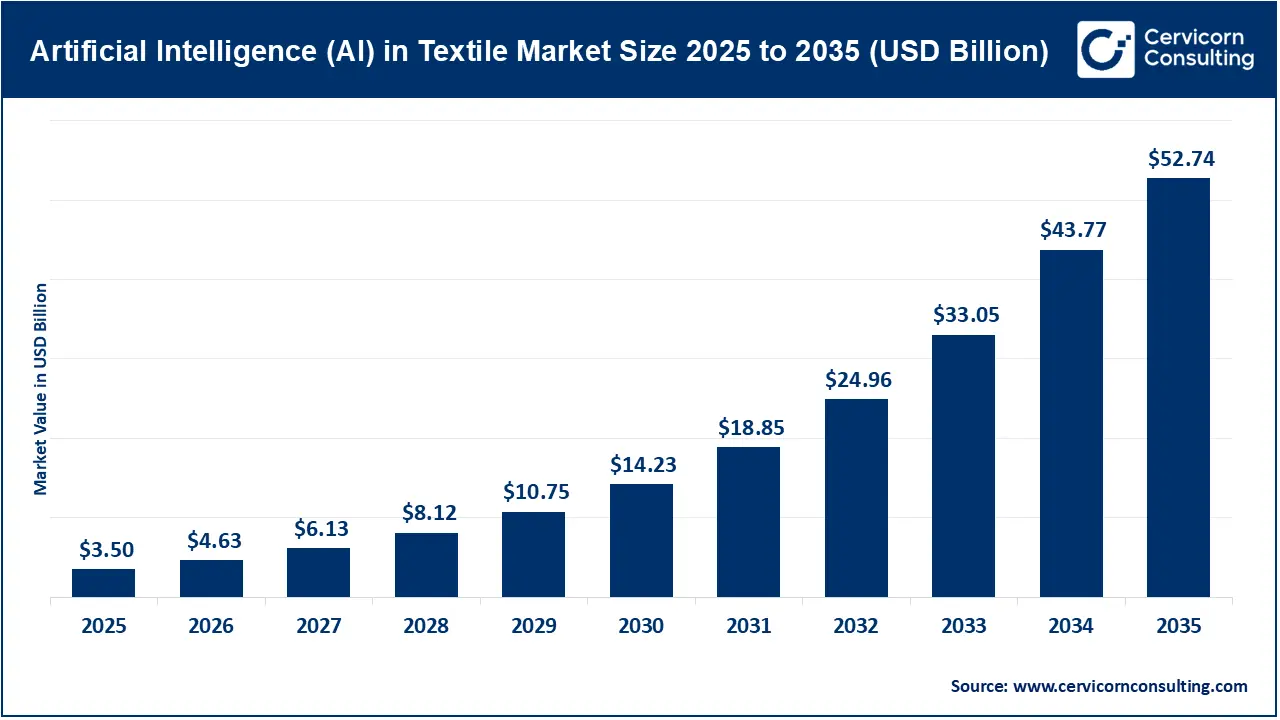
The global artificial intelligence (AI) in textile market was valued at approximately USD 3.50 billion in 2025 and is projected to reach USD 52.74 billion by 2035, expanding at a CAGR of 31.16% during the forecast period.
Artificial Intelligence (AI) in Textile Market Growth Factors
The artificial intelligence (AI) in textile market is expanding as textile manufacturers, fashion brands, retailers, and supply-chain operators increasingly adopt machine learning, computer vision, generative AI, predictive analytics, natural-language processing, digital twins, and intelligent automation to improve productivity and respond faster to changing consumer demand.
Major growth factors include the increasing need for automated fabric inspection and defect detection, growing demand for personalized fashion, rising adoption of predictive maintenance, pressure to reduce textile waste and energy consumption, increasing use of AI-powered demand forecasting, expansion of smart factories, rapid development of generative AI for fashion design, growth of e-commerce and digital fashion retail, and greater availability of cloud computing and industrial data platforms. AI is also becoming important for optimizing raw-material procurement, production scheduling, inventory levels, dyeing and finishing processes, logistics, and product recommendations.
Government programs supporting advanced manufacturing and textile modernization are further encouraging digital transformation. In India, for example, policymakers are combining textile-sector modernization, technical-textile development, manufacturing incentives, skilling, and integrated industrial infrastructure, creating an environment in which AI and other Industry 4.0 technologies can be deployed at greater scale.
Get a Free Sample: https://www.cervicornconsulting.com/sample/2729
What Is the Artificial Intelligence (AI) in Textile Market?
The artificial intelligence (AI) in textile market refers to the ecosystem of AI technologies, software, platforms, cloud services, analytics solutions, and related systems used across textile and apparel value chains.
AI can be applied from the earliest stage of design and product development through manufacturing, quality inspection, supply-chain management, retail, and after-sales engagement. Unlike conventional automation, which generally follows predefined instructions, AI systems can analyze large datasets, identify patterns, make predictions, recognize images, generate content, and continuously improve decision-making.
In textile manufacturing, computer vision can identify fabric defects such as stains, holes, color inconsistencies, weaving problems, and pattern deviations. Machine-learning systems can forecast machine failures by analyzing equipment data. AI-powered planning platforms can predict demand and optimize production schedules, while generative AI can create design concepts, product descriptions, patterns, and marketing content.
The market therefore encompasses both AI technology providers and textile companies deploying AI capabilities within their operations.
A market estimate published in 2025 projected the global AI in textile market to increase from approximately USD 4.12 billion in 2025 to USD 68.44 billion by 2035, representing a 32.45% CAGR. Because different research providers use different definitions of the market—including software, cloud platforms, AI-enabled machinery, and services—market-size estimates can vary substantially.
Why Is AI Important for the Textile Industry?
AI is important because textiles operate under intense pressure involving cost, speed, quality, sustainability, and rapidly changing consumer preferences.
1. Improved Quality Control
Traditional fabric inspection can depend heavily on human operators and can become difficult when production volumes are high. Computer vision enables manufacturers to inspect fabrics continuously and identify defects with greater consistency.
2. Reduced Waste
AI can identify production inefficiencies, optimize cutting patterns, predict demand, and reduce unnecessary prototypes. This can help manufacturers avoid overproduction and minimize material waste.
3. Faster Product Development
Generative AI allows designers to create and evaluate multiple concepts rapidly. Instead of physically producing numerous prototypes, companies can digitally visualize potential designs before committing material and manufacturing resources.
4. Better Demand Forecasting
Fashion demand can change rapidly. AI analyzes historical sales, customer behavior, online activity, seasonal patterns, pricing, and other variables to improve forecasts.
5. Predictive Maintenance
AI can monitor equipment data and detect patterns associated with potential failures. Textile mills can consequently schedule maintenance before unexpected breakdowns disrupt production.
6. Supply-Chain Optimization
AI can support procurement, inventory management, production scheduling, transportation planning, supplier selection, and distribution.
7. Personalized Customer Experiences
Fashion retailers increasingly use AI for recommendations, visual search, conversational shopping, virtual try-on, and personalized product discovery.
Key Companies in the Artificial Intelligence (AI) in Textile Market
The competitive landscape includes large technology companies that provide AI infrastructure, enterprise software, analytics, cloud platforms, and generative-AI capabilities. Their reported corporate revenues should not be interpreted as textile-specific revenue, because these companies serve many industries.
| Company | Specialization | Key Focus Areas | Notable Features | 2025 Revenue* | AI-in-Textile Market Share |
|---|---|---|---|---|---|
| Microsoft Corporation | Cloud, AI, enterprise software | Azure AI, machine learning, generative AI, analytics, manufacturing | Azure ecosystem, Copilot, Azure Machine Learning | USD 281.7B | Not separately disclosed |
| IBM Corporation | Enterprise AI, hybrid cloud, automation | AI analytics, supply chain, automation, computer vision | watsonx, hybrid-cloud capabilities, enterprise AI | USD 67.5B | Not separately disclosed |
| Google LLC | AI, cloud computing, data analytics | Generative AI, visual search, demand analytics, personalization | Gemini, Vertex AI, BigQuery, Google Cloud | USD 402.8B | Not separately disclosed |
| Amazon Web Services (AWS) | Cloud and AI infrastructure | Machine learning, predictive analytics, computer vision, data platforms | Broad cloud infrastructure, AI/ML services, scalable computing | USD 128.7B | Not separately disclosed |
| SAP SE | Enterprise software and ERP | Supply-chain intelligence, planning, production, Business AI | SAP Business AI, ERP integration, cloud applications | EUR 36.8B | Not separately disclosed |
Microsoft Corporation
Microsoft is a major AI and cloud technology provider with applications spanning manufacturing, supply chains, analytics, enterprise software, and generative AI. Its Azure ecosystem allows textile companies to build machine-learning applications, process production data, develop AI assistants, and integrate AI into enterprise workflows.
Microsoft reported USD 281.7 billion in fiscal 2025 revenue, while Microsoft Cloud revenue reached USD 168.9 billion.
A relevant fashion example is Fashable, which used Azure Machine Learning and PyTorch to develop AI-based fashion design capabilities. The platform can analyze trends and generate designs, helping designers test concepts before committing fabric and production resources.
IBM Corporation
IBM specializes in enterprise AI, hybrid cloud, automation, data analytics, and business transformation. Its AI capabilities can support textile organizations in areas such as supply-chain analytics, customer engagement, predictive maintenance, quality management, and decision support.
IBM reported USD 67.5 billion in 2025 revenue, with software revenue of approximately USD 30.0 billion. Its automation and data businesses also recorded double-digit growth during the year.
IBM’s Watson technology has also been studied in fashion retail applications. Research involving The North Face examined IBM Watson as a dialogue-based recommendation engine for apparel customers, demonstrating the potential of AI for personalized product discovery.
Google LLC
Google combines advanced AI models, cloud infrastructure, data analytics, computer vision, and generative AI. In textiles and fashion, its technology is particularly relevant to design intelligence, visual search, product recommendations, trend analysis, personalization, and digital content generation.
Alphabet reported USD 402.8 billion in total revenue in 2025, including USD 58.7 billion from Google Cloud.
Google Cloud has numerous fashion-related implementations. German fashion-technology company yoona.ai, for example, uses Google Cloud to power AI-assisted fashion design and trend analysis. Google reports that the platform reduced design process costs by as much as 87% for customers and reduced time-to-market from 40 weeks to nine weeks.
Amazon Web Services (AWS)
AWS provides the cloud computing infrastructure required to train and operate AI systems at scale. Textile and apparel organizations can use cloud-based machine learning for demand forecasting, recommendation systems, image analysis, inventory optimization, and supply-chain intelligence.
AWS generated USD 128.7 billion in sales in 2025, representing 20% year-over-year growth.
Its scalability is particularly valuable to textile companies that need to process large volumes of product images, customer data, sales records, production information, and IoT sensor data without building all computing infrastructure internally.
SAP SE
SAP provides enterprise-resource-planning and supply-chain software that can connect AI with core business processes. In textiles, SAP’s capabilities can support production planning, procurement, inventory, demand forecasting, order management, logistics, and financial operations.
SAP reported EUR 36.8 billion in total revenue in 2025, including EUR 21.02 billion from cloud revenue and EUR 32.54 billion from cloud and software.
SAP’s emphasis on Business AI is significant because textile manufacturers increasingly want AI embedded directly into their operational workflows rather than operating as a separate analytics tool. SAP stated that Business AI became a central element of its customer strategy in 2025.
Leading Trends and Their Impact on the AI in Textile Market
Generative AI for Textile and Fashion Design
Generative AI is one of the most visible changes in the textile ecosystem. Designers can provide descriptions, references, color palettes, materials, or customer preferences and generate potential designs.
Impact: It reduces early-stage design time, increases the number of concepts that can be evaluated, and supports personalization.
AI-Powered Quality Inspection
Computer vision systems are increasingly capable of identifying defects automatically.
Impact: Manufacturers can improve inspection consistency, reduce defective output, and obtain real-time production information.
Predictive Maintenance
AI analyzes machine vibration, temperature, production speed, energy consumption, and historical maintenance records.
Impact: Textile mills can reduce unexpected downtime and optimize maintenance schedules.
Demand Forecasting and Inventory Intelligence
AI can analyze historical transactions, seasonality, trends, promotional activity, and customer behavior.
Impact: Better forecasting can reduce excess inventory, stockouts, markdowns, and unnecessary production.
AI-Powered Sustainability
Textile producers are under increasing pressure to reduce water, energy, chemical, and material consumption.
Impact: AI can identify inefficient production conditions, optimize resource consumption, and support more sustainable production decisions.
Digital Product Development
Digital samples and AI-generated product visualization can reduce dependence on physical prototypes.
Impact: Companies can evaluate designs virtually before manufacturing, shortening development cycles and potentially reducing material waste.
AI-Powered Retail Personalization
Fashion companies are deploying conversational shopping, visual search, recommendation engines, and virtual styling.
Impact: AI can improve product discovery, customer engagement, conversion, and personalization.
Successful Examples of AI in Textiles and Fashion Around the World
yoona.ai – Germany
German startup yoona.ai provides an AI-powered fashion design platform running on Google Cloud. Its AI agents analyze market information, identify trends, and help designers develop concepts. Google reports that the platform can reduce clothing-prototyping emissions by up to 93%, while shortening time-to-market from 40 weeks to nine weeks.
Fashable – Global Fashion Design
Fashable uses Microsoft Azure Machine Learning and PyTorch to generate fashion designs based on information gathered from sources such as social media, retail platforms, and commerce sites. The concept allows designers to test consumer interest before manufacturing physical products, helping reduce material waste.
Omoda – Netherlands
Dutch fashion retailer Omoda introduced an AI-powered conversational shopping experience using Google Cloud’s generative AI capabilities. Its Omoda Stylist and Discover the Look features use Gemini, Vertex AI, multimodal embeddings, and Vector Search to provide personalized outfit recommendations. Omoda reported that users engaging with Discover the Look converted at 2.5 times the rate of users who did not use the feature.
THE ICONIC – Australia
Australian fashion and lifestyle platform THE ICONIC has adopted Google Cloud generative AI to provide multimodal search and recommendation capabilities. Customers can use natural-language descriptions to find products based on situations or desired styles rather than relying solely on conventional keywords.
e5 – Belgium
Belgian fashion retailer e5 has migrated data infrastructure to Google Cloud and uses technologies including BigQuery, Looker, Gemini, and Google Kubernetes Engine. Its AI roadmap includes applications such as propensity modeling, return-rate prediction, and more intelligent customer experiences.
OTB Group – Italy and Global Markets
In 2026, Italy-based OTB Group, whose portfolio includes Diesel, Jil Sander, Maison Margiela, Marni, and Viktor&Rolf, announced a collaboration with Google Cloud involving AI-powered virtual try-on and personalized styling. The rollout began with Diesel and Jil Sander in the United States and Europe.
Global Regional Analysis
North America
North America remains a major AI innovation center because of its mature cloud ecosystem, large technology companies, advanced manufacturing capabilities, venture-capital environment, and highly developed fashion and retail markets.
The United States is particularly important because many AI platforms used by textile companies originate from technology providers headquartered there. Cloud AI is being applied to demand forecasting, automated inspection, product recommendations, generative design, and supply-chain optimization.
The region is also characterized by increasing investment in intelligent manufacturing and enterprise AI. Textile and apparel companies are therefore moving from experimental AI projects toward broader enterprise deployment.
Europe
Europe is a major market for AI-enabled textile applications because sustainability, traceability, resource efficiency, and product transparency are important strategic priorities.
European fashion companies are increasingly using AI to improve personalization and reduce resource consumption. Germany’s yoona.ai illustrates how AI can be incorporated into fashion design, while Belgian retailer e5 demonstrates the role of cloud data platforms in preparing fashion businesses for AI-driven applications.
European policy also emphasizes responsible digitalization, sustainability, data governance, and circular-economy principles. These factors are likely to encourage AI applications that demonstrate measurable environmental and operational benefits.
Asia-Pacific
Asia-Pacific represents one of the most important growth regions because of its enormous textile manufacturing base, extensive garment-export ecosystem, rising automation, expanding e-commerce sector, and increasing investment in digital manufacturing.
China, India, Japan, South Korea, Bangladesh, Vietnam, and other Asian manufacturing centers are increasingly integrating automation, machine vision, IoT, analytics, and AI.
India has particular potential because textiles remain a major manufacturing and employment sector. Government programs such as PM MITRA, the Production Linked Incentive scheme, the National Technical Textiles Mission, SAMARTH, and technology-upgradation initiatives are supporting modernization and competitiveness.
India’s government has also explicitly recognized AI’s growing role in fashion forecasting. At Bharat Tex 2025, Prime Minister Narendra Modi highlighted the use of AI to identify future fashion trends, including forecasting trends for 2026.
Latin America
Latin America is an emerging market for AI-enabled textile production and fashion retail. Countries with established apparel and textile manufacturing industries are increasingly exploring automation, predictive analytics, inventory optimization, and digital retail.
AI adoption is likely to accelerate as manufacturers seek greater productivity and competitiveness in export markets. Cloud platforms also lower the technological barrier for smaller businesses because organizations can access AI capabilities without building extensive computing infrastructure.
Middle East and Africa
The Middle East and Africa are emerging markets where AI in textiles is linked to industrial diversification, digital transformation, e-commerce, manufacturing modernization, and sustainability.
Countries investing in advanced manufacturing infrastructure can use AI to improve production efficiency and develop higher-value textile and apparel capabilities. Adoption remains uneven, however, because many textile businesses face limitations related to digital infrastructure, investment capital, skills, and access to high-quality industrial data.
Government Initiatives and Policies Shaping the AI in Textile Market
Government policy is becoming an important indirect driver of AI adoption because textile modernization programs increasingly emphasize automation, advanced manufacturing, technical textiles, digital capabilities, sustainability, and workforce development.
India
India has established several programs that can facilitate AI adoption across the textile ecosystem.
PM MITRA Parks aim to create integrated, world-class textile manufacturing ecosystems covering activities from spinning and weaving to processing and garment manufacturing. The government has approved seven parks with an overall outlay of INR 4,445 crore over five years, with the objective of attracting modern technology and investment.
The Production Linked Incentive (PLI) Scheme for Textiles targets man-made-fibre apparel, fabrics, and technical textiles. Government information indicates that 96 applications had been approved, with proposed investments of INR 32,085 crore and projected turnover of INR 2,32,158 crore.
The National Technical Textiles Mission promotes research, innovation, development, market development, skilling, and exports, supporting the broader transition toward higher-value and technology-intensive textile products.
The SAMARTH scheme focuses on demand-driven and placement-oriented training, which is particularly relevant as textile factories increasingly require workers who can operate digital machinery and work alongside AI-enabled systems.
NITI Aayog has also identified AI-driven design automation as a textile manufacturing use case. Its advanced-manufacturing roadmap describes AI/ML algorithms as a frontier technology for analyzing historical designs and customer preferences to generate innovative and personalized fashion products.
European Union and India Cooperation
The EU and India’s Ministry of Textiles launched seven projects in February 2025 with EUR 9.5 million in EU grant funding to strengthen India’s textile and handicraft sector. The projects cover the textile value chain and emphasize inclusive growth, resource efficiency, and sustainability.
Such initiatives can indirectly support AI adoption because resource efficiency, traceability, productivity, and data-driven manufacturing increasingly require digital technologies.
European Policy Environment
Across Europe, textile policy is increasingly connected with sustainability, circularity, resource efficiency, and digital transformation. These priorities create opportunities for AI systems capable of monitoring materials, predicting demand, optimizing manufacturing, improving traceability, and supporting circular production.
United States
In the United States, AI development is supported by a large ecosystem of technology companies, cloud infrastructure providers, research institutions, advanced manufacturers, and private investment. Textile companies can access enterprise AI capabilities through platforms such as Microsoft Azure, Google Cloud, AWS, and IBM.
This ecosystem reduces the need for individual textile companies to build foundational AI infrastructure themselves and enables them to purchase or develop industry-specific applications on top of established cloud platforms.
The Future Direction of AI in Textiles
The next stage of AI adoption is expected to move beyond isolated applications toward connected intelligent textile factories. Production equipment, enterprise software, supply-chain platforms, digital twins, sensors, and AI models will increasingly operate as interconnected systems.
A textile manufacturer could potentially use one AI architecture to forecast demand, recommend product designs, schedule production, inspect fabric, predict machine failures, optimize energy consumption, manage inventory, and provide customers with personalized recommendations.
Generative and agentic AI may further change the operating model. Instead of simply producing analytics, AI agents can increasingly coordinate tasks across systems—for example, identifying a demand opportunity, proposing a product, checking material availability, generating a production plan, and recommending inventory levels.
Sustainability will remain another major application area. AI can help manufacturers make better decisions about raw materials, production parameters, energy consumption, waste, and recycling. The combination of AI with robotics, IoT, computer vision, cloud computing, and digital twins could therefore transform textile factories from highly automated facilities into increasingly autonomous and adaptive production environments.
The competitive advantage will increasingly depend not only on access to AI models but also on high-quality industrial data, skilled employees, interoperable systems, cybersecurity, responsible AI governance, and the ability to integrate AI with existing textile processes.
As textile companies move from experimentation to scaled deployment, AI is likely to become an increasingly important layer connecting design, manufacturing, supply chains, sustainability, and customer experience across the global textile industry.
To Get Detailed Overview, Contact Us: https://www.cervicornconsulting.com/contact-us
Read Report: India Consumer Electronics Market Revenue, Trends, and Strategic Insights by 2035