Green Steel Market Revenue, Trends, and Strategic Insights by 2035
Table of Contents
ToggleGreen Steel Market Size
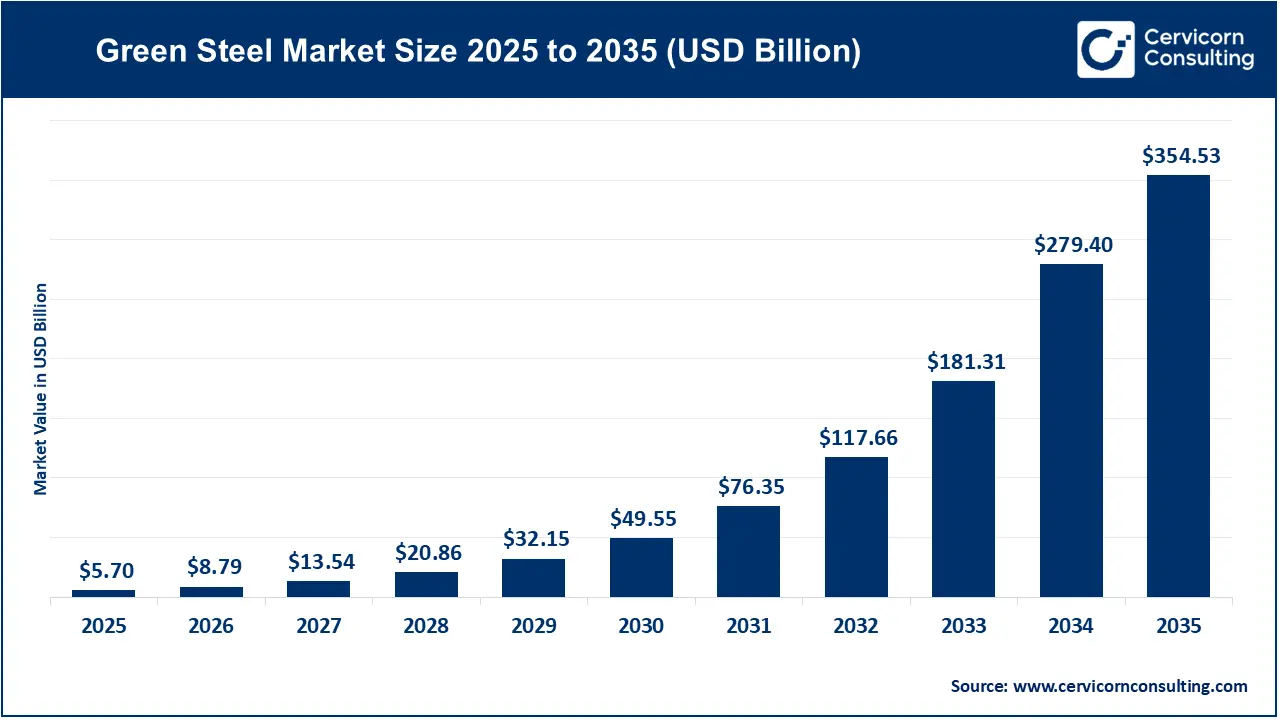
The global green steel market was valued at approximately USD 5.7 billion in 2025 and is projected to reach nearly USD 354.53 billion by 2035, growing at a CAGR of 51.14%.
Green Steel Market Growth Factors
The green steel market is experiencing substantial growth due to rising global commitments toward net-zero emissions, stringent environmental regulations, increasing carbon taxation policies, and growing investments in hydrogen-based steelmaking technologies. Governments across Europe, North America, and Asia-Pacific are introducing incentives and funding programs to encourage low-carbon steel production. The increasing adoption of electric arc furnaces (EAFs), renewable energy integration, and circular economy initiatives are further supporting market expansion. Growing demand from automotive manufacturers seeking low-emission supply chains, rising infrastructure projects focused on sustainable construction, and advancements in green hydrogen production technologies are also accelerating market development.
Additionally, corporate sustainability goals, ESG investment trends, and increasing consumer preference for environmentally friendly products are encouraging steel producers to transition from traditional blast furnace operations toward cleaner production methods.
Get a Free Sample: https://www.cervicornconsulting.com/sample/2685
What is the Green Steel Market?
The green steel market refers to the production, distribution, and utilization of steel manufactured using environmentally sustainable technologies that significantly reduce greenhouse gas emissions compared to conventional steelmaking methods.
Traditional steel production typically relies on blast furnaces fueled by coal and coke, generating substantial carbon emissions. Green steel production utilizes alternative technologies such as:
- Hydrogen-based direct reduced iron (DRI)
- Electric arc furnace (EAF) technology
- Renewable energy-powered manufacturing
- Carbon capture, utilization, and storage (CCUS)
- Increased use of recycled steel scrap
- Biomass-based reduction processes
The primary objective of green steel is to create steel products with minimal environmental impact while maintaining the performance, durability, and quality standards required across industrial applications.
Why is the Green Steel Market Important?
Addressing Industrial Carbon Emissions
Steel manufacturing remains one of the largest industrial sources of carbon emissions globally. Green steel offers a viable pathway to significantly reduce emissions and support climate goals.
Supporting Net-Zero Targets
Governments and corporations worldwide have established ambitious carbon neutrality objectives. Green steel helps organizations meet these commitments by reducing supply-chain emissions.
Enabling Sustainable Infrastructure
Green steel is becoming essential for sustainable construction projects, renewable energy installations, transportation systems, and smart city developments.
Strengthening ESG Performance
Investors increasingly evaluate companies based on Environmental, Social, and Governance (ESG) criteria. Green steel adoption enhances sustainability ratings and corporate reputation.
Meeting Customer Expectations
Consumers and businesses are increasingly demanding environmentally responsible products, encouraging manufacturers to incorporate low-carbon materials into their operations.
Major Green Steel Market Players
| Company | Specialization | Key Focus Areas | Notable Features | 2025 Revenue | Market Share | Global Presence |
|---|---|---|---|---|---|---|
| SSAB | Fossil-free steel production | Hydrogen-based steelmaking, HYBRIT initiative | First commercial fossil-free steel deliveries | Approx. USD 10.5 Billion | Significant European presence | Europe, North America, Nordic Region |
| Emirates Steel Arkan Group | Sustainable steel manufacturing | Low-carbon steel products, renewable energy integration | Middle East sustainability leader | Approx. USD 3.5 Billion | Strong regional market share | Middle East, Asia, Africa |
| Outokumpu Oyj | Stainless green steel production | Recycled steel, low-carbon stainless steel | High recycled-content stainless steel | Approx. USD 8.0 Billion | Leading stainless steel producer | Europe, Americas, Asia-Pacific |
| Swiss Steel Group | Specialty steel solutions | Sustainable specialty steel manufacturing | High-performance engineering steel products | Approx. USD 4.5 Billion | Specialized steel segment leader | Europe, North America, Asia |
| ArcelorMittal | Integrated green steel development | Hydrogen DRI, carbon capture, EAF expansion | Global decarbonization roadmap | Approx. USD 68 Billion | One of the largest global steel producers | More than 60 countries |
Company Profiles
SSAB
SSAB is recognized as a global pioneer in fossil-free steel production. The company has partnered with major stakeholders through the HYBRIT initiative to replace coking coal with green hydrogen in steelmaking processes.
Key Strengths
- Leadership in fossil-free steel innovation
- Strategic hydrogen infrastructure investments
- Strong partnerships with automotive manufacturers
- Early commercialization of green steel products
SSAB has already delivered fossil-free steel to customers in the automotive and heavy equipment sectors, demonstrating the commercial viability of green steel technologies.
Emirates Steel Arkan Group
Emirates Steel Arkan Group is one of the Middle East’s leading steel manufacturers and has made significant progress in reducing emissions through advanced production technologies and sustainable manufacturing initiatives.
Key Strengths
- Low-carbon steel production capabilities
- Renewable energy integration
- Strategic location supporting regional infrastructure growth
- Government-supported sustainability programs
The company plays a vital role in supporting the UAE’s industrial decarbonization objectives.
Outokumpu Oyj
Outokumpu is a global leader in sustainable stainless steel production and is recognized for maintaining one of the industry’s lowest carbon footprints.
Key Strengths
- High recycled-content steel production
- Circular economy leadership
- Advanced stainless steel technologies
- Strong sustainability certifications
The company continues to expand its low-carbon stainless steel portfolio to meet growing industrial demand.
Swiss Steel Group
Swiss Steel Group specializes in sustainable specialty steel solutions used in automotive, aerospace, engineering, and industrial applications.
Key Strengths
- Premium engineering steel expertise
- Sustainable production processes
- High-value specialty products
- Strong European manufacturing footprint
The company’s focus on innovation and material efficiency supports broader green manufacturing objectives.
ArcelorMittal
ArcelorMittal is among the largest steel producers globally and is investing heavily in decarbonization technologies across multiple regions.
Key Strengths
- Global production scale
- Hydrogen-based DRI projects
- Carbon capture implementation
- Large renewable energy investments
Its multi-billion-dollar sustainability strategy is positioning the company as a leading force in green steel transformation.
Leading Trends Shaping the Green Steel Market
Green Hydrogen-Based Steel Production
Hydrogen-based direct reduction technology is rapidly becoming the preferred pathway for achieving near-zero-emission steel production.
Impact
- Significant reduction in CO₂ emissions
- Reduced reliance on fossil fuels
- Increased renewable energy demand
- Creation of hydrogen supply ecosystems
Countries investing heavily in green hydrogen infrastructure are expected to lead future green steel production.
Expansion of Electric Arc Furnace Technology
Electric arc furnaces enable steel production using recycled scrap metal while consuming significantly less energy than traditional blast furnaces.
Impact
- Lower carbon footprint
- Enhanced recycling rates
- Reduced raw material dependency
- Improved production flexibility
EAF adoption continues to grow across both developed and emerging markets.
Carbon Border Adjustment Mechanisms (CBAM)
Governments are increasingly implementing carbon pricing systems and border adjustment policies.
Impact
- Encourages low-carbon steel imports
- Increases competitiveness of green steel
- Accelerates industrial decarbonization
- Drives investment in cleaner technologies
The European Union’s CBAM is expected to influence global steel trade significantly.
Renewable Energy Integration
Steel producers are increasingly securing renewable energy through direct procurement agreements and dedicated renewable projects.
Impact
- Lower lifecycle emissions
- Reduced energy cost volatility
- Enhanced ESG performance
- Increased investor confidence
Renewable-powered steel production is becoming a key differentiator in competitive markets.
Digitalization and Smart Manufacturing
Artificial intelligence, IoT, predictive maintenance, and advanced analytics are optimizing steel production efficiency.
Impact
- Improved energy efficiency
- Reduced operational emissions
- Enhanced process control
- Lower production costs
Smart factories are becoming an integral component of sustainable steel manufacturing.
Successful Examples of Green Steel Around the World
HYBRIT Project – Sweden
The HYBRIT initiative, led by SSAB, LKAB, and Vattenfall, represents one of the world’s most advanced fossil-free steel projects.
Achievements
- Hydrogen replaces coal in iron ore reduction
- Significant emission reductions
- Commercial fossil-free steel deliveries
- Global benchmark for sustainable steelmaking
The project demonstrates how large-scale industrial decarbonization can be achieved through collaboration and innovation.
H2 Green Steel – Sweden
H2 Green Steel is developing a large-scale green steel facility powered by renewable energy and green hydrogen.
Achievements
- Renewable-powered production
- Strong customer commitments
- Advanced digital manufacturing systems
- Significant emissions reduction targets
The project has attracted major investments from global institutions and industrial partners.
ArcelorMittal Hamburg Hydrogen Project – Germany
ArcelorMittal is testing hydrogen-based steel production technologies in Germany.
Achievements
- Industrial-scale hydrogen trials
- Reduced carbon intensity
- Support from European sustainability programs
- Advancement of hydrogen infrastructure
The initiative supports Europe’s broader industrial decarbonization strategy.
Emirates Steel Green Hydrogen Initiative – UAE
Emirates Steel Arkan has successfully integrated green hydrogen into steel production processes.
Achievements
- First green hydrogen use in regional steelmaking
- Support for UAE sustainability goals
- Lower production emissions
- Regional leadership in green manufacturing
The project highlights the growing role of the Middle East in green industrial development.
Boston Metal Molten Oxide Electrolysis – United States
Boston Metal is pioneering molten oxide electrolysis technology for steel production.
Achievements
- Near-zero direct emissions
- Innovative electrolysis process
- Potential breakthrough in steel manufacturing
- Strong investor support
The technology could fundamentally transform future steel production methods.
Global Regional Analysis of the Green Steel Market
North America
North America is experiencing strong growth in green steel investments driven by government funding programs, renewable energy expansion, and industrial decarbonization initiatives.
Key Market Drivers
- Inflation Reduction Act incentives
- Increasing demand from automotive manufacturers
- Expansion of hydrogen production projects
- Growing renewable energy capacity
Government Initiatives and Policies
The United States government is supporting green steel development through tax credits, clean energy funding, hydrogen hub programs, and industrial decarbonization grants. Canada is also investing in low-carbon manufacturing through sustainability-focused industrial policies.
Regional Outlook
North America is expected to become a major green steel production hub due to abundant renewable energy resources and strong policy support.
Europe
Europe currently leads the global green steel transition owing to ambitious climate regulations and substantial investment in hydrogen infrastructure.
Key Market Drivers
- European Green Deal
- Carbon pricing mechanisms
- Sustainable construction initiatives
- Advanced industrial innovation
Government Initiatives and Policies
The European Union has implemented multiple measures including:
- Carbon Border Adjustment Mechanism (CBAM)
- EU Emissions Trading System (EU ETS)
- Hydrogen Strategy for Europe
- Net-Zero Industry Act
These policies are accelerating investments in low-carbon steel technologies.
Regional Outlook
Europe is likely to remain the dominant region for green steel innovation, commercialization, and technology deployment.
Asia-Pacific
Asia-Pacific represents the largest long-term opportunity due to its enormous steel production capacity and rapidly growing infrastructure sectors.
Key Market Drivers
- Industrial modernization
- Renewable energy expansion
- Growing environmental regulations
- Large-scale infrastructure investments
Government Initiatives and Policies
China
China’s carbon neutrality target for 2060 is driving investments in cleaner steel production technologies and energy-efficient manufacturing.
Japan
Japan is supporting hydrogen-based steelmaking through national decarbonization programs and research partnerships.
South Korea
South Korea’s Green New Deal promotes industrial sustainability and green hydrogen development.
India
India’s National Green Hydrogen Mission is encouraging investments in hydrogen-based steel manufacturing and renewable energy infrastructure.
Regional Outlook
Asia-Pacific is expected to emerge as one of the fastest-growing green steel markets during the forecast period.
Middle East and Africa
The Middle East is increasingly investing in green hydrogen production, creating substantial opportunities for green steel manufacturing.
Key Market Drivers
- Abundant solar energy resources
- Hydrogen export ambitions
- Industrial diversification strategies
- Growing infrastructure projects
Government Initiatives and Policies
Countries such as the UAE and Saudi Arabia are introducing large-scale green hydrogen projects and industrial decarbonization programs to support sustainable steel production.
Regional Outlook
The region is becoming a significant future supplier of green steel and green hydrogen to global markets.
Latin America
Latin America offers considerable growth potential due to abundant renewable energy resources and increasing sustainability commitments.
Key Market Drivers
- Hydropower availability
- Renewable energy investments
- Export-oriented steel industry
- Growing environmental awareness
Government Initiatives and Policies
Brazil, Chile, and other countries are developing hydrogen roadmaps and renewable energy policies aimed at supporting low-carbon industrial production.
Regional Outlook
Latin America is expected to play an increasingly important role in supplying green steel to international markets while supporting regional sustainability objectives.
To Get Detailed Overview, Contact Us: https://www.cervicornconsulting.com/contact-us
Read Report: Vehicle Electrification Market Revenue, Trends, and Strategic Insights by 2035