Next-Generation Sequencing in Precision Medicine Market Revenue, Trends, and Strategic Insights by 2035
Table of Contents
ToggleNext-Generation Sequencing in Precision Medicine Market Size
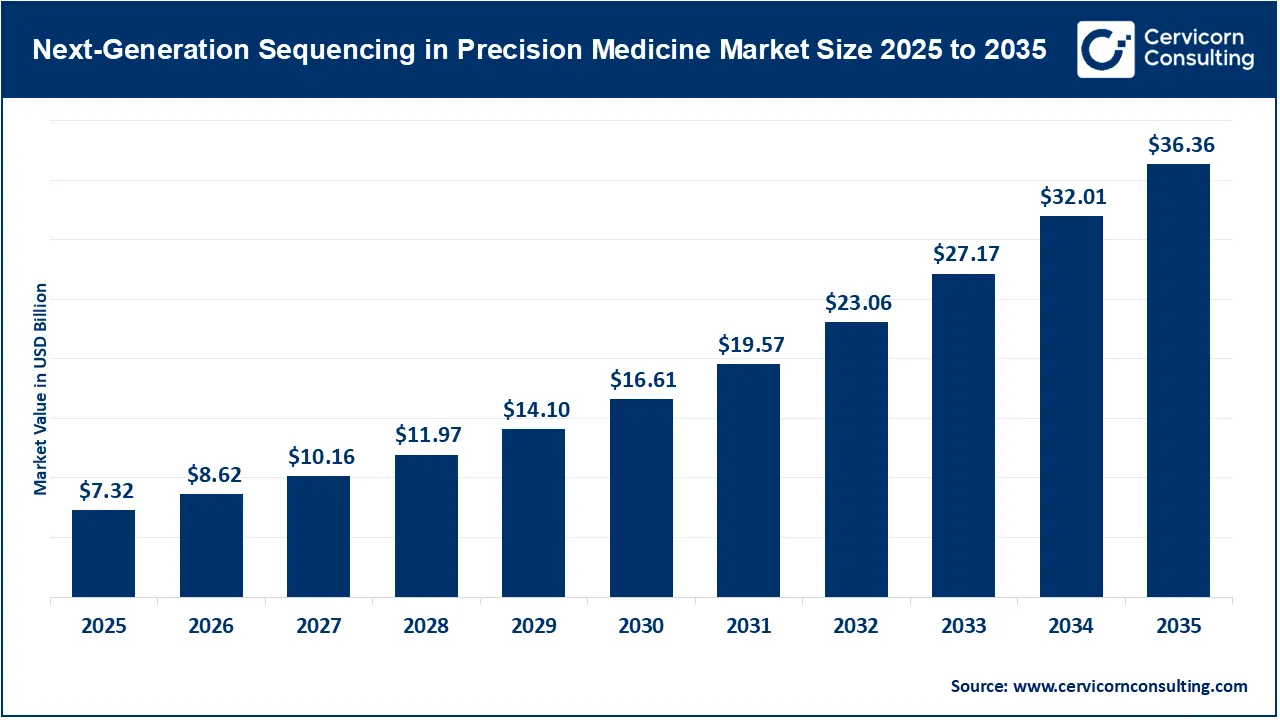
The global next-generation sequencing in precision medicine market was valued at approximately USD 7.32 billion in 2025 and is projected to reach nearly USD 36.36 billion by 2035, growing at a CAGR of 17.38%.
Next-Generation Sequencing in Precision Medicine Market Growth Factors
The growth of the next-generation sequencing in precision medicine market is driven by the increasing prevalence of cancer and genetic disorders, rising demand for personalized treatment approaches, declining sequencing costs, growing adoption of companion diagnostics, advancements in bioinformatics and artificial intelligence, expansion of national genome projects, increasing investments in genomics research, favorable government funding initiatives, growing awareness of preventive healthcare, rapid development of targeted therapies, rising pharmaceutical applications in drug discovery, integration of multi-omics technologies, improved reimbursement frameworks in developed economies, and expanding clinical applications of genomic testing across oncology, cardiology, neurology, and rare disease management.
What is the Next-Generation Sequencing in Precision Medicine Market?
The Next-Generation Sequencing in Precision Medicine Market refers to the global ecosystem of technologies, platforms, services, software, and solutions that utilize high-throughput DNA and RNA sequencing to support personalized healthcare. The market encompasses sequencing instruments, reagents, consumables, data analysis software, genomic services, and clinical applications that enable healthcare providers to identify genetic variations associated with diseases and tailor treatments accordingly.
NGS technology allows researchers and clinicians to sequence millions of DNA fragments simultaneously, generating detailed genomic information quickly and accurately. This information helps physicians understand disease mechanisms, identify biomarkers, predict treatment responses, and develop individualized therapeutic strategies.
The market serves hospitals, diagnostic laboratories, pharmaceutical companies, biotechnology firms, research institutes, and government health organizations that rely on genomic insights to improve healthcare outcomes.
Get a Free Sample: https://www.cervicornconsulting.com/sample/2669
Why is Next-Generation Sequencing Important?
Next-generation sequencing has become one of the most important technologies in modern medicine due to its ability to unlock detailed genetic information that was previously difficult or expensive to obtain.
Early and Accurate Disease Diagnosis
NGS enables the identification of disease-causing mutations at an early stage, improving diagnostic accuracy for cancer, inherited disorders, and rare diseases.
Personalized Treatment Selection
Precision medicine relies on understanding a patient’s genetic profile. NGS helps clinicians select targeted therapies that are more likely to be effective and less likely to cause adverse effects.
Cancer Genomics
The technology allows oncologists to analyze tumor mutations, identify actionable biomarkers, and develop personalized treatment plans that improve survival outcomes.
Drug Development
Pharmaceutical companies use NGS to identify therapeutic targets, stratify patient populations, and accelerate clinical trials.
Rare Disease Detection
Many rare diseases have genetic origins. NGS helps shorten the diagnostic journey for patients by identifying genetic abnormalities that traditional methods may miss.
Public Health Surveillance
NGS has played a critical role in tracking infectious disease outbreaks, monitoring pathogen evolution, and supporting global public health initiatives.
Major Companies Shaping the Next-Generation Sequencing in Precision Medicine Market
Company Profile Analysis
| Company | Specialization | Key Focus Areas | Notable Features | 2025 Revenue (Approx.) | Market Share | Global Presence |
|---|---|---|---|---|---|---|
| Illumina | Genomic Sequencing Platforms | NGS systems, clinical genomics, oncology diagnostics | Market-leading sequencing technology with extensive installed base | USD 4.8 Billion | ~40–45% | North America, Europe, Asia-Pacific, Middle East |
| Thermo Fisher Scientific | Life Sciences and Analytical Technologies | Ion Torrent sequencing, molecular diagnostics, clinical genomics | Broad life sciences portfolio and global laboratory network | USD 43 Billion | ~12–15% | More than 50 countries |
| Roche | Diagnostics and Personalized Healthcare | Companion diagnostics, oncology genomics, molecular testing | Strong integration of diagnostics and pharmaceuticals | USD 73 Billion | ~10–12% | Over 100 countries |
| Danaher | Biotechnology and Diagnostic Solutions | Genomic research, clinical sequencing, molecular diagnostics | Through subsidiaries including Beckman Coulter and Integrated DNA Technologies | USD 25 Billion | ~8–10% | Global operations across major healthcare markets |
| QIAGEN | Molecular Diagnostics and Genomic Analysis | Sample preparation, bioinformatics, NGS workflows | Comprehensive genomic testing solutions | USD 2.2 Billion | ~5–7% | More than 25 countries |
Illumina
Specialization
Illumina is widely recognized as the global leader in next-generation sequencing technologies. The company specializes in high-throughput sequencing systems used in research, clinical diagnostics, population genomics, and precision medicine applications.
Key Focus Areas
- Whole genome sequencing
- Oncology testing
- Rare disease diagnostics
- Population-scale genomics
- Clinical sequencing solutions
Notable Features
Illumina’s sequencing platforms offer high accuracy, scalability, and cost efficiency. Its instruments power many national genome initiatives and large-scale precision medicine programs worldwide.
Market Position
With a dominant market share, Illumina remains the benchmark for NGS innovation and continues to influence global genomic research and clinical applications.
Thermo Fisher Scientific
Specialization
Thermo Fisher Scientific delivers comprehensive genomic solutions through its Ion Torrent sequencing technology and extensive life sciences portfolio.
Key Focus Areas
- Clinical genomics
- Translational medicine
- Oncology diagnostics
- Infectious disease testing
- Pharmacogenomics
Notable Features
The company combines sequencing technologies with laboratory automation, reagents, and analytical instruments, enabling end-to-end genomic workflows.
Market Position
Thermo Fisher’s broad customer base and integrated healthcare solutions make it a major competitor in precision medicine applications.
Roche
Specialization
Roche is a global pioneer in personalized healthcare, combining pharmaceutical expertise with advanced molecular diagnostics and genomic testing capabilities.
Key Focus Areas
- Companion diagnostics
- Cancer genomics
- Biomarker discovery
- Precision oncology
- Molecular pathology
Notable Features
Roche’s strength lies in integrating genomic insights directly into targeted drug development and patient care strategies.
Market Position
The company plays a significant role in expanding precision medicine adoption through its diagnostics and therapeutics ecosystem.
Danaher
Specialization
Danaher operates across biotechnology, diagnostics, and life sciences, supporting genomic research and clinical sequencing applications.
Key Focus Areas
- Genomic sample preparation
- Molecular diagnostics
- Clinical laboratory solutions
- Research genomics
- Precision medicine infrastructure
Notable Features
Danaher’s subsidiaries provide critical components that support NGS workflows, including reagents, instruments, and bioinformatics solutions.
Market Position
Its diversified healthcare portfolio strengthens its influence across the genomic testing value chain.
QIAGEN
Specialization
QIAGEN focuses on molecular diagnostics, sample technologies, and bioinformatics solutions that support precision medicine workflows.
Key Focus Areas
- Sample preparation
- Genomic testing
- Companion diagnostics
- Clinical sequencing
- Bioinformatics interpretation
Notable Features
QIAGEN’s comprehensive workflow solutions help laboratories streamline genomic analysis from sample collection to data interpretation.
Market Position
The company is particularly strong in molecular testing and genomic data analysis applications.
Leading Trends in the Next-Generation Sequencing in Precision Medicine Market and Their Impact
Expansion of Precision Oncology
Cancer remains the largest application area for NGS technologies. Tumor sequencing enables clinicians to identify specific mutations and prescribe targeted therapies.
Impact
- Improved treatment outcomes
- Reduced healthcare costs
- Increased demand for companion diagnostics
- Expansion of personalized cancer therapies
Growth of Multi-Omics Integration
Healthcare providers increasingly combine genomics, transcriptomics, proteomics, and metabolomics to obtain a more comprehensive understanding of disease biology.
Impact
- Better disease characterization
- Enhanced biomarker discovery
- Improved therapeutic decision-making
- More accurate patient stratification
Artificial Intelligence and Bioinformatics Advancement
The enormous volume of genomic data generated by NGS requires advanced computational tools for analysis and interpretation.
Impact
- Faster genomic insights
- Improved diagnostic accuracy
- Reduced analysis time
- Greater scalability of precision medicine programs
Liquid Biopsy Adoption
Liquid biopsy technologies use blood samples to detect cancer-related genetic mutations and monitor disease progression.
Impact
- Less invasive testing
- Early cancer detection
- Improved patient monitoring
- Increased demand for sequencing-based diagnostics
National Genomic Programs
Governments worldwide are investing heavily in population genomics and national sequencing initiatives.
Impact
- Large-scale genomic databases
- Expanded healthcare research
- Increased sequencing demand
- Accelerated precision medicine implementation
Long-Read Sequencing Technologies
Emerging long-read sequencing platforms provide greater accuracy for detecting structural genomic variations.
Impact
- Enhanced rare disease diagnosis
- Better genome assembly
- Improved clinical utility
- New research opportunities
Successful Examples of Next-Generation Sequencing in Precision Medicine Around the World
United Kingdom – Genomics England Project
The United Kingdom launched one of the world’s most ambitious genomic initiatives through the 100,000 Genomes Project. The program utilized NGS technologies to sequence patient genomes and integrate genomic medicine into the National Health Service (NHS).
Results
- Improved diagnosis of rare diseases
- Enhanced cancer treatment planning
- Development of one of the world’s largest genomic databases
United States – All of Us Research Program
The U.S. National Institutes of Health established the All of Us Research Program to collect genomic, lifestyle, and health data from over one million participants.
Results
- Expanded genomic diversity research
- Accelerated precision medicine discoveries
- Improved understanding of disease risk factors
China – National Precision Medicine Initiative
China has invested billions of dollars in genomic research and precision medicine infrastructure.
Results
- Large-scale population sequencing
- Expansion of genomic research centers
- Growth of domestic sequencing technologies
Japan – Cancer Genome Screening Program
Japan’s healthcare system has adopted NGS-based cancer genomic profiling to support personalized oncology treatment.
Results
- Better patient stratification
- Increased access to targeted therapies
- Improved clinical outcomes
Australia – Australian Genomics Program
Australia has implemented nationwide genomic programs focused on rare diseases, cancer, and inherited disorders.
Results
- Faster diagnosis of genetic conditions
- Improved clinical decision-making
- Enhanced research collaboration
Global Regional Analysis of the Next-Generation Sequencing in Precision Medicine Market
North America
North America represents the largest market for next-generation sequencing in precision medicine.
Key Growth Drivers
- Strong healthcare infrastructure
- High genomic research spending
- Presence of leading market players
- Favorable reimbursement policies
- Extensive precision oncology adoption
Government Initiatives and Policies
The United States government supports genomic research through programs such as the Precision Medicine Initiative, Cancer Moonshot Program, and NIH-funded genomic research projects. Regulatory agencies increasingly support companion diagnostics and personalized therapies.
Market Outlook
Continued investments in genomic medicine and advanced healthcare technologies are expected to sustain regional leadership.
Europe
Europe remains a major contributor to global NGS adoption due to strong healthcare systems and collaborative genomic initiatives.
Key Growth Drivers
- National genome programs
- Growing precision oncology investments
- Advanced healthcare infrastructure
- Strong academic research ecosystem
Government Initiatives and Policies
The European Union supports genomic research through Horizon Europe programs and national precision medicine strategies. Countries such as the United Kingdom, Germany, and France have launched large-scale genome sequencing initiatives.
Market Outlook
Europe is expected to maintain robust growth through increasing integration of genomic testing into routine clinical practice.
Asia-Pacific
Asia-Pacific is projected to experience the fastest growth during the forecast period.
Key Growth Drivers
- Expanding healthcare investments
- Growing cancer burden
- Rising awareness of personalized medicine
- Increasing genomic research activities
Government Initiatives and Policies
China’s Precision Medicine Initiative, Japan’s genomic medicine programs, South Korea’s biohealth strategies, and India’s Genome India Project are driving regional adoption.
Market Outlook
Rapid technological advancement and government support are positioning Asia-Pacific as a major future growth hub.
Latin America
Latin America is gradually expanding its genomic medicine capabilities.
Key Growth Drivers
- Improving healthcare infrastructure
- Growing demand for molecular diagnostics
- Increasing research collaborations
Government Initiatives and Policies
Countries including Brazil, Mexico, and Argentina are investing in genomic research and public health genomics programs to improve disease management.
Market Outlook
Market growth is expected to accelerate as healthcare modernization efforts continue.
Middle East & Africa
The Middle East and Africa region is witnessing increasing interest in genomic healthcare and precision medicine.
Key Growth Drivers
- Rising healthcare expenditure
- Growing prevalence of genetic diseases
- Expansion of specialized medical centers
- Increasing government healthcare investments
Government Initiatives and Policies
Saudi Arabia’s Vision 2030 healthcare transformation program, the UAE Genome Program, and Qatar Genome Project are supporting precision medicine adoption through large-scale sequencing initiatives.
Market Outlook
Continued government investments and healthcare modernization strategies are expected to create substantial opportunities for NGS technology providers across the region.
To Get Detailed Overview, Contact Us: https://www.cervicornconsulting.com/contact-us
Read Report: Polypropylene Market Revenue, Trends, and Strategic Insights by 2035