Electric Trucks Market Revenue, Trends, and Strategic Insights by 2035
Electric Trucks Market Size
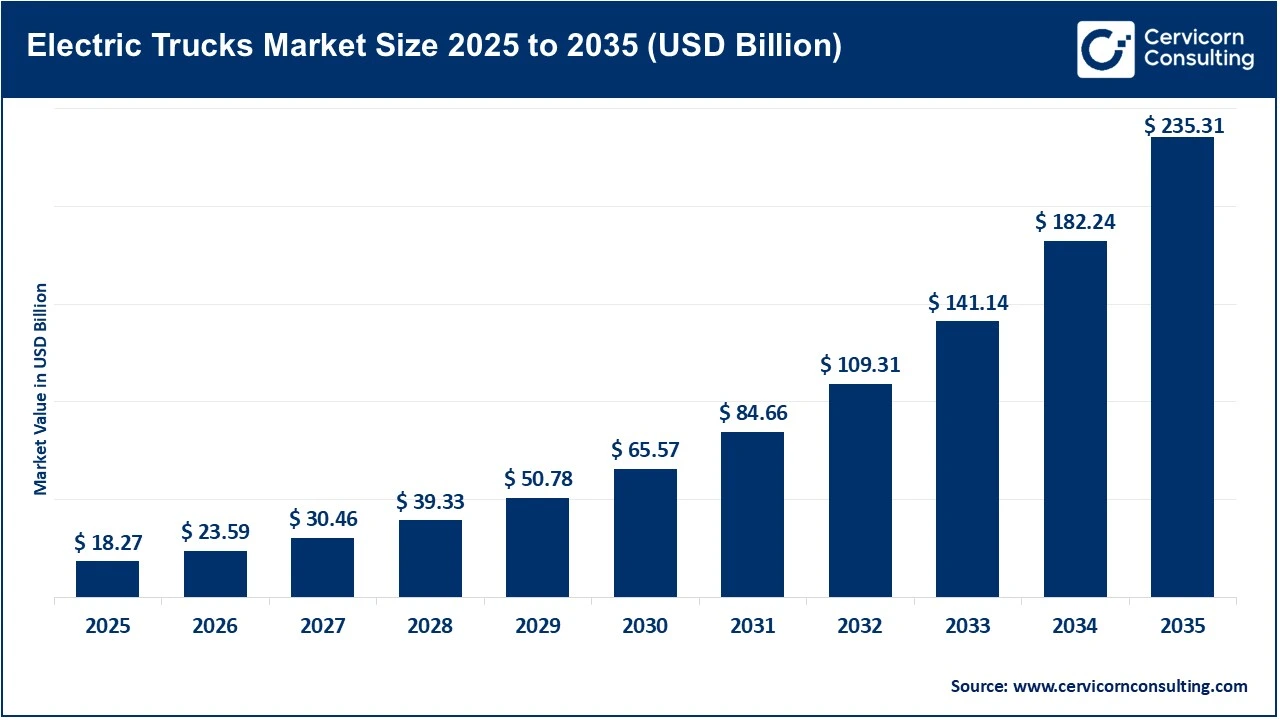
The global electric trucks market was valued at approximately USD 18.27 billion in 2025 and is projected to reach nearly USD 235.31 billion by 2035, growing at a CAGR of 29.1%.
Electric Trucks Market Growth Factors
The global electric trucks market is witnessing remarkable growth due to increasing government commitments toward carbon neutrality, stringent emission regulations, rising fuel costs, advancements in lithium-ion battery technology, declining battery prices, expanding charging infrastructure, corporate sustainability initiatives, and rapid electrification of commercial transportation. Logistics companies are increasingly adopting electric trucks to reduce operational costs, while fleet operators are benefiting from lower maintenance requirements compared to conventional diesel vehicles.
Technological innovations in battery energy density, fast charging, vehicle connectivity, regenerative braking, autonomous driving capabilities, and over-the-air software updates are further accelerating market expansion. Growing investments by automotive manufacturers, public-private partnerships for charging infrastructure, favorable subsidies, tax incentives, and zero-emission vehicle mandates across North America, Europe, and Asia-Pacific are creating strong growth opportunities.
Additionally, rising e-commerce deliveries, urban freight transportation, smart city development, and increasing demand for sustainable last-mile logistics continue to strengthen the long-term outlook for the electric trucks market.
Get a Free Sample: https://www.cervicornconsulting.com/sample/2982
What is the Electric Trucks Market?
The electric trucks market refers to the global industry involved in designing, manufacturing, distributing, and operating trucks powered partially or entirely by electricity instead of conventional internal combustion engines. These trucks use rechargeable battery packs or, in some cases, hydrogen fuel cells to power electric motors.
Electric trucks are categorized into:
- Light-duty electric trucks
- Medium-duty electric trucks
- Heavy-duty electric trucks
- Battery electric trucks (BEVs)
- Fuel-cell electric trucks (FCEVs)
They are widely used across industries including:
- Logistics
- Construction
- Municipal services
- Retail distribution
- Mining
- Waste management
- Ports and terminals
- Cold-chain transportation
Modern electric trucks integrate artificial intelligence, advanced telematics, predictive maintenance systems, real-time fleet monitoring, autonomous driving assistance, and cloud-based fleet management software, making them significantly more efficient than traditional diesel trucks.
According to the International Energy Agency (IEA), global electric truck sales surpassed 400,000 units in 2025, accounting for approximately 9% of worldwide truck sales, reflecting rapid adoption across commercial transport markets.
Why is the Electric Trucks Market Important?
Electric trucks play a critical role in transforming global transportation toward sustainability.
Reducing Carbon Emissions
Commercial trucks contribute significantly to greenhouse gas emissions. Electric trucks help companies achieve decarburization goals while complying with increasingly stringent environmental regulations.
Lower Operating Costs
Electric drivetrains have fewer moving parts than diesel engines, resulting in:
- Lower maintenance costs
- Reduced fuel expenses
- Longer vehicle lifespan
- Improved fleet efficiency
Supporting Net-Zero Goals
Governments worldwide have announced ambitious net-zero emission targets that encourage rapid commercial fleet electrification.
Cleaner Urban Transportation
Electric trucks produce zero tailpipe emissions, making them ideal for:
- Urban deliveries
- Municipal transportation
- Residential logistics
- Smart city initiatives
Energy Independence
Electric trucks reduce dependence on imported fossil fuels while encouraging renewable electricity integration.
Leading Companies Shaping the Electric Trucks Market
| Company | Specialization | Key Focus Areas | Notable Features | 2025 Revenue* | Approx. Market Position | Global Presence |
|---|---|---|---|---|---|---|
| Tesla, Inc. | Battery-electric heavy-duty trucks | Tesla Semi, battery innovation, autonomous technologies | Long-range battery systems, Megacharger ecosystem, software integration | US$94.8 billion | Strong presence in premium heavy-duty EV trucking | North America, Europe, pilot deployments globally |
| Volvo Group | Electric commercial vehicles | Heavy-duty trucks, construction equipment | Volvo FH Electric, fleet services, charging ecosystem | Approximately SEK 527 billion | Among Europe’s leading electric truck manufacturers | Europe, North America, Asia-Pacific, Latin America |
| Daimler Truck AG | Commercial transportation | Mercedes-Benz eActros, Freightliner eCascadia | Comprehensive truck portfolio, fleet connectivity | Approximately €45.9 billion (Industrial Business revenue) | Global commercial vehicle leader | More than 40 countries |
| BYD Company Ltd. | Electric commercial vehicles and batteries | Electric trucks, buses, battery manufacturing | Blade Battery technology, vertically integrated production | Approximately RMB 777 billion | Leading manufacturer in China’s electric commercial vehicle market | Asia-Pacific, Europe, Latin America, Middle East |
| Scania AB | Sustainable heavy transport | Battery-electric and fuel-cell trucks | Premium heavy-duty transportation, digital fleet management | Part of TRATON Group (Scania annual revenue approximately SEK 216 billion) | Strong European market position | Europe, Middle East, Latin America, Asia-Pacific |
Leading Trends Transforming the Electric Trucks Market
1. Rapid Battery Technology Improvements
Manufacturers continue to improve battery chemistry by increasing:
- Driving range
- Charging speed
- Energy density
- Battery lifespan
Solid-state batteries are expected to become one of the industry’s biggest breakthroughs over the coming decade.
2. Megawatt Charging Systems
Heavy-duty trucks require ultra-fast charging.
Megawatt Charging Systems (MCS) are emerging as the preferred infrastructure solution for long-haul freight transportation by reducing charging downtime and improving fleet utilization.
3. Autonomous Electric Freight
Electric trucks increasingly integrate:
- AI-assisted driving
- Adaptive cruise control
- Collision avoidance
- Lane-centering
- Predictive routing
Autonomous logistics is expected to significantly reduce operating costs while improving safety.
4. Fleet Digitalization
Modern fleet operators rely heavily on:
- Cloud fleet management
- Predictive maintenance
- Battery health monitoring
- Driver analytics
- Route optimization
- Remote diagnostics
These technologies maximize vehicle uptime and operational efficiency.
5. Battery-as-a-Service (BaaS)
Several manufacturers are exploring subscription-based battery ownership models.
Benefits include:
- Lower upfront costs
- Easier battery upgrades
- Reduced financial risk
- Improved fleet flexibility
6. Circular Battery Economy
Battery recycling and second-life energy storage applications are becoming essential components of sustainable electric truck ecosystems.
Manufacturers increasingly invest in battery reuse and material recovery to reduce costs and improve resource efficiency.
Impact of Emerging Trends on the Market
These technological developments are fundamentally reshaping commercial transportation.
Battery innovations are extending vehicle range while reducing total ownership costs. AI-driven fleet management improves route planning, minimizes energy consumption, and enables predictive maintenance. Digital connectivity enhances operational visibility, helping fleet operators monitor vehicle performance in real time. Faster charging technologies reduce downtime, making electric trucks increasingly viable for regional and long-haul applications. Meanwhile, greater integration with renewable energy and smart charging infrastructure supports grid stability and sustainability goals. Together, these trends are accelerating the shift from diesel-powered fleets to zero-emission transportation.
Successful Examples of the Electric Trucks Market Around the World
Tesla Semi – United States
Tesla has introduced the Tesla Semi for long-haul freight operations, offering high-capacity battery systems, advanced driver assistance, and rapid charging through its Megacharger network. Major fleet operators have begun deploying the vehicle for regional logistics.
Volvo FH Electric – Europe
Volvo FH Electric has become one of Europe’s most successful heavy-duty electric trucks.
It serves:
- Construction
- Retail distribution
- Regional logistics
- Municipal transportation
The truck has demonstrated substantial reductions in operating costs and emissions for fleet operators.
Mercedes-Benz eActros – Germany
Daimler Truck’s Mercedes-Benz eActros is widely used in urban freight transportation across Europe.
The vehicle offers:
- Low operating costs
- Quiet operation
- Zero tailpipe emissions
- Advanced connectivity solutions
BYD Electric Trucks – China
BYD has deployed thousands of electric trucks across Chinese cities for:
- Port logistics
- Waste collection
- Construction
- Urban delivery
Its vertically integrated battery manufacturing capabilities provide strong cost advantages.
Scania Battery Electric Trucks – Sweden
Scania continues expanding electric truck deployments across Europe with premium heavy-duty transport solutions designed for regional freight and industrial logistics.
Global Regional Analysis
North America
North America remains one of the fastest-growing electric truck markets due to expanding charging infrastructure, increasing fleet electrification, and strong corporate sustainability commitments.
Key Growth Drivers
- California zero-emission regulations
- Rising logistics demand
- Fleet modernization
- Public charging investments
- Corporate ESG initiatives
Government Initiatives
The United States supports commercial vehicle electrification through federal tax incentives, funding for charging corridors, and programs under the Inflation Reduction Act and Bipartisan Infrastructure Law. Canada complements these efforts with incentive programs for medium- and heavy-duty zero-emission vehicles and investments in clean transportation infrastructure.
Europe
Europe remains a global leader in electric commercial vehicle adoption due to ambitious climate goals and comprehensive regulatory frameworks.
Growth Drivers
- Carbon neutrality targets
- Fleet emission regulations
- Urban low-emission zones
- Advanced charging infrastructure
- Strong OEM presence
Government Policies
The European Union promotes zero-emission freight through stringent CO₂ standards for heavy-duty vehicles, Alternative Fuels Infrastructure Regulation (AFIR), national purchase incentives, and funding mechanisms that encourage charging network deployment and fleet electrification. These measures continue to stimulate adoption across member states.
Asia-Pacific
Asia-Pacific dominates global electric truck production and adoption, led by China.
Growth Drivers
- Massive manufacturing capacity
- Government subsidies
- Battery production leadership
- Growing logistics sector
- Urban electrification
China has become the world’s largest market for electric commercial vehicles, supported by large-scale investments in charging infrastructure, battery manufacturing, and industrial policy. The IEA notes that global electric truck adoption has been driven substantially by developments in China.
Government Policies
Governments across China, Japan, South Korea, and India are encouraging commercial EV adoption through purchase subsidies, industrial incentives, localization initiatives, battery manufacturing support, and investments in charging infrastructure.
Latin America
Electric trucks are gradually gaining momentum across Latin America.
Major Growth Factors
- Urban delivery electrification
- Renewable energy availability
- Fleet modernization
- Municipal sustainability initiatives
Countries such as Brazil, Chile, Colombia, and Mexico are adopting electric trucks for public services, mining operations, and urban logistics.
Government Initiatives
Several governments offer tax exemptions, import-duty reductions, green financing programs, and incentives for fleet operators transitioning to zero-emission commercial vehicles.
Middle East & Africa
Although still in the early stages of adoption, the region presents significant long-term growth potential.
Growth Drivers
- Smart city projects
- Green hydrogen initiatives
- Sustainable logistics
- Infrastructure modernization
Countries including the UAE and Saudi Arabia are investing in sustainable mobility strategies, while South Africa is exploring commercial fleet electrification opportunities.
Government Policies
National clean-energy strategies, EV roadmaps, and investments in renewable energy infrastructure are encouraging the gradual deployment of electric commercial vehicles across selected markets.
Government Initiatives and Policies Shaping the Electric Trucks Market
Governments worldwide are implementing comprehensive policies to accelerate electric truck adoption.
Key initiatives include:
- Purchase incentives for zero-emission commercial vehicles
- Tax credits for fleet operators
- Carbon pricing mechanisms
- Low-emission and zero-emission zones
- Public investment in high-power charging infrastructure
- Battery manufacturing incentives
- Research and development funding
- Renewable energy integration programs
- Public procurement of electric buses and trucks
- Corporate fleet decarbonization targets
- Green logistics strategies
- Mandatory emission reduction standards for heavy-duty vehicles
These policies reduce ownership costs, encourage infrastructure development, stimulate domestic manufacturing, and accelerate the transition toward sustainable freight transportation.
To Get Detailed Overview, Contact Us: https://www.cervicornconsulting.com/contact-us
Read Report: AI Agents Market Revenue, Trends, and Strategic Insights by 2035