Last Mile Delivery Market Revenue, Trends, and Strategic Insights by 2035
Table of Contents
ToggleLast Mile Delivery Market Size
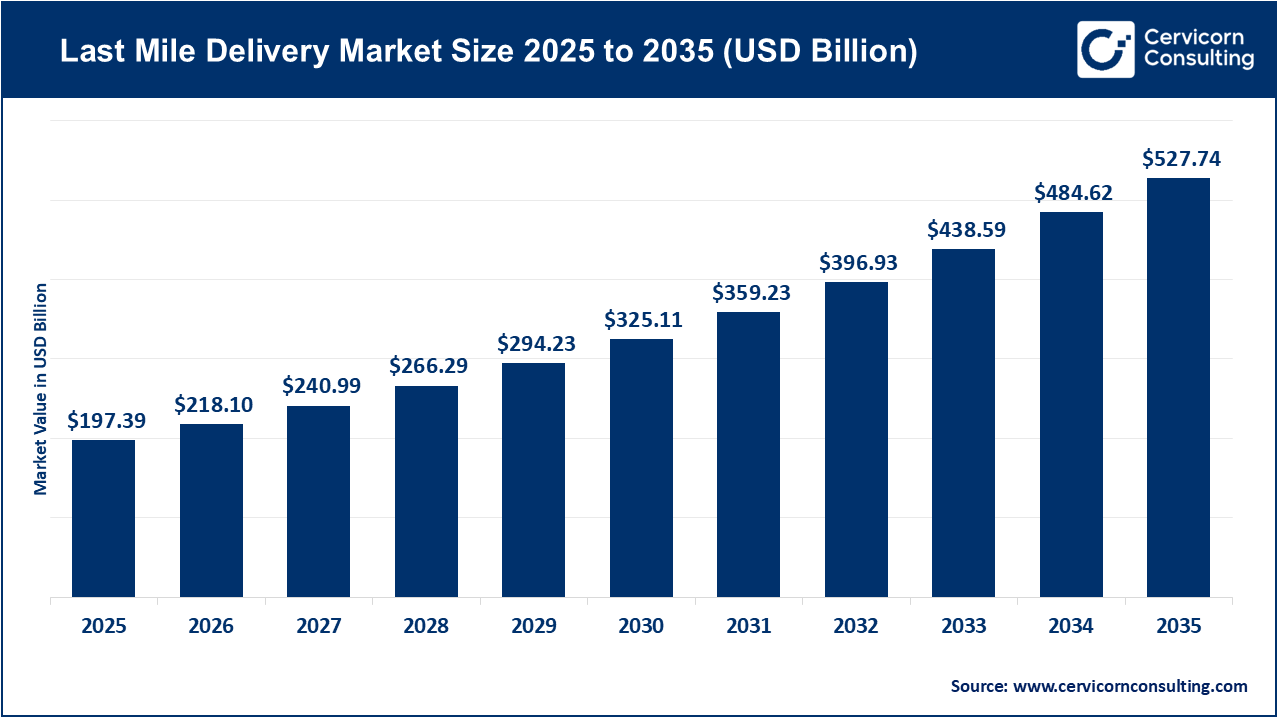
The global last mile delivery market was valued at approximately USD 197.39 billion in 2025 and is projected to reach nearly USD 527.74 billion by 2035, expanding at a compound annual growth rate (CAGR) of about 10.33% between 2026 and 2035.
What is the Last Mile Delivery Market?
The last mile delivery market refers to the final stage of the logistics and supply chain process, where goods are transported from a distribution center, warehouse, or fulfillment hub to the end customer. This segment is considered the most critical and often the most expensive part of the delivery journey because it directly impacts customer satisfaction, delivery speed, and operational efficiency. Last mile delivery encompasses various transportation modes, including vans, motorcycles, bicycles, autonomous vehicles, drones, and crowd-sourced delivery networks. The rapid growth of e-commerce, same-day delivery expectations, and digital retail platforms has significantly increased the importance of efficient last mile logistics worldwide.
Why is the Last Mile Delivery Market Important?
The last mile delivery market plays a crucial role in modern commerce by bridging the gap between retailers and consumers. As online shopping becomes increasingly prevalent, consumers expect faster, more reliable, and transparent delivery services. Efficient last mile delivery enhances customer satisfaction, reduces cart abandonment rates, strengthens brand loyalty, and improves operational efficiency for retailers. Additionally, advancements in route optimization, AI-driven logistics management, electric delivery vehicles, and autonomous delivery systems are helping businesses reduce costs while meeting growing consumer demands. For industries such as healthcare, food delivery, retail, and manufacturing, last mile delivery has become a strategic differentiator that influences purchasing decisions and overall customer experience.
Get a Free Sample: https://www.cervicornconsulting.com/sample/2625
Last Mile Delivery Market Growth Factors
The growth of the last mile delivery market is being driven by the explosive expansion of e-commerce platforms, increasing smartphone penetration, rising demand for same-day and next-day deliveries, growing urbanization, advancements in artificial intelligence and route optimization technologies, adoption of electric and autonomous delivery vehicles, increasing investments in warehouse automation, expansion of direct-to-consumer business models, development of smart city infrastructure, and government support for sustainable transportation initiatives. Additionally, changing consumer expectations regarding convenience, transparency, and delivery speed continue to push logistics providers toward innovative last mile solutions that enhance efficiency while reducing operational costs and environmental impact.
Key Companies in the Last Mile Delivery Market
| Company | Specialization | Key Focus Areas | Notable Features | 2025 Revenue | Estimated Market Share | Global Presence |
|---|---|---|---|---|---|---|
| Flirtey | Autonomous drone delivery | Healthcare, retail, emergency logistics | FAA-approved drone delivery operations | Private Company | Emerging niche player | North America, Australia |
| Amazon Logistics | E-commerce fulfillment and delivery | Same-day delivery, fulfillment centers | Extensive delivery partner ecosystem | Part of Amazon operations | Significant global share | North America, Europe, Asia-Pacific |
| Deutsche Post AG | International logistics and parcel delivery | Express delivery, cross-border logistics | DHL Express network and automation technologies | Approximately €85.8 billion revenue in 2025 | Major global player | More than 220 countries and territories |
| XPO Logistics, Inc. | Freight transportation and logistics | Last-mile delivery, LTL transportation | Advanced visibility and tracking solutions | Multi-billion-dollar logistics operations | Strong North American presence | North America and Europe |
| A1 Express Services Inc | Courier and express logistics | Time-sensitive shipments | Flexible regional delivery solutions | Private Company | Regional market participant | North America and selected international markets |
Current State of the Last Mile Delivery Market
The last mile delivery industry has evolved rapidly due to changing consumer behaviors and technological innovations. E-commerce retailers, grocery delivery providers, and logistics companies are investing heavily in advanced delivery networks to meet customer expectations. According to industry research, North America accounted for more than 31% of the global last mile delivery market in 2025, driven by strong e-commerce penetration and high consumer demand for rapid delivery services.
The market is increasingly adopting autonomous delivery technologies, AI-powered route optimization, predictive analytics, and sustainable transportation solutions to improve efficiency and reduce costs.
Leading Trends and Their Impact on the Last Mile Delivery Market
1. Autonomous Delivery Vehicles and Drones
Autonomous delivery systems are revolutionizing last mile logistics. Companies such as Flirtey and other drone delivery providers are conducting commercial deliveries for healthcare supplies, food products, and retail goods.
Impact:
- Reduced delivery times
- Lower labor costs
- Increased delivery coverage in remote areas
- Enhanced operational efficiency
2. Artificial Intelligence and Route Optimization
AI-powered logistics platforms analyze traffic patterns, weather conditions, customer availability, and delivery schedules to optimize routes.
Impact:
- Reduced fuel consumption
- Improved fleet utilization
- Lower delivery costs
- Higher customer satisfaction
3. Electric Delivery Vehicles
Logistics providers are increasingly deploying electric vans, e-bikes, and electric scooters for urban deliveries.
Impact:
- Reduced carbon emissions
- Compliance with environmental regulations
- Lower operating costs
- Improved sustainability performance
4. Micro-Fulfillment Centers
Retailers are establishing smaller fulfillment hubs closer to consumers.
Impact:
- Faster delivery speeds
- Lower transportation costs
- Improved inventory management
- Better urban logistics efficiency
5. Real-Time Tracking and Visibility
Consumers increasingly demand accurate delivery tracking.
Impact:
- Enhanced customer experience
- Improved transparency
- Reduced customer service inquiries
- Increased trust in delivery providers
6. Crowd-Sourced Delivery Networks
Gig economy-based delivery models continue to expand globally.
Impact:
- Flexible workforce management
- Increased delivery capacity
- Faster scalability during peak seasons
- Reduced fixed labor expenses
7. Contactless Delivery Solutions
Originally accelerated by the pandemic, contactless delivery remains a preferred option.
Impact:
- Improved convenience
- Enhanced safety standards
- Better customer confidence
- Streamlined delivery operations
Successful Examples of Last Mile Delivery Around the World
Amazon Logistics – United States
Amazon has built one of the world’s most sophisticated last mile delivery networks through fulfillment centers, delivery service partners, and advanced logistics technologies. The company’s same-day and next-day delivery capabilities have redefined customer expectations globally.
Key Achievements:
- Extensive fulfillment infrastructure
- AI-powered inventory management
- Advanced route optimization
- Same-day delivery capabilities
DHL Parcel Network – Europe
DHL, operated by Deutsche Post AG, has developed a highly efficient parcel delivery ecosystem across Europe.
Key Achievements:
- Extensive parcel locker network
- Sustainable delivery vehicles
- Smart logistics technologies
- Cross-border delivery expertise
JD Logistics – China
JD.com has pioneered autonomous delivery robots and drone delivery systems in China.
Key Achievements:
- Autonomous delivery robots
- Rural drone delivery
- Smart warehouses
- AI-powered logistics operations
Zipline – Africa
Zipline has transformed healthcare logistics by delivering medical supplies via drones.
Key Achievements:
- Emergency medical deliveries
- Remote area accessibility
- Reduced healthcare supply chain delays
- High operational reliability
India’s Hyperlocal Delivery Ecosystem
Companies such as Delhivery, Blue Dart Express, and Ecom Express have significantly enhanced last mile capabilities across urban and semi-urban regions.
Key Achievements:
- Wide geographic coverage
- Technology-driven logistics
- Cash-on-delivery support
- Rapid expansion into Tier-II and Tier-III cities
Global Regional Analysis of the Last Mile Delivery Market
North America
North America remains the largest regional market, accounting for more than 31% of global revenue in 2025. Strong e-commerce growth, consumer demand for fast delivery, and advanced logistics infrastructure continue to support market expansion.
Key Drivers:
- High online retail adoption
- Mature logistics ecosystem
- Significant technology investments
- Autonomous delivery testing programs
Government Initiatives and Policies
- Support for electric vehicle adoption through federal and state incentives.
- Investment in smart transportation infrastructure.
- Regulatory frameworks for commercial drone operations.
- Urban sustainability programs promoting green logistics.
Europe
Europe is a major market characterized by advanced logistics networks and strong sustainability regulations.
Key Drivers:
- Cross-border e-commerce growth
- Parcel locker adoption
- Urban delivery optimization
- Sustainability-focused logistics investments
Government Initiatives and Policies
- European Green Deal promoting low-emission transportation.
- Incentives for electric commercial vehicles.
- Smart city development programs.
- Carbon neutrality targets encouraging green delivery solutions.
Asia-Pacific
Asia-Pacific is expected to witness the fastest growth due to rapid urbanization, rising internet penetration, and booming e-commerce markets in China, India, Japan, South Korea, and Southeast Asia.
Key Drivers:
- Expanding middle-class population
- Growth of online marketplaces
- Mobile commerce adoption
- Large-scale logistics investments
Government Initiatives and Policies
China
- Smart logistics development strategies.
- AI and autonomous vehicle support programs.
- Expansion of digital infrastructure.
India
- National Logistics Policy.
- PM Gati Shakti infrastructure initiative.
- Investments in multimodal transportation networks.
- Support for electric mobility adoption.
Japan
- Smart city programs.
- Autonomous vehicle testing frameworks.
- Robotics integration initiatives.
Latin America
Latin America is emerging as a significant market due to expanding e-commerce penetration and increasing digitalization.
Key Drivers:
- Growing online retail sector
- Urban population growth
- Logistics infrastructure modernization
- Mobile payment adoption
Government Initiatives and Policies
- Investments in transportation infrastructure.
- Digital transformation programs.
- Cross-border trade facilitation measures.
- Public-private logistics partnerships.
Middle East and Africa
The Middle East and Africa are experiencing rapid growth in logistics modernization and e-commerce adoption.
Key Drivers:
- Rising digital commerce
- Infrastructure development projects
- Smart city investments
- Growing demand for healthcare logistics
Government Initiatives and Policies
United Arab Emirates
- Smart Dubai initiatives.
- Autonomous transportation strategies.
- Investment in advanced logistics hubs.
Saudi Arabia
- Vision 2030 logistics transformation programs.
- E-commerce ecosystem development.
- Infrastructure modernization projects.
Africa
- Drone delivery regulations supporting healthcare logistics.
- Digital trade initiatives.
- Investments in transportation networks.
Future Outlook of the Last Mile Delivery Market
The future of the last mile delivery market will be shaped by technological innovation, sustainability goals, and evolving consumer expectations. Autonomous vehicles, drone delivery systems, AI-driven logistics platforms, and electric transportation solutions are expected to become increasingly mainstream. Companies that successfully integrate automation, real-time analytics, and sustainable delivery practices will be better positioned to capture market share and meet the growing demands of global consumers. As governments continue supporting smart mobility, digital infrastructure, and green transportation initiatives, the last mile delivery market is likely to remain one of the most dynamic and strategically important segments of the global logistics industry.
To Get Detailed Overview, Contact Us: https://www.cervicornconsulting.com/contact-us
Read Report: Unmanned Aerial Vehicle (UAV) Market Revenue, Trends, and Strategic Insights by 2035