Carbon Farming Market Revenue, Trends, and Strategic Insights by 2035
Table of Contents
ToggleCarbon Farming Market Size
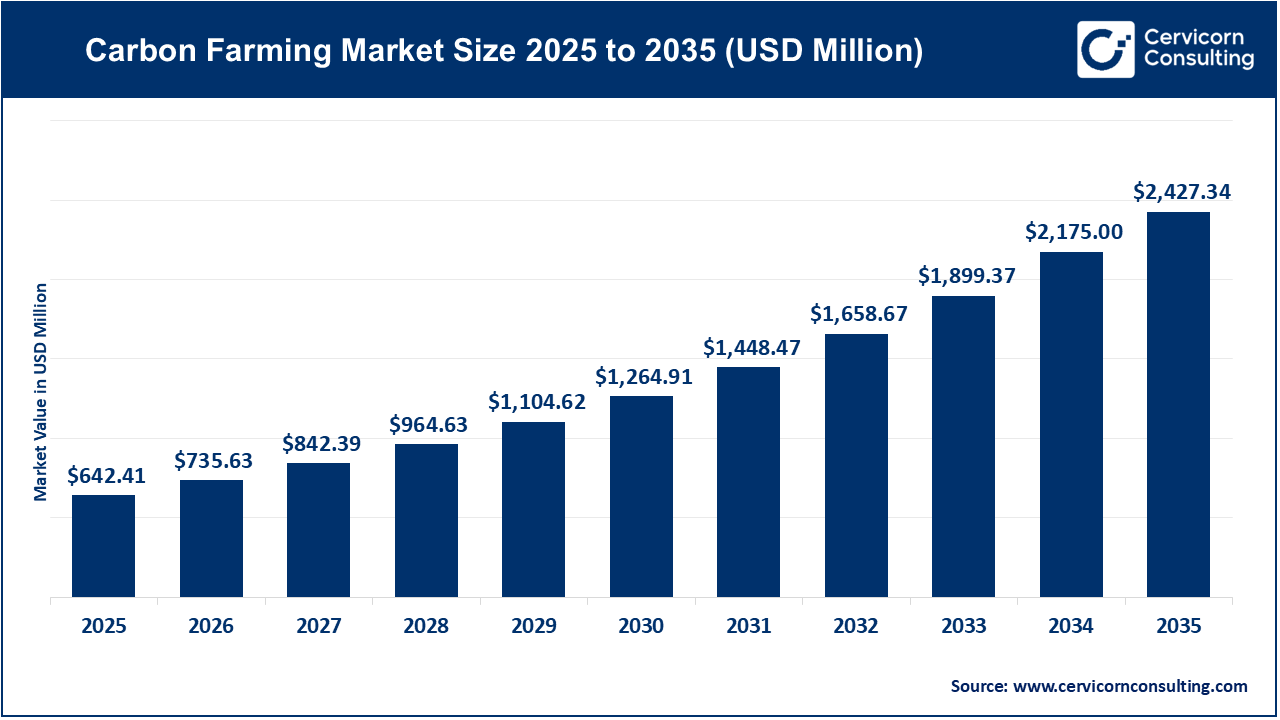
The global carbon farming market was valued at approximately USD 642.41 million in 2025 and is projected to reach nearly USD 2,427.34 million by 2035, expanding at a compound annual growth rate (CAGR) of about 14.22% between 2026 and 2035.
What is the Carbon Farming Market?
The carbon farming market refers to the ecosystem of agricultural practices, technologies, verification systems, and carbon credit trading mechanisms designed to increase the amount of carbon captured and stored in soils, vegetation, and agricultural landscapes. Carbon farming involves regenerative agricultural techniques such as cover cropping, no-till farming, agroforestry, rotational grazing, biochar application, and improved nutrient management. These practices enhance soil organic carbon while reducing greenhouse gas emissions from farming activities.
The market includes farmers, carbon credit developers, technology providers, environmental organizations, corporations seeking carbon offsets, and government agencies promoting climate-smart agriculture. As global efforts to achieve net-zero emissions intensify, carbon farming has emerged as a critical solution that simultaneously supports climate mitigation, biodiversity conservation, soil health improvement, and sustainable food production.
Carbon Farming Market Growth Factors
The carbon farming market is experiencing substantial growth due to increasing global commitments toward carbon neutrality, rising corporate demand for high-quality carbon offsets, expanding voluntary carbon markets, government incentives for climate-smart agriculture, advancements in remote sensing and soil monitoring technologies, growing awareness of regenerative farming practices, increasing investments from environmental funds and sustainability-focused organizations, rising concerns regarding soil degradation and food security, favorable policy frameworks supporting carbon sequestration projects, and the integration of digital platforms that enable transparent carbon credit verification and trading. Additionally, multinational corporations are increasingly purchasing agricultural carbon credits to meet environmental, social, and governance (ESG) objectives, while farmers are recognizing carbon farming as an additional revenue stream that complements agricultural productivity and resilience.
Why is the Carbon Farming Market Important?
The carbon farming market plays a crucial role in addressing some of the world’s most pressing environmental and economic challenges. Agriculture contributes significantly to global greenhouse gas emissions, yet it also possesses enormous potential to become a carbon sink. Through carbon farming practices, agricultural land can sequester substantial amounts of atmospheric carbon dioxide, helping mitigate climate change.
The importance of the carbon farming market extends beyond carbon removal. Improved soil health increases water retention, reduces erosion, enhances crop productivity, and strengthens resilience against droughts and extreme weather events. Carbon farming also creates new revenue opportunities for farmers through carbon credit programs, helping diversify income sources while promoting sustainable land management.
Furthermore, carbon farming supports biodiversity conservation, reduces dependency on synthetic fertilizers, improves ecosystem services, and contributes to national climate targets. As governments and businesses increasingly prioritize sustainability, the carbon farming market is becoming a vital component of global decarbonization strategies.
Get a Free Sample: https://www.cervicornconsulting.com/sample/2606
Key Companies Operating in the Carbon Farming Market
| Company | Specialization | Key Focus Areas | Notable Features | 2025 Revenue* | Market Share* | Global Presence |
|---|---|---|---|---|---|---|
| Carbon Clean Solutions | Carbon capture and removal solutions | Industrial decarbonization, carbon capture systems | Advanced modular carbon capture technology | Private company (undisclosed) | Emerging participant | Europe, Asia, North America, Middle East |
| Indigo Ag | Agricultural carbon programs | Soil carbon sequestration, regenerative agriculture | One of the largest agricultural carbon marketplaces | Private company (undisclosed) | Leading carbon farming platform | North America, South America, Europe, Australia |
| Land Life Company | Large-scale ecosystem restoration | Afforestation, reforestation, carbon sequestration | Technology-driven restoration projects | Private company (undisclosed) | Significant restoration developer | Europe, North America, Africa, Australia |
| Nori | Carbon credit trading platform | Soil carbon credits, transparent carbon markets | Blockchain-enabled carbon removal marketplace | Private company (undisclosed) | Growing marketplace share | North America, Europe |
| BioCarbon Engineering | Drone-based reforestation | Automated tree planting, landscape restoration | AI and drone-assisted ecosystem restoration | Acquired and integrated into restoration operations | Niche technology provider | Global project footprint |
Leading Trends in the Carbon Farming Market and Their Impact
Expansion of Regenerative Agriculture
Regenerative agriculture has become the foundation of carbon farming initiatives worldwide. Farmers are increasingly adopting practices such as cover cropping, reduced tillage, crop rotation, and rotational grazing to improve soil carbon content. This trend is driving demand for carbon measurement and verification services while generating new carbon credit opportunities.
Impact:
- Increased carbon sequestration rates
- Improved soil fertility and crop yields
- Expansion of carbon credit generation
Digital Monitoring and Verification Technologies
Advanced technologies including satellite imaging, artificial intelligence, machine learning, remote sensing, and soil analytics are transforming carbon farming verification processes. These innovations improve transparency and reduce monitoring costs.
Impact:
- Enhanced credibility of carbon credits
- Reduced verification expenses
- Greater investor confidence
Corporate Net-Zero Commitments
Thousands of corporations worldwide have established net-zero goals, creating strong demand for carbon offsets generated through agricultural carbon sequestration projects.
Impact:
- Higher demand for verified carbon credits
- Increased investment in carbon farming programs
- Expansion of voluntary carbon markets
Integration of Carbon Markets with Agriculture
Carbon credits are increasingly being integrated into agricultural value chains. Farmers can now monetize sustainable practices through carbon credit sales alongside traditional crop production.
Impact:
- New revenue streams for farmers
- Greater participation in sustainability programs
- Enhanced rural economic development
Growth of Nature-Based Solutions
Nature-based climate solutions are gaining prominence as governments and corporations seek cost-effective methods to reduce emissions. Carbon farming is a major component of these strategies.
Impact:
- Increased funding for ecosystem restoration
- Greater policy support
- Expansion of large-scale carbon sequestration projects
Successful Examples of Carbon Farming Around the World
Australia’s Emissions Reduction Fund (ERF)
Australia has implemented one of the world’s most advanced carbon farming frameworks through its Emissions Reduction Fund. Farmers receive Australian Carbon Credit Units (ACCUs) for activities such as soil carbon enhancement, revegetation, and improved grazing management.
Results:
- Millions of carbon credits generated
- Strong farmer participation
- Significant emissions reductions
Indigo Ag Carbon Program – United States
Indigo Ag operates one of the largest agricultural carbon programs globally. Farmers are rewarded for adopting regenerative agricultural practices that increase soil carbon storage.
Results:
- Millions of acres enrolled
- Verified soil carbon credits issued
- Increased farmer income through carbon markets
Kenya Agricultural Carbon Project
This pioneering initiative supports smallholder farmers in implementing sustainable land management practices that improve soil carbon storage.
Results:
- Improved agricultural productivity
- Enhanced climate resilience
- Successful carbon credit generation
France’s Label Bas-Carbone Program
France has established a national carbon certification framework supporting agricultural carbon sequestration projects and encouraging climate-friendly farming practices.
Results:
- Increased adoption of regenerative agriculture
- Enhanced carbon credit market development
- Alignment with national climate goals
Brazil’s Low Carbon Agriculture Program
Brazil promotes sustainable agricultural practices through financing and technical assistance programs aimed at reducing emissions and increasing carbon sequestration.
Results:
- Reduced deforestation pressures
- Improved pasture management
- Increased agricultural sustainability
Global Regional Analysis of the Carbon Farming Market
North America
North America represents one of the most developed carbon farming markets due to strong corporate demand for carbon credits, advanced agricultural infrastructure, and increasing regenerative agriculture adoption.
Key Drivers
- Corporate sustainability commitments
- Established carbon trading platforms
- Advanced precision agriculture technologies
Government Initiatives and Policies
The United States Department of Agriculture (USDA) has launched multiple climate-smart agriculture initiatives supporting carbon sequestration projects. Federal funding programs encourage adoption of regenerative practices and carbon measurement technologies.
Canada has introduced agricultural sustainability programs and carbon pricing mechanisms that support carbon farming adoption.
Market Outlook
North America is expected to maintain a leading position due to favorable policy support, extensive farmland availability, and increasing investment in agricultural carbon markets.
Europe
Europe remains a major market driven by ambitious climate targets and strong regulatory support for sustainable agriculture.
Key Drivers
- European Green Deal
- Carbon neutrality commitments
- Strong environmental regulations
Government Initiatives and Policies
The European Union’s Common Agricultural Policy (CAP) increasingly rewards sustainable farming practices and environmental stewardship. The European Green Deal promotes carbon farming as a key climate mitigation strategy.
Several European countries have developed national carbon farming frameworks, including France’s Label Bas-Carbone initiative and Germany’s climate-smart agriculture programs.
Market Outlook
Europe is expected to experience strong growth as carbon farming becomes integrated into broader sustainability and biodiversity strategies.
Asia-Pacific
Asia-Pacific is emerging as a high-growth region due to expanding agricultural sectors, increasing climate concerns, and supportive government policies.
Key Drivers
- Large agricultural land base
- Growing sustainability awareness
- Rising climate adaptation requirements
Government Initiatives and Policies
Australia remains a global leader through its carbon farming framework and carbon credit market mechanisms.
China has incorporated carbon neutrality goals into national development plans and is promoting sustainable agricultural practices that enhance carbon sequestration.
India is increasingly supporting regenerative agriculture, soil health improvement programs, and carbon market development initiatives to enhance agricultural sustainability.
Market Outlook
Asia-Pacific is projected to witness rapid expansion as governments strengthen climate policies and agricultural stakeholders adopt carbon farming practices.
Latin America
Latin America possesses significant carbon sequestration potential due to extensive agricultural land and forest resources.
Key Drivers
- Large-scale agriculture
- Ecosystem restoration opportunities
- Growing participation in voluntary carbon markets
Government Initiatives and Policies
Brazil’s Low Carbon Agriculture Program encourages sustainable farming techniques that reduce emissions and improve carbon storage.
Several regional governments are implementing programs aimed at reducing deforestation while promoting regenerative agriculture.
Market Outlook
Latin America is expected to become a major supplier of agricultural carbon credits due to its vast natural resources and favorable climatic conditions.
Middle East and Africa
The Middle East and Africa are increasingly exploring carbon farming opportunities as part of broader climate adaptation and land restoration efforts.
Key Drivers
- Land restoration initiatives
- Climate resilience programs
- International sustainability funding
Government Initiatives and Policies
African nations are participating in international carbon finance programs that support sustainable agriculture and ecosystem restoration.
Several Middle Eastern countries are incorporating carbon sequestration projects into national sustainability and food security strategies.
Market Outlook
Although still developing, the region offers substantial long-term growth potential due to increasing investments in climate-smart agriculture and restoration projects.
Future Outlook of the Carbon Farming Market
The carbon farming market is expected to evolve rapidly as climate action becomes a global priority. Increasing corporate demand for high-quality carbon offsets, technological advancements in carbon measurement, expanding government support, and growing farmer participation will continue driving market expansion. The convergence of agriculture, environmental sustainability, and carbon finance is creating a dynamic ecosystem capable of delivering significant climate, economic, and social benefits while transforming the future of global food production and land management.
To Get Detailed Overview, Contact Us: https://www.cervicornconsulting.com/contact-us
Read Report: Distributed Database Middleware Market Revenue, Trends, and Strategic Insights by 2035