Human-AI Collaboration Market Drivers, Trends, Key Players and Regional Insights by 2035
Human-AI Collaboration Market Size & Future Outlook
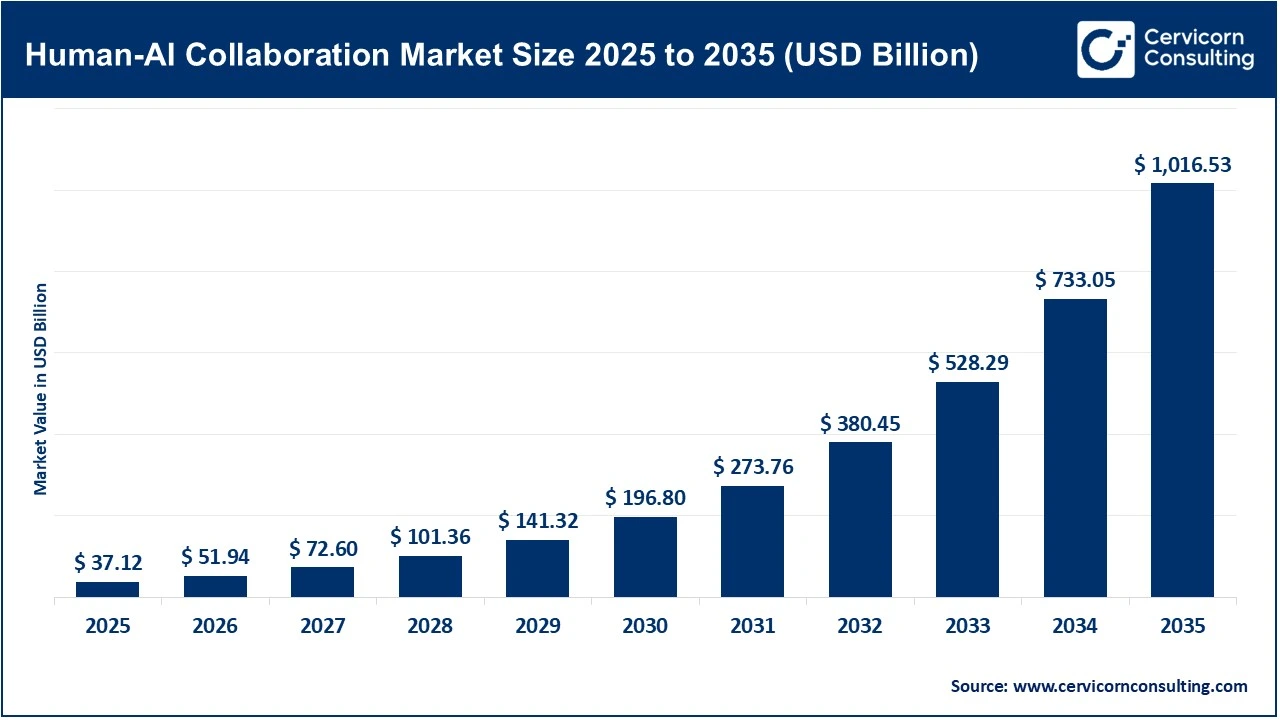
The global human-AI collaboration market size was worth USD 37.12 billion in 2025 and is anticipated to expand to around USD 1,016.53 billion by 2035, registering a compound annual growth rate (CAGR) of 39.2% from 2026 to 2035. These growth trajectories reflect a shift toward AI as a partner—not a replacement—and highlight the economic, operational, and social value of systems designed for synergy between human expertise and machine intelligence.
Human‑AI Collaboration Market Growth Factors
The growth of the human‑AI collaboration market has been propelled by several converging factors: the widespread adoption of cloud infrastructure that enables scalable AI workloads across industries; rising demand for productivity amplification in knowledge work, where AI agents reduce repetitive tasks and allow humans to focus on complex problem-solving; the explosion of generative AI models and large language models that support natural language interaction, co-creation, and personalized insights.
Increasing investments from government and private sectors in AI readiness and workforce upskilling initiatives, which accelerate adoption rates; and strategic partnerships between tech giants and industry incumbents to integrate AI into mission-critical workflows. These drivers, aligned with rising expectations for automation that collaborates rather than replaces, are fueling double-digit compound annual growth in tools and platforms that enhance human-AI teamwork.
Why Human‑AI Collaboration Matters
Human‑AI collaboration matters because it reshapes how value is generated and decisions are made in a wide range of economic sectors. In traditional automation scenarios, tasks that are repetitive and predictable are given over entirely to machines. While this delivers efficiency, it leaves gaps where nuance, context, ethical judgment, and empathy are essential—especially in healthcare, education, creative industries, and high-stakes operations. Human‑AI collaboration bridges that gap by enabling AI systems to augment human talents and judgments rather than sideline them.
For example, in healthcare, AI can sift through millions of data points to highlight meaningful patterns in patient diagnostics, but human clinicians interpret these insights and apply ethical judgment and personalized care. In creative industries, AI assists with ideation, drafts, and generative suggestions, while human creators shape final outputs with emotional intelligence and cultural nuance. In enterprise workflows, AI can handle automation of routine tasks, enabling knowledge workers to focus on strategic projects that require critical thinking. This augmentation dimension makes human‑AI collaboration essential as organizations seek both efficiency and innovation without compromising human agency, accountability, and societal values.
Get a Free Sample: https://www.cervicornconsulting.com/sample/2890
Profiles of Leading Human‑AI Collaboration Companies
1. Microsoft
Specialization: Enterprise AI platforms (Azure AI, Copilot), productivity augmentation
Key Focus Areas:
-
Integration of AI into Microsoft 365, Dynamics 365, GitHub, and enterprise systems
-
Development of AI agents (Copilot series) that enhance human productivity
-
Partnerships to embed AI across industries
Notable Features:
Deep integration into widely used enterprise tools and cloud services. Copilot tools assist humans in writing, coding, data analysis, and operational tasks, while Azure provides infrastructure to build custom human-in-loop systems.
2024 Revenue & Market Share:
Microsoft’s Intelligent Cloud segment, which includes Azure, continues to show strong double-digit growth and significant market share in enterprise AI adoption.
Global Presence:
Worldwide cloud data centers, enterprise contracts across sectors, strong presence in North America, Europe, APAC, and LATAM.
2. Google
Specialization: AI research and ML platforms (Vertex AI, TensorFlow), collaborative tools
Key Focus Areas:
-
Open-source toolkits (TensorFlow, ML platforms) for AI developers
-
Integrating AI into Google Workspace and cloud services
-
Advancing human-in-the-loop systems with human oversight
Notable Features:
Flexibility and openness, enabling enterprises to tailor AI collaboration systems. Vertex AI simplifies building, deploying, and managing human-AI applications.
2024 Revenue & Market Share:
Strong revenue growth in cloud and AI sectors, maintaining significant share in conversational AI and hybrid intelligence deployments.
Global Presence:
Data centers across multiple continents, strong enterprise footprint in Europe, Asia Pacific, and the Americas.
3. IBM
Specialization: Enterprise AI and analytics (Watson), regulated industry solutions
Key Focus Areas:
-
Cognitive AI platforms combined with business process transformation
-
Industry-specific AI in healthcare, finance, and regulated sectors
-
Human-centric AI governance and explainable decision support
Notable Features:
Emphasis on trust, transparency, and domain specialization. IBM is a go-to partner for organizations navigating compliance and ethics in AI adoption.
2024 Revenue & Market Share:
Revenue growth driven by AI adoption, with Watson and AI consulting scaling significantly in enterprise workflows.
Global Presence:
Operations in over 170 countries, strong legacy enterprise customer base.
4. Amazon Web Services (AWS)
Specialization: Cloud infrastructure and machine learning services
Key Focus Areas:
-
Platforms like SageMaker for building human-AI integrated models
-
Facilitating AI workflows with human validation steps
-
Strategic investments in AI startups and ecosystem expansion
Notable Features:
Scalable infrastructure supporting collaboration frameworks across industries. Enables human checkpoints in automated AI pipelines.
2024 Revenue & Market Share:
Leader in cloud services with growing AI service revenues and significant market share in enterprise AI.
Global Presence:
Extensive global footprint with cloud data centers spanning major regions.
5. Salesforce
Specialization: AI-enhanced CRM and workflow automation (Einstein, Agentforce)
Key Focus Areas:
-
AI embedded in sales, service, marketing, and business process systems
-
AI agents assisting human users in customer interactions and workflow optimization
Notable Features:
AI integrated directly into everyday business systems, enabling humans to access insights and task automation without switching platforms.
2024 Revenue & Market Share:
Significant enterprise SaaS player, with AI integrations becoming a differentiator in CRM and enterprise workflow markets.
Global Presence:
Headquartered in the U.S., with customers and data centers worldwide.
Leading Trends and Their Impact
-
Proliferation of Generative AI – Generative AI allows humans and machines to co-create content, enhancing knowledge work, customer service, and creative industries.
-
Human-Centered AI Design – Emphasis on explainability, ethics, and trust improves confidence in AI-assisted decisions in healthcare, finance, and critical industries.
-
Regulatory Emphasis – Emerging regulations guide responsible AI deployment with requirements for human oversight.
-
Upskilling and Workforce Strategy – Investment in training workers to collaborate effectively with AI tools enhances adoption.
-
Industry-Specific AI Adoption – Customized human-AI workflows, such as collaborative robots in manufacturing or AI-assisted clinical diagnostics, are reshaping sector productivity.
Successful Global Examples of Human‑AI Collaboration
-
Healthcare Innovation: AI assists radiologists in interpreting imaging results, improving diagnostic accuracy while clinicians make final decisions.
-
Manufacturing & Collaborative Robotics: Cobots work alongside humans to enhance precision, safety, and productivity.
-
Customer Service Platforms: AI agents handle first-level inquiries while escalating complex cases to human agents.
-
Enterprise Creativity & Workflow: AI-assisted coding, content drafting, and analytics allow humans to focus on strategy and creativity.
Global Regional Analysis & Government Initiatives
North America: Leads adoption due to strong private sector investment, cloud infrastructure, and AI research ecosystems.
Europe: Focuses on ethical AI and regulatory compliance, with initiatives such as AI legislation guiding human-in-the-loop deployment.
Asia-Pacific: Rapid growth driven by technology adoption in China, Japan, South Korea, and India, supported by government AI roadmaps and skill development programs.
Latin America & Middle East: Emerging markets expanding AI adoption through digital transformation initiatives, public-private partnerships, and government investment in AI skill development.
To Get Detailed Overview, Contact Us: https://www.cervicornconsulting.com/contact-us
Read Report: Plant-Based Food Market Revenue, Trends, and Strategic Insights by 2035