x86 PC CPU Market Revenue, Trends, and Strategic Insights by 2035
x86 PC CPU Market Size
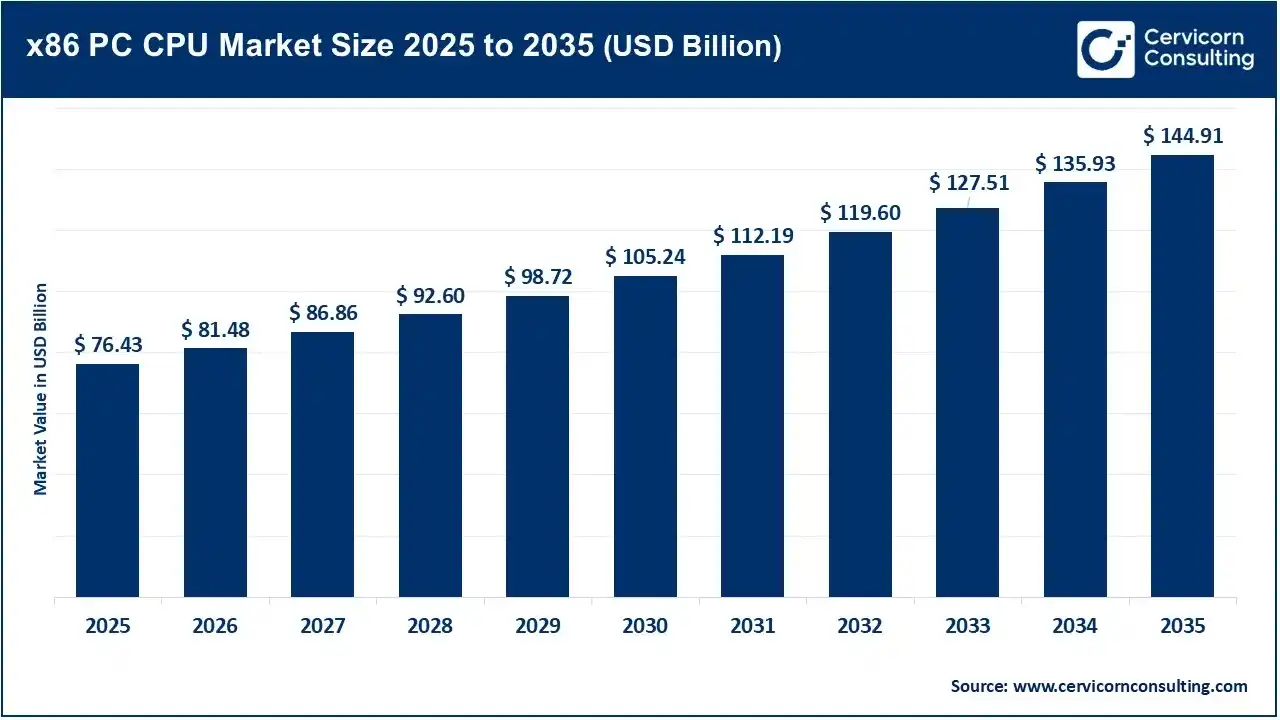
The global x86 PC CPU market size was USD 76.43 billion in 2025, with projections reaching USD 144.91 billion by 2035 at a 6.6% CAGR.
x86 PC CPU Market Growth Factors
The x86 PC CPU market is being supported by a combination of AI-enabled computing, PC replacement cycles, rising demand for high-performance laptops and desktops, gaming, enterprise digitization, cloud-connected workloads, cybersecurity requirements, and the transition toward energy-efficient processor architectures. The expansion of AI PCs is particularly important because modern processors increasingly integrate neural processing units (NPUs) alongside traditional CPU cores, allowing PCs to execute AI workloads locally with lower latency and reduced dependence on cloud processing. Intel, AMD, and other processor vendors are therefore competing on CPU performance, graphics capabilities, power efficiency, AI acceleration, and platform-level integration rather than CPU clock speed alone.
At the same time, commercial PC refresh cycles are creating demand from businesses replacing older systems that cannot efficiently support Windows upgrades, security requirements, hybrid work applications, and AI software. Gaming remains another significant driver as consumers seek higher frame rates, faster content creation, and improved multitasking. The market is also benefiting from continued growth in premium notebooks and workstations, where buyers are more willing to pay for higher-performance processors.
Get a Free Sample: https://www.cervicornconsulting.com/sample/3019
What Is the x86 PC CPU Market?
The x86 PC CPU market refers to the global market for central processing units based on the x86 instruction-set architecture and designed primarily for personal computers, including desktops, notebooks, workstations, and related client computing devices.
x86 originated with Intel’s 8086 processor and evolved through generations of 16-bit, 32-bit, and 64-bit processors. Today, the architecture is primarily associated with Intel 64 and AMD64/x86-64, which support modern operating systems and a huge ecosystem of applications.
The market includes processors across multiple performance and price categories:
- Entry-level processors for affordable laptops and desktops
- Mainstream notebook and desktop CPUs
- Premium consumer processors
- Gaming CPUs
- Workstation processors
- Commercial and enterprise PC processors
- Embedded and specialized x86 processors
Intel and AMD dominate the global x86 ecosystem. Other companies, including VIA Technologies, Zhaoxin, and Hygon, maintain more specialized or geographically concentrated positions.
The competitive landscape is also changing because x86 is no longer competing only against other x86 vendors. Arm-based processors from companies such as Apple, Qualcomm and MediaTek are increasing their presence in PCs. Deloitte noted that the PC installed base remains heavily x86-based, while Arm-powered AI PCs were emerging as an important competitive issue.
Why Is the x86 PC CPU Market Important?
The x86 PC CPU market is strategically important because processors determine much of a computer’s performance, responsiveness, energy consumption, security capabilities, and ability to execute advanced workloads.
1. Foundation of the PC Ecosystem
x86 processors support decades of software development, including operating systems, enterprise applications, games, engineering software, development environments, and productivity tools. This enormous software base creates a strong ecosystem advantage.
2. AI PC Transformation
AI is changing what consumers expect from computers. Instead of sending every AI workload to cloud infrastructure, AI PCs can execute selected workloads locally through CPU, GPU and NPU resources. This improves privacy, responsiveness and potentially energy efficiency.
TechInsights reported that Intel held 56% of the AI PC processor market in both desktop and notebook segments in 2025, with Apple and AMD following, while Qualcomm and MediaTek were also gaining ground in notebooks.
3. Enterprise Computing
Businesses depend on x86 PCs for productivity, cybersecurity, software development, financial operations, engineering and professional applications. Commercial PC refresh cycles therefore provide an important recurring demand base.
4. Gaming and Content Creation
Gaming PCs, streaming systems, video-editing workstations and creator computers require powerful processors with high single-thread and multi-thread performance. This has strengthened demand for premium CPUs.
5. Semiconductor Sovereignty
Processors are increasingly viewed as strategic technologies. Governments in the United States, Europe, China and India are investing in semiconductor design and manufacturing capabilities because CPUs are critical to digital infrastructure, defense, AI and economic competitiveness.
Competitive Landscape of the x86 PC CPU Market
| Company | Specialization | Key Focus Areas | Notable Features | 2025 Revenue* | Market Share | Global Presence |
|---|---|---|---|---|---|---|
| Intel Corporation | x86 CPUs, platforms, semiconductor manufacturing | PCs, AI PCs, data centers, foundry, connectivity | Core Ultra, Xeon, NPU integration, Intel 18A | $52.9B total revenue; $32.2B CCG | About 70.8% of total x86 CPU shipments in Q4 2025 | North America, Europe, Asia-Pacific, global |
| Advanced Micro Devices, Inc. | x86 CPUs, GPUs, adaptive computing | Ryzen PCs, EPYC servers, gaming, AI | Zen architecture, chiplets, 3D V-Cache, integrated AI | $34.64B total revenue; $10.64B Client | About 29.2% of total x86 CPU shipments in Q4 2025 | Global |
| VIA Technologies, Inc. | Power-efficient x86 processors and embedded platforms | Industrial, embedded, edge, transportation, IoT | Low-power x86 designs, embedded platforms | NT$9.55B consolidated sales | Niche; standalone global PC share not publicly disclosed | Taiwan, U.S., Europe, Asia |
| Zhaoxin | Chinese x86-compatible processors | Domestic PCs, commercial systems, government and industrial computing | KaiXian/KX processors, domestic technology ecosystem | Not publicly disclosed | Very small global share; concentrated in China | Primarily China |
| Hygon Information Technology Co., Ltd. | x86-compatible CPUs and computing solutions | Servers, high-performance computing, domestic computing | Domestic x86-compatible processor technology | RMB14.38B | Limited global PC share; primarily China-focused | Primarily China |
| Loongson Technology Corporation Limited | Proprietary LoongArch CPUs | PCs, servers, industrial and government computing | Independent LoongArch architecture and ecosystem | RMB635.3M | Not an x86 participant | Primarily China |
*Revenue figures are total company or reported segment revenues and should not be interpreted as x86 PC CPU-only revenue. Intel reported $52.9 billion total revenue and $32.2 billion from CCG in 2025; AMD reported $34.64 billion total revenue and $10.64 billion from Client. VIA reported NT$9.55 billion in 2025 consolidated sales. Hygon reported RMB14.38 billion in 2025 revenue, while Loongson reported RMB635.3 million.
Mercury Research data reported by Tom’s Hardware indicates that AMD held 29.2% of total x86 CPU shipments in Q4 2025, implying approximately 70.8% for Intel. AMD’s desktop share reached 36.4%, while its notebook share reached 26%.
Intel Corporation
Specialization: PC processors, server CPUs, AI computing, semiconductor manufacturing and foundry services.
Key Focus Areas: Intel is emphasizing AI PCs, client processors, data-center CPUs, advanced process technology and domestic semiconductor manufacturing.
Notable Features: Intel’s Core Ultra family combines CPU, GPU and NPU resources, supporting local AI workloads. Its manufacturing strategy is also important because Intel is attempting to strengthen its position as a leading-edge U.S. manufacturer and foundry.
2025 Revenue: Intel generated $52.9 billion in total revenue in 2025, including $32.2 billion from its Client Computing Group.
Market Position: Intel remained the leading x86 CPU supplier in Q4 2025, although AMD continued gaining share.
Global Presence: Intel maintains operations and customers across North America, Europe and Asia-Pacific, supported by manufacturing and R&D facilities in the United States and an extensive global PC ecosystem.
Advanced Micro Devices, Inc.
Specialization: x86 Ryzen and EPYC CPUs, Radeon GPUs, adaptive computing and AI accelerators.
Key Focus Areas: Consumer PCs, gaming, workstations, servers and AI computing.
Notable Features: AMD’s Zen architecture, chiplet design strategy and 3D V-Cache technology have strengthened its competitive position in gaming and high-performance computing.
2025 Revenue: AMD reported $34.64 billion in 2025 revenue. Client revenue reached $10.64 billion, up 51%, driven by strong demand for desktop and mobile Ryzen processors.
Market Position: AMD captured 29.2% of total x86 CPU shipments in Q4 2025 and 36.4% of desktop shipments.
Global Presence: AMD sells products through OEM and system-building partners worldwide, with strong markets in North America, Europe and Asia-Pacific.
VIA Technologies, Inc.
Specialization: Power-efficient x86 processor platforms and embedded computing.
Key Focus Areas: Industrial applications, transportation, edge computing, IoT, computer vision and smart systems.
Notable Features: VIA focuses more heavily on specialized and embedded applications than mainstream consumer PCs.
2025 Revenue: VIA reported consolidated sales of NT$9.55 billion for 2025, equivalent to approximately $306.2 million using the company’s stated conversion rate. Revenue declined 40% year over year.
Market Position: VIA has a niche position and does not disclose a material global mainstream PC CPU share comparable with Intel or AMD.
Global Presence: The company is headquartered in Taiwan and maintains connections across high-tech centers in the United States, Asia and Europe.
Zhaoxin
Specialization: Domestic x86-compatible processors for the Chinese computing ecosystem.
Key Focus Areas: Desktop PCs, commercial computing, government applications and domestically controlled computing platforms.
Notable Features: Zhaoxin is strategically important because it contributes to China’s efforts to reduce dependence on foreign processor suppliers.
2025 Revenue: A comparable standalone 2025 revenue figure for Zhaoxin is not publicly disclosed.
Market Position: Zhaoxin remains a small player in the global x86 PC CPU market, with its relevance concentrated primarily in China.
Global Presence: Its principal market is China, where demand for domestically controlled hardware can provide opportunities unavailable to many international processor suppliers.
Hygon Information Technology Co., Ltd.
Specialization: x86-compatible processors and high-performance computing products.
Key Focus Areas: Server processors, computing infrastructure, domestic semiconductor development and high-performance workloads.
Notable Features: Hygon is an important participant in China’s domestic CPU ecosystem and is particularly relevant to Chinese data-center and enterprise computing.
2025 Revenue: Hygon reported RMB14.38 billion in 2025 revenue, representing substantial growth from RMB9.16 billion in 2024.
Market Position: Hygon’s global PC CPU share is limited, with its principal competitive importance in China’s domestic computing market.
Global Presence: The company is primarily focused on China and the domestic computing ecosystem.
Loongson Technology Corporation Limited
Loongson requires a distinction in any x86 market analysis. The company develops LoongArch, its own instruction-set architecture, rather than x86. Consequently, it should be considered an adjacent competitor to x86 in China, not an x86 PC CPU supplier.
Loongson reported RMB635.3 million in 2025 revenue, up 25.99% year over year. Its 2025 portfolio included desktop, server and embedded processors, while its strategy focused on developing an independent CPU and software ecosystem.
Leading Trends and Their Impact on the x86 PC CPU Market
1. AI PCs Become Mainstream
AI is arguably the most significant change in the PC processor industry.
Modern CPUs are increasingly being designed alongside dedicated NPUs to execute generative AI, image processing, transcription, translation, productivity and security workloads locally.
Impact: Processor vendors can command higher value by selling complete AI computing platforms rather than conventional CPUs. Deloitte estimated that NPU-powered PCs could command a 10%–15% price premium, although adoption depends on whether consumers see sufficient value in AI functionality.
2. Chiplet Architecture
AMD’s chiplet strategy has demonstrated how processor designers can combine multiple dies into sophisticated computing products.
Impact: Chiplets can improve manufacturing flexibility, enable different process nodes within a single package and help manufacturers scale performance more efficiently.
3. Increasing Competition From Arm
The x86 ecosystem faces growing competition from Arm-based PC processors.
Apple’s transition to Apple Silicon demonstrated that Arm processors can deliver strong PC performance and energy efficiency. Qualcomm and MediaTek are also pursuing Windows PCs.
Impact: x86 vendors must improve performance per watt, integrated AI acceleration and battery life while preserving compatibility advantages.
4. Energy Efficiency
Notebook users increasingly prioritize battery life, thermals and portability.
Impact: CPU competition is shifting from raw performance toward performance per watt. This is especially important in premium notebooks and AI PCs.
5. Gaming Performance
Gaming remains a high-value processor segment.
Impact: Technologies such as large cache architectures, higher core counts and optimized CPU designs are supporting premium processor demand.
AMD’s 3D V-Cache approach has particularly strengthened its position among gaming enthusiasts.
6. Commercial PC Refresh Cycles
Organizations are replacing aging computers to support newer operating systems, security standards and AI applications.
Impact: Commercial PC upgrades provide a relatively predictable source of CPU demand even when consumer PC demand is volatile.
7. Geopolitical Supply-Chain Restructuring
Semiconductors have become a strategic industry. Export controls, tariffs, manufacturing incentives and national-security policies increasingly influence CPU supply chains.
Impact: Processor companies are diversifying manufacturing footprints and governments are encouraging domestic semiconductor capacity.
Successful Examples of the x86 PC CPU Market Around the World
United States: Intel’s Domestic Manufacturing Strategy
Intel provides one of the clearest examples of how CPU manufacturing and government semiconductor policy are converging.
Intel says it is investing more than $100 billion in U.S. semiconductor manufacturing and R&D, supported by up to $7.86 billion in U.S. CHIPS Act funding. Its investments span Arizona, New Mexico, Oregon and Ohio.
This strategy is significant for the x86 market because it combines processor design, manufacturing technology and national semiconductor policy.
United States and Global Markets: AMD’s Ryzen Expansion
AMD’s Ryzen family has successfully expanded from enthusiast desktops into mainstream laptops and commercial PCs.
The company’s 2025 Client revenue of $10.64 billion increased 51%, supported by higher processor shipments and average selling prices.
AMD’s Q4 2025 desktop x86 share of 36.4% demonstrates the extent to which it has challenged Intel in high-performance consumer computing.
China: Domestic CPU Development
China provides a different example, where CPU development is closely connected to technological self-reliance.
Zhaoxin and Hygon are developing domestic processor capabilities, while Loongson is pursuing an independent architecture through LoongArch. Loongson’s 2025 results showed revenue growth of approximately 26%, supported by stronger product competitiveness and the expansion of its ecosystem.
These companies demonstrate that China’s CPU market is being shaped not only by conventional commercial competition but also by supply-chain security and domestic technology objectives.
Taiwan: Specialized x86 Computing
VIA Technologies illustrates the opportunity for specialized x86 processors. Rather than competing head-to-head with Intel and AMD across mainstream consumer PCs, VIA concentrates on power-efficient and embedded applications across industrial, transportation, smart-city and edge-computing markets.
Global Regional Analysis Including Government Initiatives and Policies
North America
North America remains the most strategically important region for x86 processor innovation because of the presence of Intel and AMD, major PC manufacturers, hyperscalers, software companies and semiconductor research institutions.
The United States is placing strong emphasis on domestic semiconductor manufacturing through the CHIPS and Science Act. Intel’s investments demonstrate how federal incentives are being used to strengthen domestic manufacturing.
Government policy is also increasingly affecting semiconductor trade. In 2026, the U.S. administration was considering broader semiconductor tariffs covering products such as laptops and other electronics, creating another layer of uncertainty for global CPU supply chains.
Market impact: North America is likely to remain a major center for processor R&D, AI PC development, advanced manufacturing and semiconductor investment.
Europe
Europe is pursuing semiconductor self-sufficiency through the European Chips Act.
The European Commission states that more than €43 billion of policy-driven investment is expected to support the Chips Act through 2030, alongside private investment. The initiative also supports semiconductor startups, competence centers, design infrastructure and workforce development.
Europe has a significant PC market but is less dominant than the United States in x86 CPU design. Its policy focus is therefore broader, covering semiconductor manufacturing, equipment, design capabilities, research and supply-chain resilience.
Market impact: European policies can strengthen regional semiconductor manufacturing and create opportunities for processor packaging, design, industrial computing and AI infrastructure.
Asia-Pacific
Asia-Pacific is one of the most important regions for the x86 PC CPU market because it combines large PC consumer markets with a dense semiconductor manufacturing and electronics supply chain.
Taiwan remains strategically important because of its semiconductor ecosystem and companies such as VIA Technologies. China represents a major PC market and is simultaneously developing domestic processor alternatives.
South Korea and Japan also remain critical to the broader semiconductor supply chain through memory, manufacturing equipment, electronics and advanced components.
Market impact: Asia-Pacific is expected to remain central to PC manufacturing, processor supply chains and semiconductor component production.
China
China is particularly important because it combines significant PC demand with aggressive development of domestic computing technologies.
Government policies have encouraged semiconductor and software development, intellectual-property protection, domestic computing infrastructure and technological self-reliance. Chinese CPU companies such as Hygon and Zhaoxin are therefore operating in an environment where domestic demand can be reinforced by government procurement and localization objectives.
Loongson’s strategy goes further by creating an independent architecture and software ecosystem rather than relying on x86. Its 2025 annual report emphasizes the development of LoongArch and independent CPU IP.
Market impact: China could become an increasingly important source of alternative CPU architectures and domestically developed computing platforms.
India
India is emerging as an important semiconductor and electronics manufacturing destination.
The India Semiconductor Mission was established to develop a semiconductor and display ecosystem and position India as a global hub for electronics manufacturing and design. The program provides fiscal support for fabs, semiconductor packaging, OSAT facilities and chip design.
In 2026, the government announced India Semiconductor Mission 2.0, with a focus on semiconductor equipment and materials, full-stack Indian semiconductor IP, supply-chain development, research and workforce training.
India’s growing PC market also creates a substantial downstream opportunity. In Q2 2026, India’s PC shipments increased 12.1% year over year to 3.9 million units, while AI-enabled notebook shipments more than doubled, increasing 109.9%.
Market impact: India could become increasingly important as both a PC consumption market and a semiconductor design, manufacturing, assembly and software-development hub.
Middle East & Africa
The Middle East and Africa represent smaller x86 PC CPU markets compared with North America, Europe and Asia-Pacific, but digital transformation, enterprise modernization, cloud infrastructure, education and government technology programs are creating opportunities.
Demand is particularly concentrated around commercial PCs, laptops, enterprise computing and data-center infrastructure.
Market impact: Rising digitalization and public-sector technology investment can support long-term PC processor demand, particularly in the Gulf countries and larger African economies.
Latin America
Latin America is another developing opportunity for x86 processor suppliers. Demand is supported by business digitization, education technology, remote and hybrid work, gaming and replacement of aging PCs.
However, currency volatility, import costs and consumer purchasing power can affect PC affordability.
Market impact: Growth is likely to favor mainstream laptops, affordable desktops and commercial computing systems, while premium AI PCs will initially remain concentrated among higher-income consumers and enterprises.
To Get Detailed Overview, Contact Us: https://www.cervicornconsulting.com/contact-us
Read Report: AI Vehicle Scanner Market Revenue, Trends, and Strategic Insights by 2035