Specialty Care Market Revenue, Trends, and Strategic Insights by 2035
Specialty Care Market Overview
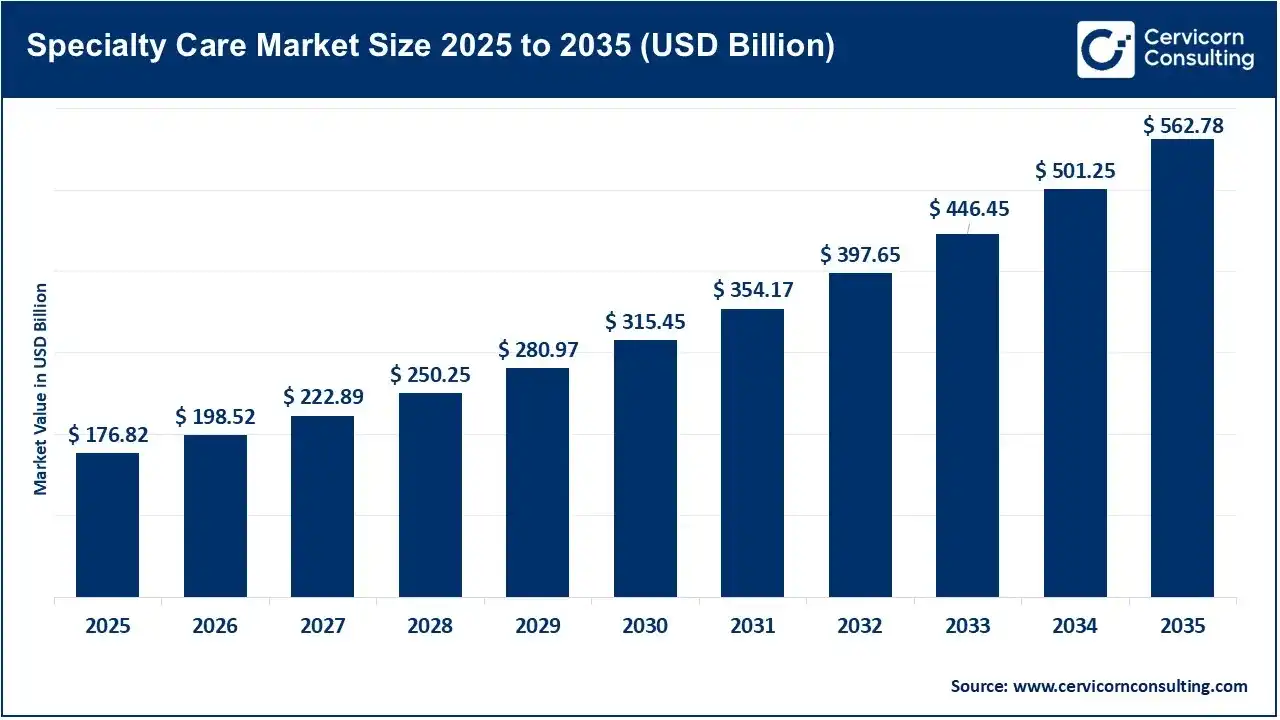
The global specialty care market was valued at approximately USD 176.82 billion in 2025 and is projected to reach around USD 562.78 billion by 2035, expanding at a 12.8% CAGR from 2026 to 2035. North America led the market with an estimated 39.8% share in 2025, while cardiology represented the leading specialty type with 18.7% share. Hospital-based specialty care accounted for approximately 46.9%, and diagnosis and consultation represented 34.2% of the market. Oncology is expected to be the fastest-growing specialty as cancer incidence, precision medicine, immunotherapy, genomic testing, and multidisciplinary cancer treatment continue to expand.
Specialty Care Market Growth Factors
The specialty care market is expanding because of the rising prevalence of chronic and complex diseases, population aging, increasing healthcare expenditure, technological advances, greater demand for early diagnosis, and the expansion of specialized healthcare infrastructure. Cardiovascular diseases, cancer, neurological disorders, diabetes, kidney disease, respiratory conditions, and orthopedic disorders increasingly require long-term specialist involvement rather than one-time medical interventions. Aging populations are further increasing demand for cardiology, oncology, neurology, nephrology, orthopedics, and geriatric services.
At the same time, AI-enabled diagnostics, robotic surgery, precision medicine, genomic testing, electronic health records, remote patient monitoring, and tele-specialty platforms are allowing providers to deliver more sophisticated care. Healthcare systems are also moving toward integrated and value-based models that emphasize outcomes, coordinated treatment, and prevention rather than volume alone. In the United States, CMS continues to develop value-based programs and accountable-care approaches, while healthcare organizations worldwide are investing in specialty networks, ambulatory centers, digital platforms, and multidisciplinary teams to improve access and efficiency.
Get a Free Sample: https://www.cervicornconsulting.com/sample/3005
What Is Specialty Care Market?
Specialty care refers to healthcare services delivered by physicians and clinical professionals who possess advanced expertise in a specific medical discipline. Unlike primary care, which focuses on general health management, prevention, routine diagnosis, and common conditions, specialty care addresses diseases and conditions that require advanced knowledge, diagnostic capabilities, procedures, or long-term management.
Major specialty areas include:
- Cardiology
- Oncology
- Neurology
- Orthopedics
- Gastroenterology
- Endocrinology
- Nephrology
- Pulmonology
- Dermatology
- Rheumatology
Specialty care can be delivered through hospitals, specialty clinics, physician offices, ambulatory surgery centers, home-based services, and tele-specialty platforms. The market also encompasses diagnosis and consultation, surgical services, chronic disease management, diagnostic imaging and laboratory services, rehabilitation, follow-up care, preventive services, and screening.
Why Is Specialty Care Important?
Specialty care is becoming increasingly important because modern healthcare is dealing with patients who frequently have multiple chronic conditions and increasingly complex treatment requirements. A patient with cardiovascular disease, diabetes, kidney dysfunction, or cancer may require coordinated involvement from several specialists.
Specialized providers offer deeper clinical expertise, advanced diagnostic capabilities, complex procedures, and disease-specific treatment plans. This can improve the accuracy of diagnosis and allow patients to receive therapies that may not be available through general healthcare facilities.
Specialty care is also important for healthcare systems because it supports early disease detection, reduces avoidable complications, improves chronic disease management, and creates pathways for advanced treatments. For hospitals and healthcare networks, specialized centers can also become important hubs for research, medical education, clinical trials, and innovation.
The increasing importance of specialty care is reflected in market segmentation. Cardiology held an estimated 18.7% share in 2025, while oncology is expected to record the fastest growth. Hospital-based specialty care remained the largest care-setting segment, while diagnosis and consultation represented the largest service category.
Leading Specialty Care Companies
The competitive landscape includes integrated healthcare organizations, hospital systems, nonprofit academic medical centers, insurers, and physician networks. Because these organizations generate revenue from multiple healthcare activities, specialty-care-specific revenue and market share are generally not separately disclosed. Therefore, total 2025 organizational revenue should not be interpreted as direct specialty-care revenue or as a comparable specialty-care market share.
| Company | Specialization | Key Focus Areas | Notable Features | 2025 Revenue | Market Share | Global Presence |
|---|---|---|---|---|---|---|
| UnitedHealth Group Incorporated | Integrated healthcare and health services | Healthcare benefits, care delivery, analytics, pharmacy services, complex-care management | Large integrated payer-provider ecosystem through UnitedHealthcare and Optum | USD 447.6B | Specialty-care-specific share not separately disclosed | Primarily U.S., with international business and technology/service operations |
| HCA Healthcare, Inc. | Hospital and acute/specialty care | Cardiology, oncology, surgery, emergency care, women’s services, neurosciences | Large hospital network with extensive specialist infrastructure | USD 75.6B | Specialty-care-specific share not separately disclosed | Primarily United States |
| Mayo Clinic | Academic specialty and tertiary/quaternary care | Oncology, cardiology, neurology, transplant, orthopedics, rare and complex diseases | Integrated clinical practice, research and education model | Not separately disclosed for 2025 in readily available public sources | Not separately disclosed | Major U.S. campuses with international patient reach |
| Cleveland Clinic | Academic specialty and tertiary care | Cardiology, oncology, neurology, transplant, orthopedics, digestive disease | Internationally recognized specialty-care and research network | USD 18.3B operating revenue | Specialty-care-specific share not separately disclosed | U.S., UAE, Canada and international patient network |
| Kaiser Permanente | Integrated health plan and healthcare delivery | Primary and specialty care, chronic disease management, preventive care, value-based healthcare | Integrated payer-provider model and emphasis on coordinated care | USD 127.7B combined operating revenue with Risant Health | Specialty-care-specific share not separately disclosed | Primarily U.S. |
UnitedHealth Group reported USD 447.6 billion in consolidated 2025 revenue, representing 12% year-over-year growth. Its UnitedHealthcare segment alone generated USD 344.9 billion, demonstrating the scale of the organization’s healthcare-benefits business.
HCA Healthcare reported USD 75.6 billion in 2025 revenue, compared with USD 70.6 billion in 2024. Its hospital network supports a wide range of specialty services, including surgical, cardiovascular, oncology, neurological, women’s, and emergency care.
Cleveland Clinic generated approximately USD 18.3 billion in operating revenue in 2025 and recorded nearly 16 million patient encounters. Its 2025 statistics included 23 hospitals, 303 outpatient locations, 83,000 caregivers, and 3.2 million surgeries and procedures.
Kaiser Permanente and Risant Health reported USD 127.7 billion in combined 2025 operating revenue, up from USD 115.8 billion in 2024. The organization continues to emphasize affordable, coordinated, value-based care.
Mayo Clinic operates as a nonprofit academic medical organization combining clinical practice, education, and research. Its innovation ecosystem is also becoming an important differentiator; in 2025, Mayo announced the Mayo Venture Partner program to accelerate commercialization and development of healthcare technologies.
Leading Trends and Their Impact on the Specialty Care Market
1. AI-Powered Diagnosis and Clinical Decision Support
Artificial intelligence is becoming one of the most important technologies influencing specialty care. AI can analyze medical images, pathology results, electronic health records, cardiovascular signals, and other clinical information to identify patterns that may be difficult to detect manually.
Its impact is particularly significant in oncology, cardiology, neurology, radiology, and pathology. AI-enabled tools can support earlier diagnosis, improve workflow efficiency, prioritize high-risk cases, and help specialists make more informed decisions.
Mayo Clinic, for example, is actively developing AI-supported cardiac imaging and diagnostic technologies. Its collaboration with UltraSight focuses on AI-assisted point-of-care cardiac ultrasound, illustrating how AI can potentially extend specialist diagnostic capabilities.
2. Precision Medicine and Personalized Treatment
Precision medicine is shifting specialty care away from standardized treatment toward therapies designed around individual patient characteristics.
Genomic sequencing, biomarker testing, molecular diagnostics, companion diagnostics, and targeted therapies are especially influential in oncology and rare diseases. Instead of treating all patients with the same diagnosis identically, specialists can increasingly identify biological characteristics that influence treatment response.
This trend is strengthening demand for advanced laboratories, genomic platforms, multidisciplinary teams, and specialized cancer centers.
3. Growth of Tele-Specialty Care
Telemedicine is expanding access to specialist expertise, particularly for patients living in rural or underserved regions. Tele-specialty services can support consultations, second opinions, follow-up visits, medication management, chronic disease monitoring, and postoperative care.
This model is especially useful where specialist physicians are concentrated in major cities. Integration with wearable devices, remote monitoring, electronic records, and digital referral systems can create a continuous care pathway rather than isolated consultations.
4. Shift Toward Value-Based Specialty Care
Healthcare providers and governments are increasingly focusing on outcomes, quality, patient experience, and cost efficiency. CMS defines value-based care around quality, provider performance, patient experience, and coordinated care.
CMS value-based programs are designed to shift payment from the quantity of services delivered toward the quality of care provided.
For specialty care providers, this encourages better coordination between primary physicians, specialists, hospitals, rehabilitation providers, and post-acute services.
5. Expansion of Ambulatory Specialty Care
Complex procedures that previously required hospital admission are increasingly moving into ambulatory settings when clinically appropriate. Ambulatory surgery centers and specialty clinics can reduce hospital utilization and provide more convenient patient experiences.
This trend is encouraging providers to invest in specialized outpatient facilities for orthopedics, ophthalmology, cardiology, gastroenterology, oncology, and other specialties.
6. Robotic and Minimally Invasive Procedures
Robotic-assisted surgery and minimally invasive techniques are transforming specialty procedures. These technologies can provide surgeons with improved visualization, precision, and control while potentially reducing recovery times for appropriate procedures.
Investment in robotic surgery is particularly visible across orthopedic, urological, gynecological, cardiac, and general surgical specialties.
7. Integrated Multidisciplinary Care
Complex conditions rarely fit within one specialty. Modern specialty centers are therefore increasingly bringing together physicians, nurses, pharmacists, rehabilitation professionals, genetic counselors, nutritionists, and other experts.
Integrated care can reduce duplicated tests, improve communication, coordinate treatment plans, and provide patients with a single pathway through complex healthcare journeys.
Successful Examples of Specialty Care Around the World
Mayo Clinic, United States
Mayo Clinic represents a strong example of the academic specialty-care model, combining patient care with research and medical education. Its approach emphasizes multidisciplinary teams and management of complex diseases.
The organization also demonstrates how healthcare providers can turn clinical research into commercial technologies. Mayo reported that its Business Development activities have helped create more than 180 companies and licensed thousands of Mayo-created technologies.
Cleveland Clinic, United States
Cleveland Clinic provides another successful example of a large specialty-focused healthcare network. Its cardiovascular programs, neurological services, oncology capabilities, transplant programs, and other specialized clinical services are supported by research and education.
In 2025, the organization recorded approximately 15.9 million patient encounters worldwide, demonstrating the scale at which an integrated specialty-care system can operate.
NHS Specialist Services, United Kingdom
The United Kingdom’s NHS demonstrates how specialized services can be integrated into a publicly funded healthcare system. Specialist cancer services, cardiovascular centers, diagnostic hubs, surgical hubs, and integrated care systems are being used to improve access and reduce waiting times.
The growing use of digital consultations and diagnostic technologies is also helping extend specialist expertise across geographically distributed populations.
Apollo Hospitals, India
India’s private healthcare ecosystem provides a strong example of specialty-care expansion in an emerging market. Large hospital networks such as Apollo Hospitals have invested in oncology, cardiology, neurosciences, orthopedics, transplant medicine, robotic surgery, advanced imaging, and international patient services.
The development of high-end specialty hospitals is also supporting India’s medical-tourism industry by attracting international patients seeking complex procedures.
Japan’s Regional Healthcare Model
Japan has developed regional healthcare policies that emphasize functional differentiation and coordination among healthcare institutions. The country’s Ministry of Health, Labour and Welfare’s regional healthcare vision focuses on aligning hospital functions with changing population structures and healthcare needs.
This approach demonstrates how governments can coordinate specialty capacity rather than simply expanding hospital infrastructure independently.
Global Regional Analysis
North America
North America dominated the specialty care market with an estimated 39.8% share in 2025, supported by advanced healthcare infrastructure, high healthcare expenditure, extensive specialist networks, advanced diagnostics, and strong adoption of digital health technologies. The regional market was estimated at USD 70.37 billion in 2025 and is projected to reach approximately USD 223.99 billion by 2035.
The United States remains the primary market because of its large healthcare expenditure, sophisticated specialty hospitals, private healthcare investment, research ecosystem, and rapid adoption of precision medicine and AI.
Government policy is increasingly focused on value-based specialty care. CMS has promoted accountable care, coordinated treatment, and quality-linked payment models. Its 2025 Medicare Physician Fee Schedule also explored approaches for increasing specialist participation in value-based care and strengthening coordination between primary and specialty care.
In 2026, CMS proposed additional Medicare reforms intended to expand accountable care, modernize physician payment, and increase the emphasis on value-based pathways.
Canada benefits from universal healthcare coverage and continued investment in specialist services, diagnostics, virtual care, and regional healthcare infrastructure.
Europe
Europe represented another significant specialty care market, supported by universal or predominantly publicly financed healthcare systems, aging populations, established specialist networks, and government-backed clinical research.
The European Union’s Europe’s Beating Cancer Plan is an important policy initiative for specialty care. The plan focuses on cancer prevention, treatment, survivorship, workforce development, access to medicines, and digital capabilities. The European Commission reviewed the plan in 2025 and continues to support specialist cancer centers and digital healthcare initiatives.
The EU has also supported specialist workforce development and digital capabilities in cancer centers, including telemedicine and remote monitoring initiatives.
Germany benefits from extensive hospital infrastructure, a strong specialist workforce, and high healthcare spending, while the United Kingdom is focusing on diagnostic centers, surgical hubs, digital consultations, and integrated care pathways.
Asia-Pacific
Asia-Pacific is expected to experience strong specialty-care growth because of rising healthcare expenditure, urbanization, aging populations, increasing chronic disease prevalence, expanding private hospitals, medical tourism, and government investment in advanced healthcare infrastructure.
The Asia-Pacific specialty care market was estimated at approximately USD 41.73 billion in 2025 according to the market assessment.
China is expanding tertiary hospitals, regional medical centers, specialty facilities, digital health systems, and precision medicine capabilities through broader healthcare modernization initiatives.
India is also emerging as a major specialty-care market. Government programs such as Ayushman Bharat and PM-JAY are increasing access to hospital-based and tertiary care, while private hospital groups are expanding oncology, cardiac, neurological, renal, transplant, and robotic-surgery capabilities.
Japan’s regional healthcare policies emphasize functional differentiation and coordination among healthcare institutions to match healthcare capacity with changing demographic and disease needs.
Latin America, Middle East and Africa
The LAMEA specialty care market was valued at approximately USD 14.50 billion in 2025 and is projected to reach around USD 46.15 billion by 2035. Growth is supported by healthcare infrastructure investments, private hospital expansion, chronic disease prevalence, digital health adoption, and medical tourism.
Brazil represents an important Latin American market, with its universal SUS healthcare system operating alongside a large private healthcare sector. Aging and increasing chronic disease prevalence are generating demand for cardiology, oncology, orthopedics, nephrology, and other specialist services.
In the Middle East, Saudi Arabia is investing heavily in healthcare transformation through Vision 2030. The strategy is supporting hospital modernization, specialized medical cities, digital health, private-sector participation, and advanced specialty services.
Across Africa, specialty-care access remains more uneven, creating opportunities for telemedicine, mobile diagnostics, regional specialist centers, public-private partnerships, and cross-border healthcare networks. Digital technologies can help connect underserved populations with specialists located in larger urban healthcare centers.
Government Initiatives and Policies Shaping the Specialty Care Market
Government policy is increasingly influencing specialty care through healthcare financing, reimbursement, infrastructure development, digital health regulations, workforce programs, and disease-specific initiatives.
In the United States, CMS value-based programs are encouraging providers to improve quality and reduce avoidable costs. The agency’s programs link provider performance with payment and support better care coordination.
In Europe, the EU Cancer Plan is strengthening cancer prevention, specialist treatment, access to medicines, workforce development, and digital cancer-care capabilities.
In Japan, the Regional Healthcare Vision encourages functional differentiation and cooperation among hospitals to ensure that healthcare capacity reflects regional population needs.
In India, government-backed health coverage and tertiary-care programs are expanding access to specialized treatment, while investments in public medical institutions and digital health infrastructure are helping address regional gaps.
Across the Middle East, healthcare transformation programs are increasing investment in specialist hospitals, digital platforms, medical cities, and private healthcare participation.
These initiatives are collectively changing the specialty care market from a hospital-centered model toward a more connected ecosystem involving specialist physicians, outpatient facilities, digital platforms, diagnostic providers, pharmaceutical companies, insurers, rehabilitation providers, and home-based care services.
To Get Detailed Overview, Contact Us: https://www.cervicornconsulting.com/contact-us
Read Report: Specialty Fertilizer Market Revenue, Trends, and Strategic Insights by 2035