Solid-State Transformer Market Revenue, Trends, and Strategic Insights by 2035
Solid-State Transformer Market Size
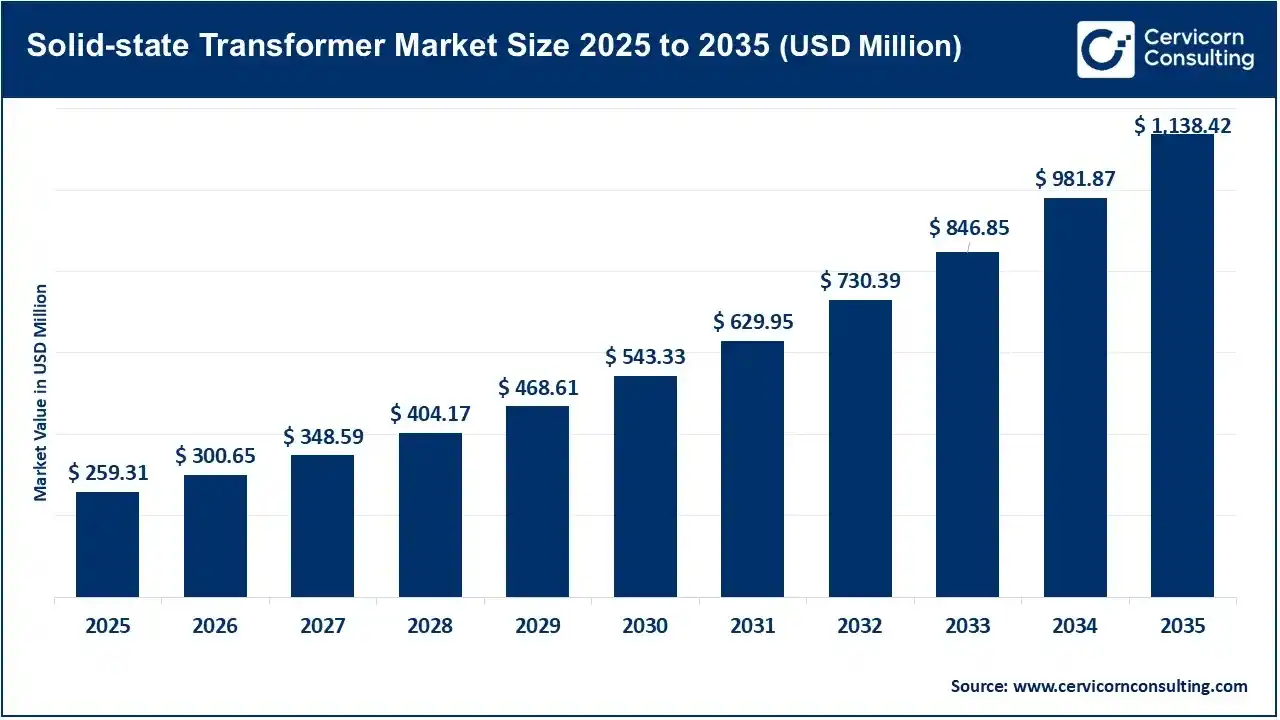
The global solid-state transformer market was valued at approximately USD 259.31 million in 2025 and is projected to reach USD 146.20 billion by 2035, representing a 15% CAGR from 2026 to 2035.
Solid-State Transformer Market Growth Factors
The solid-state transformer market growth factors include rapid smart-grid modernization, increasing renewable-energy penetration, expansion of electric-vehicle fast-charging infrastructure, rising adoption of microgrids and distributed energy resources, increasing demand for bidirectional power flow, the need for improved voltage regulation and power quality, electrification of industrial and transportation systems, growth of AI and data-center electricity demand, declining costs and improving performance of power semiconductors, and government funding for advanced grid technologies; SSTs are particularly attractive because they can combine functions traditionally performed by several pieces of equipment into a more compact and digitally controllable system, while wide-bandgap semiconductor technologies such as silicon carbide (SiC) and gallium nitride (GaN) can improve switching performance, power density and efficiency.
Get a Free Sample: https://www.cervicornconsulting.com/sample/3020
What Is the Solid-State Transformer Market?
The solid-state transformer market comprises technologies, equipment, components, software and services associated with transformers that use power electronics to convert and control electrical energy rather than relying solely on conventional electromagnetic voltage transformation.
A conventional transformer primarily changes voltage levels through electromagnetic induction. An SST adds semiconductor-based conversion stages and a high-frequency transformer. This architecture enables functions such as AC-to-DC, DC-to-DC and DC-to-AC conversion, alongside voltage regulation, power-quality improvement and bidirectional power flow. GE Vernova notes that SSTs can support DC grids, renewable-energy integration and EV charging, while their high-frequency operation can reduce transformer size and material requirements.
The market can broadly be divided according to product type, voltage level, power rating, semiconductor technology, application and end user. Key applications include smart grids, renewable-energy integration, EV charging, rail traction, industrial power systems, microgrids and data centers. Medium-voltage SSTs are particularly important because they connect distribution networks with modern loads and distributed energy resources.
Why Is Solid-State Transformer Technology Important?
SSTs are important because electricity networks are changing from relatively predictable one-way systems into highly dynamic systems containing solar farms, wind turbines, batteries, EVs, distributed generation, data centers and flexible loads.
A conventional transformer has limited ability to actively control these flows. SSTs can respond electronically and rapidly, enabling bidirectional energy flow, voltage regulation, power-factor correction and power-quality management.
This is particularly important for renewable energy. Solar and wind generation fluctuate, while modern electricity systems increasingly require power to move in both directions. SSTs can provide an interface between renewable generation, storage, AC networks and DC loads.
They can also reduce equipment footprint. GE Vernova’s technical analysis highlights the potential for medium-frequency transformers to be smaller and easier to transport than conventional line-frequency transformers.
Another major opportunity is the data-center sector. AI workloads are increasing electricity demand and creating requirements for high-density, reliable power infrastructure. Recent industry activity shows SSTs increasingly being considered for AI data-center power architectures.
Key Companies in the Solid-State Transformer Market
| Company | Specialization | Key Focus Areas | Notable Features | 2025 Revenue* | Estimated SST Market Share | Global Presence |
|---|---|---|---|---|---|---|
| Siemens AG | Electrification, grid infrastructure, automation | Smart grids, digital substations, data centers, power distribution | Strong digital-grid integration and SST development | €78.91B | ~15% | Europe, Americas, Asia-Pacific, Middle East & Africa |
| Hitachi Energy Ltd. | Power grids, transformers, HV technologies | Grid modernization, renewable integration, digital substations | Strong transformer installed base and grid expertise | See note below | ~8% | Global |
| ABB Ltd. | Electrification and power electronics | AI data centers, microgrids, industrial electrification | DG Matrix investment; Power Router architecture | $33.22B | Not separately disclosed | Global |
| Mitsubishi Electric Corporation | Electrical equipment, power electronics, automation | Infrastructure, power conversion, intelligent systems | Strong semiconductor and power-electronics capabilities | ¥5.52T | ~14% | Japan, Americas, Europe, Asia and other markets |
| GE Vernova Inc. | Energy generation, electrification and grid technologies | SST R&D, MVDC, grid modernization, data centers | DOE-supported 1 MVA FASST demonstration; hyperscaler development | $38.1B | Not separately disclosed | Global |
*Company/group revenue, rather than SST-specific revenue.
Third-party market research identifies Siemens as holding an estimated 15% of the SST market in 2025, while Mitsubishi Electric is estimated at approximately 14%. Hitachi Energy is estimated at around 8% in the same competitive assessment. The broader top-five competitive group was estimated to hold a substantial portion of the market, although market-share estimates differ by methodology.
Siemens AG
Siemens AG has a major position in electrification, automation and digital infrastructure. Its Smart Infrastructure business generated €23.0 billion in fiscal 2025 revenue, while Siemens Group revenue reached €78.914 billion.
Siemens is focusing on combining power-distribution hardware with digital controls, automation and grid-management platforms. This gives the company an advantage as SSTs increasingly become components of digitally managed electricity networks rather than standalone transformers.
Hitachi Energy Ltd.
Hitachi Energy Ltd. operates across power grids, transformers, HVDC, substations and grid automation. Its strength in conventional transformer infrastructure provides an important platform for advanced transformer technologies.
Hitachi Energy India’s FY2024–25 revenue was INR 6,442.1 crore, while orders reached INR 18,173.8 crore, demonstrating strong demand for grid-integration and transformer-related technologies in India.
ABB Ltd.
ABB Ltd. generated $33.22 billion in 2025 revenue.
A major SST-related development occurred in March 2025, when ABB acquired a minority stake in U.S.-based DG Matrix to support commercialization of solid-state power electronics. DG Matrix’s Power Router platform can consolidate numerous electrical devices into a single system and is targeted at AI data centers, renewable microgrids and industrial electrification. ABB states that the platform can be up to five times smaller and achieve energy efficiency of up to 98%.
Mitsubishi Electric Corporation
Mitsubishi Electric Corporation recorded ¥5,521.7 billion in fiscal 2025 revenue, up from ¥5,257.9 billion in fiscal 2024.
Its strengths in power electronics, semiconductors, infrastructure and factory automation provide a foundation for SST development. Mitsubishi Electric’s estimated SST market share was approximately 14% in 2025 in one industry assessment.
GE Vernova Inc.
GE Vernova Inc. reported $38.1 billion in 2025 revenue, supported by strong performance in its Power and Electrification businesses.
GE Vernova is developing SSTs for modern grids and medium-voltage DC applications. Its 2025 investor update disclosed an R&D-sharing arrangement with a hyperscaler to develop SST technology, with a potential commitment for 1,000 units from 2027 onward if development specifications are achieved.
Leading Trends and Their Impact on the Market
1. Smart Grid Modernization
Smart grids are one of the strongest long-term drivers of SST adoption. Modern distribution networks require real-time monitoring, automation and flexible power management. SSTs can provide electronically controlled voltage conversion while supporting advanced grid functions.
MarketsandMarkets identifies grid modernization, smart-grid infrastructure and advanced power distribution as major market drivers.
Impact: Utilities increasingly have a reason to consider SSTs when replacing conventional distribution assets, especially where power quality and controllability have economic value.
2. Renewable Energy Integration
Solar, wind and distributed energy resources create variable and bidirectional electricity flows. SSTs can provide the power-conversion interface required to connect these resources to AC and DC networks.
Impact: Renewable-heavy distribution networks create demand for flexible transformer architectures capable of handling changing voltage, frequency and power-flow conditions.
3. EV Fast Charging
High-power EV charging places significant stress on local distribution systems. SSTs can potentially connect medium-voltage networks directly with DC charging infrastructure, reducing conversion stages and equipment footprint.
The EV infrastructure segment is identified as an important SST application because fast charging requires high power density and flexible power management.
4. AI Data Centers
The rapid expansion of AI computing is creating unprecedented requirements for electricity infrastructure. Data centers need high power density, reliability, efficient conversion and increasingly direct DC architectures.
ABB’s DG Matrix investment and GE Vernova’s hyperscaler SST development demonstrate how the data-center market is emerging as a major commercial opportunity.
5. SiC and GaN Power Semiconductors
Wide-bandgap semiconductors such as SiC and GaN can operate at high switching frequencies and temperatures, enabling smaller and more efficient power-conversion equipment.
MarketsandMarkets forecasts particularly strong growth for GaN-based SSTs because of their switching-frequency, compactness and efficiency advantages.
6. Microgrids and Energy Storage
Microgrids require flexible interfaces between generation, storage, loads and the utility grid. SSTs can support bidirectional electricity flows and provide sophisticated power-management functions.
Impact: More microgrids, battery storage systems and distributed energy resources create additional use cases for SSTs beyond traditional utility distribution.
Successful Examples of Solid-State Transformer Development Around the World
United States: DOE-Supported FASST Demonstration
One of the strongest examples is the U.S. Department of Energy-supported Full-scale Alternating Current Solid-State Transformer Demonstration (FASST). GE Vernova received approximately $1.99 million for development and deployment of a 1 MVA three-winding SST at a public-utility-owned substation.
The project is important because it moves SST technology from laboratory-scale development toward real utility environments.
United States: DIRECT Project
The DOE is also supporting the Drop-In Replacement Electronically Controlled Transformer (DIRECT) project. The project scales a single-stage SST into a cascaded multi-module system operating at 7.2 kV, with planned long-term field operation in the Public Service Company of New Mexico service area.
United States: Solid State PowerHub
The Electric Power Research Institute received DOE support for a Solid State PowerHub Development and Demonstration project. The technology is designed to accommodate input-voltage variations and improve distribution-system stability.
United States: EV Megawatt Charging
WattEV introduced an SST-based medium-voltage power-conversion system designed for megawatt charging of heavy-duty electric trucks. The system was developed with funding support from the California Energy Commission and is intended to replace several conventional electrical components.
Europe: Digital and Flexible Electricity Networks
Europe represents another important SST opportunity because the European Commission estimates that €584 billion of investment is needed in electricity grids through 2030. The European grid strategy emphasizes digitalization, decentralization, flexibility, renewable integration and increased grid capacity.
Asia: Renewable and Smart-Grid Expansion
China, India, Japan and South Korea are expanding smart-grid, renewable-energy, industrial electrification and EV infrastructure. Asia-Pacific accounted for approximately 35.92% of the global SST market in 2025 in Fortune Business Insights’ assessment, reflecting the region’s extensive investment in smart grids and electrification.
Global Regional Analysis Including Government Initiatives and Policies
North America
North America is a major SST innovation center, particularly because of U.S. investment in grid modernization, advanced transformers, data centers and EV charging.
The U.S. Department of Energy’s Grid Innovation Program provides $5 billion for FY2022–2026 to support innovative transmission, storage and distribution infrastructure. The program specifically encourages advanced technologies that improve grid resilience and reliability.
DOE has also established dedicated funding for advanced transformer technologies. Its Flexible Innovative Transformer Technologies initiative included $18 million for research, development and demonstration of flexible, modular, scalable, hybrid and solid-state transformers.
These policies reduce technology-development risk and help SST manufacturers validate products in utility environments.
Europe
Europe’s electricity-grid transformation is being driven by renewable-energy targets, electrification and the need to replace aging infrastructure. The European Commission reports that around 40% of Europe’s distribution grids are more than 40 years old and estimates approximately €584 billion in investment needs.
The European grid action plan emphasizes long-term grid planning, renewable integration, regulatory incentives, financing, faster permitting and stronger grid supply chains.
The European Union’s smart-grid policies therefore create favorable conditions for SST deployment because SSTs support digitalized, decentralized and flexible networks.
Asia-Pacific
Asia-Pacific represents one of the most important markets for SST deployment because of rapid urbanization, renewable-energy expansion, EV adoption, industrial growth and power-grid investment.
China is expanding renewable-energy transmission and intelligent grid infrastructure. In December 2025, China’s National Development and Reform Commission and National Energy Administration issued guidance designed to accelerate high-quality grid development and support large-scale renewable-energy deployment. The guidance targets a more coordinated transmission, distribution and smart-microgrid system by 2030.
India is also modernizing its electricity distribution system. The Government of India has supported smart-grid development through initiatives including the National Smart Grid Mission and the Revamped Distribution Sector Scheme (RDSS). Under RDSS, smart-metering and distribution-transformer monitoring programs have been sanctioned at large scale.
Japan and South Korea are similarly investing in smart energy infrastructure, EV charging and industrial automation, creating opportunities for compact and digitally controlled transformer systems.
Latin America
Latin America presents an emerging opportunity as countries increase renewable-energy capacity, improve electricity reliability and expand distributed generation. Brazil, Mexico, Chile and other markets are investing in solar, wind, storage and grid infrastructure.
SST deployment in the region is likely to begin with applications where the technology’s additional functionality justifies its higher initial cost, including renewable-energy plants, industrial facilities, microgrids and high-power EV charging.
Middle East & Africa
The Middle East and Africa are emerging markets for advanced grid technologies as governments invest in renewable generation, electrification, smart cities and resilient power infrastructure.
The region’s large solar projects create opportunities for advanced power-conversion technologies. SSTs can be particularly valuable in locations where grid flexibility, renewable integration and compact electrical infrastructure are important.
Data centers and industrial projects are also creating new high-density electricity loads across the Middle East, potentially increasing demand for intelligent power-distribution technologies.
Market Outlook and Commercial Opportunity
The SST market is still relatively small compared with the conventional transformer industry, but its technological addressable market is expanding rapidly. MarketsandMarkets estimates the market could increase from approximately USD 20 million in 2025 to USD 1.52 billion by 2035, implying a 40.1% CAGR, while Fortune Business Insights estimates a larger 2025 base of USD 162 million and a 9.26% CAGR through 2034. These differences demonstrate the importance of defining exactly which SST technologies, applications and deployments are included in a market assessment.
The commercial opportunity is strongest where SSTs deliver multiple benefits simultaneously. EV charging stations can benefit from direct medium-voltage conversion and compact designs. Renewable projects can benefit from bidirectional power management. Data centers can benefit from high power density and DC architectures. Utilities can benefit from voltage regulation and power-quality management.
The next stage of market development will depend on lowering system costs, improving reliability, simplifying maintenance, developing standards, increasing semiconductor availability and demonstrating long-term performance under real grid conditions. As utilities and large electricity consumers increasingly value controllability alongside basic voltage transformation, SSTs are positioned to become an important technology within the next generation of intelligent power infrastructure.
To Get Detailed Overview, Contact Us: https://www.cervicornconsulting.com/contact-us
Read Report: Data Center Physical Infrastructure Market Revenue, Trends, and Strategic Insights by 2035