Small Molecule CDMO Market Revenue, Trends, and Strategic Insights by 2035
Table of Contents
ToggleSmall Molecule CDMO Market Size
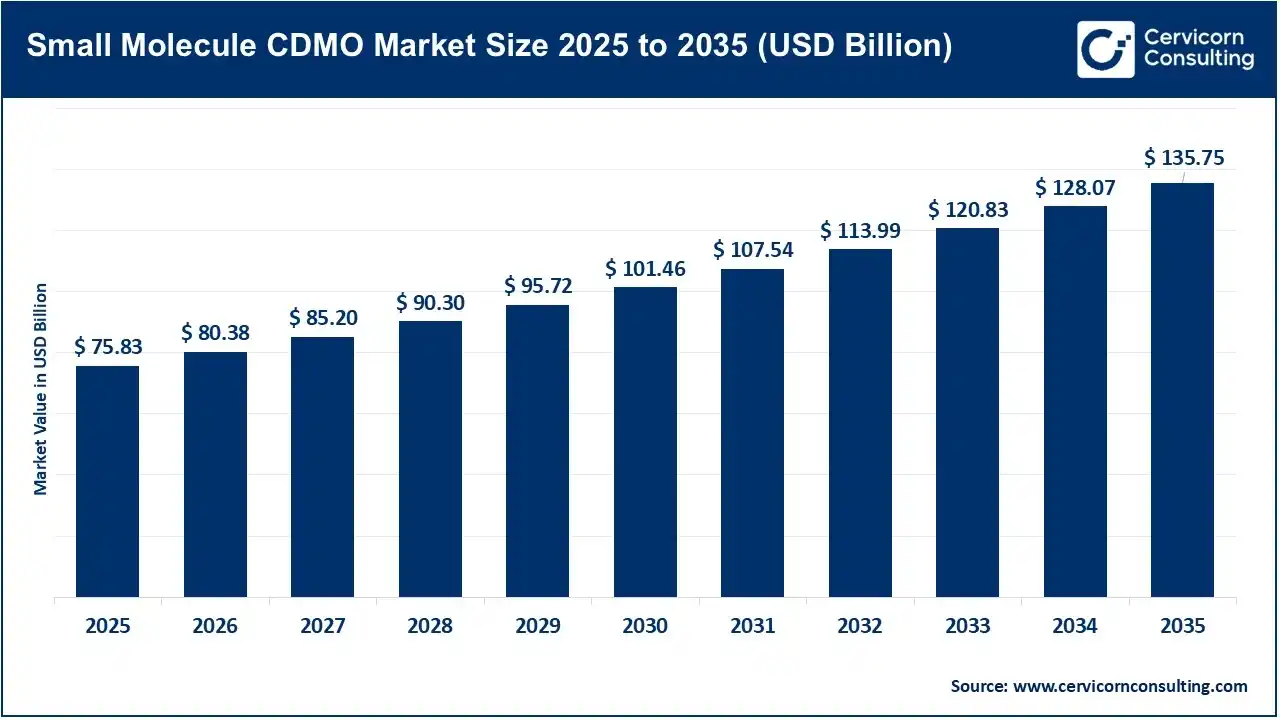
The global small molecule CDMO market was valued at approximately USD 75.83 billion in 2025 and is projected to reach nearly USD 135.75 billion by 2035, growing at a CAGR of 6%.
What is the Small Molecule CDMO Market?
The Small Molecule Contract Development and Manufacturing Organization (CDMO) market consists of companies that provide outsourced drug development and manufacturing services for chemically synthesized pharmaceutical compounds. These organizations assist pharmaceutical companies, biotechnology firms, and research organizations throughout the drug lifecycle, including:
- Drug discovery support
- Process research
- API development
- Analytical testing
- Formulation development
- Clinical trial manufacturing
- Commercial manufacturing
- Packaging and distribution
Unlike biologics, small molecules are chemically synthesized compounds with relatively low molecular weight. Approximately 85% of approved medicines worldwide remain small-molecule drugs, making CDMOs an essential component of pharmaceutical manufacturing.
Small Molecule CDMO Market Growth Factors
The small molecule CDMO market is experiencing remarkable growth due to increasing pharmaceutical outsourcing, rising investments in drug discovery, expanding generic medicine production, growing demand for oncology therapeutics, higher adoption of highly potent active pharmaceutical ingredients (HPAPIs), increasing clinical trial activities, patent expirations creating opportunities for generic manufacturers, continuous advancements in continuous manufacturing technologies, stringent regulatory compliance requirements, cost optimization strategies adopted by pharmaceutical companies, rising demand for flexible manufacturing capacities, expanding personalized medicine development, increasing mergers and acquisitions among CDMOs, growing pharmaceutical markets across Asia-Pacific, and strong government support for domestic pharmaceutical manufacturing that collectively continue to drive long-term market expansion.
Get a Free Sample: https://www.cervicornconsulting.com/sample/2995
Why is the Small Molecule CDMO Market Important?
Accelerates Drug Development
Developing a new pharmaceutical product requires enormous investments and years of research. CDMOs help pharmaceutical companies reduce development timelines by providing specialized expertise.
Reduces Manufacturing Costs
Instead of investing billions in manufacturing infrastructure, pharmaceutical companies outsource production to experienced CDMOs with established facilities.
Supports Innovation
Many biotechnology startups lack manufacturing capabilities. CDMOs enable them to focus on innovation while handling complex manufacturing processes.
Ensures Regulatory Compliance
Leading CDMOs possess deep regulatory expertise across FDA, EMA, PMDA, MHRA, and numerous global agencies.
Enables Global Supply Chains
Major CDMOs operate manufacturing sites across multiple continents, ensuring uninterrupted pharmaceutical supplies.
Major Services Offered by Small Molecule CDMOs
The market covers numerous pharmaceutical development services, including:
- API manufacturing
- Process optimization
- Route scouting
- Analytical development
- Stability testing
- Clinical manufacturing
- Commercial manufacturing
- Formulation development
- Packaging services
- Regulatory documentation
- Scale-up manufacturing
- Continuous manufacturing
- HPAPI production
- Sterile manufacturing
- Technology transfer
Leading Companies in the Small Molecule CDMO Market
| Company | Specialization | Key Focus Areas | Notable Features | 2025 Revenue* | Estimated Market Share | Global Presence |
|---|---|---|---|---|---|---|
| Lonza Group AG | API Manufacturing, Biopharma & Small Molecules | HPAPIs, Commercial Manufacturing, Drug Product Development | Industry-leading integrated CDMO capabilities | USD 7.8 Billion | ~8–10% | North America, Europe, Asia |
| Thermo Fisher Scientific Inc. (Patheon) | End-to-End CDMO Services | Clinical & Commercial Manufacturing | Comprehensive pharmaceutical services | USD 43.2 Billion | ~12–14% | 50+ Global Facilities |
| WuXi AppTec | Drug Discovery & Manufacturing | API Development, Process Chemistry | Strong presence across discovery-to-commercialization | USD 5.8 Billion | ~7–8% | Asia, Europe, North America |
| Catalent, Inc. | Drug Delivery & Manufacturing | Oral Solids, Softgel Technologies, Clinical Supply | Advanced formulation technologies | USD 4.6 Billion | ~6–7% | Global Manufacturing Network |
| Cambrex Corporation | Small Molecule APIs | Custom API Manufacturing, Process Development | Strong expertise in regulated markets | Private Company | ~3–4% | North America & Europe |
Leading Trends Transforming the Small Molecule CDMO Market
1. Rising Demand for Highly Potent APIs (HPAPIs)
Cancer therapies are becoming increasingly potent, requiring sophisticated containment technologies.
Market Impact
- Higher investment in containment facilities
- Premium manufacturing services
- Increased outsourcing by oncology companies
2. Continuous Manufacturing
Continuous manufacturing is replacing traditional batch manufacturing due to greater efficiency.
Market Impact
- Reduced production costs
- Better product consistency
- Faster commercial manufacturing
3. Artificial Intelligence in Drug Development
AI is accelerating process optimization and predictive manufacturing.
Market Impact
- Faster drug development
- Lower manufacturing failures
- Improved quality control
4. Growing Biotech Outsourcing
Thousands of biotech startups lack manufacturing infrastructure.
Market Impact
- Increased CDMO partnerships
- Higher demand for flexible production
- Expansion of early-stage manufacturing services
5. End-to-End Development Services
Drug developers increasingly prefer a single CDMO partner.
Market Impact
- Integrated service offerings
- Long-term customer contracts
- Higher customer retention
6. Expansion of Clinical Trial Manufacturing
Global clinical trials continue expanding rapidly.
Market Impact
- Higher demand for small-batch manufacturing
- Greater investment in GMP facilities
- Faster technology transfer
7. Digital Manufacturing
Industry 4.0 technologies are transforming pharmaceutical production.
Market Impact
- Predictive maintenance
- Real-time monitoring
- Enhanced quality assurance
What are Some Successful Examples of the Small Molecule CDMO Market Around the World?
Lonza’s Integrated Manufacturing Platform
Lonza has established one of the world’s most advanced integrated pharmaceutical manufacturing ecosystems. The company supports clients from early development through commercial production, significantly reducing development timelines and improving manufacturing efficiency. Its investments in HPAPI facilities have positioned it as a preferred partner for oncology drug developers.
Thermo Fisher Scientific (Patheon)
Patheon has built a comprehensive end-to-end CDMO platform covering drug substance development, formulation, clinical manufacturing, packaging, and commercial production. Its extensive global manufacturing footprint allows pharmaceutical companies to access scalable production while maintaining regulatory compliance across major markets.
WuXi AppTec’s Discovery-to-Commercialization Model
WuXi AppTec offers integrated services spanning drug discovery, process chemistry, analytical development, API manufacturing, and commercial-scale production. This streamlined model enables biotech and pharmaceutical companies to reduce development complexity and accelerate product launches.
Catalent’s Advanced Drug Delivery Solutions
Catalent has become a leading partner for pharmaceutical companies through its expertise in oral solid dosage forms, softgel technologies, and advanced formulation development. Its innovative drug delivery capabilities enhance bioavailability and improve patient compliance, making it a preferred CDMO for complex small-molecule products.
Cambrex’s Specialized API Manufacturing
Cambrex focuses on high-quality custom API manufacturing and process development, particularly for regulated markets. Its specialization in complex chemistries and scalable manufacturing has made it a trusted partner for both emerging biotech firms and established pharmaceutical companies.
Regional Analysis of the Small Molecule CDMO Market
North America
North America remains the largest regional market due to strong pharmaceutical R&D spending, advanced manufacturing infrastructure, and a high concentration of biotechnology companies.
Market Drivers
- Large pharmaceutical industry
- Strong FDA regulatory framework
- Growing oncology drug development
- Increasing outsourcing trends
Government Initiatives
- Continued support through the U.S. Food and Drug Administration (FDA) for modernization of pharmaceutical manufacturing.
- Incentives under the CHIPS and Science Act and broader federal initiatives encouraging domestic manufacturing resilience.
- Increased public funding for biomedical research through agencies such as the National Institutes of Health (NIH).
Policy Impact
- Encourages domestic production capacity.
- Strengthens supply chain resilience.
- Accelerates adoption of advanced manufacturing technologies.
Europe
Europe represents a mature CDMO market with strong pharmaceutical innovation and well-established regulatory standards.
Market Drivers
- High-quality GMP manufacturing
- Growing biologics and small molecule production
- Strong pharmaceutical exports
Government Initiatives
- The European Commission’s Pharmaceutical Strategy for Europe promotes innovation, supply security, and improved access to medicines.
- Support for advanced manufacturing and green production technologies through Horizon Europe research funding.
- National incentives across countries such as Germany, Switzerland, and Ireland to expand pharmaceutical manufacturing.
Policy Impact
- Encourages investment in sustainable manufacturing.
- Enhances Europe’s pharmaceutical competitiveness.
- Supports modernization of production facilities.
Asia-Pacific
Asia-Pacific is the fastest-growing regional market driven by lower manufacturing costs, expanding pharmaceutical industries, and increasing foreign investments.
Market Drivers
- Cost-effective manufacturing
- Skilled workforce
- Rising clinical trials
- Expanding generic drug industry
Government Initiatives
China
- Continued implementation of the Made in China 2025 strategy to strengthen high-value pharmaceutical manufacturing.
- Policies supporting innovation, API production, and modernization of manufacturing facilities.
India
- Production Linked Incentive (PLI) Scheme for pharmaceuticals and bulk drugs to boost domestic manufacturing.
- Promotion of pharmaceutical parks and API self-reliance.
- Regulatory reforms aimed at increasing exports and attracting global investments.
Japan
- Government support for advanced pharmaceutical manufacturing technologies.
- Policies encouraging supply chain diversification and resilience.
Policy Impact
- Significant increase in manufacturing investments.
- Growth of export-oriented pharmaceutical production.
- Rising number of global CDMO partnerships.
Latin America
Latin America continues expanding due to improving healthcare infrastructure and increasing pharmaceutical manufacturing capabilities.
Market Drivers
- Growing generic medicine production
- Increasing healthcare investments
- Expansion of local pharmaceutical companies
Government Initiatives
- Brazil and Mexico are strengthening domestic pharmaceutical production through industrial development programs.
- Regulatory modernization to improve manufacturing standards and facilitate exports.
Policy Impact
- Increased local manufacturing capacity.
- Greater participation in global pharmaceutical supply chains.
Middle East & Africa
The Middle East & Africa market is gradually growing as governments seek to reduce dependence on imported medicines.
Market Drivers
- Rising healthcare expenditure
- Growing pharmaceutical demand
- Expansion of domestic manufacturing
Government Initiatives
- Saudi Arabia’s Vision 2030 emphasizes localization of pharmaceutical manufacturing and investment in life sciences.
- The United Arab Emirates supports pharmaceutical production through free zones, industrial incentives, and innovation programs.
- Several African countries are implementing strategies to strengthen local medicine production in collaboration with international organizations.
Policy Impact
- Improved pharmaceutical self-sufficiency.
- Attraction of foreign direct investment.
- Expansion of regional manufacturing infrastructure.
Emerging Opportunities in the Small Molecule CDMO Market
Several high-growth opportunities are expected to shape the market over the coming decade:
- Expansion of precision medicine and targeted therapies.
- Growing demand for HPAPI manufacturing facilities.
- Increased outsourcing by virtual biotech companies.
- Adoption of continuous manufacturing and automation.
- Greater integration of artificial intelligence for process optimization.
- Rising demand for sustainable and green manufacturing practices.
- Capacity expansion for clinical and commercial-scale production.
- Strategic mergers, acquisitions, and partnerships to broaden service portfolios.
- Increasing investment in digital quality management and data analytics.
- Geographic expansion into emerging pharmaceutical hubs across Asia-Pacific, Latin America, and the Middle East.
Future Outlook
The small molecule CDMO market is poised for sustained growth as pharmaceutical companies increasingly rely on outsourcing to improve efficiency, reduce costs, and accelerate time-to-market. Advances in continuous manufacturing, digitalization, AI-driven process optimization, and the growing demand for HPAPIs and personalized medicines are reshaping the competitive landscape. Leading CDMOs are expanding global manufacturing networks, investing in next-generation technologies, and offering integrated development-to-commercialization services to meet evolving customer needs. With supportive government initiatives, increasing pharmaceutical R&D investments, and rising global demand for innovative therapeutics, the market is expected to remain a cornerstone of the pharmaceutical value chain over the next decade.
To Get Detailed Overview, Contact Us: https://www.cervicornconsulting.com/contact-us
Read Report: Bioenergy with Carbon Capture and Storage (BECCS) Market Revenue, Trends, and Strategic Insights by 2035