HVAC System Market Revenue, Trends, and Strategic Insights by 2035
Table of Contents
ToggleHVAC System Market Size
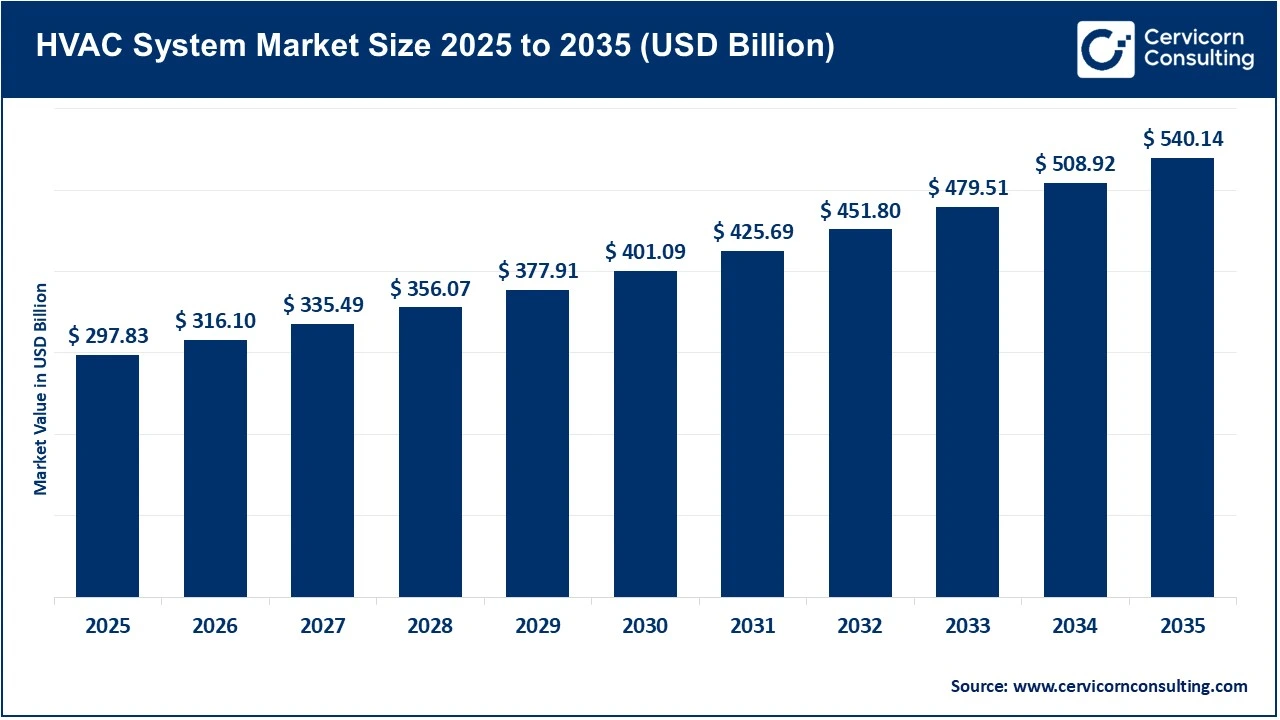
The global HVAC system market is expected to grow from approximately USD 297.83 billion in 2025 to about USD 540.14 billion by 2035, registering a CAGR of around 6.2% during the forecast period.
What Is the HVAC System Market?
The HVAC system market refers to the global industry that designs, manufactures, distributes, installs, and services technologies used for heating, ventilation, and air conditioning across residential, commercial, industrial, and infrastructure environments. These systems regulate indoor temperature, humidity levels, airflow circulation, and air quality to ensure occupant comfort, operational efficiency, and regulatory compliance across buildings and industrial facilities. HVAC technologies include chillers, heat pumps, rooftop units, furnaces, air conditioners, ventilation systems, filtration equipment, smart thermostats, and building automation–integrated climate control platforms. The global HVAC systems market was valued at approximately USD 258.96 billion in 2025 and is projected to reach USD 445.73 billion by 2033, expanding at around 7% CAGR, supported by urbanization, infrastructure modernization, and growing demand for energy-efficient indoor climate solutions.
HVAC systems now play a central role not only in residential comfort but also in healthcare ventilation safety, semiconductor manufacturing precision environments, data center cooling reliability, green building compliance, and industrial productivity optimization. Increasingly, the market overlaps with smart building ecosystems, renewable energy integration, and carbon-neutral infrastructure strategies, positioning HVAC as a foundational component of next-generation built environments.
Why the HVAC System Market Is Important
The HVAC system market is essential because it directly supports indoor environmental quality, which influences health outcomes, energy consumption efficiency, productivity performance, and sustainability goals across modern economies. Commercial buildings depend on HVAC technologies to maintain safe airflow circulation and thermal comfort for employees and customers, while hospitals rely on precision ventilation systems to control infection spread and maintain sterile surgical conditions. Industrial facilities require advanced climate control systems to protect temperature-sensitive manufacturing processes such as semiconductor fabrication and pharmaceutical production. Meanwhile, residential HVAC adoption is accelerating globally due to rising temperatures associated with climate change and increasing middle-class purchasing power across emerging economies.
Beyond comfort and safety, HVAC infrastructure accounts for a significant share of global building energy consumption. Governments worldwide therefore treat HVAC modernization as a strategic lever for achieving climate targets. Integration with renewable energy systems, smart sensors, AI-based predictive maintenance platforms, and building automation software enables HVAC systems to reduce emissions while improving performance efficiency. As buildings increasingly transition toward net-zero energy models, HVAC technologies are becoming central to decarbonization strategies.
Get a Free Sample: https://www.cervicornconsulting.com/sample/2940
HVAC System Market Growth Factors
The HVAC system market is expanding rapidly due to accelerating urbanization, increasing residential and commercial construction activity, rising global temperatures linked to climate change, stricter building energy-efficiency regulations, and growing adoption of smart building automation platforms across developed and emerging economies. Demand for energy-efficient climate control solutions continues to rise as governments introduce incentive programs supporting sustainable cooling and heating technologies, while consumers increasingly prioritize indoor air quality improvements and eco-friendly refrigerants in purchasing decisions. The expansion of data centers, healthcare infrastructure modernization, industrial automation, and green building certification frameworks further strengthens HVAC deployment worldwide, alongside replacement cycles for aging legacy systems in mature markets and strong installation growth across developing regions.
Additionally, integration of IoT-enabled monitoring platforms and AI-driven predictive maintenance technologies is transforming HVAC performance optimization strategies, encouraging enterprises to upgrade legacy systems and adopt next-generation smart climate control infrastructure.
Leading Companies in the HVAC System Market
Major industry participants collectively held approximately 32% global market share in 2025, demonstrating strong competitive concentration across technology innovation and infrastructure deployment capabilities.
Major HVAC Companies Overview
| Company | Specialization | Key Focus Areas | Notable Features | 2024 Revenue | Market Share | Global Presence |
|---|---|---|---|---|---|---|
| Daikin Industries Ltd. | Air conditioning & heat pump systems | Residential, commercial HVAC, refrigerant innovation | Leader in inverter technology and eco-friendly refrigerants | ~USD 30+ billion | Industry leader | 170+ countries |
| Carrier Global Corporation | Commercial HVAC, chillers, building automation | Smart climate systems, heat pumps, sustainability solutions | Pioneer of modern air conditioning | ~USD 22+ billion | Top-tier global player | 160+ countries |
| Johnson Controls International plc | Building automation & HVAC controls | Smart buildings, integrated infrastructure systems | Strong building management platform portfolio | ~USD 26+ billion | Major enterprise segment player | 150+ countries |
| Trane Technologies plc | Industrial & commercial HVAC systems | Energy-efficient cooling and heating solutions | Sustainability-focused innovation strategy | ~USD 19+ billion | Leading commercial HVAC provider | 100+ countries |
| LG Electronics Inc. | Residential & commercial HVAC equipment | VRF systems, smart home HVAC integration | Strong electronics-HVAC ecosystem integration | ~USD 60+ billion (total company) | Growing HVAC share globally | 140+ countries |
Strategic positioning highlights
- Daikin leads global air-conditioning innovation with strong inverter compressor leadership.
- Carrier remains dominant in commercial cooling infrastructure deployment.
- Johnson Controls excels in integrated building automation ecosystems.
- Trane Technologies focuses heavily on decarbonization-aligned HVAC engineering.
- LG Electronics benefits from smart-home ecosystem integration advantages.
Leading Trends Shaping the HVAC System Market and Their Impact
1. Smart HVAC and IoT Integration
Smart HVAC solutions connected through cloud analytics platforms allow real-time performance optimization, predictive maintenance scheduling, and automated energy consumption adjustments. These capabilities significantly reduce operating costs for enterprises while improving occupant comfort levels in commercial buildings.
Impact: Enhances lifecycle efficiency and reduces total cost of ownership across enterprise infrastructure portfolios.
2. Energy-Efficient Refrigerant Innovation
Environmental regulations worldwide are accelerating transitions away from high-global-warming-potential refrigerants toward sustainable alternatives such as R-32 and natural refrigerant systems.
Impact: Supports carbon neutrality goals while enabling compliance with international environmental policies.
3. Heat Pump Adoption Acceleration
Heat pumps are replacing traditional heating technologies across residential and commercial applications due to higher efficiency performance compared to conventional boilers.
Impact: Expands electrification of heating infrastructure globally.
4. Indoor Air Quality Monitoring Technologies
Growing awareness following pandemic-era ventilation concerns has accelerated adoption of filtration systems, air purification technologies, and airflow monitoring sensors.
Impact: Expands HVAC roles beyond temperature control toward health-focused building management systems.
5. Data Center Cooling Demand Expansion
Rapid growth in artificial intelligence infrastructure and hyperscale computing environments is increasing demand for advanced precision cooling systems.
Impact: Creates a high-value specialized HVAC market segment supporting digital transformation infrastructure.
Successful Examples of HVAC System Market Deployment Around the World
Singapore Smart Nation Cooling Infrastructure
Singapore integrates district cooling systems across commercial zones such as Marina Bay, improving energy efficiency by centralizing thermal management infrastructure for large urban developments.
Impact: Demonstrates scalable energy-efficient cooling solutions for dense urban environments.
European Heat Pump Transition Programs
Countries such as Germany and Sweden are rapidly replacing fossil-fuel-based heating systems with electric heat pumps supported by government subsidies and carbon-reduction frameworks.
Impact: Accelerates sustainable HVAC adoption aligned with climate neutrality goals.
United States Commercial Retrofit Programs
Large-scale retrofit initiatives across office towers and institutional buildings are improving HVAC efficiency through smart automation integration and high-efficiency chillers.
Impact: Strengthens replacement-cycle market opportunities.
India Smart Cities Mission
India’s Smart Cities Mission encourages installation of advanced HVAC systems in transportation hubs, hospitals, airports, and municipal infrastructure projects.
Impact: Expands emerging-market HVAC infrastructure modernization.
Global Regional Analysis Including Government Initiatives and Policies Shaping the Market
Asia-Pacific
Asia-Pacific represents the largest regional HVAC market with roughly 47% global share, driven by rapid urbanization, infrastructure development, and industrial expansion across China, India, and Southeast Asia.
Government initiatives shaping the market
- India’s Energy Conservation Building Code (ECBC)
- China’s Green Building Evaluation Standards
- Japan’s Top Runner efficiency program
- Smart Cities infrastructure programs across Southeast Asia
These initiatives promote adoption of energy-efficient cooling technologies and smart climate management platforms in both residential and commercial sectors.
North America
North America represents one of the most technologically advanced HVAC markets globally, supported by strong replacement demand cycles and sustainability compliance regulations.
Key policies influencing growth
- U.S. Department of Energy efficiency standards
- Inflation Reduction Act heat-pump incentives
- LEED green building certification adoption
- Canada Net-Zero Building Strategy
These frameworks encourage transition toward electrified heating technologies and high-efficiency cooling infrastructure.
Europe
Europe’s HVAC market growth is strongly influenced by climate neutrality commitments and strict emissions reduction targets under the European Green Deal.
Major regulatory drivers
- F-Gas Regulation refrigerant restrictions
- Renewable Energy Directive heating electrification goals
- EU Energy Performance of Buildings Directive
These initiatives are accelerating adoption of low-carbon HVAC technologies such as district heating integration and heat pump systems.
Middle East and Africa
Rapid commercial construction activity across Gulf Cooperation Council countries is expanding HVAC demand significantly due to extreme climate conditions requiring advanced cooling infrastructure.
Key policy drivers
- Saudi Vision 2030 infrastructure programs
- UAE Net Zero 2050 strategy
- Smart city megaproject developments such as NEOM
These initiatives are generating large-scale HVAC deployment opportunities across transportation hubs and commercial complexes.
Latin America
Latin America’s HVAC market growth is supported by expanding retail infrastructure, healthcare modernization, and tourism-sector construction investments.
Government initiatives supporting growth
- Brazil energy-efficiency labeling programs
- Mexico building efficiency codes
- Chile climate action policy frameworks
These policies are gradually encouraging transition toward energy-efficient HVAC equipment adoption across emerging economies.
Market Outlook and Competitive Landscape Dynamics
The HVAC system market continues to evolve toward integrated smart infrastructure ecosystems combining automation, sustainability, and predictive analytics capabilities. Increasing investments in green buildings, smart cities, healthcare infrastructure, transportation hubs, and hyperscale computing facilities are expected to sustain long-term demand growth across both developed and emerging markets. Meanwhile, replacement cycles for aging HVAC infrastructure in North America and Europe and rapid installation growth across Asia-Pacific continue to strengthen global market expansion momentum through the forecast period.
To Get Detailed Overview, Contact Us: https://www.cervicornconsulting.com/contact-us
Read Report: Hydrogen Generator Market Revenue, Trends, and Strategic Insights by 2035