Generative AI Market Revenue, Global Presence, and Strategic Insights by 2034
Generative AI Market Size
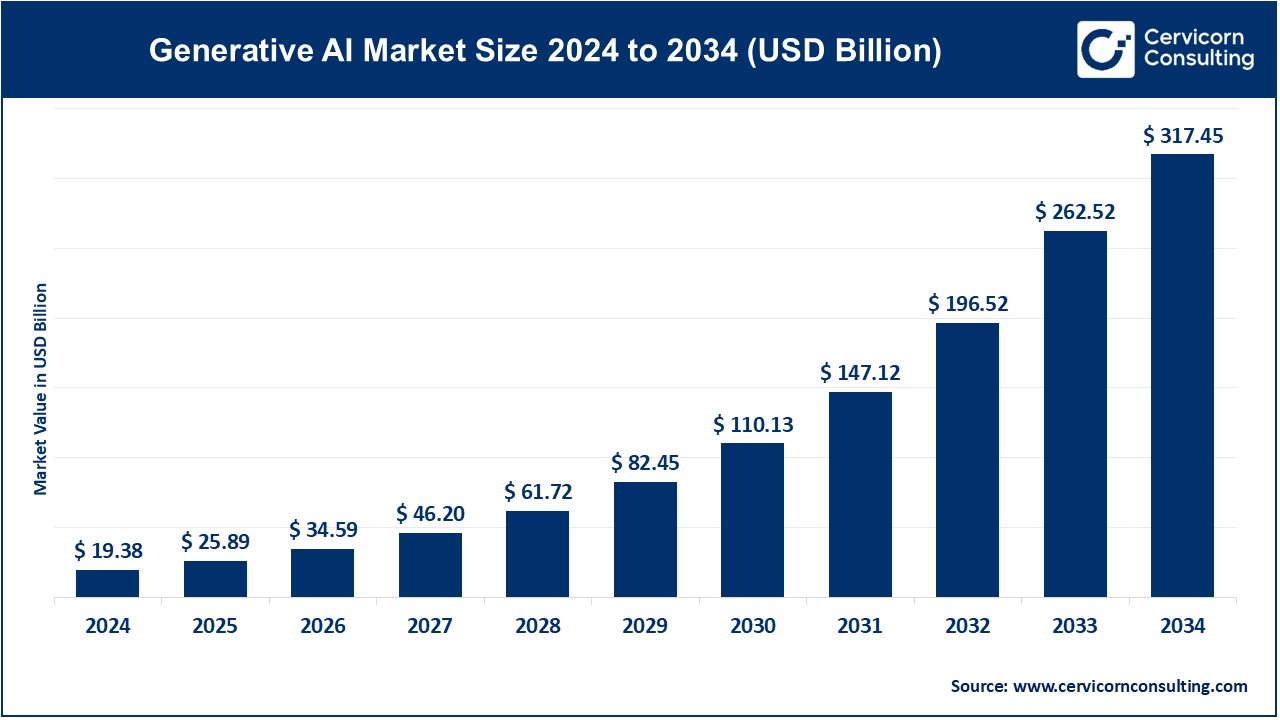
The global generative AI market size was worth USD 19.38 billion in 2024 and is anticipated to expand to around USD 317.45 billion by 2034, registering a compound annual growth rate (CAGR) of 33.58% from 2025 to 2034.
What Is the Generative AI Market?
The generative AI market refers to the ecosystem of technologies, models, tools, platforms, and commercial applications built to generate new digital content using artificial intelligence. These models learn patterns from massive datasets and use them to produce high-quality outputs that resemble — and often improve on — human-created content.
The market includes:
- Foundation model developers (e.g., OpenAI, Google DeepMind)
- Cloud platforms offering training/inference infrastructure (e.g., AWS, Microsoft Azure)
- Model marketplaces and API providers
- Enterprise software embedding generative features (customer service, marketing, product design)
- Industry-specific applications (healthcare synthetic data, advertising creative engines, game asset generators)
- Services for fine-tuning, customization, governance, and deployment
Generative AI is now foundational to digital transformation strategies across nearly all sectors: media, e-commerce, manufacturing, IT, financial services, entertainment, healthcare, and government operations.
Get a Free Sample: https://www.cervicornconsulting.com/sample/2396
Why Is the Generative AI Market Important?
Generative AI is important because it fundamentally changes how value is created. Traditional AI focused on decision-making and classification — generative AI adds the ability to create. By generating content, designs, ideas, or even executable code, it enhances productivity and reduces the need for repetitive labor-intensive tasks.
Key reasons it matters:
1. Transforms productivity
Generative AI automates everything from content creation to documentation, software coding, and reporting, enabling workers to shift to higher-value tasks.
2. Expands creativity
It empowers individuals and small businesses with creative superpowers — producing designs, images, videos, and concepts traditionally reserved for highly skilled teams.
3. Reduces costs
Marketing, design, customer support, prototyping, and R&D cycles become significantly more cost-efficient.
4. Enables new business models
Subscription APIs, AI-powered creative platforms, automated video production, AI agents, and hyper-personalized digital experiences are transforming digital commerce.
5. Supports innovation in regulated sectors
Healthcare, finance, and government agencies use generative AI for risk reduction, modeling, synthetic data generation, and process improvement.
Growth Factors of the Generative AI Market
The generative AI market is expanding rapidly due to massive breakthroughs in model training, falling GPU and cloud compute costs, strong investment from both private and public sectors, rising enterprise adoption of AI-enabled workflows, increasing availability of developer APIs, multimodal capabilities that combine text, images, audio, and video, heavy demand for automated content creation in marketing and media, the integration of AI into cloud platforms, the growth of model fine-tuning services for domain-specific use cases, and the introduction of government frameworks that clarify guidelines for responsible AI development — all of which collectively fuel sustained global growth.
Top Companies in the Generative AI Market
Below are detailed, citation-free profiles of the leading global participants, including their specialties, focus areas, notable features, 2024 revenue context, and market presence.
1. OpenAI
Specialization:
Large language models, multimodal systems, generative text and image tools, developer APIs, and consumer-facing AI applications.
Key Focus Areas:
Foundation model development, enterprise AI solutions, ChatGPT enhancements, agentic systems, safety research, fine-tuning services, and partnerships with global platforms.
Notable Features:
- Creator of industry-leading GPT models
- Highly popular consumer product (ChatGPT) with global brand recognition
- Strong ecosystem of developers and enterprise users
- Rapid iteration and model deployment cycles
2024 Revenue:
OpenAI’s estimated 2024 revenue is widely reported to be around $3–4 billion, driven by API consumption, enterprise licenses, and ChatGPT subscriptions.
Market Share & Global Presence:
OpenAI is one of the most influential generative AI companies, with worldwide API usage across North America, Europe, Asia-Pacific, and emerging markets. Its models power thousands of third-party apps.
2. Google DeepMind (Alphabet)
Specialization:
Advanced AI research, multimodal models, applied generative AI for cloud and consumer products.
Key Focus Areas:
Search augmentation, Workspace productivity tools, image and video generation, AI-native assistants, data governance, and embedding generative capabilities across Google Cloud.
Notable Features:
- Long-standing research excellence
- Integration across Search, YouTube, Gmail, Ads, and Android
- Strong AI safety and ethics frameworks
- Massive compute and proprietary datasets
2024 Revenue:
Alphabet’s overall 2024 revenue places it among the world’s largest tech companies. Google Cloud demonstrated strong double-digit growth, with significant contributions from AI services. DeepMind’s revenue is not publicly broken out but fuels strategic internal product development.
Market Share & Global Presence:
Google has unparalleled global reach through its consumer ecosystem and cloud presence across multiple regions.
3. IBM Watson (IBM)
Specialization:
Enterprise-grade AI, hybrid cloud deployments, automation, AI governance, and models tailored for regulated industries.
Key Focus Areas:
Watsonx generative AI services, industry-specific model governance, synthetic data for regulated environments, consulting-led AI transformation, and integrated hybrid cloud infrastructure.
Notable Features:
- Strong reputation for explainability and responsible AI
- Deep roots in enterprise solutions
- Specialization in finance, healthcare, and government clients
- Focus on governance, compliance, and risk mitigation
2024 Revenue:
IBM’s total 2024 revenue was approximately $62–63 billion, with a growing portion attributed to AI-driven software and consulting. Generative AI is a core pillar across IBM’s cloud and enterprise offerings.
Market Share & Global Presence:
IBM maintains strong global enterprise presence across North America, Europe, Asia-Pacific, the Middle East, and Africa, particularly in highly regulated sectors.
4. Microsoft AI
Specialization:
Cloud AI infrastructure, enterprise AI solutions, productivity AI (Microsoft 365 Copilot), developer tooling, and strategic AI partnerships.
Key Focus Areas:
Azure AI services, Copilot across Office apps, GitHub Copilot for developers, enterprise-grade LLMs, and integration of AI into Dynamics, Windows, and Azure cloud workloads.
Notable Features:
- Deep partnership with OpenAI
- Huge enterprise software footprint
- End-to-end platform: cloud + productivity + development tools
- Cloud-scale compute resources for training and inference
2024 Revenue:
Microsoft generated more than $245 billion in total revenue in 2024, with AI and cloud services contributing significantly to its rapid growth.
Market Share & Global Presence:
Microsoft is one of the top cloud providers worldwide, with generative AI deployed across all major industry verticals and global enterprise customers.
5. Amazon Web Services (AWS)
Specialization:
Cloud infrastructure for generative AI, model hosting, scalable training clusters, and enterprise-ready AI services.
Key Focus Areas:
Managed AI services, enterprise inference endpoints, model marketplaces, vector databases, multimodal model development, and training infrastructure.
Notable Features:
- Largest cloud infrastructure provider
- Powerful global data center network
- Strong focus on scalable, cost-efficient model serving
- Broad ecosystem of third-party models integrated into AWS tools
2024 Revenue:
AWS generated around $108 billion in 2024 cloud revenue, reflecting its central role in powering global generative AI training and inference workloads.
Market Share & Global Presence:
AWS holds one of the highest global cloud market shares and has data centers in nearly every region, serving AI workloads worldwide.
Leading Trends in the Generative AI Market and Their Impact
1. Rise of Foundation Models + Fine-Tuning Ecosystems
Enterprises increasingly prefer pre-trained models optimized through fine-tuning or adapters.
Impact: Faster deployment, customized outputs, and reduced training costs.
2. Multimodal AI Goes Mainstream
Models capable of understanding text, vision, audio, and video are now standard.
Impact: Enables new applications like AI video generation, smart assistants, and multimodal search.
3. On-Device AI and Edge Inference
Smaller, optimized models run directly on mobile or embedded devices.
Impact: Enhances privacy, reduces latency, and unlocks AR/VR interactions.
4. Regulatory Acceleration
Countries are now developing structured AI guidelines, safety protocols, and compliance frameworks.
Impact: Encourages responsible innovation while increasing documentation and regulatory costs for vendors.
5. AI Agents (Autonomous Multi-Step Systems)
Models now act beyond single responses — performing tasks, managing tools, and executing workflows.
Impact: Significant productivity boost and early automation of complex tasks.
6. Commoditization of AI APIs
Core model capabilities become standardized across providers.
Impact: Vendors differentiate through performance, integration, vertical specialization, and pricing models.
7. Specialized Chips and AI Infrastructure
Custom accelerators and optimized compute clusters drive down model training costs.
Impact: More organizations can train large models, expanding competition.
Successful Examples of Generative AI Adoption Worldwide
1. Marketing & Creative Industries
Companies use generative AI to produce ad copy, banners, product imagery, video ads, website content, and social media assets — reducing creative cycles from weeks to minutes.
2. Software Development
Tools like coding assistants and automated documentation generators help developers increase throughput, reduce debugging time, and improve code quality.
3. Gaming & Entertainment
Studios generate concept art, 3D models, NPC dialogues, soundtracks, and world-building assets using generative tools — dramatically accelerating pre-production.
4. Customer Support & Automation
AI agents summarize conversations, suggest solutions, and automate repetitive support tasks, improving customer satisfaction and lowering operational costs.
5. Healthcare & Pharmaceutical R&D
Generative models are used for drug molecule design, protein modeling, clinical data summarization, and synthetic patient datasets used for safe AI training.
6. E-commerce Personalization
Retailers generate personalized product descriptions, dynamic ads, user recommendations, and automated merchandising content.
7. Media & Journalism
Generative systems assist with story drafting, research synthesis, headline testing, and automated localization.
Global Regional Analysis — Government Initiatives & Policies
Government regulations and national AI strategies are shaping the pace and direction of generative AI adoption worldwide. Below is a region-wise breakdown.
North America
United States
The U.S. follows a hybrid regulatory approach — encouraging innovation through federal research funding while issuing executive orders and agency guidelines on safety, privacy, security, and critical infrastructure protection.
Key dynamics:
- Massive private sector investment
- Robust cloud and compute infrastructure
- Wide enterprise adoption in finance, healthcare, retail, and government
- Sandboxes and federal AI R&D programs accelerating foundational research
Canada
Canada promotes ethical AI guidelines, transparency, and responsible experimentation, with strong public investment in AI research clusters and innovation hubs.
Europe (EU & UK)
European Union
The EU leads with comprehensive AI regulations focused on risk classification, safety, transparency, data governance, and human oversight.
Impact on market:
- Companies must meet strict compliance requirements
- Boosts trust and public adoption
- Slows deployment speed but improves long-term reliability
- Encourages European startups specializing in AI safety, compliance, and governance
United Kingdom
The UK supports pro-innovation regulatory frameworks, publishes national AI safety strategies, and positions itself as a global center for AI evaluation and governance expertise.
Asia-Pacific
India
India positions generative AI as key to digital growth, prioritizing AI research, skills development, digital public infrastructure, and enterprise AI adoption. Startups in fintech, education, and e-commerce are driving rapid deployment.
China
China takes a state-guided approach — investing heavily in domestic large models, enforcing algorithmic accountability, and integrating AI into manufacturing, finance, and public services.
Japan
Japan emphasizes industrial automation, robotics, and multimodal AI research while promoting responsible innovation and collaboration between academia and industry.
South Korea
South Korea invests in large-scale AI clusters, chip manufacturing, and digital government transformation, positioning itself as a leader in AI hardware and smart city solutions.
Singapore
Singapore has developed robust AI governance frameworks and regulatory sandboxes, enabling safe experimentation in finance, healthcare, and public services.
Middle East & Africa
United Arab Emirates, Saudi Arabia
Gulf countries invest in AI mega-projects, national AI strategies, and government-led innovation, fostering rapid adoption in public services, smart cities, and energy.
Africa
AI adoption is growing in finance, mobile services, agriculture, and public healthcare, supported by innovation hubs in Nigeria, Kenya, South Africa, and Rwanda.
To Get Detailed Overview, Contact Us: https://www.cervicornconsulting.com/contact-us
Read Report: Artificial Intelligence (AI) in Smart Cities Market Revenue, Global Presence, and Strategic Insights by 2034