Generative AI in Hardware Market Revenue, Trends, and Strategic Insights by 2035
Generative AI in Hardware Market Size
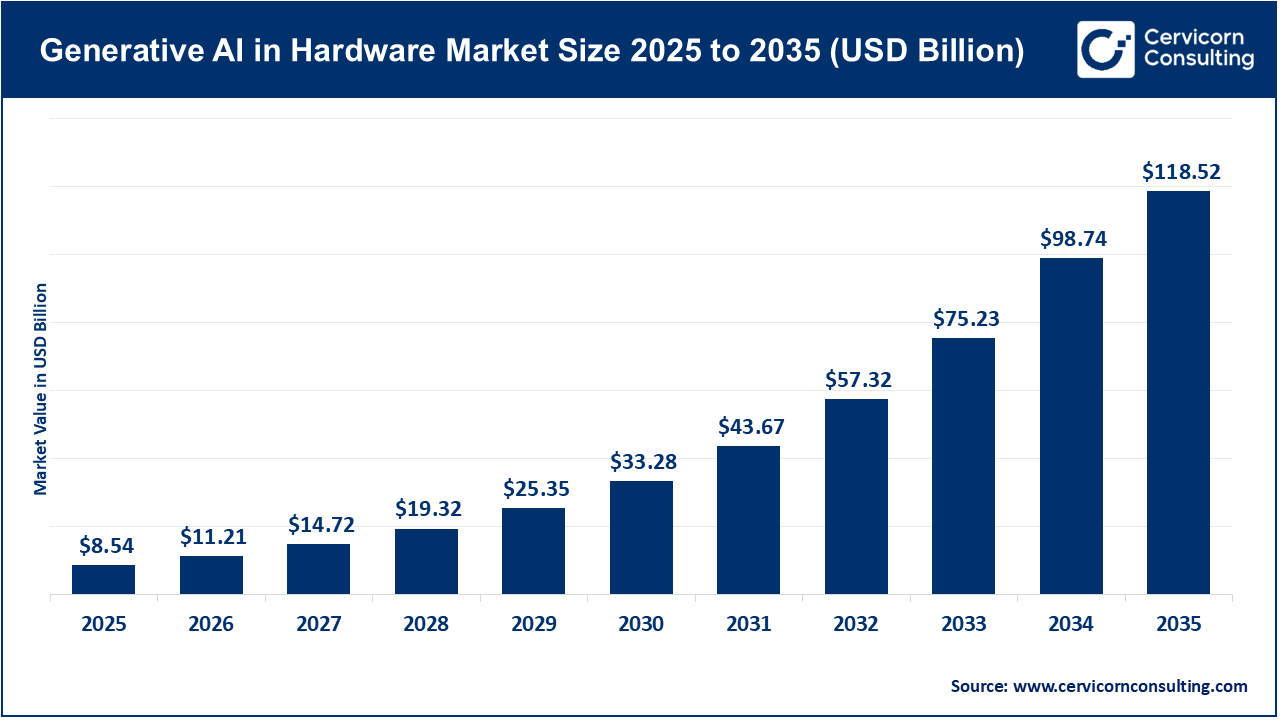
The global generative AI in hardware market size was valued at approximately USD 8.54 billion in 2025 and is projected to reach nearly USD 118.52 billion by 2035, growing at a CAGR of 30.09%.
Generative AI in Hardware Market Growth Factors
The generative AI in hardware market is experiencing remarkable growth due to the rapid adoption of artificial intelligence across industries, increasing demand for high-performance computing infrastructure, rising investments in AI data centers, expansion of cloud-based AI services, and the growing need for specialized processors capable of handling large language models (LLMs) and generative AI workloads. The proliferation of AI-powered applications in healthcare, finance, automotive, manufacturing, media, and retail sectors is driving demand for advanced GPUs, AI accelerators, TPUs, and neural processing units.
Additionally, the emergence of edge AI, autonomous systems, digital twins, smart devices, and AI-enabled consumer electronics has significantly increased the requirement for dedicated hardware solutions. Government investments in semiconductor manufacturing, AI research programs, and national AI strategies further support market expansion. The growing popularity of generative AI models such as ChatGPT, Gemini, Claude, Midjourney, and enterprise AI platforms has accelerated the deployment of AI infrastructure worldwide, creating substantial opportunities for hardware manufacturers and technology providers.
Get a Free Sample: https://www.cervicornconsulting.com/sample/2641
What is the Generative AI in Hardware Market?
The generative AI in hardware market refers to the ecosystem of processors, accelerators, memory systems, networking components, and computing infrastructure specifically designed to support the training, deployment, and inference of generative artificial intelligence models.
Generative AI systems require enormous computational resources because they process billions or even trillions of parameters. Traditional CPUs alone are often insufficient to handle such workloads efficiently. As a result, specialized AI hardware has become essential for enabling the development and deployment of advanced generative AI applications.
The market includes:
- Graphics Processing Units (GPUs)
- Tensor Processing Units (TPUs)
- AI Accelerators
- Neural Processing Units (NPUs)
- High-Bandwidth Memory (HBM)
- AI Servers
- Edge AI Chips
- Data Center Infrastructure
- AI Networking Components
These hardware solutions provide the computational power necessary for machine learning training, inference, deep learning workloads, and real-time generative AI applications.
Why is Generative AI Hardware Important?
Generative AI hardware serves as the backbone of modern AI innovation. Without specialized hardware, advanced AI models would be impractical due to excessive processing times and energy requirements.
Accelerates AI Model Training
Training large language models can require thousands of GPUs operating simultaneously. Advanced AI hardware dramatically reduces training time from months to weeks or days.
Supports Real-Time Inference
Generative AI applications require immediate responses. AI accelerators enable low-latency performance for chatbots, recommendation systems, and content-generation tools.
Improves Energy Efficiency
Dedicated AI processors are optimized for parallel computing, delivering higher performance while consuming less power compared to traditional processors.
Enables Edge AI
AI hardware allows generative AI capabilities to run directly on smartphones, vehicles, robots, and IoT devices without relying entirely on cloud infrastructure.
Drives Innovation Across Industries
Healthcare diagnostics, autonomous driving, financial forecasting, drug discovery, manufacturing automation, and creative content generation all depend on advanced AI hardware capabilities.
Competitive Landscape
NVIDIA
| Category | Details |
|---|---|
| Company | NVIDIA |
| Specialization | AI GPUs and Accelerated Computing |
| Key Focus Areas | Data Center AI, Generative AI Infrastructure, AI Training |
| Notable Features | H100, H200, Blackwell GPUs, CUDA Ecosystem |
| 2025 Revenue | Approximately USD 190+ Billion |
| Market Share | Estimated 75–85% of AI Accelerator Market |
| Global Presence | North America, Europe, Asia-Pacific, Middle East, Latin America |
NVIDIA remains the undisputed leader in generative AI hardware. The company’s GPUs power many of the world’s largest AI models and cloud computing environments.
Its CUDA software ecosystem provides developers with optimized tools for AI training and deployment, creating a significant competitive advantage.
The introduction of Blackwell architecture further strengthens NVIDIA’s position by delivering substantial improvements in AI performance and efficiency.
AMD
| Category | Details |
|---|---|
| Company | AMD |
| Specialization | AI GPUs and Data Center Accelerators |
| Key Focus Areas | AI Computing, Cloud Infrastructure, Enterprise AI |
| Notable Features | Instinct MI300 Series Accelerators |
| 2025 Revenue | Approximately USD 35–40 Billion |
| Market Share | Estimated 10–15% AI Accelerator Market |
| Global Presence | Worldwide Operations |
AMD has emerged as a major challenger in the AI hardware landscape through its Instinct accelerator portfolio.
The MI300 series has gained traction among hyperscale cloud providers and enterprises seeking alternatives to NVIDIA solutions.
AMD’s strategy focuses on delivering high-performance AI computing combined with open software ecosystems.
Intel
| Category | Details |
|---|---|
| Company | Intel |
| Specialization | CPUs, AI Accelerators, Edge AI Solutions |
| Key Focus Areas | Enterprise AI, Edge Computing, AI PCs |
| Notable Features | Gaudi AI Accelerators, Xeon AI Processors |
| 2025 Revenue | Approximately USD 55–60 Billion |
| Market Share | Estimated 5–10% AI Hardware Market |
| Global Presence | More than 100 Countries |
Intel leverages its extensive semiconductor expertise to provide AI-enabled processors and accelerator technologies.
The company’s Gaudi AI accelerator family has attracted interest from organizations seeking cost-effective AI infrastructure solutions.
Intel is also investing heavily in AI-enabled PCs featuring integrated neural processing capabilities.
Google (TPU)
| Category | Details |
|---|---|
| Company | |
| Specialization | Tensor Processing Units |
| Key Focus Areas | Cloud AI Infrastructure, AI Training |
| Notable Features | TPU v5 and Advanced AI Clusters |
| 2025 Revenue | Alphabet Revenue Exceeding USD 400 Billion |
| Market Share | Significant Share in Cloud AI Infrastructure |
| Global Presence | Global Cloud Platform |
Google developed Tensor Processing Units specifically for machine learning workloads.
TPUs support Google’s own AI initiatives, including Gemini models, while also serving customers through Google Cloud.
The company’s vertically integrated approach combines hardware, software, and cloud infrastructure.
Apple (Neural Engine)
| Category | Details |
|---|---|
| Company | Apple |
| Specialization | On-Device AI Processing |
| Key Focus Areas | Consumer AI, Edge AI, Mobile AI |
| Notable Features | Apple Neural Engine (ANE) |
| 2025 Revenue | Approximately USD 400+ Billion |
| Market Share | Leading Position in Consumer AI Hardware |
| Global Presence | Worldwide Consumer Electronics Market |
Apple focuses on embedding AI capabilities directly into consumer devices.
The Apple Neural Engine powers AI-driven functionalities across iPhones, iPads, Macs, and wearable devices.
Its strategy emphasizes privacy-preserving AI by enabling local processing rather than relying exclusively on cloud infrastructure.
Leading Trends in the Generative AI Hardware Market and Their Impact
AI-Specific Chip Development
Traditional processors are increasingly being replaced by AI-optimized chips designed specifically for machine learning workloads.
Impact
- Faster AI training
- Improved performance per watt
- Reduced infrastructure costs
- Enhanced scalability
Growth of AI Data Centers
Hyperscale cloud providers continue investing billions of dollars in AI-focused data centers.
Impact
- Increased demand for GPUs and accelerators
- Expansion of cloud AI services
- Strong semiconductor revenue growth
- Global infrastructure modernization
High-Bandwidth Memory (HBM) Adoption
Generative AI models require rapid access to massive datasets.
HBM technologies significantly improve memory bandwidth, enabling faster model training and inference.
Impact
- Reduced processing bottlenecks
- Higher AI model efficiency
- Increased demand for advanced memory solutions
Edge AI Expansion
Organizations increasingly deploy AI capabilities at the edge rather than relying solely on centralized cloud systems.
Impact
- Growth in AI-enabled smartphones
- Smart manufacturing adoption
- Autonomous vehicle advancements
- Real-time AI decision-making
AI PCs and Consumer Devices
Major technology vendors are introducing AI-capable PCs equipped with neural processing units.
Impact
- Enhanced productivity tools
- Local AI execution
- Improved privacy protection
- Reduced cloud dependency
Sustainable AI Infrastructure
Energy consumption has become a significant concern for AI deployments.
Hardware manufacturers are prioritizing energy-efficient architectures.
Impact
- Reduced operating costs
- Improved sustainability metrics
- Regulatory compliance
- Lower environmental footprint
Successful Examples of Generative AI Hardware Around the World
OpenAI and Microsoft AI Infrastructure
Microsoft has deployed thousands of advanced AI accelerators to support OpenAI’s large language models.
The partnership demonstrates how specialized hardware enables large-scale AI deployment serving millions of users globally.
Key Achievements
- Massive AI training clusters
- Global cloud deployment
- Enterprise AI accessibility
Google Gemini Infrastructure
Google relies on TPU-based infrastructure to train and deploy Gemini models.
Its AI supercomputing environment demonstrates the effectiveness of custom-designed AI hardware.
Key Achievements
- Optimized AI performance
- Reduced training costs
- Cloud-based AI scalability
Tesla AI Supercomputer
Tesla utilizes specialized AI hardware for autonomous driving model development.
Its Dojo supercomputer represents one of the world’s most advanced AI training systems.
Key Achievements
- Autonomous vehicle training
- Large-scale video processing
- Enhanced AI model development
Apple Intelligence Ecosystem
Apple integrates AI hardware directly into consumer devices through its Neural Engine architecture.
Key Achievements
- On-device AI processing
- Improved privacy
- Real-time AI functionality
Healthcare AI Infrastructure
Hospitals and research institutions worldwide utilize GPU-based systems for medical imaging, genomics research, and drug discovery.
Key Achievements
- Faster diagnosis
- Accelerated drug development
- Improved patient outcomes
Global Regional Analysis
North America
North America dominates the generative AI hardware market due to the presence of major technology companies, advanced semiconductor ecosystems, and substantial AI investments.
Market Drivers
- Strong cloud infrastructure
- High AI adoption rates
- Extensive R&D spending
- Presence of leading AI companies
Government Initiatives and Policies
The United States government has launched multiple initiatives to strengthen domestic semiconductor manufacturing and AI leadership.
Key measures include:
- Semiconductor investment incentives
- National AI research programs
- AI safety frameworks
- Public-private research partnerships
- Advanced computing infrastructure investments
Regional Outlook
North America is expected to remain the largest market throughout the forecast period due to continuous innovation and large-scale AI deployment.
Europe
Europe is rapidly expanding its AI infrastructure capabilities while emphasizing responsible AI development.
Market Drivers
- Industrial automation
- Smart manufacturing
- Digital transformation
- Research collaborations
Government Initiatives and Policies
European governments have introduced policies focused on AI innovation and digital sovereignty.
Major initiatives include:
- European AI development programs
- Semiconductor manufacturing support
- AI regulatory frameworks
- Cross-border AI research funding
- Green computing initiatives
Regional Outlook
Europe is expected to witness steady growth supported by industrial AI applications and regulatory clarity.
Asia-Pacific
Asia-Pacific represents the fastest-growing region in the generative AI hardware market.
Market Drivers
- Semiconductor manufacturing leadership
- Growing AI startups
- Expanding cloud infrastructure
- Government-backed AI programs
Government Initiatives and Policies
China
- National AI Development Strategy
- Semiconductor self-sufficiency initiatives
- AI innovation funding programs
Japan
- AI-driven industrial transformation programs
- Advanced semiconductor investments
- Smart manufacturing initiatives
South Korea
- AI chip development programs
- Semiconductor ecosystem expansion
- AI research funding
India
- National AI Mission
- Semiconductor incentive schemes
- Digital infrastructure modernization
- AI startup support programs
Regional Outlook
Asia-Pacific is projected to record the highest growth rate due to strong manufacturing capabilities and increasing AI adoption.
Latin America
Latin America is gradually embracing AI technologies across financial services, telecommunications, and public-sector applications.
Market Drivers
- Digital transformation
- Cloud adoption
- Emerging startup ecosystems
- Smart city projects
Government Initiatives and Policies
Regional governments are investing in:
- Digital economy programs
- AI research centers
- Technology modernization initiatives
- Innovation funding mechanisms
Regional Outlook
The market is expected to grow steadily as organizations modernize digital infrastructure.
Middle East and Africa
The Middle East and Africa are increasingly investing in AI technologies as part of broader economic diversification strategies.
Market Drivers
- Smart city development
- Government digitalization programs
- Data center expansion
- AI-focused economic strategies
Government Initiatives and Policies
United Arab Emirates
- National AI Strategy
- Smart government initiatives
- AI innovation hubs
Saudi Arabia
- Vision 2030 digital transformation goals
- AI infrastructure investments
- Advanced technology partnerships
South Africa
- Digital economy programs
- AI research collaborations
- Innovation ecosystem development
Regional Outlook
Growing public and private investments in digital transformation will drive significant opportunities for AI hardware vendors throughout the region.
Future Outlook
The future of the generative AI hardware market will be shaped by increasing demand for specialized AI processors, advancements in semiconductor technologies, expansion of AI cloud infrastructure, and the widespread adoption of edge AI solutions. As organizations continue integrating generative AI into core business operations, demand for high-performance computing hardware will accelerate. Emerging technologies such as AI supercomputers, advanced packaging, chiplet architectures, quantum-inspired computing, and next-generation memory systems are expected to further enhance performance and efficiency. These developments will create new growth opportunities for hardware manufacturers while supporting the next wave of AI innovation across industries worldwide.
To Get Detailed Overview, Contact Us: https://www.cervicornconsulting.com/contact-us
Read Report: Smart Enterprise Market Revenue, Trends, and Strategic Insights by 2035