Electric Bus Market Growth Drivers, Trends, Key Players and Regional Insights by 2035
Electric Bus Market Size
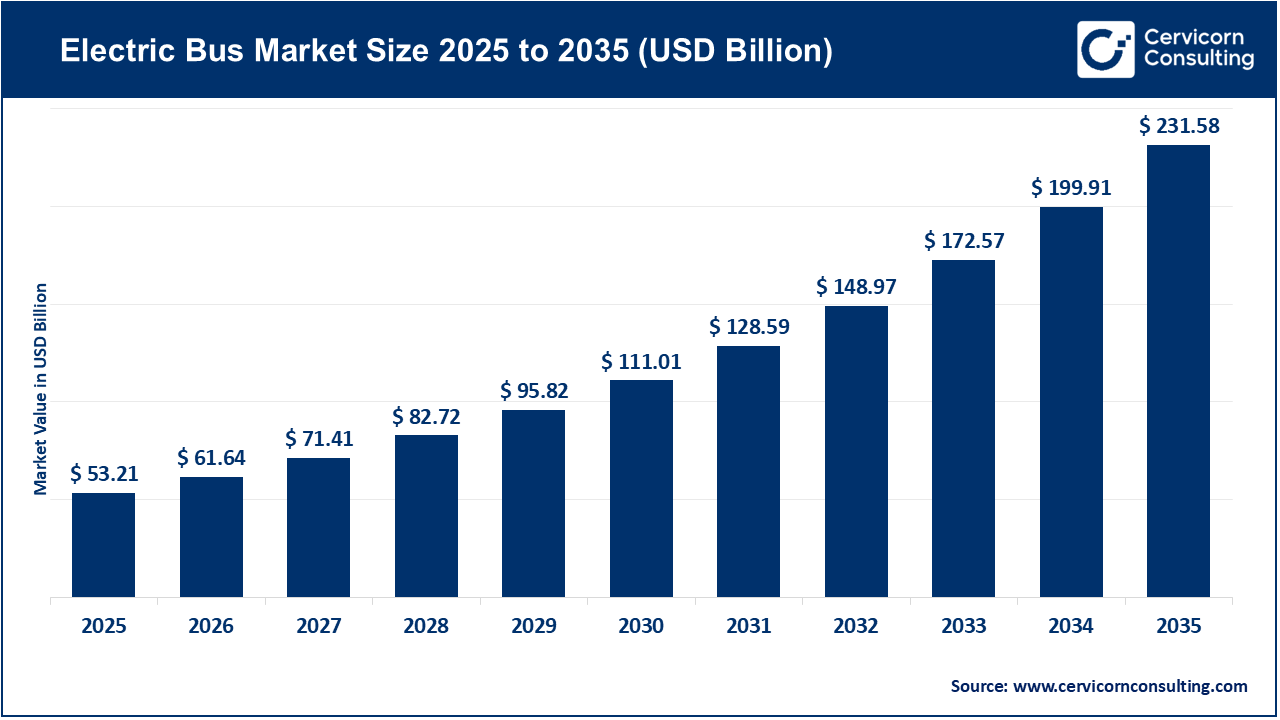
The global electric bus market size was worth USD 53.21 billion in 2025 and is anticipated to expand to around USD 231.58 billion by 2035, registering a compound annual growth rate (CAGR) of 15.8% from 2026 to 2035.
What Is the Electric Bus Market?
The electric bus market refers to the global industry involved in the manufacturing, deployment, operation, and servicing of buses powered entirely by electricity. These buses rely primarily on rechargeable battery systems, although hydrogen fuel cell-powered electric buses are also gaining traction in select applications. Electric buses are used across urban transit, intercity travel, school transportation, shuttle services, and last-mile connectivity.
The market includes not only vehicle manufacturers but also battery suppliers, charging infrastructure providers, software developers, fleet operators, and policy stakeholders. Battery electric buses currently dominate the market due to their technological maturity, cost-effectiveness, and compatibility with urban operating conditions. As cities modernize public transport networks, electric buses are increasingly integrated with smart mobility platforms, renewable energy grids, and digital fleet management systems.
Get a Free Sample: https://www.cervicornconsulting.com/sample/2881
Why Is the Electric Bus Market Important?
The importance of the electric bus market extends far beyond transportation, influencing environmental sustainability, public health, energy security, and economic development.
Electric buses produce zero tailpipe emissions, significantly reducing greenhouse gas emissions and harmful air pollutants such as nitrogen oxides and particulate matter. This directly improves air quality in urban environments and lowers the incidence of respiratory and cardiovascular diseases. Noise pollution is also reduced, enhancing overall urban livability.
From an economic standpoint, electric buses offer lower long-term operating and maintenance costs compared to diesel buses due to fewer moving parts and lower energy costs. They reduce dependence on fossil fuel imports, strengthening national energy security and enabling greater use of domestically generated electricity, including renewable sources.
The electric bus market also stimulates innovation and job creation across sectors such as battery manufacturing, software development, power electronics, and charging infrastructure, contributing to broader industrial growth and technological leadership.
Key Company Profiles in the Electric Bus Market
BYD Company Ltd.
Specialization: Battery electric buses and commercial electric vehicles
Key Focus Areas: Large-scale urban transit electrification, vertically integrated battery and vehicle manufacturing
Notable Features: Proprietary battery technologies, turnkey electric transit solutions, high-volume production capability
2024 Revenue: Part of BYD’s multi-billion-dollar global electric vehicle business
Market Share: One of the world’s largest electric bus suppliers with dominant market presence in China
Global Presence: China, Europe, North America, Latin America, Asia-Pacific
BYD is widely regarded as the global leader in electric bus manufacturing. Its vertically integrated approach allows it to control battery production, vehicle assembly, and system integration, resulting in competitive pricing and scalability. BYD has supplied tens of thousands of electric buses worldwide and has played a pivotal role in fully electrified public transport systems in major cities.
Yutong Bus
Specialization: Electric city buses, coaches, and double-decker buses
Key Focus Areas: Energy efficiency, long-range electric buses, international market expansion
Notable Features: Intelligent fleet management systems, high-capacity battery designs, premium electric coaches
2024 Revenue: Strong contribution from electric and alternative energy buses
Market Share: Significant share in China with growing presence in Europe and emerging markets
Global Presence: China, Europe, Latin America, Asia-Pacific
Yutong Bus has rapidly expanded its electric bus portfolio, focusing on both urban and intercity transportation solutions. The company is known for adapting its electric models to meet diverse regulatory and operational requirements across international markets.
Proterra
Specialization: Battery electric transit buses and charging infrastructure
Key Focus Areas: North American public transit electrification, fast-charging solutions
Notable Features: Modular battery platforms, advanced telematics, energy management systems
2024 Revenue: Primarily driven by electric bus and battery technology segments
Market Share: One of the leading electric bus manufacturers in the United States
Global Presence: United States and North America
Proterra has played a key role in advancing electric bus adoption in North America. Its focus on integrated charging and energy management solutions has made it a preferred partner for municipal transit agencies transitioning to zero-emission fleets.
Volvo Buses
Specialization: Electric and hybrid buses
Key Focus Areas: Sustainable public transport, safety systems, digital fleet services
Notable Features: Advanced safety technologies, premium build quality, lifecycle support services
2024 Revenue: Part of Volvo Group’s commercial vehicle segment
Market Share: Strong presence in Europe and growing global share
Global Presence: Europe, Asia-Pacific, Latin America, North America
Volvo Buses leverages its strong engineering heritage to deliver high-quality electric buses tailored for urban and regional transit. The company emphasizes safety, reliability, and integrated digital solutions.
Daimler Buses (Mercedes-Benz Buses)
Specialization: Battery electric and fuel cell electric buses
Key Focus Areas: Premium electric city and intercity buses, advanced safety and energy systems
Notable Features: High-capacity battery systems, over-the-air updates, intelligent energy management
2024 Revenue: Growing contribution from electric bus portfolio
Market Share: Increasing share in European electric bus registrations
Global Presence: Europe with expanding international footprint
Daimler Buses focuses on premium electric mobility solutions, combining advanced engineering with digital innovation. Its electric bus models are widely adopted across European cities aiming for high-performance, zero-emission transit.
Leading Trends and Their Impact on the Electric Bus Market
One of the most significant trends shaping the electric bus market is the rapid improvement in battery technology. Higher energy density, faster charging, and longer battery life have extended vehicle range and reduced downtime, enabling electric buses to operate across full-day schedules without operational disruption.
Public-private partnerships are increasingly common, allowing governments to collaborate with manufacturers and energy providers to deploy electric bus fleets and charging infrastructure efficiently. These partnerships reduce financial risks and accelerate adoption.
Another major trend is the integration of digital technologies such as telematics, predictive maintenance, and real-time fleet monitoring. These tools improve reliability, optimize energy usage, and lower total cost of ownership.
Hydrogen fuel cell electric buses are also emerging as a complementary solution for long-distance routes and high-demand applications where fast refueling and extended range are essential. Although battery electric buses dominate today, fuel cell technology is expected to grow steadily.
Successful Examples of Electric Bus Adoption Worldwide
Shenzhen, China, stands as one of the most successful examples of electric bus deployment, having fully electrified its public bus fleet. This transition has significantly reduced emissions and set a global benchmark for large-scale adoption.
European cities such as London, Paris, Amsterdam, and Oslo have deployed thousands of electric buses as part of aggressive climate action plans. These cities combine electric buses with low-emission zones and renewable energy integration.
In North America, cities like Los Angeles, Seattle, and New York have committed to fully electric bus fleets over the next decade, supported by federal and state-level funding programs.
Bogotá, Colombia, represents a landmark example in emerging markets, having implemented one of the largest electric bus fleets outside China, demonstrating scalability in developing economies.
Global Regional Analysis and Government Initiatives
Asia-Pacific
The Asia-Pacific region dominates the electric bus market, driven primarily by China’s large-scale government-backed electrification programs. Strong subsidies, manufacturing capacity, and charging infrastructure investments have enabled rapid deployment. India is also accelerating adoption through national incentive programs supporting electric bus procurement and infrastructure development.
Europe
Europe is one of the fastest-growing regions due to strict emission regulations and climate commitments. Policies mandating zero-emission public transport, combined with financial incentives and green financing, are driving widespread adoption across cities.
North America
The United States and Canada are witnessing growing electric bus adoption supported by federal funding programs and state-level zero-emission mandates. Public transit agencies are increasingly transitioning fleets as charging infrastructure expands.
Latin America
Countries such as Colombia, Chile, and Brazil are emerging as strong adopters of electric buses, supported by development banks and international climate financing aimed at improving urban air quality.
Middle East and Africa
While adoption is still in early stages, pilot projects and government-backed initiatives are gaining momentum, particularly in major urban centers seeking sustainable mobility solutions.
To Get Detailed Overview, Contact Us: https://www.cervicornconsulting.com/contact-us
Read Report: Paper Bottles Market Growth Drivers, Trends, Key Players and Regional Insights by 2035