eHealth Market Growth Drivers, Trends, Key Players and Regional Insights by 2034
eHealth Market Size
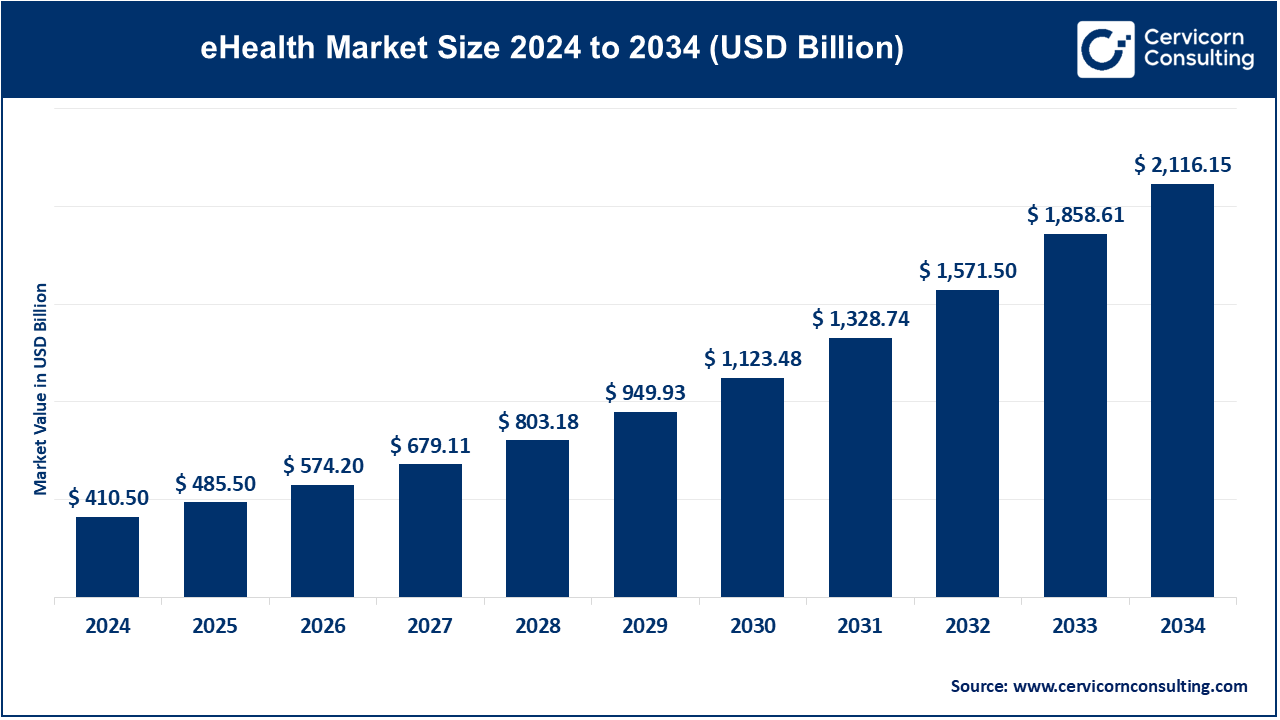
The global eHealth market size was worth USD 410.50 billion in 2024 and is anticipated to expand to around USD 2,116.15 billion by 2034, registering a compound annual growth rate (CAGR) of 18.27% from 2025 to 2034.
eHealth Market – Growth Factors
The eHealth market is expanding swiftly due to a combination of demographic, technological, economic, and policy-driven forces. A growing global incidence of chronic diseases, aging populations, and healthcare provider shortages have increased the need for scalable digital-care solutions. Advances in AI, cloud computing, miniaturized sensors, and mobile connectivity make telemedicine, remote patient monitoring, and electronic health data exchange highly viable. Healthcare systems facing rising costs increasingly adopt digital tools to improve efficiency and outcomes. At the same time, widespread smartphone penetration, acceptance of virtual care after the pandemic, strong private and public investments, and evolving government reimbursement frameworks have removed major barriers to adoption. These converging factors together fuel the sustained double-digit global growth of the eHealth industry.
What Is the eHealth Market?
The eHealth market refers to the ecosystem of digital technologies, services, systems, and devices that enhance or deliver healthcare using information and communication technologies. It includes telemedicine and telehealth platforms, electronic health records (EHR/EMR), mobile health (mHealth) apps, remote patient monitoring devices, AI-powered clinical solutions, digital therapeutics, medication management platforms, provider collaboration networks, patient engagement tools, and cloud-based healthcare data systems. In simple terms, eHealth is the digital infrastructure that enables clinicians, patients, devices, and data to work together — making healthcare more accessible, efficient, measurable, and tailored.
Get a Free Sample: https://www.cervicornconsulting.com/ehealth-market
Why is eHealth Important?
eHealth drives transformational change in global healthcare systems because it reshapes three core pillars: access, efficiency, and evidence. It expands access to care by bringing medical expertise to remote or underserved regions through virtual visits and remote monitoring. It improves efficiency by automating administrative tasks, enabling digital workflows, and minimizing unnecessary hospital visits. And it strengthens evidence-based care by generating continuous streams of real-world health data that help clinicians personalize treatments and help health systems optimize population health strategies. These capabilities reduce healthcare costs, improve patient outcomes, and enhance the overall resilience of healthcare systems — especially in contexts with workforce shortages or limited physical infrastructure. eHealth is becoming not just an innovation but a necessity for modern healthcare delivery.
Company Profiles
1. LiftLabs (Liftware)
- Company: Lift Labs, creator of Liftware, later acquired by Google’s life-science division (now Verily).
- Specialization: Assistive digital health devices designed to stabilize hand tremors using embedded sensors and motion-control technology.
- Key Focus Areas: Enhancing quality of life for people with Parkinson’s disease and essential tremor by enabling smoother daily activities like eating.
- Notable Features:
- Motion-stabilizing utensils with miniaturized sensors
- Interchangeable attachments (spoons, forks)
- Real-time tremor compensation to support independence
- 2024 Revenue: Not publicly disclosed due to integration into Alphabet’s ecosystem.
- Market Share: A leading product in the niche assistive-tremor device segment but not reported as part of broader eHealth market share.
- Global Presence: Devices distributed internationally; supported by both consumer markets and humanitarian programs.
2. Doximity, Inc.
- Company: A public company providing a digital platform for medical professionals.
- Specialization: Clinician networking, telehealth tools, workforce insights, and workflow productivity software.
- Key Focus Areas: Physician collaboration, hospital communications, telemedicine visits, recruitment advertising, and clinical productivity solutions.
- Notable Features:
- Verified clinician profiles
- HIPAA-compliant telehealth tools
- Widely used medical communication and fax-replacement services
- Influential physician compensation and workforce research
- 2024 Revenue: Approximately $475.4 million (publicly reported).
- Market Share: Over 80% of U.S. physicians are registered users, making it the dominant clinician network in the U.S.
- Global Presence: Primarily focused on the U.S., but its digital insights and workflow tools influence global medical communities.
3. IBM
- Company: One of the world’s largest technology and consulting enterprises.
- Specialization: Hybrid cloud, AI, analytics, security, and enterprise digital transformation, including large-scale healthcare solutions.
- Key Focus Areas:
- Healthcare AI and cognitive computing
- Population health analytics
- Cloud-based data infrastructure
- EHR integrations
- Healthcare consulting and managed services
- Notable Features:
- Global enterprise-grade infrastructure
- Healthcare-specific AI models and analytics
- Deep experience with regulated environments
- Support for massive data interoperability initiatives
- 2024 Revenue: Approximately $62.7 billion in total global revenue.
- Market Share: Influential in enterprise healthcare IT, cloud migration, and analytics; not reported as a unified “eHealth market share” due to broad segment coverage.
- Global Presence: Operates worldwide with healthcare clients across North America, Europe, APAC, Africa, and Latin America.
4. SetPoint Medical
- Company: A clinical-stage bioelectronic medicine company.
- Specialization: Implantable vagus nerve stimulation devices designed to modulate the immune system and treat chronic inflammatory diseases.
- Key Focus Areas:
- Development and clinical validation of implantable neuromodulation therapy
- Focus on rheumatoid arthritis and emerging autoimmune indications
- Clinical trials, regulatory approvals, and neuromodulation research
- Notable Features:
- Leadless, miniaturized, fully implanted VNS device
- One-minute daily therapy approach
- Positive clinical results in rheumatoid arthritis patients
- 2024 Revenue: Not publicly disclosed (privately held).
- Market Share: A niche leader in the emerging bioelectronic-medicine category.
- Global Presence: Primarily U.S.-focused with future international potential pending approvals.
5. Medisafe
- Company: A leading medication management and adherence platform.
- Specialization: mHealth apps and digital engagement tools designed to improve medication adherence for chronic-disease patients.
- Key Focus Areas:
- Pill reminders
- Dose tracking
- Patient engagement
- Pharma partnerships
- Real-world evidence generation
- Notable Features:
- Millions of users worldwide
- Predictive analytics for adherence risk
- Integrated engagement modules
- Data-driven support strategies for pharma companies
- 2024 Revenue: Not publicly disclosed; known for strong B2B partnerships with pharmaceutical companies.
- Market Share: Among the global leaders in medication adherence applications.
- Global Presence: Large user base in North America, Europe, and emerging markets with HIPAA/GDPR compliance for international operations.
Leading Trends and Their Market Impact
1. Normalization of Telehealth
Virtual consultations remain a mainstream mode of care following pandemic disruptions. Telemedicine platforms are increasingly integrated into clinical workflows and payer systems, driving hybrid care models that combine in-person and digital services.
Impact: Increased healthcare accessibility, reduced travel burden, improved provider productivity, and broader adoption of home-based care services.
2. Remote Patient Monitoring (RPM) and Wearables
Continuous monitoring devices for chronic conditions (e.g., blood pressure, glucose, arrhythmia, sleep, and respiration) provide real-time patient data to clinicians.
Impact: Early intervention, better chronic-disease control, reduced hospital readmissions, and new reimbursement pathways.
3. Artificial Intelligence in Diagnosis, Triage, and Workflow Automation
AI now supports radiology, pathology, population health management, and administrative automation.
Impact: Faster diagnoses, reduced clinician workload, greater consistency in medical impressions, and data-driven care pathways.
4. Rise of Digital Therapeutics & Bioelectronic Medicine
Software-based prescription therapies and neuromodulation devices (e.g., SetPoint Medical) are redefining how conditions are treated without pharmaceuticals.
Impact: New reimbursement models, enhanced patient engagement, and diversification of treatment options.
5. Interoperability and Healthcare Data Integration
Health systems increasingly prioritize secure, standardized data exchange through cloud platforms and APIs.
Impact: Better continuity of care, improved analytics, reduced data silos, and enhanced patient empowerment.
6. Shift Toward Patient-Centered Engagement Platforms
Tools like Medisafe emphasize behavior change, personalized engagement, and real-world evidence collection.
Impact: Improved adherence, reduced complications, and stronger partnerships between digital-health vendors and pharmaceutical companies.
Successful Examples of eHealth Market Applications Worldwide
- Doximity (USA) – An influential clinician platform enabling telehealth, medical communications, and professional networking among U.S. physicians, supporting better care coordination.
- Liftware (Global) – A successful assistive device showing how simple, accessible digital devices can significantly improve quality of life for people with neurodegenerative conditions.
- Medisafe (Global) – A top-rated medication adherence platform with millions of users and clinical validation of improved adherence outcomes.
- National Digital Health Platforms – Countries like Estonia, Denmark, Singapore, and the UAE have implemented advanced national EHR systems, e-prescription platforms, and telemedicine programs that demonstrate successful, scalable eHealth adoption.
These examples highlight the diversity of eHealth innovation — from assistive hardware to large enterprise IT ecosystems.
Global Regional Analysis — Government Policies Shaping the Market
Government policies play a defining role in eHealth adoption. Below is a region-by-region breakdown of major strategic priorities.
North America
United States
- Expansion of telehealth reimbursement
- Increased acceptance of remote monitoring
- Strong private-sector innovation and venture funding
- Regulatory emphasis on data privacy, cybersecurity, and interoperability
- Adoption of national health data exchange frameworks
These policies have positioned the U.S. as one of the fastest-growing eHealth markets in the world.
Canada
- Provincial-led digital health strategies
- Telehealth reimbursement flexibility
- Emphasis on centralized patient data records
Europe
Europe benefits from mature digital healthcare ecosystems supported by strong national strategies and strict data protection laws.
- Deployment of national EHR systems
- Reimbursement for teleconsultations in leading countries
- EU-level funding for cross-border healthcare data initiatives
- GDPR establishing strong trust in digital systems
Countries like Denmark, Estonia, and Finland are among the world leaders in eHealth readiness.
Asia-Pacific
India
- National Digital Health Mission driving unified health IDs, digital records, and telemedicine guidelines
- Massive smartphone adoption enabling mHealth growth
- Strong public-private partnerships
China
- Rapid growth of telemedicine platforms
- Government investment in hospital digitization
- Integration of digital health into broader smart-city infrastructure
Australia & Southeast Asia
- Expansion of telehealth in rural regions
- Strong focus on interoperable EHR systems
Latin America
- Growing interest in telemedicine and digital prescription systems
- Public sector investments to strengthen primary-care digitization
- High variability across countries due to infrastructure differences
Africa
- Many nations are still scaling national eHealth strategies
- Large donor-funded programs supporting digital health infrastructure
- Rising focus on mobile health to overcome geographic barriers
How Governments Shape eHealth Adoption
- Reimbursement policy determines whether digital services are financially sustainable.
- Interoperability mandates push health systems to adopt standardized, connected records.
- Privacy regulations build public trust needed for widespread digital adoption.
- Government procurement often seeds nationwide platforms (telehealth portals, vaccination systems, EHRs).
- Innovation grants and public-private partnerships help startups scale into national solutions.
To Get Detailed Overview, Contact Us: https://www.cervicornconsulting.com/contact-us
Read Report: Connected Health and Wellness Solutions Market Growth Drivers, Trends, Key Players and Regional Insights by 2034