Construction Equipment Market Revenue, Trends, and Strategic Insights by 2035
Construction Equipment Market Size
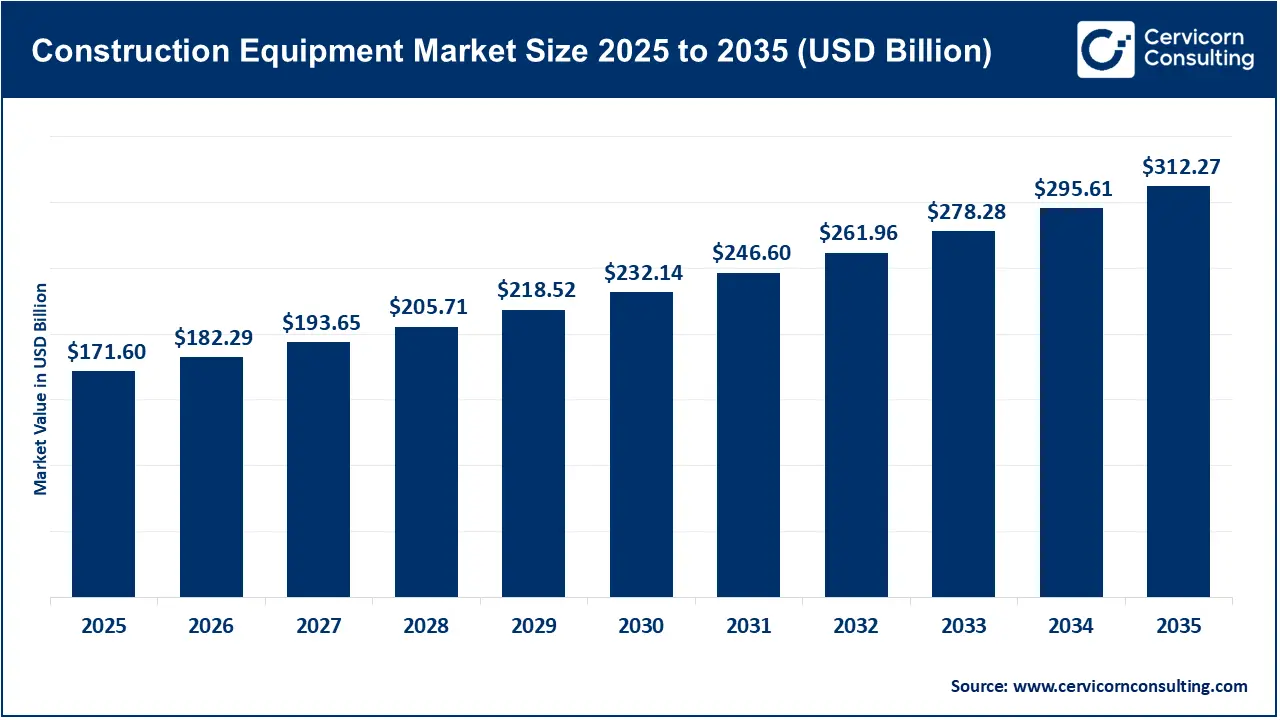
The global construction equipment market was valued at approximately USD 171.60 billion in 2025 and is projected to reach USD 312.27 billion by 2035, representing a 6.17% CAGR from 2026 to 2035.
Construction Equipment Market Growth Factors
The construction equipment market is being driven by rapid urbanization, large-scale infrastructure development, transportation modernization, rising residential and commercial construction, mining and quarrying activity, equipment replacement cycles, and increasing investment in renewable-energy infrastructure such as solar farms, wind projects, transmission networks, and battery facilities. Governments across developed and emerging economies are increasing spending on roads, bridges, railways, airports, ports, water systems, public housing, and urban infrastructure, creating sustained demand for excavators, loaders, cranes, bulldozers, graders, compactors, concrete equipment, and material-handling machinery. The expansion of equipment rental and leasing is also making high-value machinery more accessible to small and medium-sized contractors.
At the same time, contractors are prioritizing productivity, fuel efficiency, lower total cost of ownership, and reduced downtime, accelerating adoption of telematics, machine-control systems, automation, predictive maintenance, connected fleets, and electric and hybrid equipment. Construction companies are also under growing pressure to comply with increasingly stringent emissions standards, encouraging manufacturers to develop low-emission engines, battery-electric machines, alternative-fuel powertrains, and more efficient hydraulic systems. Asia Pacific remains particularly important because of infrastructure expansion and urban development, while North America and Europe are benefiting from infrastructure renewal and fleet modernization.
Get a Free Sample: https://www.cervicornconsulting.com/sample/2752
What Is the Construction Equipment Market?
The construction equipment market encompasses machinery, vehicles, attachments, tools, and technology used to perform construction, excavation, earthmoving, lifting, material handling, road building, demolition, concrete placement, site preparation, and related infrastructure activities.
Major equipment categories include excavators, backhoe loaders, wheel loaders, skid-steer loaders, track loaders, bulldozers, motor graders, cranes, dump trucks, rollers, asphalt pavers, concrete pumps, telehandlers, drilling equipment, crushing and screening equipment, and specialized civil-engineering machinery.
The market serves residential, commercial, industrial, infrastructure, mining, quarrying, utilities, and public-sector construction projects. Equipment can be purchased directly by contractors and construction companies or obtained through rental and leasing models.
The industry is also shifting from conventional machinery toward connected and intelligent equipment. Modern machines increasingly incorporate GPS, telematics, sensors, remote diagnostics, automated machine control, collision-avoidance systems, digital fleet-management platforms, and semi-autonomous operating capabilities.
By equipment type, excavators remain one of the industry’s most important categories. Mordor Intelligence estimates that excavators accounted for 51.24% of construction equipment market share in 2025, reflecting their extensive use across infrastructure, mining, utilities, demolition, and general construction.
Why Is the Construction Equipment Market Important?
Construction equipment is fundamental to economic development because major infrastructure projects cannot be executed efficiently using manual labor alone. Modern excavators, loaders, cranes, graders, pavers, and compactors enable contractors to complete large projects faster, with greater precision and improved worker productivity.
The sector is particularly important for transportation infrastructure. Highways, bridges, tunnels, airports, ports, and railway networks require large quantities of earthmoving, lifting, grading, paving, and material-handling equipment.
Construction machinery also plays an increasingly important role in energy-transition infrastructure. Solar parks, wind farms, power transmission systems, battery factories, hydrogen facilities, and data centers require extensive site preparation and civil construction before they become operational.
Another important factor is employment and industrial development. Construction equipment manufacturing supports engineering, component manufacturing, software, logistics, dealerships, maintenance, financing, and aftermarket services. Manufacturers increasingly generate revenue beyond initial machine sales through parts, maintenance contracts, digital services, financing, fleet-management solutions, and equipment-as-a-service models.
The market also contributes to sustainability. Electric mini excavators, hybrid machines, alternative-fuel engines, intelligent hydraulics, and automated systems can reduce fuel consumption, emissions, and unnecessary machine movement.
Major Companies in the Construction Equipment Market
| Company | Specialization | Key Focus Areas | Notable Features | 2025 Revenue | Market Share* | Global Presence |
|---|---|---|---|---|---|---|
| Caterpillar, Inc. | Heavy construction, mining, earthmoving equipment | Excavators, loaders, dozers, road equipment, digital solutions | Cat dealer network, telematics, automation, broad product portfolio | $67.589B total company revenue; about $37.5B construction equipment sales | 15.2% | Global, operating across every continent |
| CNH Industrial America LLC | Construction machinery through CASE and related brands | Excavators, loaders, backhoe loaders, compact equipment, road machinery | CASE brand, precision technology, connected equipment | $18.095B total CNH revenue; $2.956B construction revenue | ~1.2% based on construction revenue | North America, Europe, Latin America, Asia Pacific |
| Deere & Company | Construction and forestry equipment | Excavators, loaders, dozers, graders, forestry machinery | Smart Industrial strategy, precision technology, connected machines | $45.684B total revenue; $11.382B Construction & Forestry sales | 5.4% | North America, Latin America, Europe, Asia, other global markets |
| Doosan Corporation | Construction equipment through Doosan Bobcat and related businesses | Compact equipment, loaders, excavators, material handling | Strong compact-equipment portfolio, connected solutions, global dealer network | $6.182B Doosan Bobcat revenue | ~2.5% based on 2025 revenue against $246.6B industry benchmark | North America, Europe, Asia, Latin America, Middle East & Africa |
| Escorts Limited / Escorts Kubota | Construction equipment and agricultural machinery | Backhoe loaders, compactors, cranes, construction machinery | Strong Indian manufacturing base and domestic distribution | ₹10,243.88 crore consolidated revenue; ₹1,730.09 crore construction-equipment revenue | 6.27% in India’s construction-equipment market during Apr–Dec 2025 | India with expanding international presence |
*Market-share figures are not directly comparable because industry sources use different definitions. Caterpillar and Deere shares are based on the 2025 Yellow Table global OEM ranking, while CNH and Doosan figures shown here are indicative calculations using reported construction-related revenue. Escorts’ figure refers specifically to India’s construction-equipment market.
Caterpillar remained the world’s largest construction equipment manufacturer in the 2025 Yellow Table, recording approximately $37.5 billion in construction-equipment sales and a 15.2% share of global sales. Its total company sales and revenues reached $67.589 billion in 2025, the highest in the company’s history.
CNH Industrial reported $18.095 billion in total 2025 revenue, with its Construction segment generating $2.956 billion. Construction revenue declined 3.2% year over year, although global heavy construction equipment industry volume increased 7% during the year.
Deere & Company generated $45.684 billion in total sales and revenues during fiscal 2025. Its Construction & Forestry segment generated approximately $11.382 billion in net sales. In the 2025 Yellow Table, Deere ranked fourth globally, with approximately $13.2 billion in construction equipment sales and a 5.4% market share.
Doosan Bobcat, the construction-equipment business associated with Doosan, reported $6.182 billion in revenue for 2025. Compact Equipment represented its major product area, although revenue declined 1.4% amid weaker market conditions.
Escorts Kubota generated consolidated revenue of ₹10,243.88 crore in FY2025, while its construction-equipment segment generated ₹1,730.09 crore. The segment sold 6,484 units during the year. In India’s construction equipment market, Escorts Kubota held a 6.27% share during April–December 2025 according to industry sales data.
Leading Trends and Their Impact
1. Electrification of Construction Machinery
Electrification is moving from niche applications toward a broader construction-equipment strategy. Battery-electric mini excavators, compact loaders, electric wheel loaders, and other smaller machines are particularly suitable for urban construction because they can operate with lower noise and zero tailpipe emissions.
Government incentives are strengthening this trend. Japan, for example, has introduced subsidies for electric construction machinery and charging infrastructure through its GX construction-equipment initiatives. The government is also promoting the gradual use of GX construction machinery in public works.
The impact is extending beyond equipment manufacturers. Contractors must increasingly consider charging infrastructure, battery management, machine utilization, electricity availability, and total lifecycle costs when modernizing fleets.
2. Automation and Autonomous Equipment
Construction sites are becoming increasingly automated. Machine-control technologies allow equipment to follow digital site plans and execute grading, excavation, and other activities with greater accuracy.
Autonomous and semi-autonomous operation can reduce operator workload and improve consistency. It can also address labor shortages by allowing experienced operators to supervise multiple machines or perform more complex tasks.
For manufacturers, automation creates opportunities to generate recurring software and digital-service revenue in addition to traditional equipment sales.
3. Telematics and Connected Fleets
Telematics has become an increasingly important differentiator. Connected machines can provide information about location, fuel consumption, utilization, operating hours, maintenance requirements, fault codes, and machine health.
Fleet owners can use this information to identify underutilized equipment, schedule preventive maintenance, reduce idle time, and improve asset utilization.
Caterpillar, for example, is increasingly positioning itself around integrated lifecycle solutions rather than equipment alone. Its 2025 services revenue reached approximately $24 billion, demonstrating the growing significance of aftermarket and service-based business models.
4. Equipment Rental and Leasing
Rental companies are becoming increasingly influential buyers of construction machinery. Renting allows contractors to access expensive equipment without making large upfront investments.
Rental penetration is particularly attractive for compact machinery, aerial equipment, loaders, excavators, and specialized machines. Manufacturers therefore need to design equipment for high utilization, easy maintenance, remote monitoring, and rapid parts availability.
5. Alternative Powertrains
Although internal-combustion engines continue to dominate, manufacturers are investigating hybrid, battery-electric, hydrogen, renewable fuels, and other alternative powertrains.
Mordor Intelligence estimates that internal-combustion construction equipment still represented about 90.12% of the market in 2025, while hybrid and battery-electric equipment is projected to grow significantly faster.
This transition will likely happen at different speeds. Compact urban equipment can electrify relatively quickly, while extremely large mining and earthmoving machines may require alternative fuels, hybrid systems, or new charging solutions.
6. Artificial Intelligence and Predictive Maintenance
Artificial intelligence is increasingly being integrated into construction-equipment software. AI can analyze machine-health information to predict failures, recommend maintenance, identify inefficient operating patterns, and optimize fleet deployment.
Over time, construction companies are expected to move from reactive maintenance toward predictive and condition-based maintenance, reducing downtime and increasing equipment availability.
7. Digital Construction and BIM Integration
Building Information Modeling, digital twins, drone surveying, 3D mapping, GPS, and machine-control systems are creating a more digitally integrated construction environment.
Equipment manufacturers that can connect machinery with project-management and digital-construction platforms will have an advantage because contractors increasingly want a single flow of information from project design through machine operation and maintenance.
Successful Examples of Construction Equipment Market Development Around the World
India’s Expressway and Multimodal Infrastructure Expansion
India is one of the most important growth markets for construction equipment because of its large-scale highway, railway, airport, metro, port, industrial-corridor, and urban-development programs.
PM Gati Shakti has created a national framework for integrated multimodal infrastructure planning. The program brings together infrastructure initiatives from different ministries and incorporates projects involving roads, ports, inland waterways, airports, industrial corridors, and other economic infrastructure.
By February 2026, the Network Planning Group under PM Gati Shakti had evaluated 352 infrastructure projects with an estimated value of ₹16.10 lakh crore.
These projects generate demand for excavators, backhoe loaders, graders, crushers, pavers, compactors, cranes, and concrete machinery.
China’s Large-Scale Infrastructure and Equipment Renewal
China continues to demonstrate how government investment and equipment-renewal policies can stimulate machinery demand. In 2025, China issued 188 billion yuan in ultra-long special treasury bonds to support equipment upgrades across approximately 8,400 projects, generating more than 1 trillion yuan of total investment.
The policy supports modernization across energy, logistics, environmental infrastructure, education, healthcare, and other sectors. For construction-equipment manufacturers, such programs create opportunities for replacement of aging fleets and adoption of more technologically advanced machines.
United States Infrastructure Modernization
The United States remains an important market for construction equipment because of road, bridge, airport, water, energy, manufacturing, and data-center construction.
The Infrastructure Investment and Jobs Act continues to provide federal infrastructure funding. The U.S. Department of Transportation tracks the progression of IIJA funding through grants and project agreements covering stages ranging from design and pre-construction to construction.
The combination of infrastructure spending and aging construction fleets supports demand for replacement machinery, while high labor costs encourage contractors to invest in productivity-enhancing technologies.
Saudi Arabia’s Vision 2030 Construction Pipeline
Saudi Arabia has emerged as another major construction-equipment opportunity because of its Vision 2030 economic diversification program and large-scale urban, tourism, infrastructure, housing, logistics, and entertainment developments.
The country’s Vision 2030 framework identifies real estate and infrastructure development as a strategic pillar and emphasizes world-class urban communities, infrastructure improvement, tourism development, local supply-chain growth, and construction best practices.
Large projects create demand for high-capacity excavators, cranes, loaders, haulage equipment, concrete machinery, road-building machinery, and specialized equipment.
Global Regional Analysis Including Government Initiatives and Policies Shaping the Market
North America
North America is one of the world’s largest construction-equipment markets. The region benefits from infrastructure modernization, residential and commercial development, manufacturing investments, energy projects, data centers, mining, and equipment replacement.
The U.S. Infrastructure Investment and Jobs Act remains a major demand driver. Funding continues to progress through federal transportation programs, grants, and construction projects.
The region is also experiencing rapid growth in data-center construction because of artificial intelligence and cloud-computing demand. This creates additional demand for earthmoving, cranes, concrete equipment, electrical infrastructure machinery, and site-development equipment.
Canada’s infrastructure, mining, energy, and housing investments add further demand. Contractors are increasingly emphasizing machine utilization, fuel efficiency, operator-assistance technologies, and telematics.
Europe
Europe is characterized by strong demand for infrastructure renewal, urban redevelopment, rail projects, renewable energy infrastructure, and sustainable construction.
Environmental regulations are particularly influential. The EU Machinery Regulation 2023/1230 establishes health and safety requirements for machinery placed on the European market and increasingly incorporates considerations associated with digital technologies and machinery autonomy.
European emissions requirements are also pushing manufacturers toward cleaner engines, electrification, hybridization, and improved energy efficiency.
The region’s transition toward low-carbon construction is creating opportunities for electric excavators, compact electric loaders, battery-powered equipment, and machines designed for low-noise urban projects.
Asia Pacific
Asia Pacific is the largest regional market for construction equipment. One 2025 industry estimate places the region’s share at approximately 42.97%, while another estimates 45.8%, with the difference reflecting varying market definitions and methodologies.
China, India, Japan, South Korea, Southeast Asia, and Australia contribute significantly to regional demand.
China benefits from large-scale infrastructure investment and equipment-renewal programs. The government expanded the scope of equipment-upgrade programs in 2025, while ultra-long special treasury bonds supported large-scale equipment renewal.
India is benefiting from highways, railways, airports, metro systems, ports, industrial corridors, smart cities, housing, and logistics infrastructure. PM Gati Shakti is helping integrate infrastructure planning across government departments.
Japan is moving strongly toward low-carbon construction equipment. Its GX construction-equipment program provides support for electric machinery and charging infrastructure, while the government is working toward broader adoption in public works.
Southeast Asian markets such as Indonesia and Vietnam are also benefiting from urbanization, industrialization, transportation projects, ports, and manufacturing investments.
Middle East & Africa
The Middle East is increasingly important because of large-scale urban development, tourism infrastructure, energy projects, airports, logistics hubs, and smart-city developments.
Saudi Arabia’s Vision 2030 remains a major driver, with infrastructure and real-estate development positioned as important components of economic diversification.
The United Arab Emirates is similarly investing in transportation, urban development, logistics, renewable energy, and large commercial projects.
Africa presents a longer-term opportunity because many countries require substantial investment in roads, housing, ports, electricity infrastructure, water systems, and urban transportation. Demand is particularly attractive for versatile equipment such as backhoe loaders, compact excavators, wheel loaders, and road-building machinery.
However, financing constraints, import costs, currency volatility, and limited service infrastructure can affect equipment adoption in several African markets.
Latin America
Latin America is supported by mining, agriculture-related infrastructure, energy development, road construction, housing, and urbanization. Brazil is the region’s largest opportunity because of its large construction base and infrastructure requirements.
Brazil’s Novo PAC represents a significant source of infrastructure investment. Government data indicate planned investment of approximately R$1.9 trillion, including R$1.3 trillion during 2023–2026 and R$0.6 trillion after 2026.
In 2025, the government also announced more than R$49.2 billion for a new stage of Novo PAC selections covering infrastructure, mobility, housing, health, and education projects.
Brazil’s mining sector additionally supports demand for heavy-duty excavators, haulage equipment, loaders, crushing systems, and specialized machinery.
Across Latin America, rental models are becoming increasingly attractive because contractors can access machinery without carrying the full capital burden of ownership.
Competitive Outlook
Competition in the construction equipment industry is increasingly based on more than machine horsepower or purchase price. Manufacturers are competing on fuel economy, machine uptime, technology integration, financing, dealer coverage, aftermarket support, parts availability, resale value, operator comfort, automation, and emissions performance.
The 2025 global manufacturer rankings illustrate the industry’s concentration among large OEMs. Caterpillar retained the No. 1 position, while Komatsu ranked second, XCMG moved into third, Deere ranked fourth, and other major global manufacturers followed. The top manufacturers benefit from extensive dealer networks, manufacturing scale, strong brand recognition, and sophisticated aftermarket businesses.
At the same time, Chinese manufacturers are becoming increasingly competitive internationally, particularly in price-sensitive markets. European and North American manufacturers are responding through premium technology, digital services, automation, sustainability solutions, and lifecycle support.
The future competitive environment is therefore likely to combine equipment manufacturing with software, data, financing, rental, maintenance, automation, and energy solutions. Companies capable of providing a complete digital and physical ecosystem around construction machinery will be better positioned to capture the next phase of market growth.
To Get Detailed Overview, Contact Us: https://www.cervicornconsulting.com/contact-us
Read Report: Sachet Packaging Market Revenue, Trends, and Strategic Insights by 2035