Cloud Computing Market Revenue, Global Presence, and Strategic Insights by 2034
Cloud Computing Market Size
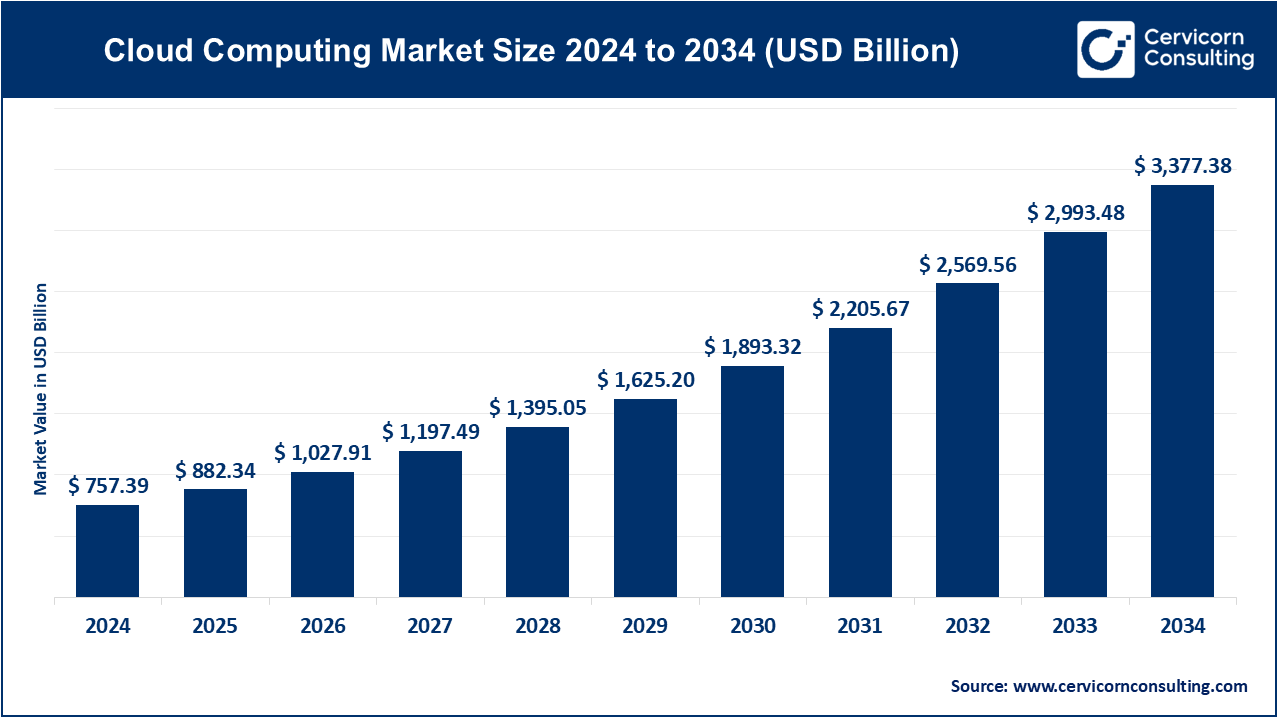
The global cloud computing market size was worth USD 757.39 billion in 2024 and is anticipated to expand to around USD 3,377.38 billion by 2034, registering a compound annual growth rate (CAGR) of 16.12% from 2025 to 2034.
Cloud Computing Market Growth Factors
The cloud computing market is expanding rapidly due to rising enterprise digital transformation efforts, increasing adoption of AI and machine learning workloads that require scalable GPU-powered infrastructure, and the shift from capital expenditure to cost-efficient operational expenditure models. The surge in remote and hybrid work has boosted demand for collaboration and productivity platforms hosted on the cloud. In addition, the modernization of legacy systems using cloud-native architectures, such as microservices, serverless computing, and container orchestration, has accelerated migration efforts. Enhanced security, improved global connectivity, the expansion of edge computing, stricter data sovereignty requirements, and the need for real-time analytics all further contribute to strong cloud market growth across regions and industries.
Get a Free Sample: https://www.cervicornconsulting.com/sample/2414
What Is the Cloud Computing Market?
The cloud computing market consists of companies that deliver computing resources—such as servers, storage, networking, databases, software, analytics, AI platforms, and developer tools—via the internet or private networks. These services are generally categorized as Infrastructure-as-a-Service (IaaS), Platform-as-a-Service (PaaS), Software-as-a-Service (SaaS), and specialized workloads such as serverless computing, edge computing, or AI model hosting.
The market includes hyperscalers (large cloud providers with global data centers), managed service providers, telecommunications companies, content delivery networks (CDNs), enterprise software vendors, and regional cloud operators. It covers everything from enterprise cloud migration and hybrid-cloud deployments to cloud-enabled application development, data analytics, cybersecurity, and industry-specific cloud services.
Why the Cloud Computing Market Is Important
Cloud computing plays a pivotal role in enabling global digital transformation. Its flexibility and scalability allow organizations to innovate faster while reducing infrastructure costs and operational complexity. Businesses utilize the cloud to launch new digital services, expand internationally, enhance customer experiences, and run compute-intensive workloads such as AI model training, big-data analytics, and real-time personalization engines.
Cloud platforms also strengthen business resilience by offering built-in backup, disaster recovery, security services, and compliance frameworks. For startups, cloud computing eliminates the need for large upfront investments. For enterprises, it modernizes IT operations and supports hybrid and multi-cloud environments. In short, the cloud computing market matters because it empowers organizations to operate efficiently, securely, and competitively in a global digital economy.
Top Cloud Computing Companies
Below are detailed profiles of your specified companies, including their specialization, key focus areas, notable features, estimated 2024 revenue where publicly known, market position, and global footprint.
1. Amazon Web Services (AWS)
Specialization:
AWS is the world’s largest cloud provider with the broadest portfolio of infrastructure, platform, database, and AI services.
Key Focus Areas:
- AI and machine learning (including model training, hosting, and generative AI services)
- Custom silicon such as Graviton and Trainium chips
- Hybrid cloud solutions such as AWS Outposts and Local Zones
- Large-scale enterprise cloud migration
- Security, compliance, and developer tools
Notable Features:
- Largest global network of data centers and availability zones
- Richest cloud service catalog
- Mature partner ecosystem and marketplace
- Highly reliable and secure infrastructure
2024 Revenue (AWS segment):
Approximately $108 billion.
Market Share (IaaS):
AWS leads the global IaaS market with the largest single share worldwide.
Global Presence:
Data centers across North America, South America, Europe, the Middle East, Africa, and Asia-Pacific, serving millions of customers from startups to large governments.
2. Alibaba Group — Alibaba Cloud
Specialization:
Asia’s largest cloud provider and a global leader in cloud services, especially for high-scale commerce, finance, and logistics platforms.
Key Focus Areas:
- AI and cloud intelligence platforms
- Data analytics, distributed databases, and enterprise cloud solutions
- Industry-specific cloud services for finance, logistics, and retail
- Hybrid cloud and government cloud solutions
- Digital public services in Asia
Notable Features:
- Dominant market position in China
- Deep integration with Alibaba’s ecosystem
- Strong AI and retail-tech capabilities
- Local compliance-driven features
2024 Revenue (Cloud Intelligence Group):
Approximately US$14.7 billion.
Market Share:
Largest cloud provider in China and consistently ranked among the top global cloud players.
Global Presence:
Data centers across China, Southeast Asia, Europe, the Middle East, and parts of the U.S.
3. Akamai Technologies
Specialization:
Akamai is a global leader in content delivery networks (CDN), edge computing, and cloud security services.
Key Focus Areas:
- Edge compute and low-latency web performance
- Cloud security solutions (WAF, DDoS, bot protection)
- Video streaming optimization
- Gaming and media content delivery
- Enterprise application protection and acceleration
Notable Features:
- One of the world’s largest distributed edge networks
- Highly resilient infrastructure for low-latency delivery
- Industry-leading cybersecurity capabilities integrated with CDN
- Strong customer base in media, gaming, and e-commerce
2024 Revenue:
Approximately $3.99 billion.
Market Share:
Among the largest global CDN and edge platform providers worldwide.
Global Presence:
A vast network of edge nodes across hundreds of cities in over 130 countries.
4. Deutsche Telekom AG (T-Systems)
Specialization:
A leading provider of telecommunications, hybrid cloud services, managed services, and sovereign cloud solutions, especially in Europe.
Key Focus Areas:
- Managed cloud services and systems integration
- Hybrid and multi-cloud solutions
- Telecom-integrated cloud connectivity
- Digital transformation for public sector institutions
- Sovereign cloud offerings aligned with EU data regulations
Notable Features:
- Strong compliance posture for EU data protection
- Deep integration with network services such as SD-WAN and private networking
- Strategic partnerships with hyperscalers
- Trusted provider for government and high-security organizations
2024 Cloud-Related Revenue:
Systems Solutions segment generated around €4.0 billion, with cloud as a major portion.
Market Share:
One of Europe’s leading managed cloud and sovereign cloud providers.
Global Presence:
Operations in Europe, Asia, the Americas, and Africa with data centers strategically located for local compliance.
5. Edgio (formerly Limelight Networks / Edgecast)
Specialization:
Edge computing, content delivery, and media streaming acceleration.
Key Focus Areas:
- Edge hosting for faster content delivery
- Media and video streaming optimization
- Application security and performance services
- Gaming, software distribution, and real-time applications
Notable Features:
- Low-latency global content delivery infrastructure
- Specialized solutions for high-volume media workloads
- Integrated edge compute and security stack
2024 Status and Revenues:
Historically a smaller CDN and edge competitor, with annual revenues around the low hundreds of millions. The company underwent major changes and ceased operations in early 2025, marking a notable shift in the CDN landscape.
Market Share:
A niche player relative to Akamai and larger CDN providers.
Global Presence:
Provided global PoP coverage prior to operational changes.
Leading Cloud Computing Trends in 2024 and Their Impact
1. AI-Driven Cloud Expansion
Cloud providers invested heavily in GPU clusters, AI chips, and managed model-access services. This shift made the cloud the go-to environment for training, tuning, and deploying AI models, dramatically increasing usage of high-performance compute (HPC) instances.
Impact:
Accelerated enterprise AI adoption, boosted cloud spending, and made hyperscalers pivotal in the global AI revolution.
2. Rise of Multi-Cloud and Hybrid Cloud Architectures
Organizations increasingly choose multiple cloud providers to reduce vendor lock-in, improve resilience, and optimize costs.
Impact:
Growth in cloud orchestration tools, cross-cloud networking, unified observability platforms, and multi-cloud security solutions.
3. Edge Computing Integrated with Cloud
With low-latency applications such as gaming, AR/VR, autonomous systems, and live streaming gaining demand, cloud providers and CDNs expanded edge computing nodes.
Impact:
Improved application responsiveness, global service reliability, and more opportunities for edge-cloud hybrid development.
4. Security and Zero Trust Becoming a Core Cloud Offering
With cyber threats increasing, cloud platforms embedded advanced security tools such as identity protection, threat intelligence, encryption, and compliance automation.
Impact:
Security became a strategic differentiator, benefiting providers with native cloud security stacks.
5. Cost Optimization and FinOps
Enterprises adopted structured FinOps practices to control cloud spending, reduce over-provisioning, and optimize workload placement.
Impact:
Greater transparency in resource usage and more widespread adoption of automation-driven cost controls.
6. Sovereign Cloud and Data Residency
Governments required data to be stored locally, creating demand for sovereign cloud offerings from regional and global providers.
Impact:
Growth in regional cloud data centers, partnerships with local telcos, and specialized government cloud programs.
Successful Global Examples of Cloud Computing Deployments
1. AI Application Modernization on AWS
Companies worldwide use AWS to scale AI-driven workloads, from recommendation engines to generative AI interfaces. AWS’s AI infrastructure enables businesses to train large models without investing in costly on-prem hardware.
2. Alibaba Cloud Supporting China’s Digital Ecosystem
Alibaba Cloud powers mega-scale e-commerce, fintech transactions, and logistics networks in China. It also supports government services and smart-city deployments.
3. Media & Gaming Acceleration Through Akamai
Akamai enables major streaming companies and gaming publishers to deliver seamless, low-latency experiences globally, ensuring smooth content delivery even during peak traffic.
4. European Government Cloud via Deutsche Telekom
Deutsche Telekom’s sovereign cloud and hybrid cloud services power several public-sector and regulated workloads across Europe, supporting secure data handling and compliance.
Global Regional Analysis: Government Initiatives and Policies Shaping Cloud Adoption
North America
Governments promote cloud-first strategies for federal and state modernization programs. Major investments include secure cloud infrastructure for defense, healthcare, and AI initiatives. Data protection laws at the state level influence how organizations use cloud services.
Europe
GDPR and digital sovereignty imperatives strongly influence cloud strategies. Many EU nations mandate data locality and encourage sovereign cloud programs. Partnerships between cloud providers and regional telcos have accelerated adoption. Public-sector cloud migration is supported through national digital transformation funds.
Asia-Pacific
China’s cloud market is driven by strict data regulations and strong domestic players such as Alibaba Cloud and Huawei Cloud. Southeast Asia continues to grow rapidly due to rising e-commerce, fintech, and government digital initiatives. Countries like Singapore, Indonesia, and India are heavily investing in cloud infrastructure to support smart cities and digital services.
Middle East & Africa
Nations are investing in national digital transformation, AI initiatives, and smart-city programs. Many governments are partnering with global cloud providers to build local data centers that comply with data sovereignty requirements.
Latin America
Cloud adoption is driven by fintech innovation, e-commerce growth, and modernization of public services. Investment in regional data centers improves latency and meets compliance needs. Brazil, Mexico, and Chile show the fastest adoption rates.
To Get Detailed Overview, Contact Us: https://www.cervicornconsulting.com/contact-us
Read Report: U.S. Energy Storage Market Growth Drivers, Trends, Key Players and Regional Insights by 2034