Clinical Decision Support Systems (CDSS) Market Revenue, Trends, and Strategic Insights by 2035
Clinical Decision Support Systems (CDSS) Market Size
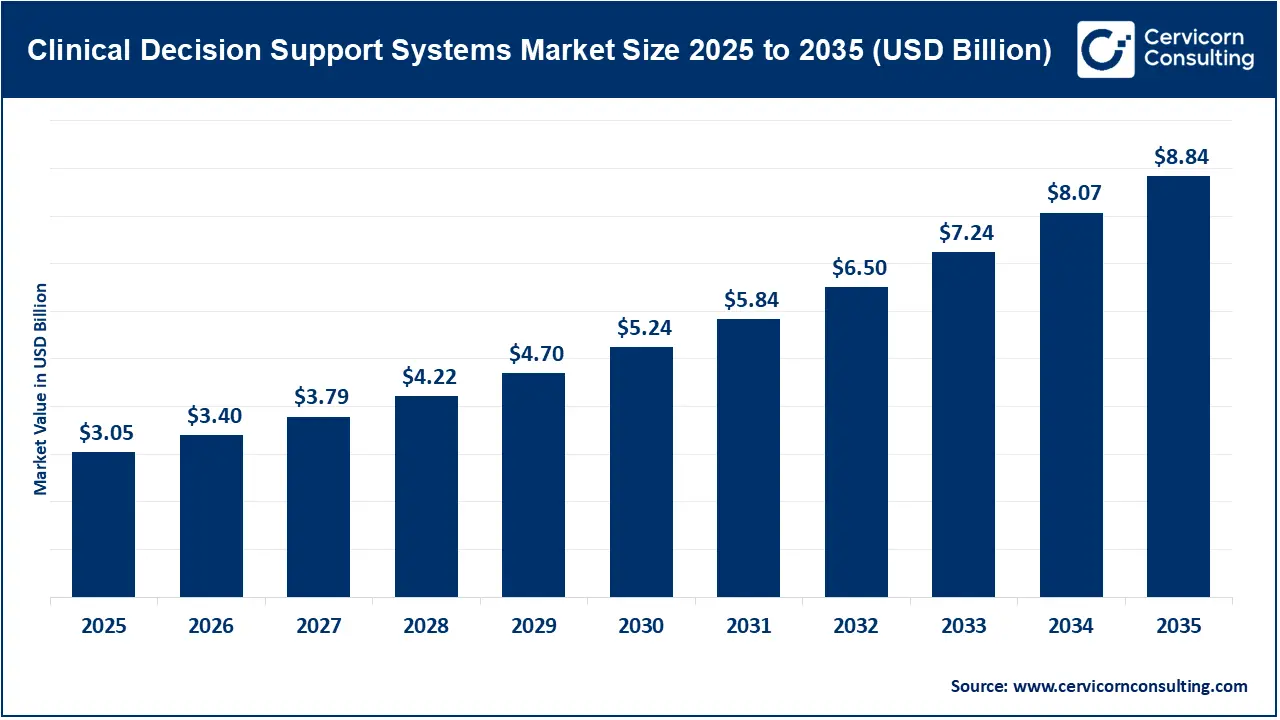
The global clinical decision support systems (CDSS) market was valued at approximately USD 3.05 billion in 2025 and is projected to reach USD 8.84 billion by 2035, expanding at a CAGR of 11.23% during the forecast period.
Clinical Decision Support Systems (CDSS) Market Growth Factors
The clinical decision support systems (CDSS) market is witnessing robust growth due to the increasing adoption of electronic health records (EHRs), rapid integration of artificial intelligence and machine learning into healthcare, rising prevalence of chronic diseases, growing demand for personalized medicine, expanding healthcare digitization initiatives, increasing government investments in health IT infrastructure, greater emphasis on reducing medical errors, rising demand for evidence-based clinical practices, expansion of cloud-based healthcare platforms, improved interoperability standards, growing adoption of predictive analytics, increasing healthcare expenditure worldwide, and the need to optimize hospital workflows while enhancing patient safety and treatment accuracy.
What is the Clinical Decision Support Systems (CDSS) Market?
The Clinical Decision Support Systems (CDSS) market refers to the global industry involved in the development, deployment, integration, and maintenance of software solutions that assist healthcare professionals in making informed clinical decisions. These systems analyze patient-specific data together with medical knowledge databases, clinical guidelines, laboratory findings, diagnostic imaging, medication history, and evidence-based research to generate recommendations that support physicians, nurses, pharmacists, and other healthcare professionals.
Modern CDSS solutions are integrated into hospital information systems, electronic health records, laboratory information systems, radiology platforms, pharmacy management software, and cloud-based healthcare ecosystems. They provide alerts, reminders, diagnostic assistance, medication recommendations, predictive risk assessments, clinical pathways, and treatment suggestions based on real-time patient information.
The market includes software vendors, AI technology providers, healthcare IT companies, cloud infrastructure providers, medical device manufacturers, and digital healthcare organizations working together to improve clinical decision-making across hospitals, specialty clinics, ambulatory care centers, research institutions, and telemedicine platforms.
Get a Free Sample: https://www.cervicornconsulting.com/sample/2707
Why is the Clinical Decision Support Systems (CDSS) Market Important?
Clinical Decision Support Systems have become indispensable because healthcare is becoming increasingly data-intensive. Physicians must interpret vast amounts of patient information while following rapidly evolving clinical guidelines. CDSS bridges this gap by delivering relevant information at the point of care.
Key reasons why CDSS is important include:
- Improves diagnostic accuracy through evidence-based recommendations.
- Reduces medication errors and adverse drug interactions.
- Supports personalized treatment planning.
- Enhances patient safety.
- Improves healthcare quality and consistency.
- Reduces unnecessary healthcare costs.
- Enables faster clinical workflows.
- Assists physicians in managing chronic diseases.
- Supports value-based healthcare initiatives.
- Facilitates compliance with clinical guidelines and regulatory standards.
Healthcare providers increasingly recognize that intelligent decision support not only improves patient outcomes but also enhances operational efficiency while reducing physician workload.
Major Companies Driving the Clinical Decision Support Systems (CDSS) Market
| Company | Specialization | Key Focus Areas | Notable Features | Estimated 2025 Revenue | Estimated Market Share | Global Presence |
|---|---|---|---|---|---|---|
| IBM Watson Health* | AI-powered healthcare analytics and decision support technologies | Artificial intelligence, predictive analytics, oncology support, clinical insights | AI-driven clinical recommendations, natural language processing, data analytics | Approx. USD 1.8 Billion* | 8–10% | North America, Europe, Asia-Pacific, Middle East |
| Cerner Corporation (Oracle Health) | Electronic Health Records and integrated clinical decision support | Hospital information systems, EHR integration, population health | Seamless EHR integration, medication alerts, workflow optimization | Approx. USD 7.5 Billion | 18–20% | More than 35 countries |
| Siemens Healthineers | Digital healthcare and diagnostic decision support | Imaging AI, diagnostics, workflow intelligence | AI-enabled imaging, laboratory integration, precision diagnostics | Approx. USD 25 Billion | 14–16% | More than 180 countries |
| Philips Healthcare | Connected care and clinical informatics | Patient monitoring, AI diagnostics, ICU decision support | Remote monitoring, predictive analytics, integrated clinical platforms | Approx. USD 20 Billion | 12–14% | More than 100 countries |
| Epic Systems Corporation | Electronic medical records and clinical workflow software | Hospital EHR systems, patient records, physician support | Highly integrated clinical workflow, real-time alerts, interoperability | Estimated USD 5 Billion | 16–18% | North America, Europe, Middle East, Asia-Pacific |
Leading Trends Shaping the Clinical Decision Support Systems (CDSS) Market
1. Artificial Intelligence-Powered Clinical Intelligence
Artificial intelligence is transforming CDSS from simple rule-based systems into intelligent platforms capable of predictive decision-making. Machine learning algorithms continuously improve diagnostic accuracy by analyzing millions of clinical records, medical images, laboratory results, and genomic datasets.
Impact
- Improved disease prediction
- Faster diagnosis
- Personalized treatment recommendations
- Reduced diagnostic errors
2. Integration with Electronic Health Records
Modern CDSS platforms are tightly integrated with EHR systems, allowing healthcare professionals to receive recommendations without leaving their primary workflow.
Impact
- Better physician productivity
- Improved data accessibility
- Reduced administrative burden
- Enhanced clinical efficiency
3. Predictive Analytics for Population Health
Healthcare providers increasingly use predictive analytics to identify high-risk patients before serious complications occur.
Applications include:
- Sepsis prediction
- Heart failure monitoring
- Diabetes risk assessment
- Readmission prediction
Impact
- Early intervention
- Reduced hospitalization
- Better chronic disease management
4. Cloud-Based Clinical Decision Support
Cloud deployment is becoming the preferred model due to lower infrastructure costs and improved scalability.
Benefits include:
- Remote accessibility
- Faster software updates
- Lower IT costs
- Better interoperability
5. Personalized Medicine
Genomics, biomarker analysis, and AI-driven patient profiling are enabling individualized treatment plans.
Impact
- Higher treatment success
- Precision oncology
- Customized medication selection
- Improved patient outcomes
6. Natural Language Processing (NLP)
NLP technologies allow CDSS platforms to interpret physician notes, discharge summaries, pathology reports, and medical literature.
Benefits include:
- Faster documentation
- Improved clinical insights
- Reduced manual data entry
- Better evidence retrieval
7. Mobile Clinical Decision Support
Healthcare professionals increasingly access CDSS platforms through smartphones and tablets.
Advantages include:
- Point-of-care recommendations
- Telemedicine integration
- Faster emergency response
- Improved clinician collaboration
8. AI-Assisted Medical Imaging
Radiology departments are integrating CDSS with imaging platforms to improve disease detection.
Applications include:
- Lung cancer screening
- Stroke diagnosis
- Breast cancer detection
- Cardiovascular disease analysis
Successful Examples of Clinical Decision Support Systems Around the World
Mayo Clinic (United States)
Mayo Clinic utilizes advanced AI-powered clinical decision support integrated with electronic health records to assist physicians in diagnosing complex diseases, improving treatment planning, and enhancing patient safety. Predictive analytics also help identify patients at risk of complications, enabling earlier interventions.
Cleveland Clinic (United States)
Cleveland Clinic employs sophisticated CDSS solutions for cardiovascular care, oncology, and chronic disease management. The institution leverages predictive models to support evidence-based clinical decisions and optimize patient outcomes across multiple specialties.
National Health Service (United Kingdom)
The NHS has expanded the use of digital decision support technologies across primary and secondary care settings. Clinical guidelines are embedded within digital workflows, helping clinicians make standardized treatment decisions while improving medication safety and reducing variation in care.
Karolinska University Hospital (Sweden)
Karolinska integrates AI-assisted clinical decision tools into diagnostic imaging, pathology, and precision medicine programs. The hospital combines genomic information with clinical data to support personalized treatment planning.
Singapore General Hospital (Singapore)
Singapore General Hospital utilizes advanced healthcare analytics and clinical decision support to improve intensive care management, medication safety, and chronic disease monitoring. AI-driven tools assist clinicians in identifying high-risk patients and enhancing operational efficiency.
Apollo Hospitals (India)
Apollo Hospitals has embraced digital healthcare technologies, including AI-enabled clinical decision support systems integrated with electronic medical records. These solutions assist physicians in diagnosis, patient monitoring, and evidence-based treatment recommendations while supporting telemedicine services.
Global Regional Analysis of the Clinical Decision Support Systems (CDSS) Market
North America
North America dominates the global Clinical Decision Support Systems market due to advanced healthcare infrastructure, widespread EHR adoption, substantial healthcare IT investments, and strong AI innovation. The United States accounts for the largest regional market share, supported by major technology companies, leading academic medical centers, and favorable reimbursement policies.
Government Initiatives and Policies
- Continued promotion of healthcare interoperability through national standards.
- Government incentives supporting electronic health record implementation.
- Expansion of digital health funding programs.
- Increasing investments in AI-driven healthcare innovation.
- Strong regulatory emphasis on patient safety and quality improvement.
These initiatives continue to accelerate CDSS adoption across hospitals, ambulatory care centers, and integrated health systems.
Europe
Europe represents one of the fastest-growing markets due to widespread healthcare digitization, increasing demand for evidence-based medicine, and strong government support for digital transformation.
Countries including Germany, France, the United Kingdom, the Netherlands, and the Nordic region are investing heavily in AI-enabled healthcare infrastructure.
Government Initiatives and Policies
- National digital health strategies promoting integrated healthcare.
- Investments in interoperable electronic patient records.
- Support for AI innovation in healthcare.
- Data governance frameworks that facilitate secure health information exchange.
- Funding for hospital digital modernization projects.
These initiatives encourage healthcare providers to adopt intelligent decision support systems while maintaining high standards of patient privacy and data security.
Asia-Pacific
Asia-Pacific is expected to experience the highest growth rate during the forecast period due to expanding healthcare infrastructure, rising healthcare expenditure, increasing chronic disease prevalence, growing adoption of cloud computing, and rapid digital transformation.
China, India, Japan, South Korea, Singapore, and Australia are major contributors to regional growth.
Government Initiatives and Policies
- National digital health missions promoting electronic health records.
- AI development strategies encouraging healthcare innovation.
- Investments in smart hospitals.
- Expansion of telemedicine infrastructure.
- Government funding for healthcare digitalization projects.
- Programs supporting precision medicine research.
Growing public-private partnerships continue to accelerate AI adoption throughout the region.
Latin America
Latin America is witnessing steady adoption of clinical decision support technologies as healthcare providers modernize hospital infrastructure and improve access to digital healthcare services.
Brazil, Mexico, Argentina, Chile, and Colombia represent important regional markets.
Government Initiatives and Policies
- National health digitization programs.
- Expansion of electronic medical record systems.
- Investments in telehealth infrastructure.
- Healthcare modernization initiatives supported by public funding.
- Policies encouraging interoperability between healthcare providers.
These developments are improving clinical efficiency while expanding healthcare accessibility.
Middle East & Africa
Healthcare modernization programs across the Middle East are driving increasing adoption of intelligent clinical decision support systems.
Countries including Saudi Arabia, the United Arab Emirates, Qatar, and South Africa are investing heavily in digital healthcare transformation.
Government Initiatives and Policies
- National healthcare transformation strategies.
- Smart hospital development initiatives.
- AI-focused healthcare innovation programs.
- Investments in cloud healthcare infrastructure.
- Digital health regulatory frameworks.
- Expansion of integrated electronic medical records.
These policies are supporting long-term adoption of advanced CDSS platforms across hospitals, specialty clinics, and primary healthcare centers.
Future Outlook of the Clinical Decision Support Systems (CDSS) Market
The future of the Clinical Decision Support Systems market is expected to be defined by intelligent automation, real-time predictive analytics, and deeper integration with emerging healthcare technologies. AI-powered decision engines will increasingly leverage multimodal data—including electronic health records, medical imaging, wearable devices, genomics, and remote patient monitoring—to deliver highly personalized clinical recommendations. Advances in generative AI, explainable AI, and interoperable healthcare ecosystems will enhance clinician trust and enable faster, evidence-based decisions across diverse care settings. As healthcare systems worldwide prioritize value-based care, preventive medicine, and digital transformation, CDSS platforms will continue to evolve from supportive tools into essential components of modern clinical practice, improving patient outcomes, operational efficiency, and healthcare sustainability.
To Get Detailed Overview, Contact Us: https://www.cervicornconsulting.com/contact-us
Read Report: Injectable Hydrogels Market Revenue, Trends, and Strategic Insights by 2035