Autonomous Vehicle Market Revenue, Trends, and Strategic Insights by 2035
Table of Contents
ToggleAutonomous Vehicle Market Size
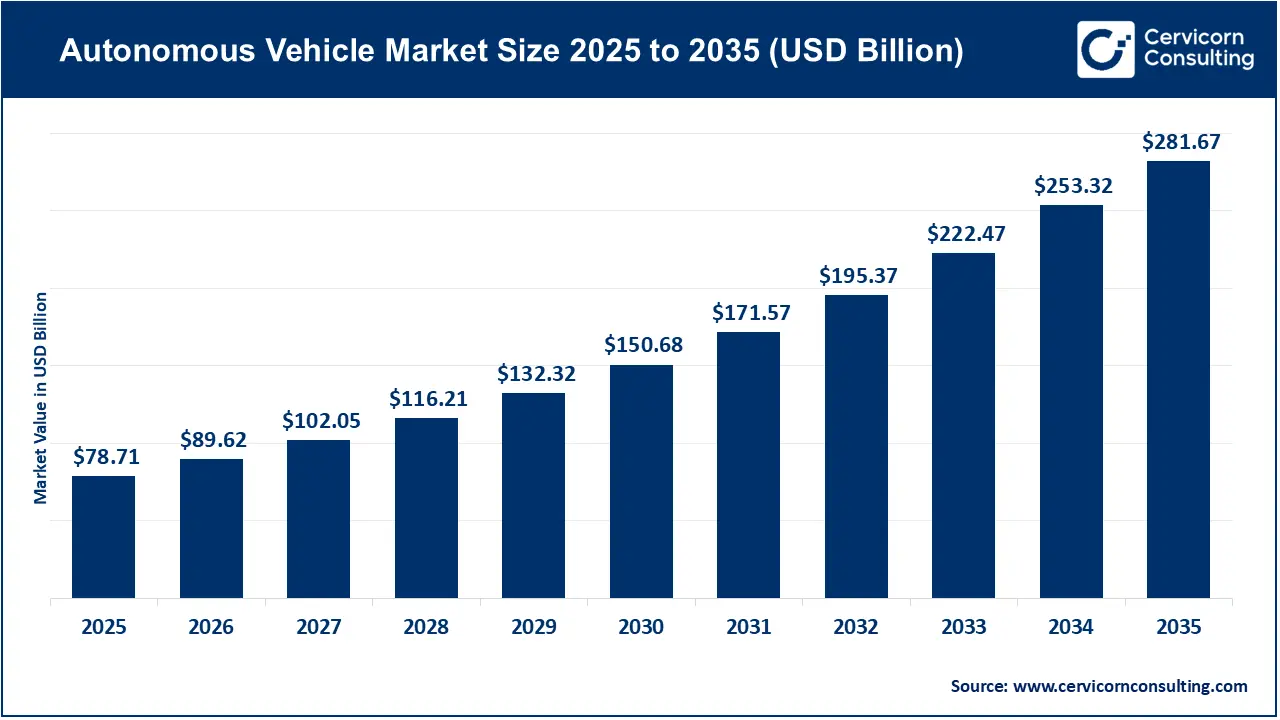
The global autonomous vehicle market was valued at approximately USD 78.71 billion in 2025 and is projected to reach nearly USD 281.67 billion by 2035, growing at a CAGR of 13.6%.
Autonomous Vehicle Market Growth Factors
The autonomous vehicle market is experiencing remarkable growth due to rapid advancements in artificial intelligence (AI), machine learning, computer vision, LiDAR and radar technologies, increasing investments by automotive manufacturers and technology companies, rising demand for safer transportation systems, favorable government regulations supporting autonomous testing, expansion of connected vehicle infrastructure, development of 5G communication networks, growing consumer interest in smart mobility solutions, increasing adoption of electric vehicles integrated with autonomous capabilities, and significant investments in smart city projects worldwide. Additionally, logistics automation, robotaxi deployment, commercial autonomous trucking, and continuous improvements in sensor accuracy are accelerating market expansion across passenger and commercial transportation sectors.
Get a Free Sample: https://www.cervicornconsulting.com/sample/2690
What is the Autonomous Vehicle Market?
The autonomous vehicle market refers to the global industry focused on developing, manufacturing, deploying, and commercializing vehicles capable of navigating roads with minimal or no human intervention. These vehicles utilize an integrated ecosystem of advanced sensors, cameras, radar, LiDAR, GPS, artificial intelligence, machine learning algorithms, cloud computing, and high-definition mapping to perceive their surroundings, make driving decisions, and operate safely.
Autonomous vehicles are categorized according to the Society of Automotive Engineers (SAE) automation levels, ranging from Level 0 (no automation) to Level 5 (fully autonomous driving). Today, most commercially available vehicles feature Level 2 or Level 3 automation, while extensive testing is underway for Level 4 and Level 5 autonomous systems.
The market includes passenger cars, commercial trucks, shuttle buses, robotaxis, delivery vehicles, mining vehicles, agricultural equipment, and industrial transportation systems.
Why is the Autonomous Vehicle Market Important?
Autonomous vehicles represent one of the biggest technological transformations in transportation history. Their importance extends beyond convenience and significantly impacts road safety, urban planning, sustainability, logistics, and economic productivity.
Improved Road Safety
Human error contributes to the majority of road accidents worldwide. Autonomous systems continuously monitor road conditions, eliminate distracted driving, and react faster than human drivers, potentially reducing accidents dramatically.
Enhanced Mobility
Self-driving vehicles provide transportation independence for elderly individuals, disabled passengers, and people unable to drive, improving social inclusion.
Reduced Traffic Congestion
AI-powered traffic optimization enables autonomous vehicles to maintain smoother traffic flow, reduce bottlenecks, and improve fuel efficiency.
Lower Transportation Costs
Fleet operators benefit from lower labor costs, improved fuel efficiency, optimized routing, and predictive maintenance.
Environmental Benefits
Autonomous technology is increasingly integrated with electric vehicles (EVs), reducing emissions and supporting sustainable transportation goals.
Economic Productivity
Passengers can work, communicate, or relax while traveling, transforming commuting into productive time.
Major Companies Shaping the Autonomous Vehicle Market
| Company | Specialization | Key Focus Areas | Notable Features | Estimated 2025 Revenue | Estimated Market Share | Global Presence |
|---|---|---|---|---|---|---|
| AB Volvo | Autonomous commercial vehicles | Autonomous trucks, mining, logistics | Autonomous freight and industrial transport | ~$58 Billion | Strong commercial vehicle segment | Europe, North America, Asia-Pacific |
| AUDI Aktiengesellschaft (Volkswagen Group) | Premium autonomous passenger vehicles | AI-assisted driving, luxury mobility | Advanced driver assistance and connected mobility | Part of Volkswagen Group (~$380+ Billion) | Significant premium automotive share | Global |
| Bayerische Motoren Werke AG (BMW) | Intelligent luxury mobility | Autonomous driving, digital cockpit, EV integration | BMW Personal Pilot technologies | ~$170 Billion | Major luxury automotive player | Worldwide |
| Daimler AG | Commercial and passenger autonomous mobility | Mercedes-Benz autonomous systems, trucking | DRIVE PILOT and autonomous trucking | ~$165 Billion | Leading premium automotive manufacturer | Global |
| Ford Motor Company | Autonomous mobility and fleet solutions | Robotaxis, autonomous commercial fleets | BlueCruise, AI mobility platforms | ~$190 Billion | Strong North American presence | North America, Europe, Asia-Pacific |
Key Technologies Powering Autonomous Vehicles
The autonomous vehicle ecosystem depends on multiple advanced technologies working together.
Artificial Intelligence
AI enables real-time object detection, path planning, behavioral prediction, and driving decision-making.
Computer Vision
High-resolution cameras analyze lane markings, pedestrians, traffic lights, signs, and surrounding vehicles.
LiDAR
Laser-based sensors create highly detailed three-dimensional maps for accurate navigation.
Radar
Radar performs reliably in poor weather conditions, complementing cameras and LiDAR.
High-Definition Maps
HD maps provide centimeter-level navigation accuracy essential for autonomous driving.
Vehicle-to-Everything (V2X)
V2X communication enables vehicles to exchange information with infrastructure, traffic systems, pedestrians, and nearby vehicles.
Leading Trends Driving the Autonomous Vehicle Market
Artificial Intelligence Becoming the Brain of Autonomous Driving
AI models are becoming significantly more sophisticated, enabling vehicles to understand complex traffic scenarios, predict driver behavior, and continuously improve through machine learning.
Impact
- Faster decision-making
- Improved driving accuracy
- Reduced accident rates
- Better adaptability to changing road environments
Robotaxi Expansion
Autonomous ride-hailing services are moving from pilot programs toward commercial deployment in multiple cities.
Impact
- Reduced transportation costs
- Improved urban mobility
- Lower vehicle ownership
- Growth of Mobility-as-a-Service (MaaS)
Electric Autonomous Vehicles
Automakers increasingly combine autonomous technologies with electric powertrains.
Impact
- Lower emissions
- Reduced operating costs
- Improved sustainability
- Enhanced government support
5G Connectivity
Ultra-low latency communication significantly improves autonomous vehicle responsiveness.
Impact
- Faster communication
- Improved remote monitoring
- Enhanced safety
- Real-time cloud processing
Autonomous Commercial Trucks
Logistics companies increasingly invest in autonomous freight transportation.
Impact
- Reduced shipping costs
- Improved fuel efficiency
- 24/7 freight operations
- Faster deliveries
Advanced Sensor Fusion
Manufacturers now combine LiDAR, cameras, radar, ultrasonic sensors, and GPS simultaneously.
Impact
- Improved perception accuracy
- Enhanced redundancy
- Better operation in adverse weather
- Increased passenger safety
Digital Twins for Autonomous Vehicles
Manufacturers use virtual simulation platforms to test millions of driving scenarios before real-world deployment.
Impact
- Faster software validation
- Lower testing costs
- Improved safety
- Reduced development timelines
Successful Examples of Autonomous Vehicle Market Around the World
Waymo – United States
Waymo has established one of the world’s most advanced autonomous ride-hailing services, operating commercial robotaxis in select U.S. cities. Its vehicles have accumulated millions of autonomous driving miles and demonstrate the viability of Level 4 autonomous mobility in urban environments.
Cruise – United States
Cruise has conducted extensive autonomous vehicle testing and pilot deployments focused on urban mobility, leveraging advanced AI and sensor technologies to navigate complex city streets.
Baidu Apollo – China
China’s Baidu Apollo platform has developed autonomous taxis, buses, and intelligent transportation solutions while collaborating closely with municipal governments to build smart mobility ecosystems.
AutoX – China
AutoX operates fully driverless robotaxi fleets in selected Chinese cities using high-definition mapping and AI-powered perception systems.
Motional – Singapore and United States
Motional has successfully deployed autonomous vehicle pilot programs focused on commercial ride-hailing and urban transportation services.
Navya – France
Navya specializes in autonomous electric shuttle buses operating across airports, universities, hospitals, and smart cities.
EasyMile – Europe
EasyMile autonomous shuttles provide low-speed transportation for campuses, industrial facilities, and urban mobility projects.
Volvo Autonomous Mining Trucks – Sweden and Australia
Volvo has deployed autonomous heavy-duty trucks for mining operations, significantly improving operational safety and productivity.
Applications of Autonomous Vehicles Across Industries
Passenger Transportation
Self-driving passenger cars improve convenience, safety, and commuting efficiency.
Logistics
Autonomous trucks optimize long-haul freight transportation while reducing operational costs.
Public Transportation
Driverless buses improve urban transit systems and reduce labor shortages.
Agriculture
Autonomous tractors increase farming efficiency and precision.
Mining
Autonomous haul trucks operate continuously under hazardous conditions.
Defense
Military organizations utilize autonomous vehicles for surveillance, logistics, and hazardous missions.
Healthcare
Autonomous delivery robots transport medicines and medical supplies across hospitals.
Global Regional Analysis of the Autonomous Vehicle Market
North America
North America remains the largest autonomous vehicle market due to strong technological innovation, substantial investments by automotive manufacturers and technology companies, mature digital infrastructure, and supportive regulatory environments.
The United States leads global autonomous vehicle testing and commercialization through extensive investments from automotive manufacturers, AI companies, and mobility startups. Canada also supports autonomous mobility research through advanced automotive innovation programs.
Government Initiatives and Policies
- National and state-level autonomous vehicle testing regulations
- Smart transportation infrastructure investments
- Federal funding for connected vehicle research
- Expansion of intelligent transportation systems
- Support for autonomous trucking pilots
- Development of 5G-enabled transportation corridors
Europe
Europe represents one of the most technologically advanced autonomous vehicle markets, supported by strong automotive manufacturing capabilities and stringent vehicle safety standards.
Germany, France, Sweden, and the United Kingdom lead autonomous vehicle innovation, particularly in premium passenger vehicles and commercial transportation.
Government Initiatives and Policies
- European Union Connected and Automated Mobility strategy
- Investments in intelligent transport systems
- Cross-border autonomous vehicle testing initiatives
- Funding for AI-powered mobility research
- Carbon reduction regulations promoting electric autonomous vehicles
- Standardized autonomous safety frameworks
Asia-Pacific
Asia-Pacific is projected to experience the fastest market growth due to rapid urbanization, smart city development, expanding automotive manufacturing, and increasing government investments.
China, Japan, South Korea, and Singapore have become global leaders in autonomous mobility innovation.
China continues large-scale autonomous vehicle testing while Japan invests heavily in autonomous public transportation and logistics solutions.
Government Initiatives and Policies
- China’s intelligent connected vehicle strategy
- Smart city development initiatives
- National AI development programs
- Japan’s autonomous mobility roadmap
- South Korea’s autonomous vehicle commercialization policies
- Singapore’s autonomous mobility testing framework
- Investments in V2X infrastructure
Latin America
Latin America is gradually adopting autonomous vehicle technologies, particularly in mining, logistics, and commercial transportation.
Brazil and Mexico lead regional automotive manufacturing and increasingly integrate intelligent mobility solutions.
Government Initiatives and Policies
- Smart transportation pilot projects
- Connected infrastructure development
- Public-private partnerships for intelligent mobility
- Digital transportation modernization initiatives
- Investments in electric mobility ecosystems
Middle East & Africa
The Middle East is becoming an emerging autonomous mobility hub through smart city developments and digital transformation initiatives.
The United Arab Emirates and Saudi Arabia have announced ambitious plans to integrate autonomous transportation into future urban mobility networks.
Africa remains in the early stages of autonomous vehicle adoption but is increasingly investing in digital transportation infrastructure.
Government Initiatives and Policies
- UAE Smart Dubai mobility initiatives
- Saudi Vision 2030 transportation modernization
- Smart infrastructure investments
- Autonomous shuttle pilot programs
- AI innovation strategies
- Connected transportation corridor development
Challenges Facing the Autonomous Vehicle Market
Despite significant progress, several challenges continue to influence market development:
- High development and deployment costs
- Complex regulatory approval processes
- Cybersecurity risks
- Public trust and acceptance
- Ethical decision-making in AI systems
- Limited infrastructure readiness in developing economies
- Weather-related sensor limitations
- High-definition mapping requirements
- Liability and insurance complexities
- Integration with mixed human-driven traffic environments
Future Opportunities in the Autonomous Vehicle Market
Several emerging opportunities are expected to accelerate long-term market growth:
- Expansion of fully autonomous robotaxi services
- Autonomous freight corridors for long-haul trucking
- Integration with smart city ecosystems
- Growth in autonomous delivery robots
- AI-powered fleet management platforms
- Autonomous mobility for aging populations
- Increased adoption in agriculture, mining, ports, and airports
- Advancements in edge computing and V2X communication
- Commercialization of Level 4 and Level 5 autonomous vehicles
- Partnerships between automotive manufacturers, AI developers, telecom providers, and cloud computing companies to build next-generation intelligent transportation ecosystems.
To Get Detailed Overview, Contact Us: https://www.cervicornconsulting.com/contact-us
Read Report: Orthodontics Market Revenue, Trends, and Strategic Insights by 2035