Automotive Battery Aftermarket Market: Where Is Replacement Demand Shifting and What Should Companies Prioritize?
Automotive Battery Aftermarket Market: Where Is Replacement Demand Shifting and What Should Companies Prioritize?
The automotive battery aftermarket is becoming less dependent on simple vehicle replacement cycles and increasingly shaped by vehicle age, utilization, electrical load, battery technology, digital purchasing, and recycling requirements.
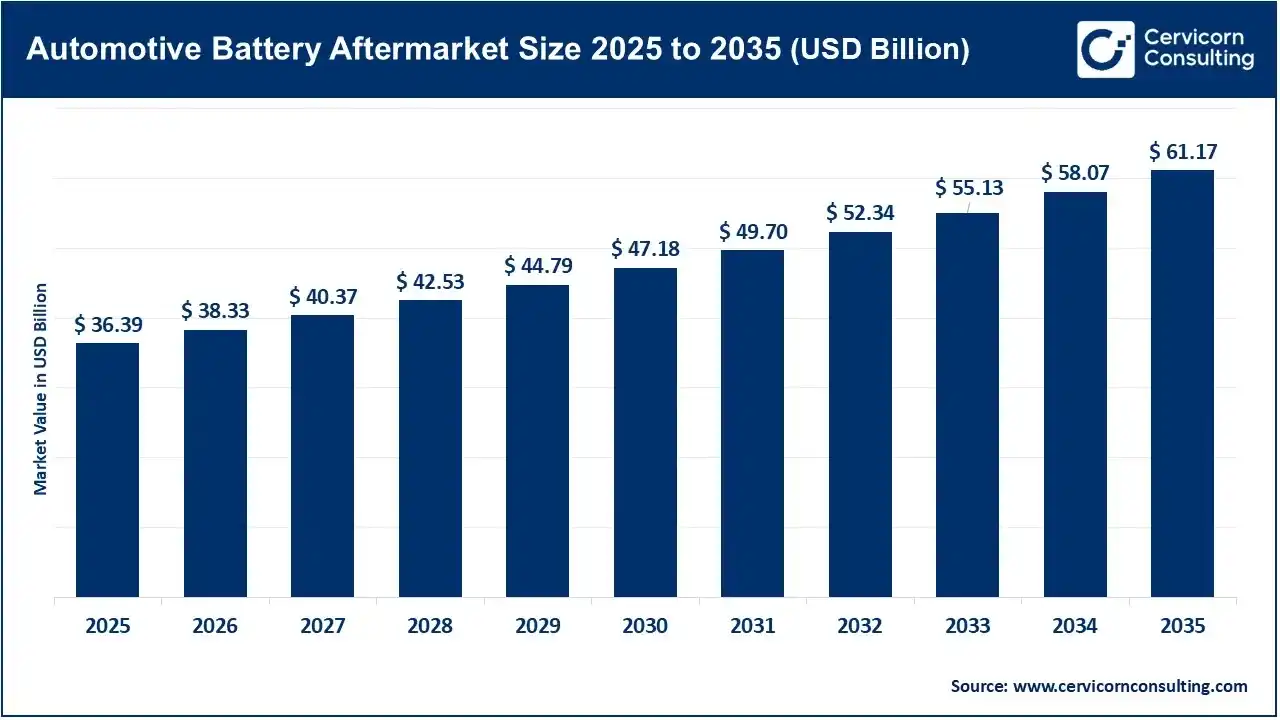
The global automotive battery aftermarket market was valued at approximately USD 36.39 billion in 2025 and is projected to reach around USD 61.17 billion by 2035, expanding at a 5.3% CAGR from 2026 to 2035. Asia-Pacific accounted for approximately 41.1% of the global market in 2025, while lead-acid batteries continued to dominate with an estimated 84.9% share.
For battery manufacturers, distributors, retailers, workshops, and investors, however, market growth alone does not indicate where the strongest commercial opportunities will emerge.
The more important questions are:
- Which vehicle segments will generate the highest replacement volumes?
- How quickly will AGM and EFB replace conventional flooded batteries in key applications?
- How should companies balance traditional lead-acid demand with emerging lithium-ion applications?
- Which sales channels can improve replacement conversion and customer retention?
- How will battery collection and recycling requirements affect aftermarket economics?
A Larger Vehicle Parc Is Creating a Recurring Replacement Opportunity
The aftermarket has one structural advantage over the new-vehicle market: batteries have to be replaced even when consumers are not purchasing new vehicles.
Longer vehicle ownership can therefore support aftermarket demand rather than weaken it.
Older vehicles typically require more frequent maintenance, while high utilization, congestion, short-distance driving, extreme temperatures, and increasing electrical loads can accelerate battery degradation.
For companies planning capacity or distribution expansion, this means vehicle-in-operation data may be more useful than new-vehicle sales alone when estimating future replacement demand.
A market with slower new-vehicle growth can still offer attractive battery aftermarket opportunities if its installed vehicle population is large, aging, and heavily utilized.
Get a Free Sample: https://www.cervicornconsulting.com/sample/3051
India Shows Why Vehicle Utilization Matters
India provides an important example of this dynamic.
Domestic sales in FY2024–25 included approximately 4.3 million passenger vehicles and 19.6 million two-wheelers, creating a large future replacement pool for starter and auxiliary batteries. Cervicorn also estimates that India recorded approximately 26 million vehicle registrations in FY2024–25, with two-wheelers representing roughly 78% of registrations.
The aftermarket opportunity is already visible in consumer search behavior.
Justdial data reported a 13% year-on-year increase in searches for car battery dealers between March 2025 and February 2026, indicating rising consumer interest in replacement services.
India’s wider automotive aftermarket reached approximately INR 99,500 crore in FY2025, according to ICRA, and is projected by ICRA to reach around INR 1,55,000 crore by FY2030. The growth is being supported by an expanding and aging vehicle population and increasing vehicle utilization.
For battery companies, the implication is significant: replacement demand should be mapped by vehicle age, annual mileage, geography, and vehicle category rather than simply by total vehicle sales.
Lead-Acid Will Remain Important—but the Product Mix Is Changing
Lead-acid batteries continue to provide the volume foundation of the aftermarket.
Cervicorn estimates that lead-acid batteries accounted for approximately 84.9% of automotive battery aftermarket demand in 2025, with flooded lead-acid batteries representing about 61.2% of the battery-technology segment.
However, maintaining a lead-acid-heavy portfolio does not necessarily mean maintaining the same product mix.
Modern vehicles increasingly require batteries capable of handling:
- Start-stop operation
- Higher electrical loads
- Advanced driver-assistance systems
- Connected and infotainment systems
- Auxiliary electrical functions
- Electrified powertrain architectures
This is increasing the relevance of AGM and EFB technologies.
Cervicorn estimates that more than 50 million AGM-equipped vehicles required aftermarket replacement batteries in 2025, while the share of new passenger vehicles equipped with start-stop systems in India is estimated to have increased from below 15% in 2020 to approximately 40–45% in 2026.
This creates a strategic distinction between volume growth and value growth.
Conventional flooded batteries may continue generating significant replacement volumes, while AGM and EFB products can capture a larger share of aftermarket value as vehicle electrical architectures become more demanding.
The Emerging Question: How Much Lithium-Ion Exposure Is Necessary?
Electrification is creating a second layer of aftermarket demand.
Battery aftermarket companies increasingly need to consider not only conventional starter batteries but also 12V auxiliary batteries, EV battery diagnostics, refurbishment, second-life applications, and eventual traction-battery replacement.
This does not mean that lithium-ion will immediately displace lead-acid across the aftermarket.
Instead, the market is likely to become more segmented.
A conventional passenger vehicle may continue using a lead-acid battery, a start-stop vehicle may require AGM or EFB, while an EV may create demand for auxiliary-battery replacement, battery diagnostics, refurbishment, and eventually traction-battery services.
For manufacturers, the strategic question is therefore not simply whether to enter lithium-ion.
It is which applications, vehicle platforms, and service capabilities justify investment in lithium-ion technology.
That distinction can prevent companies from allocating excessive capital toward applications where aftermarket volumes are still limited.
Independent Workshops Remain a Critical Route to Market
Distribution strategy is becoming as important as battery technology.
Independent automotive repair shops accounted for approximately 33.6% of automotive battery aftermarket sales channels in 2025, according to Cervicorn. Their importance comes from geographic reach, competitive pricing, and their role in servicing older vehicles.
Authorized dealerships remain important for newer and technology-intensive vehicles, but independent workshops can have stronger access to the large installed base of aging vehicles.
This creates different channel requirements.
Manufacturers targeting independent workshops may need to prioritize:
- Broad SKU availability
- Fast delivery
- Fitment accuracy
- Competitive dealer margins
- Technician training
- Battery testing equipment
- Warranty handling
- Used-battery collection
For distributors, the challenge is increasingly one of inventory optimization.
Holding every battery specification across every vehicle application can increase working capital requirements, while insufficient local inventory can result in lost replacement sales.
Companies can therefore benefit from combining vehicle-parc data with SKU-level demand forecasting to determine which battery specifications should be stocked region by region.
Digital Channels Are Changing the Replacement Purchase
Battery replacement has historically been a highly offline transaction.
That is changing.
Consumers increasingly discover battery suppliers online and compare prices, warranty periods, specifications, and installation services before purchasing.
The increase in Indian searches for car battery dealers illustrates this transition, while the expansion of organized aftermarket networks is creating greater scope for online-to-offline replacement models.
The strongest digital models are unlikely to be pure e-commerce businesses.
A battery replacement often requires:
Vehicle identification → Battery selection → Availability confirmation → Delivery → Installation → Testing → Warranty registration → Old-battery collection
Companies that control more of this process can potentially improve customer retention while generating additional service and recycling value.
This makes mobile installation, digital diagnostics, online booking, and doorstep replacement increasingly relevant competitive factors.
Recycling Is Becoming Part of Aftermarket Strategy
Battery recycling is moving from an environmental consideration toward an operating and compliance requirement.
India’s Battery Waste Management Rules establish Extended Producer Responsibility (EPR), making producers responsible for the collection and environmentally sound recycling or refurbishment of waste batteries.
For automotive batteries, the recovery target is 60% from 2025–26 onward, according to the current EPR framework. The rules also establish mechanisms for EPR registration, certificates, and traceability through the centralized CPCB portal.
This changes the economics of the aftermarket.
The transaction is no longer simply:
Sell new battery → earn replacement revenue
It increasingly becomes:
Sell → collect used battery → recover materials → recycle/refurbish → potentially feed recovered materials back into production
For manufacturers and distributors, reverse logistics can therefore become a competitive capability rather than only a compliance cost.
Companies with strong dealer collection networks may have an advantage because the same distribution infrastructure used to sell batteries can potentially be used to recover end-of-life batteries.
Regional Strategy Should Reflect Vehicle and Channel Differences
Asia-Pacific remains the largest regional opportunity, with Cervicorn estimating a market size of approximately USD 14.96 billion in 2025, rising to around USD 25.14 billion by 2035.
But a regional growth strategy should not treat Asia-Pacific as one homogeneous market.
India offers substantial two-wheeler and passenger-vehicle replacement potential, supported by a large and expanding vehicle population.
China combines a massive vehicle population with rapid electrification. Cervicorn estimates approximately 31.44 million vehicle sales in China in 2025, including around 16.49 million new-energy vehicles. This points toward a gradual expansion of EV-related diagnostics, auxiliary-battery services, refurbishment, and recycling opportunities.
North America, meanwhile, represents a mature replacement market. Cervicorn estimates the regional aftermarket at approximately USD 8.30 billion in 2025, with the U.S. benefiting from around 268 million vehicles in operation and intensive vehicle utilization.
The commercial priorities therefore differ:
| Market characteristic | Strategic priority |
|---|---|
| Large aging vehicle parc | Replacement volume and distribution reach |
| High start-stop penetration | AGM/EFB portfolio expansion |
| High EV penetration | Diagnostics, auxiliary batteries and recycling |
| Fragmented workshops | Distributor and independent-repair partnerships |
| Strong e-commerce adoption | Digital ordering and mobile installation |
| Tight recycling requirements | Collection and reverse-logistics infrastructure |
Where Should Companies Allocate Investment?
The next phase of automotive battery aftermarket growth is unlikely to be won simply by adding production capacity.
Companies should evaluate investment across five interconnected areas.
1. Product Portfolio
Determine where flooded lead-acid remains commercially attractive and where AGM, EFB or lithium-ion products can capture higher-value demand.
2. Vehicle-Parc Intelligence
Track vehicle age, annual utilization, powertrain mix, geography and replacement cycles to forecast demand more accurately.
3. Distribution Density
Identify regions where independent workshops, distributors, retailers and mobile installation networks can generate sufficient replacement volumes to justify inventory investment.
4. Digital Service Infrastructure
Evaluate whether online ordering, fitment tools, diagnostics, doorstep installation and warranty management can improve conversion and customer retention.
5. Circularity and Reverse Logistics
Build battery collection and recycling partnerships early, particularly in markets where EPR requirements are becoming more demanding.
What the Automotive Battery Aftermarket Could Look Like by 2030
The aftermarket is gradually shifting from a replacement-product business toward an integrated battery lifecycle business.
Lead-acid batteries are likely to remain the volume foundation for many conventional vehicles, but higher-performance AGM and EFB products should gain importance as start-stop and electrical loads increase.
At the same time, electrification will introduce new revenue pools around auxiliary batteries, diagnostics, refurbishment, traction-battery servicing and recycling.
Digital channels will further change how customers discover and purchase replacement batteries, while regulations will make collection and material recovery increasingly important to the economics of the industry.
For manufacturers and aftermarket players, the strongest strategy may therefore be to segment the opportunity by vehicle parc, battery technology, geography and channel rather than treating automotive battery replacement as a single global market.
The companies best positioned for the next phase will likely be those that can connect product portfolio decisions with vehicle-parc intelligence, distribution economics, digital service capability and circularity infrastructure.
Strategic Questions for Market Participants
Before expanding capacity, entering a new geography, or launching a new battery platform, companies should evaluate:
- Where will the largest replacement pools emerge over the next five years?
- Which vehicle categories are moving fastest toward AGM, EFB or lithium-ion?
- What is the addressable replacement pool by vehicle age and powertrain?
- Which independent workshops and distributors provide the strongest route to market?
- How much inventory is required to achieve acceptable service levels without excessive working capital?
- How will EPR and recycling requirements affect landed cost and channel economics?
- Which digital services can increase battery replacement conversion?
- Where do local competitors have stronger distribution or pricing advantages?
- Which markets justify localized manufacturing, assembly or recycling partnerships?
The answers to these questions can materially change the attractiveness of a market, product category, or expansion strategy.
To Get Detailed Overview, Contact Us: https://www.cervicornconsulting.com/contact-us
Read Report: Data center PON is moving beyond connectivity: What companies need to solve before scaling optical infrastructure