Augmented Intelligence Market Revenue, Global Presence, and Strategic Insights by 2034
Augmented Intelligence Market Size
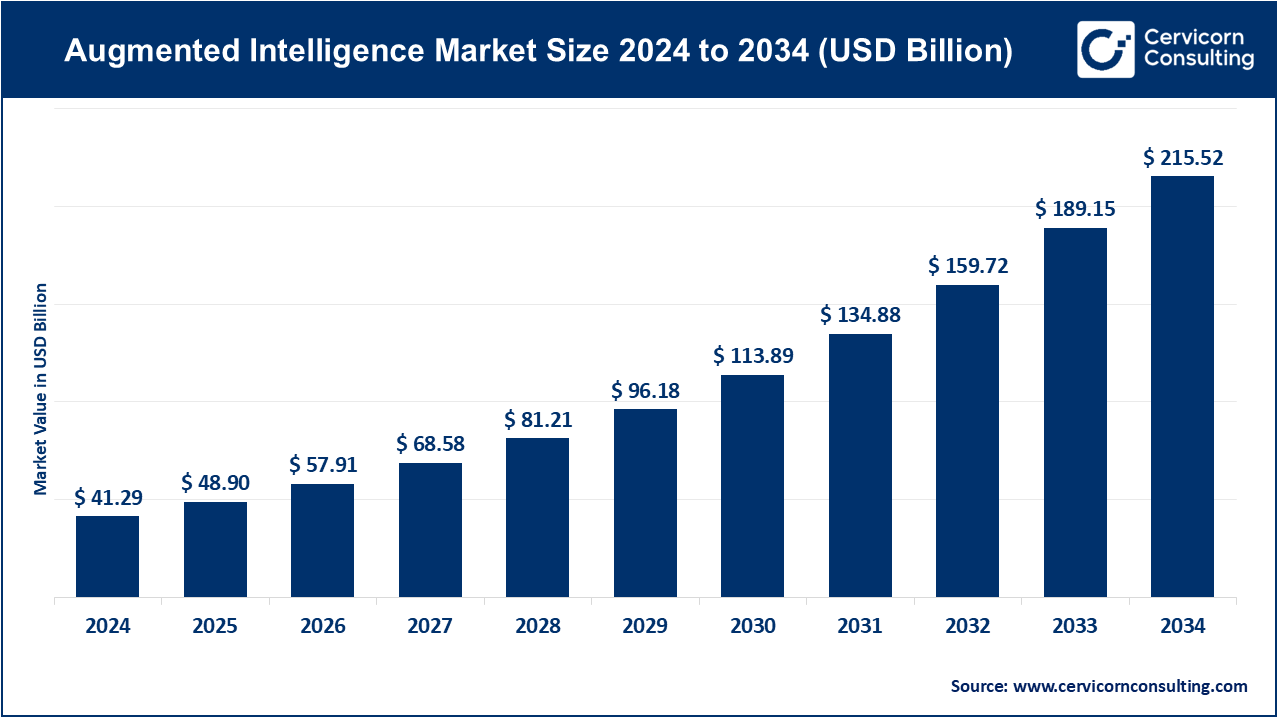
The global augmented intelligence market size was worth USD 41.29 billion in 2024 and is anticipated to expand to around USD 215.52 billion by 2034, registering a compound annual growth rate (CAGR) of 17.97% from 2025 to 2034.
What Is the Augmented Intelligence Market?
The augmented intelligence market focuses on technologies and systems designed to enhance, rather than replace, human intelligence. Unlike traditional artificial intelligence—often associated with full automation—augmented intelligence emphasizes human-in-the-loop approaches, where AI systems assist users with insights, predictions, recommendations, patterns and automated tasks, while humans remain the final decision-makers. This segment includes AI-enabled analytics tools, predictive platforms, digital assistants, copilots, industry-specific intelligent systems (healthcare, manufacturing, finance), cloud-based AI services, edge AI solutions, and enterprise integration platforms that help organizations safely embed AI into human workflows. The market reflects a shift toward collaborative intelligence, where machines provide scalable computational strength and humans provide context, judgment, ethics and creativity.
Get a Free Sample: https://www.cervicornconsulting.com/sample/2408
Why Augmented Intelligence Is Important
Augmented intelligence is becoming essential for modern digital transformation because organizations increasingly require tools that increase productivity, improve decision quality, reduce human error, and deliver insights at scale. It resolves major challenges of traditional AI by allowing human supervision and reducing risks linked to bias or misinterpretation. In regulated sectors such as healthcare, finance, defense, insurance and government services, augmented intelligence aligns better with compliance frameworks because humans maintain oversight. It helps non-experts perform expert-level tasks through intelligent guidance, enabling organizations to scale specialized skills, improve operational efficiency, and accelerate outcomes. Moreover, augmented intelligence supports transparency, ethical AI deployment, and trust—making it widely acceptable across business and government ecosystems.
Augmented Intelligence Market Growth Factors
The augmented intelligence market is expanding due to rapid enterprise digitalization, exponential data growth, and rising adoption of AI-powered decision-support tools that empower human workers rather than automate them entirely. Broader use of advanced analytics, generative AI models, and domain-specific AI copilots is increasing demand across industries such as healthcare, BFSI, manufacturing, retail and government. Cloud platforms have simplified deployment, enabling even small and medium enterprises to implement augmented solutions without major infrastructure investment.
Regulatory emphasis on responsible and explainable AI is driving organizations toward human-centric augmentation rather than autonomous decision-making. Enterprises are adopting augmented intelligence to enhance productivity, reduce errors, accelerate workflows, and derive value from complex data. Investments from major technology providers in model governance, interpretability and enterprise integrations are further boosting adoption. Collectively, these factors are enabling the augmented intelligence market to grow at a strong pace globally.
Top Augmented Intelligence Market Companies
1. IBM Corporation
Specialization:
Enterprise AI platforms, hybrid cloud, explainable AI, model governance, domain-specific augmented intelligence solutions.
Key Focus Areas:
watsonx AI and data platform, model governance, risk evaluation, industry-specific applications for healthcare, BFSI, supply chain and government.
Notable Features:
Strong emphasis on trustworthy AI, compliance-ready solutions, support for on-prem, hybrid or cloud deployments, and professional consulting expertise to customize augmented intelligence implementations.
2024 Revenue:
Approximately USD 62–63 billion (full-year 2024).
Market Share:
IBM is considered a major enterprise AI provider but does not break out augmented intelligence revenue separately.
Global Presence:
Extensive operations across the Americas, Europe and Asia-Pacific, with a strong presence in regulated industries.
2. Microsoft Corporation
Specialization:
Augmented productivity solutions, enterprise copilots, cloud AI infrastructure.
Key Focus Areas:
Microsoft 365 Copilot, Dynamics 365 Copilot, Azure AI infrastructure, enterprise integrations, developer tools, security and governance.
Notable Features:
Deep integration of AI assistants into widely used tools such as Word, Excel, Outlook, Teams, GitHub and Dynamics. Strong commitment to responsible AI and enterprise-grade security.
2024 Revenue:
Approximately USD 245 billion (Fiscal Year 2024).
Market Share:
Microsoft is one of the dominant global vendors in enterprise copilots and cloud AI tools.
Global Presence:
Worldwide operations with extensive customer bases across North America, EMEA, APAC and Latin America.
3. Google LLC (Alphabet Inc.)
Specialization:
AI research, cloud-based AI systems, multimodal models, enterprise AI solutions.
Key Focus Areas:
Google Cloud (Vertex AI), Gemini models, enterprise data analytics, search enhancement, industry-specific intelligent assistants.
Notable Features:
Leader in developing large-scale multimodal models, custom TPUs for AI training, cloud-native tools for AI deployment, and strong data architecture offerings.
2024 Revenue:
Alphabet recorded roughly USD 350 billion in revenue in FY2024.
Market Share:
Provides AI infrastructure and cloud services used heavily in augmented intelligence deployments.
Global Presence:
Extensive global footprint, strong cloud presence across North America, Europe, and growing adoption in Asia-Pacific.
4. Amazon Web Services (AWS)
Specialization:
Cloud computing, enterprise AI/ML platforms, foundation model access and customization.
Key Focus Areas:
Amazon Bedrock, Amazon SageMaker, industry cloud solutions, low-latency edge AI, AI-enabled analytics.
Notable Features:
Wide cloud infrastructure, specialized AI chips (Trainium and Inferentia), and broad partnerships for industry-specific augmented AI solutions.
2024 Revenue:
Amazon’s consolidated revenue surpassed USD 630 billion; AWS contributed approximately USD 107 billion.
Market Share:
AWS is one of the largest global AI infrastructure providers enabling augmented intelligence across industries.
Global Presence:
Largest cloud region coverage worldwide, with customers in nearly every major industry and region.
5. Oracle Corporation
Specialization:
Enterprise applications, autonomous database, cloud infrastructure, AI-enhanced ERP/HR/finance tools.
Key Focus Areas:
AI in business applications, secure data management, enterprise automation, hybrid cloud AI, industry-specific solutions for government, finance, telecom and healthcare.
Notable Features:
Deep integration between databases, cloud applications and AI assistants, enabling real-time augmented decision-making in business-critical processes.
2024 Revenue:
Oracle reported approximately USD 53 billion in its Fiscal 2024.
Market Share:
A major player in enterprise software and AI-enabled applications with strong cloud growth.
Global Presence:
Large global enterprise footprint across the Americas, EMEA and APAC.
Leading Trends in the Augmented Intelligence Market and Their Impact
1. Hyper-Personalized Copilots and Task-Specific AI Agents
Businesses are adopting AI assistants embedded directly into tools people use daily—CRM platforms, ERP dashboards, design tools, coding environments and office productivity suites. These copilots boost efficiency by suggesting actions, summarizing data, enabling rapid drafting and providing analytical insights. Their impact includes faster decision cycles, reduced workload, and democratization of advanced analytics across the workforce.
2. Enterprise-Grade RAG (Retrieval-Augmented Generation)
RAG has become the core architecture for enterprise augmented intelligence. It allows AI systems to use verified internal documents, knowledge bases and databases to generate factual responses. This improves accuracy, supports compliance and reduces hallucination risks. The impact is large-scale enterprise adoption, especially in sectors requiring precision such as healthcare, legal and finance.
3. Explainability, Governance and Compliance
As global regulations tighten, companies are prioritizing model interpretability, transparent audit trails, bias detection and lifecycle governance. This trend significantly enhances trust and is a major driver for augmented systems where human oversight must be documented.
4. On-Device and Edge-Augmented Intelligence
Organizations are moving toward edge and on-prem AI—manufacturing floors, hospitals, security systems—where real-time decision support is critical. The impact includes lower latency, enhanced data privacy, and expanded use cases where cloud connectivity is limited.
5. Democratization of AI Development
Low-code/no-code augmented intelligence platforms enable non-technical users to build intelligent workflows. This increases organizational agility and accelerates AI adoption in non-technical departments such as marketing, HR and operations.
6. Industry-Specific Vertical AI
Healthcare, finance, manufacturing, retail, logistics and energy are adopting AI tools tailored to their compliance, workflow and data patterns. The impact includes higher adoption rates, reduced integration burden and faster ROI.
Successful Examples of Augmented Intelligence Around the World
Healthcare Decision Support Systems
Hospitals worldwide use augmented intelligence systems to support clinicians with diagnosis suggestions, medical imaging analysis, treatment planning and patient risk scoring. These tools help physicians process large volumes of patient data, research findings and clinical guidelines to make more informed decisions.
Microsoft Copilot Across Enterprises
Thousands of companies globally use Microsoft 365 Copilot and Dynamics Copilot to automate note-taking, document drafting, meeting summarization, CRM updates, and administrative workflows. These tools significantly reduce manual tasks and give employees real-time insights during decision-making.
AI-Augmented Manufacturing Systems
Manufacturing firms use AWS and Google Cloud–powered systems to analyze sensor data from equipment, detect anomalies, recommend maintenance, and guide technicians through repairs. This reduces downtime, improves worker efficiency and supports safer operations.
Financial Risk Assessment Tools
Banks and insurance companies increasingly rely on augmented intelligence to analyze patterns in transactions, evaluate customer risk, detect fraud, and recommend personalized financial products. The AI offers insights while human analysts make final decisions—improving accuracy and regulatory compliance.
Government Service Platforms
Governments in Asia, North America and Europe are adopting augmented intelligence for tasks such as citizen support services, document verification, benefits processing and digital governance. AI improves efficiency while human officers maintain oversight to ensure fairness and accountability.
Global Regional Analysis and Government Initiatives Shaping the Market
North America
North America leads the augmented intelligence market due to high technology adoption, strong AI research, and heavy investment from major cloud providers. The U.S. government has introduced national AI frameworks emphasizing transparency, safety and responsible innovation, encouraging enterprises to adopt augmented solutions that retain human oversight. Public-sector agencies are increasingly deploying augmented platforms for defence, healthcare modernization, fraud detection and administrative services.
Europe
Europe’s regulatory landscape strongly influences the global augmented intelligence market. The EU AI Act requires strict oversight, documentation and risk management for high-risk AI systems. This naturally promotes augmented intelligence over autonomous systems because the regulation favors human involvement, auditability and explainability. European enterprises in healthcare, automotive, banking and public administration are accelerating deployment of augmented tools that meet compliance requirements.
Asia-Pacific
Asia-Pacific is one of the fastest-growing regions due to government-led AI missions, digital public infrastructure, large skilled workforces and rapid digital transformation. Countries like India, Japan, South Korea and Singapore promote augmented intelligence for healthcare, agriculture, smart governance, education and industry automation. National AI strategies emphasize using AI to support, not replace, human workers—especially in government and public services. China’s policies encourage heavy AI investment, with organizations adopting hybrid augmented intelligence solutions due to data sovereignty laws.
Latin America
Adoption in Latin America is increasing as governments and enterprises invest in digital transformation and public services modernization. Augmented intelligence supports sectors such as banking, mining, agriculture and healthcare. Although regulatory frameworks are less mature, many countries are developing AI guidelines focusing on ethical and responsible implementation with human oversight.
Middle East & Africa
Middle Eastern nations are investing significantly in AI-driven economic diversification, smart cities and government services. Augmented intelligence supports healthcare, finance, security and citizen services programs. African nations are adopting AI more gradually, focusing on healthcare, agriculture and education augmentation. International collaborations and digital infrastructure programs are helping accelerate adoption.
How Government Policies Influence Market Evolution
Government strategies worldwide emphasize ethical AI deployment, data protection, risk-based regulation and transparency. These policies naturally drive organizations to choose augmented intelligence—where humans remain accountable—over fully autonomous AI. Regulations require clear audit trails, bias mitigation and governance models, pushing vendors to build tools that support real-time monitoring, human overrides, traceability and explainable outputs. Public investments in cloud infrastructure, digital public services, national AI research centers and workforce skill initiatives further expand the market for augmented intelligence across sectors.
To Get Detailed Overview, Contact Us: https://www.cervicornconsulting.com/contact-us
Read Report: Metal Casting Market Growth Drivers, Trends, Key Players and Regional Insights by 2034