Aluminum Alloys Market Revenue, Trends, and Strategic Insights by 2035
Aluminum Alloys Market Size
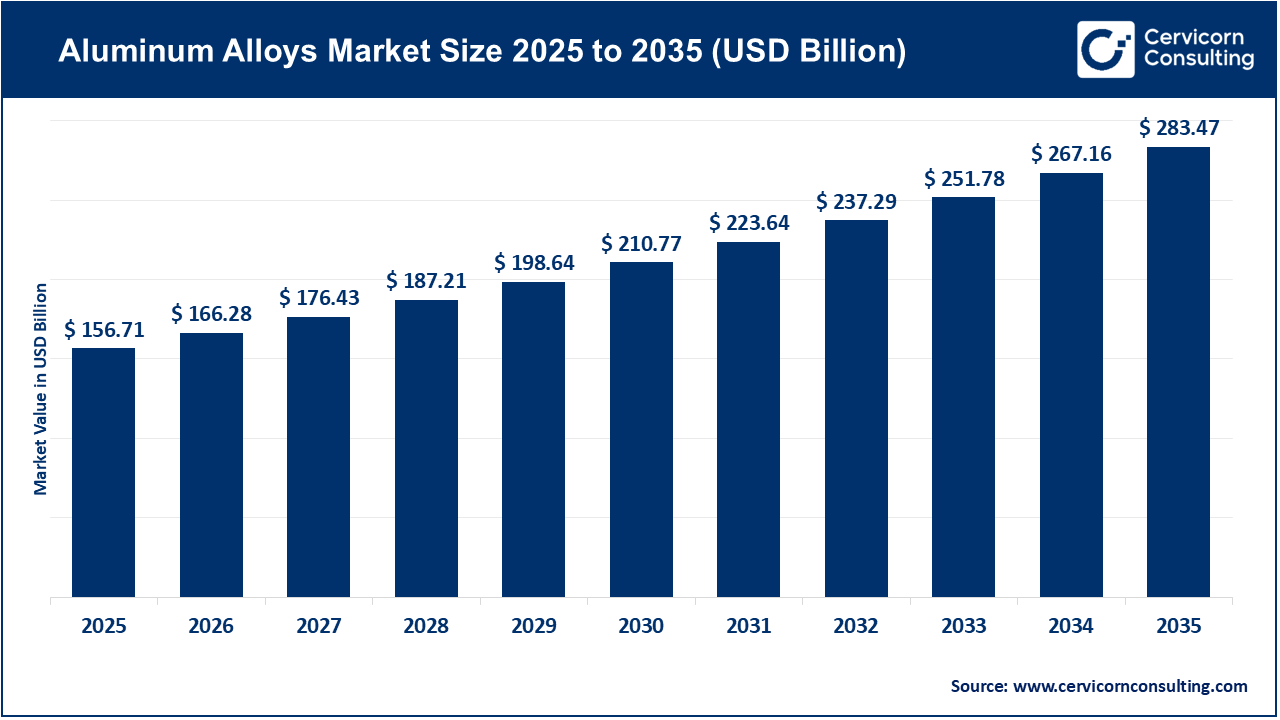
The global aluminum alloys market size was worth USD 156.71 billion in 2025 and is anticipated to expand to around USD 283.47 billion by 2035, registering a compound annual growth rate (CAGR) of 6.1% from 2026 to 2035.
Aluminum Alloys Market Growth Factors
The aluminum alloys market is expanding rapidly due to a convergence of technological advancement, industrial demand, and environmental priorities. One of the most significant growth drivers is the increasing global focus on lightweight materials, particularly within automotive and aerospace industries, where reducing structural weight directly improves fuel efficiency, energy consumption, and emissions performance. Simultaneously, the rise of electric vehicles has intensified demand for aluminum alloys, as weight optimization directly affects battery efficiency and vehicle range.
Infrastructure modernization, urbanization, and construction activities further contribute to rising consumption, with aluminum alloys being favored for their durability and corrosion resistance. Sustainability initiatives also play a central role; aluminum’s high recyclability aligns perfectly with circular economy goals, encouraging manufacturers to adopt recycled alloy products. Additionally, continuous innovation in alloy compositions and fabrication techniques is enabling highly specialized applications, expanding the market across renewable energy, defense, electronics, and industrial machinery sectors.
What Is the Aluminum Alloys Market?
The aluminum alloys market refers to the global ecosystem of producers, processors, and suppliers involved in the creation and distribution of aluminum-based alloy materials. Unlike pure aluminum, alloys are designed to exhibit enhanced mechanical, thermal, and chemical properties suited for demanding industrial applications. The market encompasses upstream activities such as bauxite mining, alumina refining, and aluminum smelting, as well as downstream operations including casting, rolling, extrusion, forging, machining, and finishing.
Aluminum alloys are categorized into families based on their alloying elements — for example:
- 1000 Series: High purity aluminum
- 2000 Series: Aluminum-copper alloys (high strength)
- 5000 Series: Aluminum-magnesium alloys (corrosion resistant)
- 6000 Series: Aluminum-magnesium-silicon alloys (widely used)
- 7000 Series: Aluminum-zinc alloys (extreme strength)
These materials are essential across industries requiring lightweight yet structurally reliable materials.
Get a Free Sample: https://www.cervicornconsulting.com/sample/2902
Why the Aluminum Alloys Market Is Important
The aluminum alloys market is not simply another metals segment; it is foundational to modern industrial development. Aluminum alloys enable engineers and designers to achieve structural performance while minimizing weight — a capability that has become central to efficiency-driven industries.
In transportation, reduced weight translates directly into lower fuel consumption, improved battery performance, and decreased emissions. In construction, aluminum alloys offer longevity, corrosion resistance, and reduced maintenance costs. In renewable energy, they provide durability and reliability for installations exposed to harsh environmental conditions. Their recyclability further elevates their strategic value, as aluminum can be reused indefinitely with minimal property degradation.
In essence, aluminum alloys sit at the intersection of performance engineering and sustainability, making them indispensable to global decarbonization efforts.
Major Companies Shaping the Aluminum Alloys Market
Alcoa Corporation
Specialization:
Alcoa is one of the world’s most recognized aluminum producers, operating across the entire value chain — from bauxite mining to refined aluminum and alloy products.
Key Focus Areas:
The company emphasizes high-performance alloys, low-carbon aluminum production, and advanced materials for aerospace and automotive applications.
Notable Features:
Alcoa is known for technological leadership, particularly in sustainable smelting processes and alloy innovation.
2024 Revenue:
Approximately USD 12 billion (industry estimates).
Market Position:
Alcoa remains a globally influential supplier with strong brand recognition.
Global Presence:
Operations across North America, South America, Europe, and Australia.
Aluminum Corporation of China Limited (Chalco)
Specialization:
Chalco is China’s largest aluminum producer with vertically integrated operations spanning mining, refining, smelting, and alloy manufacturing.
Key Focus Areas:
Large-scale aluminum production, industrial alloys, and materials for infrastructure and transportation.
Notable Features:
Its scale and state-supported operations make Chalco a dominant global force.
2024 Revenue:
Exceeds USD 60 billion (industry estimates).
Market Position:
One of the largest players globally by output volume.
Global Presence:
Extensive domestic operations with international partnerships.
Aluminium Bahrain B.S.C. (Alba)
Specialization:
Alba operates one of the world’s largest single-site aluminum smelters.
Key Focus Areas:
Primary aluminum production used for alloy fabrication across industries.
Notable Features:
High production efficiency and strategic location advantages.
2024 Revenue:
Several billion USD (industry estimates).
Market Position:
Key supplier within Middle Eastern and Asian markets.
Global Presence:
Exports across Asia, Europe, and the Middle East.
UACJ Corporation
Specialization:
UACJ is a leading Japanese manufacturer specializing in rolled and extruded aluminum alloy products.
Key Focus Areas:
Precision-engineered alloys for automotive, aerospace, and electronics.
Notable Features:
Strength in advanced processing technologies and high-quality alloy fabrication.
2024 Revenue:
Multi-billion USD range (industry estimates).
Market Position:
Strong presence in high-performance applications.
Global Presence:
Operations and partnerships across Asia, Europe, and North America.
Hindalco Industries Limited
Specialization:
Hindalco is India’s flagship aluminum producer with integrated operations and a strong global footprint through its subsidiary Novelis.
Key Focus Areas:
Rolled aluminum products, recycling, automotive materials, and packaging alloys.
Notable Features:
Leader in recycled aluminum alloys and downstream manufacturing.
2024 Revenue:
Tens of billions USD (industry estimates).
Market Position:
Major global supplier with strong vertical integration.
Global Presence:
India, North America, Europe, and South America.
Leading Trends Transforming the Aluminum Alloys Market
1. Lightweight Engineering Revolution
Industries are aggressively reducing material weight without compromising performance. Aluminum alloys are replacing steel in vehicle bodies, aircraft structures, and rail systems, accelerating demand across transportation sectors.
2. Electric Vehicle Expansion
Electric vehicles require lightweight materials to maximize range. Aluminum alloys are heavily used in battery enclosures, chassis components, and body panels.
3. Sustainability & Recycling Boom
Recycled aluminum alloys are gaining traction as companies pursue lower carbon footprints. Recycling requires significantly less energy compared to primary production, enhancing economic and environmental value.
4. High-Performance Alloy Innovation
New alloy chemistries are enabling extreme strength, heat resistance, and fatigue durability, unlocking opportunities in aerospace, defense, and advanced industrial applications.
5. Digital Manufacturing & Smart Processing
Artificial intelligence and advanced analytics are improving alloy formulation, defect detection, and production efficiency.
Successful Global Applications of Aluminum Alloys
Automotive Industry
Modern vehicles increasingly use aluminum alloys in body structures, suspension systems, and powertrain components. This shift significantly improves fuel efficiency and performance.
Aerospace Sector
Aircraft manufacturers depend on advanced aluminum alloys for structural integrity combined with weight reduction — critical for flight economics.
Renewable Energy Systems
Solar panel frames, wind turbine components, and energy storage systems frequently utilize aluminum alloys for durability and corrosion resistance.
Rail & Transportation Infrastructure
High-speed trains benefit from aluminum alloys’ lightweight properties, enabling higher speeds and energy efficiency.
Consumer Electronics
Lightweight, thermally conductive alloys are widely used in laptops, smartphones, and electronic casings.
Global Regional Analysis
Asia-Pacific: Market Dominance
Asia-Pacific represents the largest and fastest-growing regional market, driven by industrial expansion, infrastructure development, and vehicle manufacturing. China remains the dominant consumer and producer, while India is rapidly emerging as a major growth engine.
Government Influence:
Industrial development policies, manufacturing incentives, and infrastructure investments continue to accelerate alloy demand.
North America: Innovation-Driven Growth
North America maintains strong demand due to aerospace, defense, and EV manufacturing. Advanced materials research and sustainability initiatives reinforce aluminum alloy adoption.
Government Influence:
Policies promoting domestic manufacturing and clean energy technologies support alloy consumption.
Europe: Sustainability Leadership
Europe’s aluminum alloys market is heavily shaped by environmental regulations and circular economy strategies. Recycling rates are among the highest globally.
Government Influence:
Carbon reduction mandates, emissions regulations, and green industrial policies drive adoption of recycled alloys.
Middle East: Production Hub
The Middle East has become a major aluminum production center, leveraging low-cost energy and strategic geographic positioning.
Government Influence:
Economic diversification programs encourage expansion of downstream alloy industries.
Latin America: Emerging Potential
Latin America’s market growth is linked to infrastructure development and industrialization.
Government Influence:
Investment in renewable energy and construction projects supports alloy demand.
Government Initiatives and Policies Shaping the Market
Government policies play a pivotal role in the aluminum alloys market, influencing production economics, sustainability priorities, and trade dynamics.
Decarbonization Policies
Many nations are implementing carbon reduction frameworks that favor lightweight, recyclable materials like aluminum alloys.
Recycling & Circular Economy Regulations
Recycling mandates and sustainability standards are accelerating adoption of secondary aluminum alloys.
Infrastructure Investment Programs
Large-scale infrastructure projects significantly increase alloy consumption.
Trade & Tariff Policies
Import/export regulations impact global supply chains and pricing structures.
Electric Vehicle Incentives
EV subsidies indirectly boost aluminum alloy demand.
Market Dynamics & Competitive Landscape
The aluminum alloys market is characterized by:
- Intense global competition
- Technological differentiation
- Vertical integration strategies
- Sustainability-driven innovation
- Expanding recycling ecosystems
Companies increasingly compete on performance capabilities, environmental impact, and cost efficiency.
Future Outlook
The aluminum alloys market is poised for sustained long-term growth as lightweight engineering, electrification, sustainability, and advanced manufacturing continue reshaping global industry. Innovations in alloy design, recycling technologies, and low-carbon production methods are expected to unlock new applications and demand streams across emerging sectors.
To Get Detailed Overview, Contact Us: https://www.cervicornconsulting.com/contact-us
Read Report: Dental Implants and Prosthetics Market Revenue, Trends, and Strategic Insights by 2035