AI in Life Science Market Revenue, Trends, and Strategic Insights by 2035
Table of Contents
ToggleAI in Life Science Market Size
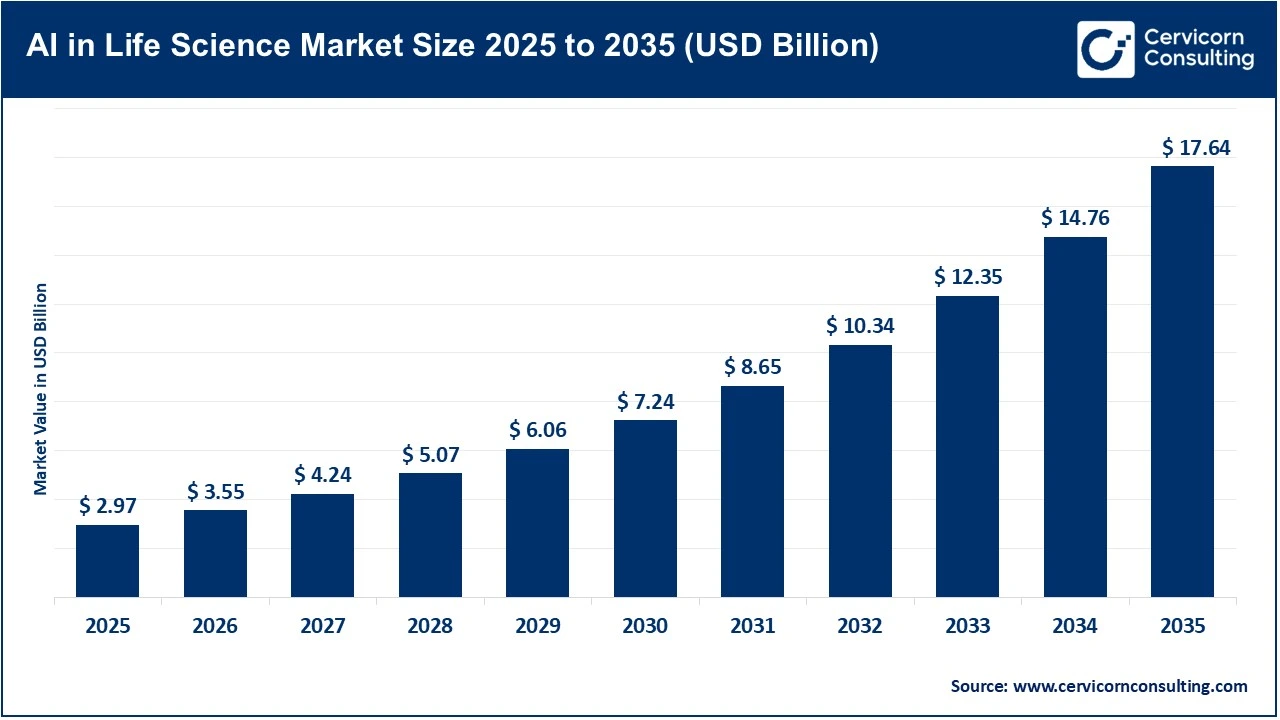
The global AI in life science market size was valued at approximately USD 2.97 billion in 2025 and is projected to reach around USD 17.64 billion by 2035, expanding at a compound annual growth rate (CAGR) of 19.5% over the forecast period from 2026 to 2035.
What is the AI in Life Science Market?
The AI in life science market refers to the use of artificial intelligence technologies across pharmaceutical, biotechnology, medical device, genomics, diagnostics, and healthcare research industries. AI systems analyze large biological and clinical datasets to identify patterns, automate processes, and support decision-making in areas such as:
- Drug discovery and development
- Clinical trial optimization
- Precision medicine
- Medical imaging and diagnostics
- Genomic analysis
- Biomarker discovery
- Regulatory compliance
- Manufacturing optimization
- Real-world evidence analytics
AI helps life science organizations reduce research costs, improve clinical outcomes, shorten drug development timelines, and enhance patient-centric healthcare delivery.
Get a Free Sample: https://www.cervicornconsulting.com/sample/2958
Why AI in Life Science is Important
AI has become critical in life sciences because traditional drug development and biomedical research processes are expensive, time-consuming, and data intensive. Developing a single new drug can take more than a decade and cost billions of dollars. AI significantly improves efficiency by identifying promising molecules faster, predicting clinical success rates, and automating repetitive research tasks.
Key reasons AI is important in life sciences include:
- Faster drug discovery and reduced R&D costs
- Improved clinical trial design and patient recruitment
- Better disease prediction and diagnosis accuracy
- Enhanced precision medicine and personalized treatment
- Efficient management of massive genomic and clinical datasets
- Early detection of adverse drug reactions
- Automation of regulatory documentation and workflows
- Accelerated vaccine and biologics development
AI also played a major role during the COVID-19 pandemic, where predictive analytics and AI-driven research accelerated vaccine development, epidemiological modeling, and clinical trial analysis.
Major Companies in the AI in Life Science Market
| Company | Specialization | Key Focus Areas | Notable Features | 2025 Revenue | Estimated Market Share | Global Presence |
|---|---|---|---|---|---|---|
| IQVIA | Healthcare analytics and life science technology | Clinical trials, AI-driven analytics, real-world evidence | Advanced healthcare data ecosystem and AI-powered research platforms | Approx. USD 16.3 billion | Strong presence in healthcare analytics | Operations in more than 100 countries |
| IBM | AI, cloud computing, healthcare analytics | Watson Health technologies, hybrid cloud, genomics | Strong AI research capabilities and enterprise AI platforms | Approx. USD 65+ billion (estimated annualized) | Significant enterprise AI market share | Presence across 170+ countries |
| Oracle | Cloud infrastructure and healthcare data management | Healthcare cloud, EHR systems, AI-driven analytics | Large-scale healthcare database integration | Approx. USD 57.4 billion | Growing healthcare cloud share | Strong global enterprise network |
| Microsoft | Cloud AI and healthcare solutions | Azure AI, healthcare cloud, medical data interoperability | Strong partnerships with healthcare providers and pharma companies | Over USD 245 billion (FY2025 estimated) | Major cloud AI provider | Presence in 190+ countries |
| AI research and data analytics | DeepMind, medical imaging AI, genomics | Advanced deep learning and predictive healthcare models | Alphabet revenue exceeded USD 350 billion (estimated FY2025) | Leading AI innovation share | Extensive worldwide operations |
Leading Trends in the AI in Life Science Market and Their Impact
1. AI-Driven Drug Discovery
AI is revolutionizing drug discovery by enabling researchers to analyze millions of molecular structures and biological interactions rapidly. Pharmaceutical companies are increasingly using generative AI models to identify drug candidates with higher probability of clinical success.
Impact:
- Reduces drug discovery timelines
- Lowers research costs
- Improves success rates in early-stage development
- Accelerates treatment availability for rare diseases and cancers
Companies such as Google DeepMind and IBM Research are investing heavily in AI-driven molecular modeling and protein structure prediction.
2. Precision Medicine and Personalized Healthcare
AI is enabling personalized treatment approaches by analyzing genetic, clinical, and lifestyle data. Precision medicine uses AI algorithms to recommend targeted therapies tailored to individual patient characteristics.
Impact:
- Improves treatment effectiveness
- Reduces adverse drug reactions
- Enhances cancer care outcomes
- Supports customized therapeutics development
The growing adoption of genomic sequencing technologies is strengthening this trend worldwide.
3. AI in Clinical Trials
Clinical trials often face delays due to inefficient patient recruitment and data analysis. AI platforms help identify eligible patients faster, monitor trial performance, and predict patient outcomes.
Impact:
- Faster clinical trial completion
- Improved patient retention rates
- Reduced operational costs
- Better regulatory compliance
AI also improves decentralized and virtual clinical trial models.
4. Real-World Evidence Analytics
Healthcare organizations increasingly use AI to analyze electronic health records, insurance claims, and patient-generated data for real-world evidence studies.
Impact:
- Better post-market surveillance
- Enhanced pharmacovigilance
- Improved healthcare decision-making
- Support for value-based healthcare systems
5. Generative AI in Life Sciences
Generative AI tools are now being used to automate scientific documentation, summarize research findings, and create predictive biological models.
Impact:
- Increased productivity for researchers
- Faster scientific literature analysis
- Improved collaboration between research teams
- Enhanced innovation capabilities across pharmaceutical organizations
Successful Examples of AI in Life Science Around the World
AlphaFold by Google DeepMind
Google DeepMind AlphaFold transformed biological research by accurately predicting protein structures using AI. The platform has accelerated research in drug discovery, disease understanding, and molecular biology.
Global Impact:
- Millions of protein structures predicted
- Used by researchers worldwide
- Accelerated biological and pharmaceutical innovation
IBM Watson for Oncology
IBM Watson Health developed AI-powered oncology tools that help healthcare providers analyze patient records and recommend treatment options based on medical evidence.
Global Impact:
- Improved cancer treatment support
- Faster medical decision-making
- Enhanced clinical workflow efficiency
IQVIA AI-Powered Clinical Research
IQVIA Connected Intelligence uses AI and advanced analytics to optimize clinical trials and healthcare research processes.
Global Impact:
- Improved patient recruitment
- Enhanced clinical data analysis
- Reduced pharmaceutical R&D timelines
Microsoft Cloud for Healthcare
Microsoft Cloud for Healthcare provides AI-enabled healthcare data integration and analytics solutions for hospitals, pharmaceutical firms, and healthcare providers.
Global Impact:
- Improved interoperability
- Enhanced patient engagement
- Accelerated digital transformation in healthcare systems
AI-Based Medical Imaging in Europe
European hospitals increasingly use AI-driven imaging systems for cancer screening, radiology diagnostics, and disease detection.
Global Impact:
- Faster diagnosis
- Reduced radiologist workload
- Improved diagnostic accuracy
Global Regional Analysis
North America
United States dominates the global AI in life science market due to strong healthcare infrastructure, large pharmaceutical investments, advanced research institutions, and early AI adoption.
Major drivers include:
- Strong presence of leading technology companies
- Extensive healthcare digitization
- Large-scale genomic research programs
- Government support for AI innovation
Government Initiatives and Policies
The U.S. government supports AI and biomedical innovation through agencies such as:
- National Institutes of Health (NIH)
- FDA AI regulatory frameworks
- National AI Initiative Act
- Biomedical Advanced Research and Development Authority (BARDA) programs
The FDA has also introduced frameworks for AI-enabled medical devices and software-based diagnostics, supporting faster commercialization.
Canada is also investing heavily in AI research through healthcare AI innovation hubs and public-private partnerships.
Europe
Europe is a major market driven by healthcare modernization, precision medicine initiatives, and strong regulatory frameworks.
Countries such as:
- Germany
- United Kingdom
- France
- Switzerland
are actively investing in AI-driven healthcare infrastructure.
Government Initiatives and Policies
The European Union’s AI Act and healthcare digitization programs are shaping responsible AI adoption. The EU also supports:
- Genomics research initiatives
- Cross-border healthcare data sharing
- AI ethics and transparency standards
- Funding for biotech and AI startups
Europe emphasizes ethical AI usage, patient privacy protection, and secure healthcare data management.
Asia-Pacific
Asia-Pacific is expected to witness the fastest growth due to rising healthcare investments, large patient populations, and rapid digital transformation.
Key countries include:
- China
- Japan
- India
- South Korea
- Singapore
Government Initiatives and Policies
China
China’s national AI strategy strongly supports healthcare AI innovation, including:
- AI-assisted diagnostics
- Smart hospitals
- Genomics and biotechnology research
- Healthcare data integration
Japan
Japan promotes AI-enabled elderly care and precision medicine through national healthcare modernization programs.
India
India is rapidly expanding digital healthcare infrastructure through:
- Ayushman Bharat Digital Mission
- National Digital Health Mission
- AI-based telemedicine and diagnostics initiatives
Indian startups and hospitals are increasingly adopting AI tools for pathology, radiology, and predictive healthcare analytics.
Latin America
South America is gradually adopting AI in healthcare and life sciences, particularly in:
- Brazil
- Mexico
- Argentina
The region is seeing growth in:
- Telemedicine platforms
- AI-enabled diagnostics
- Digital healthcare systems
Government Initiatives and Policies
Governments are investing in:
- Healthcare digitalization
- Electronic medical records
- Public health AI initiatives
- Biotechnology innovation programs
However, infrastructure limitations and data privacy challenges continue to affect market expansion.
Middle East and Africa
Africa and the Middle East are emerging markets for AI in life sciences.
Countries including:
- United Arab Emirates
- Saudi Arabia
- South Africa
are investing in smart healthcare infrastructure and AI-based diagnostics.
Government Initiatives and Policies
UAE
The UAE National AI Strategy promotes AI integration across healthcare systems, including predictive medicine and digital hospitals.
Saudi Arabia
Saudi Vision 2030 supports healthcare modernization and AI-enabled medical innovation.
Africa
Several African nations are adopting AI-driven disease surveillance systems and digital health technologies to improve healthcare accessibility.
The region still faces challenges related to:
- Limited healthcare infrastructure
- Skilled workforce shortages
- Data management capabilities
Despite these challenges, increasing investments and public-private collaborations are expected to accelerate AI adoption across the healthcare and life science sectors globally.
To Get Detailed Overview, Contact Us: https://www.cervicornconsulting.com/contact-us
Read Report: Hydrogen Mobility Market Revenue, Trends, and Strategic Insights by 2035