Surgical Devices Market Outlook: Minimally Invasive Surgery, Robotic Technologies, Hospital Procurement, and Digital Integration
Surgical Devices Market: Where Should Manufacturers Invest as Surgical Technology and Hospital Procurement Evolve?
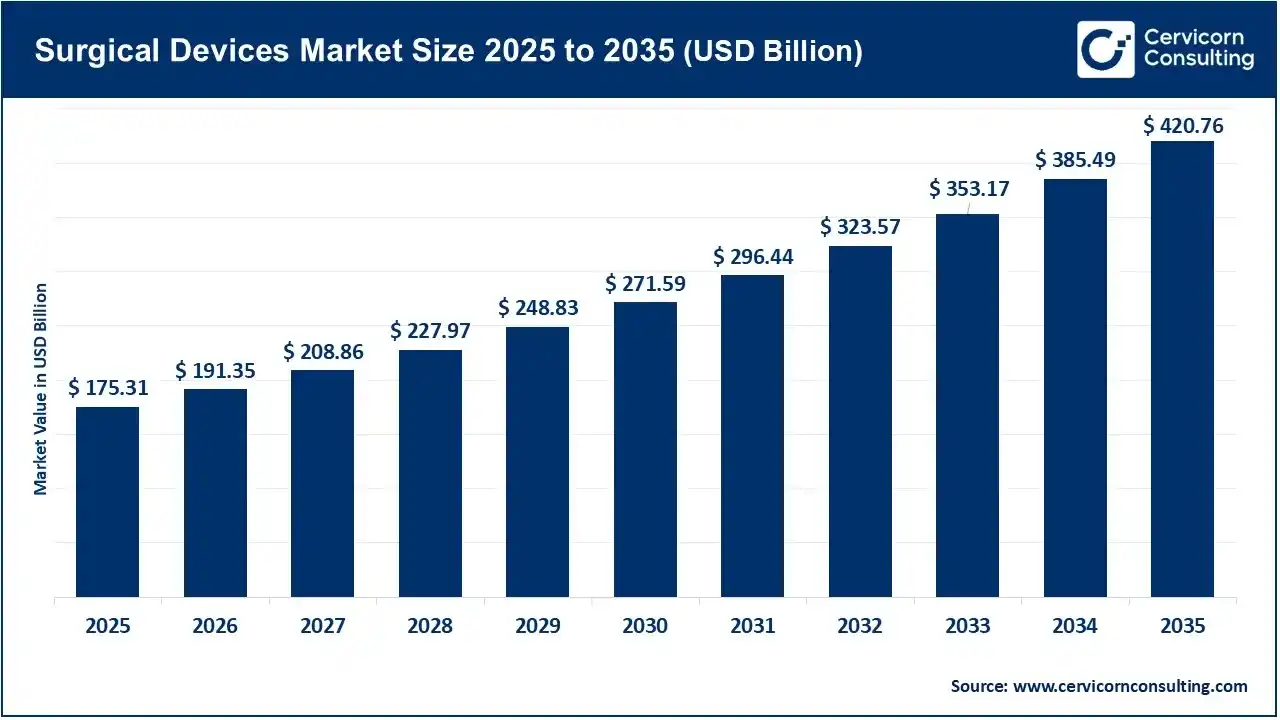
The global surgical devices market was valued at USD 175.31 billion in 2025 and is projected to reach USD 420.76 billion by 2035, expanding at a CAGR of 9.2% from 2026 to 2035. Market expansion is being supported by increasing surgical volumes, an ageing population, rising chronic disease prevalence, and growing adoption of minimally invasive and robotic-assisted procedures.
However, market growth alone does not guarantee commercial success for surgical device manufacturers. Healthcare providers are increasingly evaluating equipment based on clinical outcomes, procedure efficiency, total ownership costs, compatibility with existing operating room infrastructure, and the ability to support higher surgical volumes. At the same time, manufacturers face decisions around technology investment, product differentiation, regulatory compliance, and geographic expansion.
For companies operating in this industry, the central question is no longer simply how to participate in a growing market, but where to allocate resources to achieve sustainable competitive advantages.
Here are six strategic considerations that should shape business decisions in the surgical devices industry.
1. Should Manufacturers Prioritize Minimally Invasive and Robotic-Assisted Technologies?
The shift toward minimally invasive surgery (MIS) is changing product development priorities across the surgical devices industry. MIS accounted for approximately 42% of global market revenue in 2025, making it the leading technology segment. Its adoption is supported by smaller incisions, reduced patient trauma, shorter recovery periods, and potentially shorter hospital stays.
Robotic-assisted surgery, meanwhile, is emerging as an important growth opportunity. Advancements in visualization, instrument control, surgical navigation, and procedural precision are expanding the applications of robotic platforms across orthopedic, general, gynecological, and other surgical specialties.
For manufacturers, the investment decision should involve more than developing robotic platforms. Companies should evaluate opportunities across the supporting technology ecosystem, including:
- Robotic-compatible surgical instruments and accessories.
- High-definition 3D visualization and endoscopic systems.
- Advanced energy-based surgical devices.
- Image-guided navigation and intraoperative imaging.
- Specialized instruments designed for minimally invasive procedures.
The commercial opportunity also extends to manufacturers of conventional surgical instruments that can adapt existing portfolios for minimally invasive procedures.
Business implication: Companies should assess which product categories can benefit from the transition toward minimally invasive procedures and whether developing complete robotic platforms, specialized instruments, or supporting technologies offers the most attractive return on investment.
Get a Free Sample: https://www.cervicornconsulting.com/sample/3078
2. How Should Companies Balance Product Innovation with Hospital Procurement Economics?
Hospitals accounted for approximately 64% of the surgical devices market in 2025, reflecting their significant surgical volumes and broad range of clinical specialties. However, purchasing decisions are becoming increasingly complex as healthcare providers balance clinical requirements with operating budgets.
Advanced surgical equipment often involves substantial upfront investment, installation costs, maintenance expenses, software updates, and specialized training. These considerations can delay procurement, particularly for hospitals operating under strict capital expenditure constraints.
Manufacturers therefore need to demonstrate the economic value of their products alongside clinical performance.
Important considerations include:
- Total cost of ownership: Evaluate equipment acquisition, servicing, consumables, maintenance, and replacement costs throughout the product lifecycle.
- Operating room efficiency: Demonstrate how equipment can support procedure standardization, reduce workflow interruptions, and improve operating room utilization.
- Clinical performance: Establish evidence around reliability, precision, safety, and procedure-specific outcomes.
- Equipment utilization: Understand whether hospitals can achieve sufficient procedure volumes to justify investment in advanced equipment.
- Flexible procurement models: Assess leasing, service agreements, equipment-as-a-service arrangements, and other financing structures where commercially viable.
For example, a manufacturer introducing a robotic-assisted surgical platform may need to demonstrate not only its technical capabilities but also its economic viability across the hospital’s expected procedure volumes.
Business implication: Manufacturers should build product positioning around measurable clinical and operational value rather than relying exclusively on technological differentiation. Understanding hospital purchasing criteria can help companies develop more competitive pricing and service strategies.
3. Which Product Categories Offer the Strongest Opportunities for Portfolio Expansion?
The surgical devices market includes several product categories with different adoption patterns, replacement cycles, and competitive requirements. Manufacturers should avoid treating the market as a single opportunity and instead evaluate where their existing capabilities can support profitable expansion.
Handheld surgical instruments accounted for approximately 24% of market revenue in 2025, supported by their extensive use across open, minimally invasive, and specialty procedures. Their established demand provides manufacturers with opportunities to improve material durability, ergonomics, precision, and instrument performance.
Other important product categories include:
- Electrosurgical devices: Opportunities are emerging through advanced energy delivery, improved tissue management, hybrid ultrasonic-bipolar systems, and integrated surgical smoke evacuation.
- Surgical scopes and visualization systems: Demand is supported by high-definition imaging, flexible endoscopy, and 3D visualization technologies.
- Surgical power tools: Orthopedic and other specialty procedures create opportunities for precision-driven cutting, drilling, and powered instrumentation.
- Surgical sutures and staples: Manufacturers can focus on specialized materials, improved handling, and procedure-specific product development.
- Robotic-assisted surgical systems: Increasing adoption of robotic procedures is creating opportunities for platforms, instruments, accessories, and software integration.
The strategic challenge is determining whether to expand through internal product development, acquisitions, licensing agreements, or partnerships.
Companies with established distribution networks may find it commercially attractive to introduce complementary product categories rather than entering entirely unfamiliar technology segments.
Business implication: Portfolio expansion should be based on procedure demand, competitive intensity, existing manufacturing capabilities, regulatory requirements, and cross-selling potential. A broader product portfolio is valuable only when it strengthens market access and improves commercial positioning.
4. Should Manufacturers Shift Their Commercial Strategies Toward Ambulatory Surgical Centers?
The growing use of outpatient surgical facilities is changing the traditional purchasing landscape. Ambulatory surgical centers (ASCs) are becoming increasingly important as healthcare systems seek to manage costs, improve patient throughput, and move suitable procedures away from inpatient hospital settings.
The expansion of same-day surgical procedures creates demand for compact, reliable, and efficient equipment that supports streamlined workflows.
Manufacturers should evaluate whether their existing products are appropriate for ASC environments or require modifications in terms of equipment size, installation requirements, operating costs, and maintenance.
Key opportunities include:
- Compact endoscopic and visualization systems.
- Portable surgical equipment and power tools.
- Procedure-specific instruments and consumables.
- Efficient sterilization and instrument reprocessing solutions.
- Energy-based devices suitable for outpatient procedures.
- Equipment that supports shorter setup and turnover times.
The distinction between hospital and ASC procurement is important. ASCs may prioritize affordability, utilization rates, operational simplicity, and rapid equipment servicing, while larger hospitals may require broader equipment capabilities and integration across multiple specialties.
The market page also highlights that ambulatory surgical centers are expected to be the fastest-growing end-user segment during the forecast period.
Business implication: Manufacturers should develop separate commercial strategies for hospitals and ASCs. Product configurations, pricing structures, distribution partnerships, and service models should reflect the different operational requirements of each customer group.
5. How Should Companies Approach Geographic Expansion and Regulatory Compliance?
Regional expansion offers significant opportunities, but manufacturers must evaluate healthcare infrastructure, purchasing power, regulatory requirements, and local competitive conditions before entering new markets.
North America accounted for approximately 38% of global surgical devices market revenue in 2025, making it the largest regional market. The region benefits from established healthcare infrastructure, advanced surgical capabilities, and relatively strong adoption of innovative medical technologies.
Asia-Pacific, valued at approximately USD 43.83 billion in 2025, is projected to reach USD 105.19 billion by 2035. Expanding healthcare infrastructure, rising surgical volumes, and increasing access to advanced medical technologies are supporting regional growth.
These differences create distinct market-entry opportunities.
North America
Companies should assess opportunities in advanced surgical visualization, robotic-assisted systems, orthopedic devices, and specialized instruments. However, established competitors, regulatory requirements, and hospital procurement expectations make product differentiation essential.
Asia-Pacific
Manufacturers can evaluate opportunities arising from healthcare infrastructure development, expanding surgical capacity, and increasing adoption of minimally invasive technologies. Local distribution partnerships, manufacturing capabilities, and competitive pricing may be important for market penetration.
Europe
Market-entry strategies should account for regulatory compliance, established healthcare systems, and country-level differences in surgical capacity and procurement processes.
Regulatory planning should be integrated into product development rather than treated as a final commercialization step. Companies need to assess applicable device classification, clinical evidence requirements, quality management systems, post-market surveillance, and cybersecurity obligations for connected surgical technologies.
Business implication: Geographic expansion should be prioritized using a combination of market size, growth potential, regulatory complexity, competitive positioning, distribution access, and achievable market share. A high-growth region is not automatically the most attractive market if commercialization costs and entry barriers are substantial.
6. How Can Manufacturers Differentiate Through Digital Integration and Strategic Partnerships?
Surgical device innovation is increasingly extending beyond mechanical performance. Artificial intelligence, advanced imaging, connected equipment, real-time visualization, and surgical navigation are creating opportunities to improve operating room capabilities.
For manufacturers, this transition introduces both product-development opportunities and new competitive requirements.
Companies should evaluate investment opportunities in:
- AI-enabled surgical visualization and anatomical identification.
- Real-time surgical navigation and image-guided procedures.
- Connected surgical equipment and operating room data integration.
- Advanced imaging and fluorescence-based visualization.
- Patient-specific instruments, implants, and 3D-printed surgical solutions.
- Cybersecurity and software lifecycle management.
However, developing every technology internally may not be commercially practical. Partnerships can help companies access complementary capabilities and reduce development timelines.
For instance, the July 2026 collaboration between KARL STORZ, Moon Surgical, and Sovato highlighted the importance of developing a more open and interoperable robotics ecosystem for operating rooms.
Such developments indicate that competitive differentiation may increasingly depend on how well devices integrate with broader surgical workflows rather than on individual equipment capabilities alone.
Manufacturers should also evaluate partnerships with technology developers, hospitals, research institutions, and specialized component suppliers to strengthen product development and commercialization.
Business implication: Companies should identify which digital capabilities are strategically important to their product portfolios and determine whether internal R&D, technology partnerships, or acquisitions offer the most effective route to commercialization.
Competitive Landscape: Which Companies Are Shaping the Surgical Devices Industry?
The surgical devices market includes established medical technology manufacturers with diversified portfolios, specialized surgical equipment providers, and companies developing advanced robotic and visualization platforms.
The competitive landscape is influenced by product innovation, clinical adoption, distribution networks, regulatory capabilities, and the ability to maintain relationships with hospitals and surgeons.
Some of the major companies operating in this market include:
- Johnson & Johnson MedTech: Its surgical technology and medical device portfolio provides exposure to multiple procedure categories. The company can leverage its established healthcare presence to strengthen its position in advanced surgical technologies.
- Medtronic: Its broad medical technology portfolio and capabilities across surgical specialties position it in conventional and advanced surgical equipment markets.
- Stryker: The company has a strong presence in orthopedic technologies and surgical equipment. Its Mako robotic platform supports its positioning in robotic-assisted joint replacement procedures.
- Intuitive Surgical: A prominent participant in robotic-assisted surgery, with its da Vinci platform supporting minimally invasive procedures across multiple specialties.
- B. Braun Aesculap: Its surgical instruments and medical technology capabilities support demand across hospitals and surgical specialties.
- Olympus: Its endoscopic and visualization technologies position the company in minimally invasive procedures and surgical imaging.
- CONMED: Its surgical technologies and instrumentation portfolio provide exposure to general surgery and other specialty applications.
- Boston Scientific: Its medical device portfolio includes technologies used in interventional and minimally invasive procedures.
- Integra LifeSciences: Its surgical technologies and specialty medical products provide exposure to neurosurgery and other surgical applications.
- Zimmer Biomet: Its orthopedic portfolio and robotic-assisted surgical technologies position it in joint replacement and musculoskeletal procedures.
For established manufacturers, maintaining competitive advantage will require continuous product innovation, effective commercialization, and the ability to respond to changing hospital procurement priorities. Smaller companies may find opportunities in specialized instruments, surgical software, advanced imaging, and complementary technologies.
Conclusion: Strategic Priorities Will Determine the Next Phase of Market Competition
The surgical devices market is entering a period in which technological innovation and healthcare economics will increasingly influence competitive positioning. Although the market is projected to grow from USD 175.31 billion in 2025 to USD 420.76 billion by 2035, manufacturers will need to make selective investment decisions to convert market expansion into sustainable business growth.
The transition toward minimally invasive and robotic-assisted surgery creates opportunities across instruments, visualization systems, energy-based devices, and connected surgical platforms. At the same time, the expansion of ambulatory surgical centers is changing equipment requirements and procurement priorities.
For manufacturers, the most important priorities include identifying high-potential product categories, demonstrating measurable value to healthcare providers, adapting commercial strategies to different end users, and selecting geographic markets based on realistic commercialization opportunities.
Companies that align product development, regulatory planning, procurement economics, and technology partnerships will be better positioned to compete as surgical practices and healthcare delivery models evolve.
To Get Detailed Overview, Contact Us: https://www.cervicornconsulting.com/contact-us