3D Printing Construction Market: Where Should Companies Invest to Achieve Cost-Efficient, Scalable Building Automation?
3D Printing Construction Market: Where Should Companies Invest as Automated Building Moves Toward Commercial Scale?
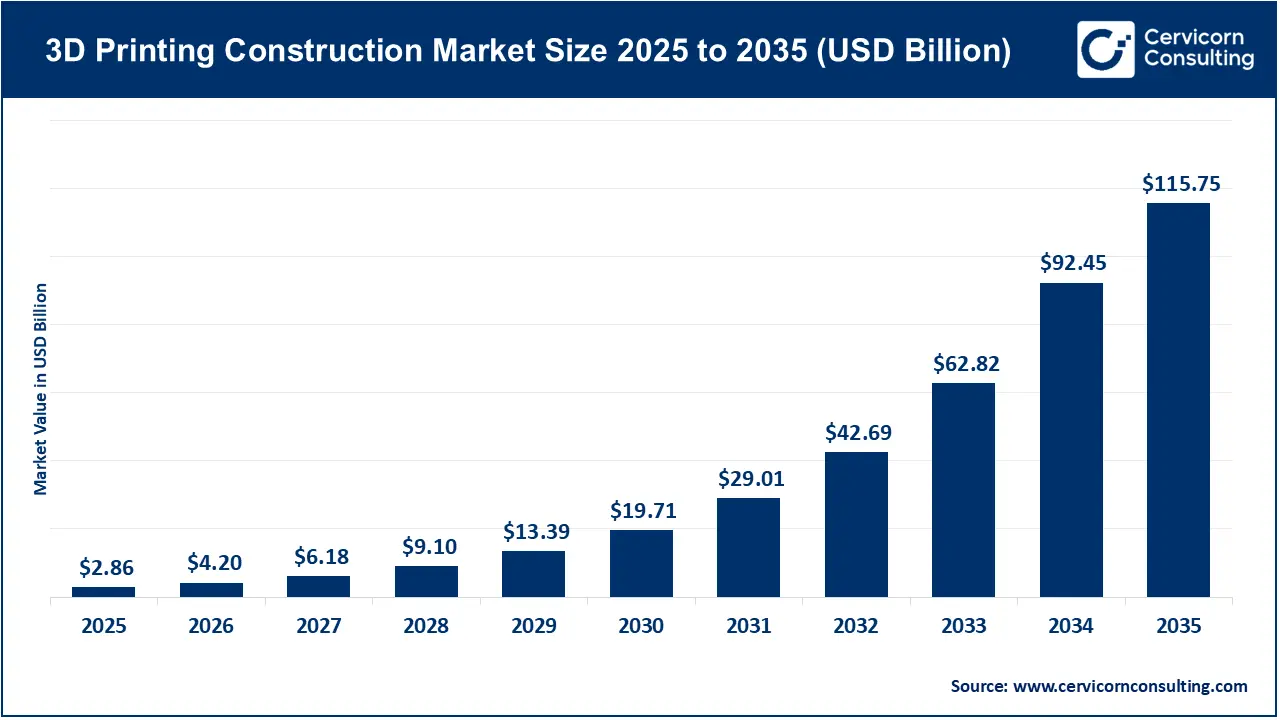
The global 3D printing construction market is projected to grow from USD 2.86 billion in 2025 to USD 115.75 billion by 2035, reflecting a projected CAGR of 44.78% from 2026 to 2035. The forecast signals substantial potential for construction automation, but the commercial opportunity depends on whether companies can translate faster building processes into lower total project costs, repeatable delivery and regulatory acceptance.
For construction companies, real estate developers, building-material manufacturers and technology providers, the key decision is not simply whether to adopt 3D printing. It is which applications, materials and business models can generate sustainable returns as the technology scales.
Why Construction Companies Are Evaluating 3D Printing
Conventional construction relies heavily on formwork, repetitive on-site activities and labour-intensive execution. Construction-scale 3D printing introduces a different production model, using digitally controlled equipment to deposit or bind materials layer by layer.
This approach can reduce formwork requirements, improve design flexibility and automate portions of building construction. However, printing a building’s walls does not eliminate the need for foundations, reinforcement where required, roofing, electrical and plumbing installations, finishing or regulatory inspections.
A March 2026 study comparing two post-office buildings reported that 3D-printed concrete construction reduced embodied carbon by 19%, material use by 17%, steel reinforcement use by 48%, formwork requirements by 86% and construction duration by 56%. These results demonstrate potential efficiency gains, but they should be treated as project-specific findings rather than universal savings across all building types.
For companies assessing adoption, the more useful question is how much of the total construction budget and schedule can realistically be improved after accounting for equipment, materials, site preparation and conventional work that remains necessary.
Get a Free Sample: https://www.cervicornconsulting.com/sample/2792
Where Are the Most Promising Commercial Opportunities?
1. Residential Construction and Affordable Housing
Residential construction is an important application for companies seeking to standardise designs and replicate building processes across multiple units. Repeated floor plans, predictable site conditions and large housing programmes can potentially improve printer utilisation and reduce setup costs per unit.
The opportunity is particularly relevant to:
- Residential developers building repeatable housing units.
- Contractors working on affordable housing and public housing programmes.
- Construction technology companies offering printing equipment and project-delivery services.
- Material suppliers developing printable concrete and mortar formulations.
India provides a relevant example of emerging institutional demand. In July 2026, CSIR–Structural Engineering Research Centre and Merlin Automation Solutions initiated a collaboration to develop specialised concrete mixes for 3D printing and conduct seismic evaluations of ground-plus-one-storey printed buildings. The initiative highlights the importance of material performance and structural validation alongside equipment development. Source: Press Information Bureau
Business implication: Companies targeting residential projects should evaluate repeatable housing programmes, local building approvals, structural requirements and the cost per completed, occupiable unit—not just the speed of printing the walls.
2. Commercial Buildings and Hospitality
Commercial projects can benefit from digitally fabricated walls, architectural features and geometrically complex components that are expensive or time-consuming to produce using conventional formwork.
Hotels, retail developments, visitor facilities and selected low-rise commercial buildings may provide opportunities where design flexibility is valuable and project requirements can be standardised.
Nevertheless, commercial adoption depends on more than architectural freedom. Fire resistance, acoustic performance, insulation, accessibility, building services and approval requirements must be addressed.
For developers, the strongest business case may emerge when 3D printing enables a distinctive design or simplifies a repeated construction process enough to offset the additional technology and material costs.
3. Infrastructure and Specialised Structures
Infrastructure applications include selected landscape structures, drainage components, pedestrian infrastructure, architectural elements and other geometrically complex structures. The commercial appeal lies in reducing formwork complexity and producing components that would otherwise require labour-intensive fabrication.
However, infrastructure projects can carry demanding requirements for durability, load-bearing performance, exposure resistance and long-term maintenance. Printing speed alone is insufficient to establish economic viability.
Equipment manufacturers and contractors should prioritise applications where conventional fabrication is particularly expensive, design complexity is high or repeatable components can be produced at scale.
Which Technologies and Materials Deserve Investment?
Cervicorn Consulting identifies extrusion, powder bonding and other methods within the market, with concrete, plastics and polymers, metals, and composites among the material categories. Each presents different opportunities and technical constraints.
Extrusion-based printing: This method deposits printable material through a nozzle and is particularly relevant to concrete construction. Equipment providers should differentiate through print precision, material compatibility, site mobility, throughput and reliable operation.
Concrete and cementitious materials: Material manufacturers have an opportunity to develop mixes with suitable pumpability, extrudability, shape retention and interlayer bonding. Performance consistency is critical because a formulation that works under laboratory conditions may behave differently under changing site temperatures, humidity and operating conditions.
Polymers and composites: These materials can serve selected components and specialised construction applications. Companies should assess fire performance, weathering, durability, local standards and end-use suitability before committing to commercial production.
Software and automation: Design-to-print software, robotic control, digital modelling, process monitoring and quality assurance can become important sources of differentiation. Integrating design data with on-site execution can help reduce printing errors and material waste.
For investors and suppliers, the opportunity therefore extends beyond printer sales. Recurring revenue may also come from material supply, software licences, maintenance, operator training, equipment rental and specialised construction services.
The Cost Question: Can 3D Printing Compete With Conventional Construction?
A shorter printing cycle does not automatically produce a cheaper building. Companies need to evaluate the entire project economics, including costs that remain outside the automated process.
The most important cost variables are:
- Capital expenditure: Printer purchase or lease, robotic systems, software and supporting equipment.
- Material economics: Printable mix costs, admixtures, testing, transportation and storage.
- Site readiness: Foundations, site access, equipment positioning, power and material-handling infrastructure.
- Remaining construction work: Reinforcement, roofing, windows, plumbing, electrical systems, finishing and other non-printed elements.
- Utilisation: The number of projects completed annually and the proportion of available equipment time used productively.
- Quality and compliance: Testing, certification, inspection, insurance and potential rework.
Companies should compare conventional and printed construction on a like-for-like basis, using total delivered cost per square metre, project completion time, labour hours, material consumption, rework rates and lifecycle performance.
A contractor with a steady pipeline of similar projects may justify owning equipment, while a company with irregular demand may be better served by equipment rental, a specialist printing contractor or a joint venture.
What Could Slow Market Adoption?
Despite its potential, construction 3D printing faces commercial and technical barriers that businesses should evaluate before scaling.
Regulatory uncertainty: Approval requirements differ by jurisdiction and building type. Structural calculations, fire safety, seismic performance, material certification and inspection procedures can influence project timelines.
Limited repeatability across sites: Weather, material availability, site geometry and equipment logistics can affect production consistency. A successful demonstration does not necessarily establish reliable performance across multiple locations.
Workforce and integration requirements: Companies need personnel who can coordinate digital design, material preparation, printer operation and conventional construction activities. Automation changes the skills required rather than removing the need for construction expertise.
Uncertain project-level savings: The proportion of total building costs addressed by printing varies by design and delivery model. Companies should avoid basing investment decisions solely on headline reductions in printing time.
A 2026 review of construction 3D printing research also identified gaps in performance evidence, particularly around acoustic performance, reinforcing the need to assess building performance beyond printability and structural strength. Source: ScienceDirect
Strategic Priorities for Companies Entering the Market
Companies can reduce investment risk by matching their entry strategy to their existing capabilities and customer base.
- Construction contractors: Pilot a repeatable, clearly defined project before committing to large-scale equipment purchases. Establish a cost baseline against conventional construction.
- Cement and building-material manufacturers: Develop printable formulations with consistent performance, local raw-material availability and scalable production economics.
- Real estate developers: Identify projects with repetitive designs, predictable site conditions and clear approval pathways. Evaluate the cost of the completed building rather than the printed structure alone.
- Equipment manufacturers: Focus on uptime, deployment flexibility, maintenance, operator training and integration with existing construction workflows.
- Technology providers: Build solutions around design optimisation, quality monitoring, material traceability and integration with construction management systems.
- Investors and strategic partners: Examine customer pipelines, equipment utilisation, repeat orders, unit economics and the ability to operate across different regulatory environments.
A phased approach—technical validation, a commercial pilot, repeat-project testing and then capacity expansion—can provide stronger evidence for investment decisions than scaling based on market growth projections alone.
What Companies Should Monitor Next
Three developments will help determine how quickly construction 3D printing moves from specialised applications toward broader commercial adoption.
First, demonstrated project economics will matter more than isolated printing-speed records. Evidence of lower delivered costs, reduced rework and consistent project completion will be important for contractors and developers.
Second, building-code acceptance and independent performance validation will influence the range of structures that can be delivered commercially. Progress in seismic testing, fire performance, durability and quality assurance can help reduce adoption uncertainty.
Third, repeatable demand and local supply chains will shape equipment utilisation and material economics. Housing programmes, commercial project pipelines and partnerships between equipment providers, contractors and material manufacturers can create more predictable demand.
For companies operating in India and other developing construction markets, public-sector projects and collaborations with research institutions may offer opportunities to validate technology before pursuing larger commercial contracts.
Conclusion
The 3D printing construction market presents opportunities across automated building systems, printable materials, construction services and digital quality management. However, the strongest commercial positions are likely to emerge where the technology solves a specific construction problem and demonstrates repeatable economic value.
Companies evaluating the market should prioritise application selection, total project economics, regulatory readiness and equipment utilisation before expanding capacity. For investors and suppliers, understanding which project types are moving beyond pilot deployments—and which technical requirements remain unresolved—will be central to identifying viable growth opportunities.
To Get Detailed Overview, Contact Us: https://www.cervicornconsulting.com/contact-us
Read Report: Hydrogen Internal Combustion Engine Market: Which Applications Offer the Strongest Commercial Opportunities?