Electric Mobility Market: Which Segments and Regions Will Attract the Next Wave of EV Investment?
Electric Mobility Market: Where Should Businesses Invest as EV Adoption Enters Its Next Phase?
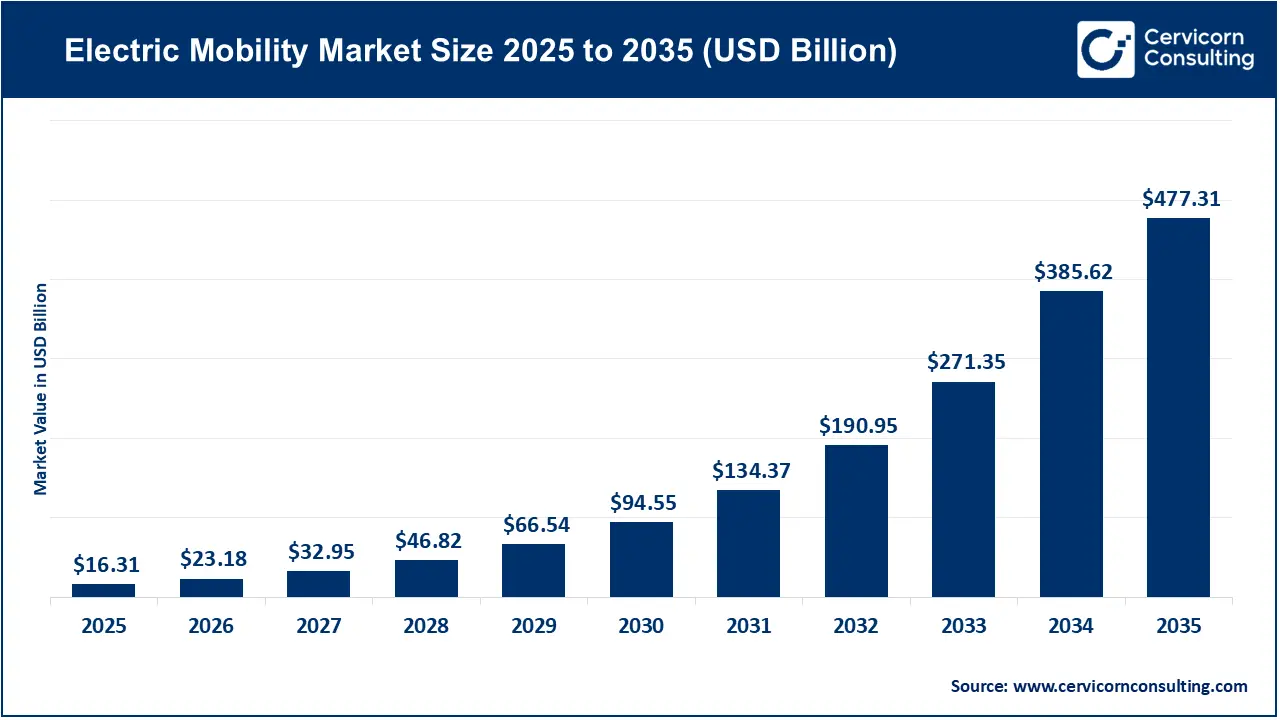
The global electric mobility market was valued at approximately USD 16.31 billion in 2025 and is projected to reach USD 477.31 billion by 2035, expanding at a 40.16% CAGR. Battery electric vehicles accounted for about 52.6% of the market in 2025, while battery cells and packs represented approximately 48.4%, highlighting how strongly the value chain remains tied to electrification and energy storage.
But the more important business question is no longer whether electric mobility will expand. It is where companies should allocate capital as the market moves from vehicle adoption toward a broader mobility-energy ecosystem.
The opportunity is moving beyond vehicle sales
Global electric car sales exceeded 20 million units in 2025, representing roughly one-quarter of all new cars sold. The IEA expects global electric car sales to reach around 23 million in 2026, or approximately 28% of total car sales. At the same time, adoption is becoming increasingly diversified: Asia-Pacific markets excluding China are expected to record more than 50% sales growth in 2026, while Latin America is projected to grow by about 45%.
For manufacturers, this creates opportunities across more than vehicle assembly. Battery systems, power electronics, charging hardware, fleet software, thermal management, energy management and vehicle connectivity are becoming increasingly important parts of the mobility value chain.
Cervicorn’s market data similarly shows battery cells and packs as the largest component segment, while DC fast charging represented approximately 44.9% of charging infrastructure revenue in 2025.
Charging infrastructure could become a major investment bottleneck
EV adoption is increasingly dependent on the availability, speed and economics of charging infrastructure.
The IEA reports that China accounted for more than 65% of global public charging points at the end of 2025, with its public charging network exceeding 4.7 million points. Fast and ultra-fast chargers in China increased from 1.5 million in 2024 to 2.2 million in 2025.
The infrastructure requirement will continue to expand as EV fleets grow. Under the IEA’s current-policy scenario, electricity consumption from EVs could exceed 1,500 TWh by 2035, roughly six times 2025 levels.
This changes the investment equation for businesses. Charging networks cannot be evaluated only on charger deployment. Site utilization, electricity tariffs, grid capacity, fleet density, charging speed and software-enabled load management increasingly determine project economics.
Get a Free Sample: https://www.cervicornconsulting.com/sample/2783
Fleet electrification creates a different business case
Passenger vehicles receive much of the attention, but commercial fleets can offer a more measurable route to EV economics.
Delivery vehicles, buses, logistics fleets, taxis and other high-mileage applications can generate greater vehicle utilization, making fuel savings and total cost of ownership more significant. Cervicorn’s market analysis also identifies commercial vehicles, public transport, last-mile delivery and fleet services as important applications.
India provides a useful example. The government’s PM E-DRIVE programme has been extended through March 2028, with a reported ₹11,900 crore outlay. As of June 2026, approximately 26.59 lakh EVs had been sold under the scheme. It also supports 14,028 e-buses, while ₹2,000 crore has been earmarked for public EV charging infrastructure.
For businesses, this suggests that fleet electrification should be assessed route-by-route rather than simply by vehicle category. Daily mileage, charging windows, depot infrastructure, electricity costs and vehicle utilization can determine whether electrification produces attractive returns.
Battery investment is becoming a strategic decision
Battery technology remains one of the most important areas for electric mobility investment. Cervicorn estimates that battery cells and packs represented nearly half of electric mobility market revenue in 2025.
However, future competitiveness will depend on more than increasing battery capacity.
Companies are increasingly evaluating:
- Battery energy density and charging speed
- Thermal management
- Battery-management systems
- Solid-state and next-generation chemistries
- Battery recycling and second-life applications
- Critical-mineral supply security
- Localized battery manufacturing
The IEA notes that battery-related patents account for nearly half of energy-sector patents, demonstrating how strongly innovation activity is concentrating around energy storage.
For suppliers and investors, this makes the battery ecosystem potentially more attractive than competing solely in finished vehicles.
Vehicle-to-grid could expand the addressable market
Another opportunity is emerging where transportation intersects with electricity infrastructure.
As EV penetration rises, vehicles increasingly represent flexible electricity demand—and potentially distributed storage. Smart charging and vehicle-to-grid (V2G) technologies can shift charging loads or allow compatible EVs to return electricity to the grid. The IEA notes that commercial V2G offerings for private EV owners began appearing in 2025, although vehicle availability, regulation and standards remain limiting factors.
This creates opportunities for companies operating across:
EVs → charging → energy management → renewable power → grid services
The winners may therefore not be companies selling the most vehicles, but those capable of integrating mobility with energy infrastructure.
Regional strategies will need to be different
Asia-Pacific currently represents the largest regional opportunity in Cervicorn’s market analysis, accounting for approximately 45.1% of global electric mobility revenue in 2025. Europe represented 28.7%, followed by North America at 21.4%.
The investment rationale differs considerably between these markets.
Asia-Pacific: Manufacturing scale, two- and three-wheelers, batteries, charging networks and rapidly expanding EV adoption create opportunities across the supply chain.
Europe: Regulatory pressure, charging infrastructure and fleet electrification remain important, with the region also moving toward higher-speed charging infrastructure. The IEA expects Europe’s public charging network to exceed 4.3 million points by 2035 under its current-policy scenario.
North America: Advanced EV technologies, commercial fleets, charging infrastructure and battery manufacturing remain important areas, although policy and trade conditions can materially influence investment decisions.
What should businesses prioritize?
The electric mobility opportunity is becoming increasingly fragmented. A company entering the market today does not necessarily need to compete with established automakers.
Higher-potential opportunities can emerge in battery technologies, charging infrastructure, fleet electrification, power electronics, thermal management, EV software, energy management, battery recycling and grid integration.
The key investment questions therefore become:
- Which vehicle segments have the strongest utilization economics?
- Where will charging infrastructure remain undersupplied?
- Which battery technologies can achieve cost and performance advantages?
- Which regions offer the strongest combination of policy support and demand?
- Where can EV infrastructure connect with renewable energy and grid services?
- Which parts of the EV value chain offer recurring revenue rather than one-time vehicle sales?
With global EV electricity demand potentially exceeding 1,500 TWh by 2035, the next stage of electric mobility is increasingly an infrastructure and energy-management story as much as an automotive one.
For automotive OEMs, battery manufacturers, charging companies, energy providers, fleet operators and technology suppliers, understanding these shifts can help identify where capacity expansion and capital deployment are most likely to generate long-term value.
To Get Detailed Overview, Contact Us: https://www.cervicornconsulting.com/contact-us
Read Report: Long-term care is moving beyond nursing homes: Where are the next growth and investment opportunities?