Which data center components are gaining demand as AI workloads scale?
Data center components market: How AI is reshaping power, cooling and infrastructure demand
Artificial intelligence is changing what a data center needs to look like.
The expansion of AI workloads is not only increasing demand for GPUs and servers. It is also putting pressure on the physical infrastructure surrounding those systems—power distribution, cooling, high-density racks, networking, backup power, monitoring, and thermal-management equipment. In many new AI facilities, the infrastructure required to operate computing equipment is becoming almost as important as the computing equipment itself.
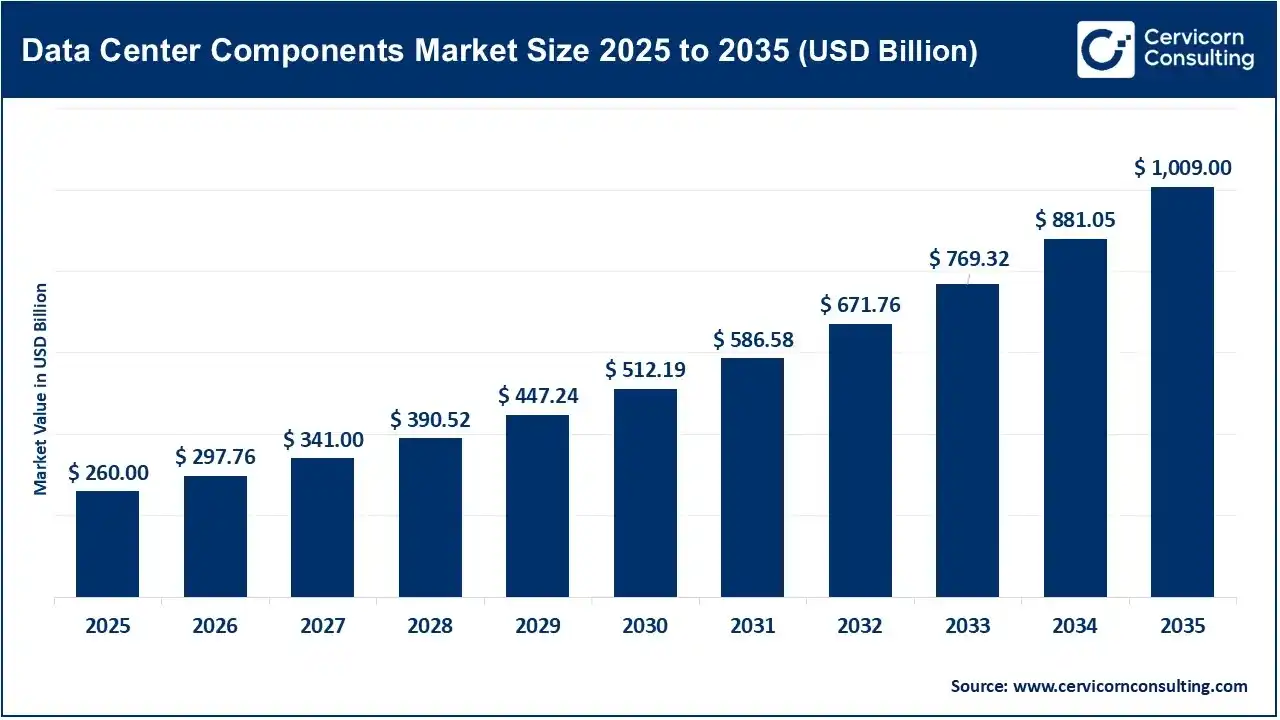
This shift is creating a significant opportunity across the data center components market, which was valued at USD 260 billion in 2025 and is projected to exceed USD 1,009 billion by 2035, expanding at a 14.5% CAGR from 2026 to 2035.
But the more important question for component manufacturers, technology providers, investors, and data center developers is not simply how large the market will become.
Which components are likely to experience the greatest demand as AI data centers move toward higher power and rack densities?
AI is turning data center infrastructure into a power and cooling challenge
Traditional data centers were designed around comparatively moderate rack densities. AI infrastructure is changing that equation.
Cervicorn Consulting’s analysis indicates that current AI systems can exceed 40 kW per rack, while some newer systems exceed 100 kW per rack. NVIDIA’s GB200 NVL72 rack-scale system, for example, has been rated at approximately 130 kW, illustrating how quickly power requirements can increase when computing is concentrated into high-density AI systems.
Deloitte’s 2026 technology outlook similarly identifies higher-power racks and liquid cooling as important areas of infrastructure development. It notes that next-generation AI racks could reach around 370 kW in 2026, compared with traditional racks that operated at much lower power levels.
This creates a chain reaction:
More compute → higher rack density → higher electricity demand → greater heat generation → advanced power and cooling requirements.
As a result, data center component demand is increasingly moving beyond conventional servers and storage toward infrastructure capable of supporting high-density AI environments.
Get a Free Sample:https://www.cervicornconsulting.com/sample/3045
Power infrastructure is becoming a critical component market
Power availability is emerging as one of the biggest constraints on data center expansion.
The global data center components market is already seeing substantial demand for transformers, switchgear, UPS systems, power distribution units, busways, generators, power shelves, and related electrical equipment. Cervicorn estimates that power infrastructure accounted for a significant portion of component demand in 2025.
The issue is becoming even more visible as AI campuses require significantly more electricity.
Recent industry developments show why power infrastructure is becoming strategically important. In the U.S., some data center developers are exploring behind-the-meter generation because grid-connection delays can slow deployment. Reuters reported in September 2026 that 29.6 GW of behind-the-meter gas generation could be added by 2030, with data centers expected to account for 88% of that projected addition.
For component suppliers, this means the opportunity extends beyond the server room.
Transformers, switchgear, UPS systems, backup generation, power monitoring, distribution equipment, and intelligent power-management technologies are becoming part of the broader AI infrastructure investment cycle.
Cooling is becoming one of the fastest-changing parts of the market
Higher power density creates another problem: heat.
Conventional air cooling can become increasingly difficult to deploy efficiently as rack densities rise. This is accelerating interest in direct-to-chip liquid cooling, coolant distribution units, cold plates, pumps, heat exchangers, rear-door heat exchangers, and immersion cooling.
Cervicorn Consulting expects cooling infrastructure to be the fastest-growing component segment during the forecast period, driven by the increasing number of high-density AI racks.
This creates opportunities across multiple layers of the cooling ecosystem rather than for cooling-system manufacturers alone.
Component suppliers can participate through:
- Cold plates
- Coolant distribution units
- Pumps and manifolds
- Heat exchangers
- Cooling towers
- Chillers
- Rear-door heat exchangers
- Direct-to-chip cooling systems
- Immersion-cooling technologies
- Thermal-management materials
The market is therefore shifting from a relatively standardized cooling requirement toward more application-specific thermal architectures.
The data center retrofit market could become increasingly important
Not every operator can simply build a new AI-ready facility.
Power availability, land constraints, permitting, construction timelines, and existing infrastructure can make greenfield development difficult. This is creating a second route for capacity expansion: retrofitting existing data centers.
Operators can upgrade existing facilities with higher-capacity electrical systems, liquid cooling, advanced monitoring, higher-density racks, and improved power-management technologies.
Cervicorn’s market analysis identifies retrofit as the fastest-growing deployment segment through the forecast period.
This matters because retrofit demand creates a different opportunity than new construction.
A new hyperscale facility may require a complete infrastructure package, whereas an existing facility may need only selected components. Suppliers able to address these upgrade requirements can therefore participate in AI infrastructure expansion without relying exclusively on greenfield construction.
Networking is another component opportunity created by AI clusters
AI infrastructure does not only require more computing power. It requires significantly more communication between computing systems.
Large AI clusters depend on high-bandwidth, low-latency connections, creating demand for high-speed switches, optical transceivers, interconnects, fiber, and other networking components.
As AI clusters become larger, the network architecture itself becomes an important part of overall infrastructure performance.
This creates opportunities for component manufacturers operating in optical connectivity and high-speed networking, particularly where data center operators need to move increasing volumes of information between accelerators, servers, storage systems, and other infrastructure.
North America leads while Asia Pacific expands rapidly
North America remains the largest regional market for data center components.
Cervicorn estimates that the North American market was valued at USD 101.40 billion in 2025 and could exceed USD 393.51 billion by 2035. The region benefits from its concentration of hyperscale facilities, cloud infrastructure, AI investment, colocation facilities, and major technology companies.
However, Asia Pacific is becoming increasingly important for future component demand.
The Asia-Pacific data center components market was estimated at USD 70.20 billion in 2025 and is projected to reach USD 272.43 billion by 2035. Digitalization, cloud adoption, AI infrastructure, data localization, and new data center construction are contributing to the region’s expansion.
India is particularly notable. Cervicorn’s analysis places India’s live data center IT capacity at approximately 1.7 GW, with around 1.3 GW under construction and another 3.2 GW in early development, based on recent industry research.
This creates potential demand across power systems, cooling infrastructure, networking, racks, monitoring systems, and other components as operators expand capacity.
Data center development is increasingly constrained by electricity availability
The rapid growth of AI infrastructure is also exposing a fundamental limitation: data centers cannot operate without sufficient power.
The International Energy Agency estimates that global data center electricity consumption was approximately 415 TWh in 2024 and could reach around 945 TWh by 2030. Cervicorn’s analysis also highlights the rapidly increasing electricity requirements associated with accelerated servers and AI workloads.
Recent reporting illustrates how this constraint is affecting planned infrastructure. The Financial Times reported in September 2026 that power availability, along with transformers and cooling systems, remains a significant constraint for the physical deployment of AI infrastructure.
This changes the competitive landscape for component suppliers.
The question is no longer simply:
“How many data centers will be built?”
It is increasingly:
“What infrastructure will be required to make each new megawatt of computing capacity operational?”
That distinction is important when assessing component-level opportunities.
Sustainability is becoming part of component selection
Data center operators are also facing increasing pressure to manage electricity consumption, cooling efficiency, water use, and emissions.
As data center power consumption rises, infrastructure decisions increasingly have to consider both performance and efficiency. This is encouraging interest in efficient UPS systems, intelligent power management, advanced cooling architectures, heat recovery, renewable-energy integration, and monitoring technologies.
Regulatory requirements are also becoming more relevant. The European Union has introduced energy-performance reporting requirements for large data centers, while governments and regulators in several markets are increasing attention to energy efficiency, water use, renewable energy, and grid impacts.
For component manufacturers, sustainability is therefore becoming less of a separate ESG consideration and more of a product-development and procurement requirement.
Where could the next component opportunities emerge?
Several technology areas stand out as data center architectures evolve toward the end of the decade.
High-density racks: AI-ready racks are expected to move toward much higher power levels, increasing demand for specialized racks, busways, power distribution, and thermal-management systems.
Direct-to-chip liquid cooling: Greater deployment of liquid cooling could expand demand for cold plates, CDUs, pumps, manifolds, and heat exchangers.
Advanced power distribution: Higher-density AI systems are likely to require new approaches to electrical distribution and power delivery.
Intelligent power management: Digital UPS systems, intelligent PDUs, monitoring platforms, and predictive power-management technologies can help operators manage increasingly dynamic loads.
Optical networking: Larger AI clusters will continue to increase requirements for high-speed connectivity and low-latency data movement.
Retrofit technologies: Existing facilities represent a substantial installed base that may require power, cooling, rack, and monitoring upgrades rather than complete replacement.
Cervicorn’s technology roadmap points toward wider deployment of high-density racks, direct-to-chip cooling, advanced power distribution, AI-optimized UPS systems, smart transformers, digital switchgear, and advanced thermal-management materials through 2028–2030.
What this means for companies entering the data center components market
The data center components opportunity is becoming more fragmented and technology-intensive.
Companies supplying traditional infrastructure can find new demand from AI-driven capacity expansion, while specialized suppliers can target emerging requirements around liquid cooling, high-density power distribution, optical networking, intelligent monitoring, and thermal management.
The competitive landscape includes companies such as Schneider Electric, Vertiv, Eaton, ABB, Siemens, Delta Electronics, Huawei, Legrand, and Rittal, spanning different parts of the power, cooling, electrical, rack, and infrastructure ecosystem.
For investors and component manufacturers, however, overall market growth alone may not be enough to identify the most attractive opportunities. The more useful analysis is increasingly component-specific, application-specific, regional, and deployment-specific.
A supplier focused on liquid cooling may face a very different market opportunity from a transformer manufacturer. Likewise, demand from a hyperscale AI campus can differ substantially from demand generated by edge facilities, colocation expansion, or enterprise retrofits.
The key question for the data center components market
AI is increasing the amount of infrastructure required around every unit of computing capacity.
That is reshaping the market from a traditional equipment-replacement cycle into a broader infrastructure expansion cycle involving power, cooling, networking, racks, monitoring, and thermal management.
The global data center components market is projected to grow from USD 260 billion in 2025 to more than USD 1 trillion by 2035, but the underlying opportunity is not evenly distributed across technologies or regions.
The areas worth watching are increasingly those where AI creates a physical bottleneck: electricity availability, high-density power delivery, heat removal, networking capacity, and the modernization of existing facilities.
For companies evaluating market entry, capacity expansion, product development, partnerships, or regional opportunities, understanding these component-level shifts can be more useful than looking at the overall data center market alone.
To Get Detailed Overview, Contact Us: https://www.cervicornconsulting.com/contact-us
Read Report: AI Optical Transceiver Market Revenue, Trends, and Strategic Insights by 2035