Remote Monitoring and Control Market Revenue, Trends, and Strategic Insights by 2035
Table of Contents
ToggleRemote Monitoring and Control Market Size
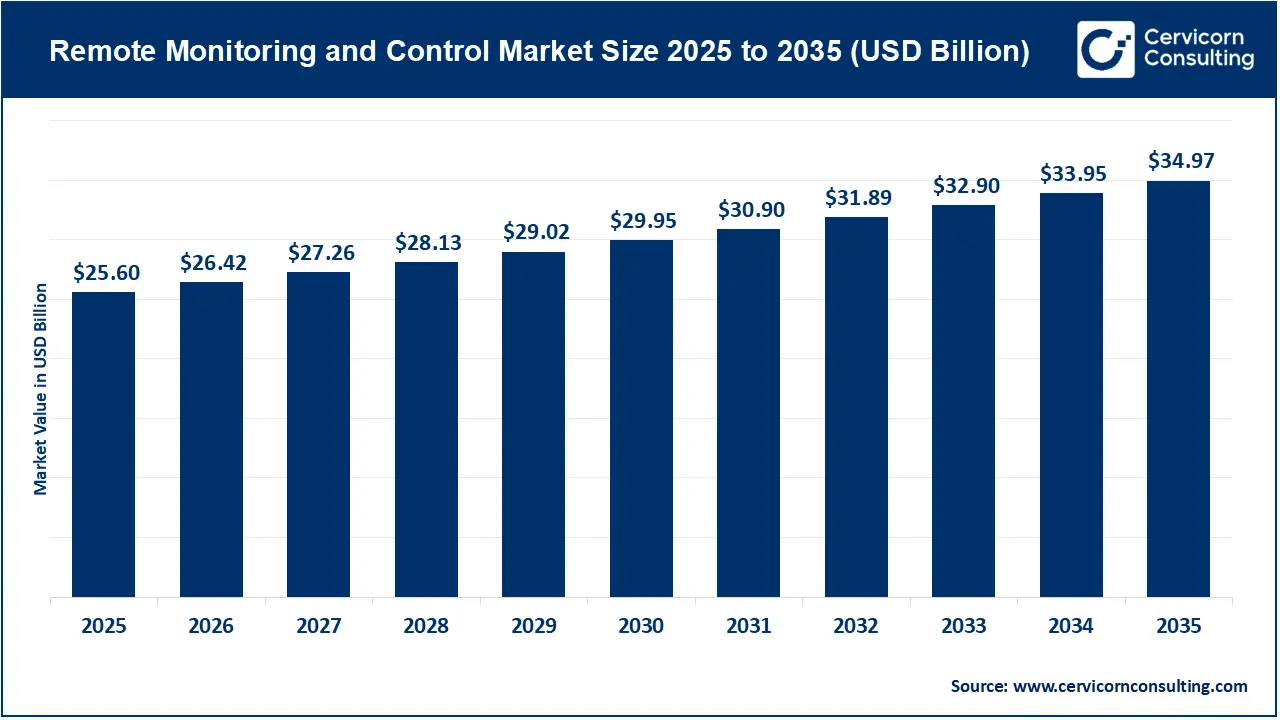
The global remote monitoring and control market size was valued at USD 25.60 billion in 2025 and is projected to reach USD 34.97 billion by 2035, representing a 3.17% CAGR.
Remote monitoring and control market growth factors
The global remote monitoring and control market is being driven by the rapid adoption of industrial automation, Industrial Internet of Things (IIoT), cloud computing, edge computing, artificial intelligence (AI), wireless connectivity, and predictive maintenance across manufacturing, energy, utilities, oil and gas, chemicals, water and wastewater, mining, transportation, and other industries. Organizations are increasingly replacing periodic manual inspections with continuous digital monitoring that allows operators to observe equipment conditions, process parameters, energy consumption, alarms, and production performance from centralized or remote locations. The market is also benefiting from the expansion of geographically distributed infrastructure, where remote assets such as pipelines, substations, pumping stations, renewable-energy installations, mines, and water facilities require real-time visibility without requiring personnel to be physically present.
Get a Free Sample: https://www.cervicornconsulting.com/sample/2767
What is the remote monitoring and control market?
The remote monitoring and control market includes hardware, software, connectivity, platforms, and services that enable organizations to observe, analyze, and control equipment, industrial processes, and distributed physical assets from a remote location.
A typical remote monitoring and control architecture can include sensors, transmitters, programmable logic controllers (PLCs), remote terminal units (RTUs), industrial gateways, communication networks, SCADA systems, distributed control systems (DCS), human-machine interfaces (HMIs), cloud platforms, analytics software, and cybersecurity solutions.
Remote monitoring primarily involves collecting information from equipment and processes. Sensors can measure parameters such as temperature, pressure, vibration, flow, energy consumption, voltage, current, speed, humidity, and equipment health. This information is transferred to an operator dashboard or control center.
Remote control adds the ability to respond to those conditions. Operators or automated systems can change process parameters, activate or deactivate equipment, adjust valves and pumps, manage electrical systems, or initiate maintenance procedures without requiring personnel to travel to the physical site.
The market therefore connects physical assets with digital decision-making. Current market definitions cover applications across oil and gas, power generation, chemicals, water and wastewater, metals and mining, food and beverages, automotive, pharmaceuticals, and other industries.
Why is the remote monitoring and control market important?
Remote monitoring and control has become important because modern industrial infrastructure is increasingly complex, geographically distributed, and dependent on continuous availability.
1. Reduced downtime
Continuous monitoring can identify abnormal equipment conditions before they develop into major failures. Sensors can detect changes in vibration, temperature, pressure, energy consumption, or other operating parameters and send alerts to maintenance teams.
2. Predictive maintenance
Instead of maintaining equipment only according to fixed schedules, companies can use real-time condition data to determine when intervention is required. This approach can reduce unnecessary maintenance and help avoid unexpected equipment failures.
3. Improved worker safety
Remote control reduces the requirement for employees to enter hazardous or difficult-to-access environments. Applications include mines, oil and gas facilities, electrical substations, wastewater facilities, and chemical plants.
4. Better operational visibility
Centralized dashboards allow organizations to monitor multiple facilities simultaneously. This is particularly valuable for companies managing distributed infrastructure across cities, countries, or continents.
5. Energy efficiency
Remote monitoring systems can identify excessive energy consumption and optimize equipment operation. Pumping stations, HVAC systems, motors, compressors, electrical networks, and industrial machinery can be monitored continuously.
6. Faster decision-making
Real-time information enables operators to respond more rapidly to equipment alarms, process changes, and environmental conditions. This is particularly important for power generation, water management, manufacturing, and critical infrastructure.
7. Integration with AI and analytics
Modern platforms increasingly combine remote monitoring with predictive analytics, digital twins, machine learning, and AI. This changes remote monitoring from a passive visibility tool into a decision-support and automation platform.
Major companies in the remote monitoring and control market
| Company | Specialization | Key Focus Areas | Notable Features | 2025 Revenue | Market Share | Global Presence |
|---|---|---|---|---|---|---|
| ABB Ltd. | Electrification, automation, digital industrial solutions | SCADA, DCS, industrial IoT, power automation, condition monitoring | ABB Ability, System 800xA, remote operations, predictive maintenance | USD 33.22 billion | Not separately disclosed | 100+ countries; around 112,000 employees |
| Advantech Co., Ltd. | Industrial computing and IoT platforms | Edge computing, industrial PCs, gateways, IIoT, AI | Edge AI, embedded systems, industrial connectivity | USD 2.274 billion | Not separately disclosed | Global operations across Asia, Europe, North America and emerging markets |
| AVEVA Group plc | Industrial software and data management | SCADA, HMI, MES, PI System, digital twins, industrial analytics | AVEVA PI System, PI Vision, remote operations centers | Not separately reported as a standalone company | Not separately disclosed | Global industrial software customer base |
| Cisco Systems, Inc. | Networking, cybersecurity and industrial connectivity | Industrial networking, IoT, edge connectivity, cybersecurity | Secure connectivity, network monitoring, industrial IoT infrastructure | USD 56.7 billion | Not separately disclosed | Global; Americas, EMEA and APJC |
| Emerson Electric Co. | Industrial automation and process control | Process automation, instrumentation, control systems, industrial software | Plantweb, DeltaV, intelligent devices, remote monitoring | USD 18.016 billion | 11.5% of global market according to GMI | International sales represented 59% of 2025 sales |
ABB Ltd.
ABB Ltd. is a major provider of electrification, automation, robotics, motion, and digital industrial technologies. Its ABB Ability portfolio connects industrial equipment and control systems with digital monitoring and analytics capabilities. ABB’s System 800xA integrates process control, electrical control, safety, and information management, while its digital solutions support remote condition monitoring and predictive maintenance.
ABB reported USD 33.22 billion in 2025 revenue, with orders of USD 36.77 billion. The company operates on a global scale and reported more than 160 manufacturing sites in its 2025 figures.
Advantech Co., Ltd.
Advantech Co., Ltd. specializes in industrial computing, embedded systems, edge computing, IoT gateways, industrial communication, and intelligent systems.
Its technology provides the computing and connectivity layer between physical equipment and higher-level monitoring platforms. Advantech is increasingly emphasizing Edge AI, which allows some data processing and decision-making to occur closer to machines instead of sending every data point to centralized cloud infrastructure.
Advantech reported NT$70.882 billion, or approximately USD 2.274 billion, in 2025 revenue, representing 19% year-over-year growth in New Taiwan dollars.
AVEVA Group plc
AVEVA Group plc is an industrial software provider whose technologies support engineering, operations, asset performance management, manufacturing execution, industrial data management, and visualization.
AVEVA’s PI System is particularly relevant to remote monitoring because it collects and contextualizes operational data from geographically distributed assets. PI Vision provides visualization for operational information, while AVEVA’s software portfolio supports remote operations centers and industrial analytics.
AVEVA is now part of Schneider Electric, so standalone 2025 revenue for AVEVA is not reported as an independent publicly listed company. AVEVA’s current applications include remote operations centers, digital twins, real-time industrial visibility, and predictive analytics.
Cisco Systems, Inc.
Cisco Systems, Inc. provides the networking, cybersecurity, connectivity, and data infrastructure required for remote monitoring architectures.
Industrial remote monitoring depends on reliable connectivity between sensors, controllers, edge devices, control rooms, enterprise applications, and cloud platforms. Cisco’s industrial networking and cybersecurity technologies address this connectivity layer.
Cisco reported USD 56.7 billion in FY2025 revenue, up 5% year over year. Its FY2025 geographic revenue mix included 59% from the Americas, 26% from EMEA, and 14% from APJC.
Emerson Electric Co.
Emerson Electric Co. has a broad industrial automation portfolio covering process control, instrumentation, intelligent devices, industrial software, and asset monitoring.
Emerson’s Plantweb ecosystem combines operational technology, sensors, automation, analytics, and software to support asset performance and remote monitoring. Its DeltaV automation systems and intelligent field devices are used in industries such as oil and gas, chemicals, life sciences, power, and manufacturing.
Emerson generated USD 18.016 billion in 2025 sales, while Software and Control sales increased 5%. The company reported international sales equivalent to 59% of total sales.
Leading trends and their impact on the remote monitoring and control market
AI-powered predictive monitoring
Artificial intelligence is changing remote monitoring from simple alarm generation toward predictive decision-making. Machine-learning models can analyze historical and real-time equipment data to identify patterns associated with failures.
The impact is particularly significant for rotating equipment, pumps, motors, compressors, turbines, and production machinery. AI-based monitoring can prioritize alarms and help maintenance teams focus on the assets presenting the greatest risk.
Edge computing
Edge computing reduces the need to send all industrial data to centralized cloud platforms. Processing data near the machine can reduce latency and support rapid responses.
This is especially relevant for applications where control decisions must be made in milliseconds or seconds. Edge systems can also continue operating when connectivity to a central cloud platform is temporarily unavailable.
Cloud-based monitoring
Cloud platforms enable companies to monitor multiple sites from centralized dashboards. Cloud adoption also supports software updates, analytics, fleet-level benchmarking, and remote expert services.
Global Market Insights identifies a continuing shift from isolated SCADA installations toward connected operating models combining field devices, local computing, centralized analytics, and managed services.
Industrial IoT expansion
The proliferation of connected sensors is expanding the volume of operational data available to companies. IIoT devices can connect legacy equipment, motors, pumps, valves, electrical systems, and production machinery to modern monitoring platforms.
Digital twins
Digital twins combine operational data with digital models of physical assets or processes. They can help organizations simulate performance, detect deviations, and evaluate possible interventions.
AVEVA’s industrial software ecosystem, for example, is being used for digital operating models and remote operations. SCG Chemicals reported using AVEVA solutions to develop a digital reliability platform and reported 99% plant reliability and a 9x ROI over six months.
Remote operations centers
Remote operations centers are becoming a major model for managing geographically distributed industrial assets. Instead of assigning technical experts to every site, organizations can centralize expertise in a dedicated operations center.
AVEVA describes applications involving Nutrien, ArcelorMittal, and ADNOC, where centralized operating environments provide visibility across facilities and assets.
Cybersecurity integration
Greater connectivity also increases cybersecurity requirements. Remote monitoring systems can create new pathways between operational technology and enterprise IT networks.
Consequently, industrial cybersecurity, identity management, segmentation, encryption, anomaly detection, secure remote access, and continuous monitoring are increasingly integrated into remote-control architectures. The U.S. Department of Energy’s ICS/OT cybersecurity guidance specifically emphasizes improving detection, mitigation, forensic capabilities, and system visibility.
Successful examples of remote monitoring and control around the world
Singapore: Tuas Water Reclamation Plant
Singapore’s PUB selected ABB to deliver a site-wide monitoring and control system for the Tuas Water Reclamation Plant. The system is designed to integrate more than 100,000 input/output signals from multiple assets into a unified ABB Ability 800xA and SCADA environment. The project illustrates how remote monitoring can consolidate large-scale water infrastructure into a centralized operational environment.
Canada: ArcelorMittal mining operations
ArcelorMittal Mining Canada implemented an integrated remote operations center using AVEVA PI System and PI Vision. The system connected operational information from pit-to-port activities and was designed to address production bottlenecks. The company reported USD 120 million in additional revenue and a 300% reduction in concentrator slowdown in the cited case study.
Italy and Florida: Ansaldo Energia
Ansaldo Energia uses two integrated plant solution centers in Italy and Florida to provide 24/7 remote monitoring and maintenance support across customers in 35 countries. AVEVA PI System collects data from power-generation equipment, enabling centralized monitoring and earlier identification of equipment issues.
Chile: Enel hydropower plants
ABB connected 16 remotely located hydropower plants operated by Enel in Chile to central operations in Santiago. ABB’s digital control technology enables information from distant plants to be brought into centralized control environments, allowing engineers to monitor and coordinate the fleet without regularly traveling to remote facilities.
Brazil: Saneago water pumping
Saneago implemented ABB digital powertrain solutions, Smart Sensors, cloud connectivity, and remote condition monitoring across four water pumping stations. The project reported energy savings of more than 6,000 MWh annually, while remote monitoring helped identify excessive motor vibration before it developed into a more serious equipment problem.
Global manufacturing: Nestlé
Cisco describes connected smart-factory applications at Nestlé involving machinery, sensors, IoT, IIoT, and operational technology. Real-time monitoring, analytics, and alerts provide visibility into factory and warehouse environments, including temperature, humidity, and equipment health.
Global regional analysis
North America
North America currently represents the largest regional market for remote monitoring and control. Global Market Insights estimates that North America held the leading position in 2025.
The region benefits from established industrial automation infrastructure, significant oil and gas operations, mature power and utility networks, advanced manufacturing, and high adoption of cloud and cybersecurity technologies.
The United States is also emphasizing cybersecurity monitoring for industrial control systems. The U.S. Department of Energy’s guidance encourages owners and operators to improve visibility, detection, mitigation, and forensic capabilities across ICS and OT environments.
Demand is consequently expanding beyond conventional SCADA toward connected asset-management, predictive maintenance, industrial cybersecurity, and AI-supported monitoring.
Europe
Europe has a mature industrial automation ecosystem supported by manufacturing, energy, chemicals, automotive, pharmaceuticals, water management, and environmental regulations.
Remote monitoring is increasingly connected with energy efficiency and sustainability objectives. European industrial organizations are using digital monitoring to measure energy consumption, optimize processes, identify equipment inefficiencies, and manage emissions-related information.
The European industrial ecosystem also has a strong base of automation and engineering companies, supporting adoption of DCS, SCADA, industrial software, sensors, and remote operations centers.
Asia Pacific
Asia Pacific is projected to be the fastest-growing regional market.
Growth is supported by manufacturing expansion, smart factories, industrial IoT, infrastructure development, data centers, renewable energy, transportation, water infrastructure, and government-supported digital transformation.
China has placed substantial policy emphasis on industrial internet and intelligent manufacturing. Its 2025 industrial policy agenda called for expansion of industrial networks, including 5G, industrial optical networks, Industrial Ethernet, and time-sensitive networking, alongside greater industrial Internet and AI integration.
China’s 2025 smart-factory program also established a four-level cultivation structure covering basic, advanced, excellent, and leading smart factories, encouraging digital transformation and network connectivity.
At the provincial level, Jiangsu’s 2025–2027 action plan targets widespread intelligent transformation of manufacturing enterprises and expansion of industrial Internet platforms, while also emphasizing industrial network and data security.
India is another important growth market because of expanding manufacturing, utilities, infrastructure, renewable energy, water management, and industrial digitalization. ABB’s deployment of remote terminal units and SCADA for water-management applications in India demonstrates how remote monitoring can be applied to geographically distributed pumping stations and water infrastructure.
Latin America
Latin America is adopting remote monitoring particularly in mining, energy, oil and gas, water, utilities, and manufacturing. Geographic dispersion is a major driver because mines, hydroelectric facilities, pipelines, and utility assets can be located far from technical centers.
The Saneago project in Brazil demonstrates the role of remote condition monitoring in water infrastructure, while ABB’s Chilean hydropower project illustrates centralized monitoring of geographically distributed energy assets.
Middle East & Africa
The Middle East is creating opportunities through oil and gas digitalization, desalination, water management, power infrastructure, smart cities, and industrial diversification. Remote operations centers can provide centralized visibility across energy and industrial assets, particularly where facilities are geographically distributed or operate in demanding environments.
Africa offers opportunities in mining, utilities, water infrastructure, telecommunications, renewable energy, and distributed power. Remote monitoring can be particularly valuable where specialist technical personnel are limited or physical access to infrastructure is difficult.
Government initiatives and policies shaping the market
Government policies are increasingly supporting remote monitoring indirectly through industrial digitalization, smart manufacturing, cybersecurity, AI, and infrastructure modernization programs.
United States: Government guidance around ICS/OT cybersecurity is encouraging organizations to improve monitoring and visibility of industrial systems. This increases demand for secure remote-access and monitoring technologies.
China: The country’s industrial policy promotes intelligent manufacturing, industrial Internet infrastructure, 5G industrial connectivity, AI-enabled manufacturing, and smart-factory development. The 2025 smart-factory initiative specifically emphasizes digital transformation and networked connectivity.
China’s AI-industrial integration: The Industrial Internet and AI Integration Action Plan targets expanded industrial networking and AI integration, including deployment of upgraded industrial networks across at least 50,000 enterprises by 2028.
India: Industrial digitalization, smart infrastructure, manufacturing modernization, digital public infrastructure, and Industry 4.0 adoption are creating an environment favorable to remote monitoring technologies. Water, energy, manufacturing, transportation, and utilities represent important application areas.
European Union: European industrial policy increasingly emphasizes digital transformation, resource efficiency, sustainability, and industrial competitiveness. These priorities encourage companies to deploy continuous monitoring systems capable of measuring energy, production, equipment performance, and environmental parameters. The EU also continues to evaluate emerging technologies and their implications for industrial and innovation policy.
Global cybersecurity requirements: As industrial assets become increasingly connected, governments and regulators are placing greater emphasis on OT cybersecurity, critical-infrastructure resilience, data protection, and secure remote access. This is influencing system architecture by making cybersecurity an integral component of remote monitoring and control rather than an optional layer.
To Get Detailed Overview, Contact Us: https://www.cervicornconsulting.com/contact-us
Read Report: Digital Twin in Semiconductor Market Revenue, Trends, and Strategic Insights by 2035