AI in Supply Chain Market Revenue, Trends, and Strategic Insights by 2035
AI in Supply Chain Market Size
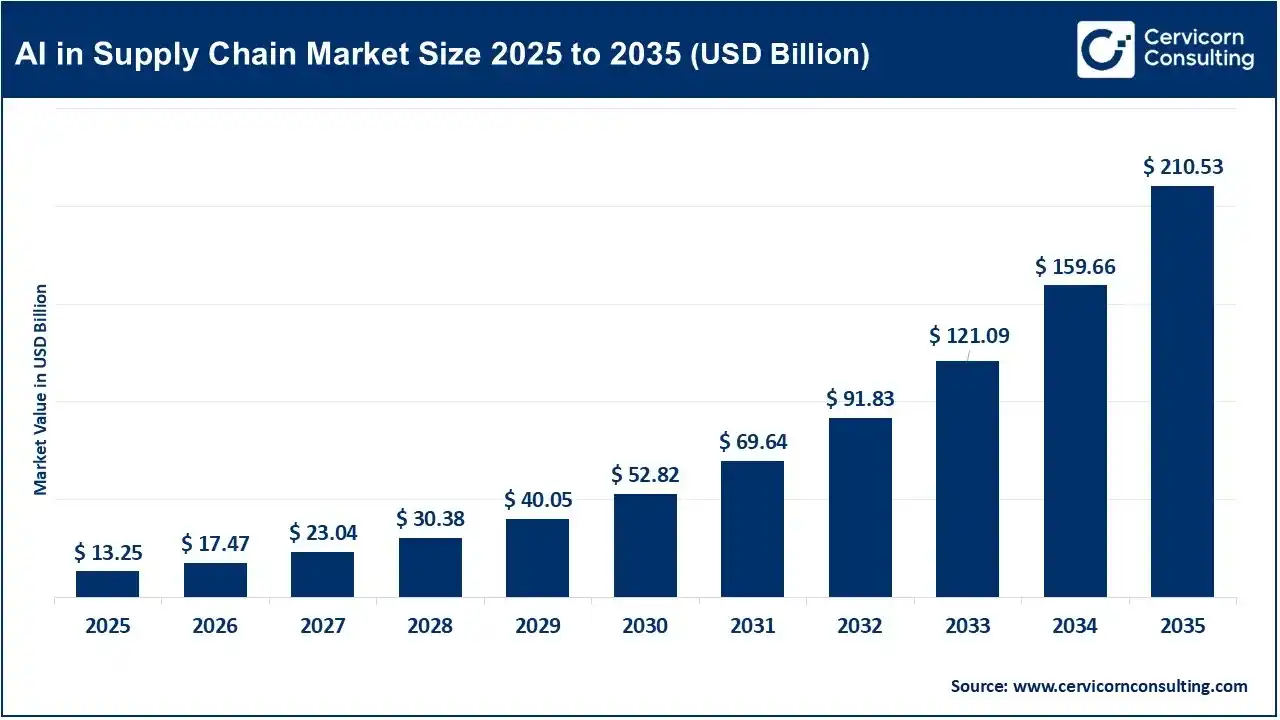
The global AI in supply chain market size was valued at USD 13.25 billion in 2025 and is projected to reach USD 210.53 billion by 2035, representing a 31.8% CAGR.
AI in supply chain market growth factors
Growth is being supported by increasing supply chain complexity, volatile customer demand, geopolitical uncertainty, labor shortages, rising logistics costs, and the growing availability of cloud-based AI platforms. Machine learning is increasingly being applied to demand sensing, inventory optimization, supplier risk assessment, predictive maintenance, warehouse management, transportation planning, and dynamic pricing. Generative AI and AI agents are adding another layer of automation by allowing supply chain professionals to interact with enterprise data using natural language and automate tasks that traditionally required manual analysis.
At the same time, expanding e-commerce and omnichannel retail are increasing the need for real-time inventory visibility and accurate fulfillment decisions. The movement toward connected factories, IoT-enabled logistics assets, digital twins, autonomous warehouses, and integrated enterprise platforms is also creating larger volumes of structured and unstructured data that AI can analyze. Cloud adoption is further lowering the technology barrier for organizations that previously lacked the infrastructure required for advanced analytics.
Regulatory requirements around traceability, sustainability, responsible AI, and supplier transparency are also encouraging organizations to improve supply chain data management and visibility. Together, these factors are shifting AI in supply chains from an experimental technology toward an operational capability spanning planning, procurement, manufacturing, warehousing, transportation, and customer fulfillment.
Get a Free Sample: https://www.cervicornconsulting.com/sample/3040
What is the AI in supply chain market?
The AI in supply chain market encompasses software, platforms, services, and technologies that use artificial intelligence to improve the planning, execution, monitoring, and optimization of supply chain activities. AI technologies used in supply chains include machine learning, deep learning, natural language processing, generative AI, computer vision, predictive analytics, optimization algorithms, robotic process automation, and increasingly autonomous AI agents.
AI can process information from enterprise resource planning systems, warehouse management systems, transportation management systems, procurement platforms, customer orders, supplier databases, IoT sensors, weather information, market data, and logistics networks. By combining these sources, AI systems can identify patterns and recommend or execute actions.
Applications include demand forecasting, inventory optimization, supply planning, procurement, supplier risk management, warehouse automation, transportation optimization, route planning, predictive maintenance, shipment visibility, quality control, and supply chain risk monitoring.
The market is therefore broader than AI-powered forecasting alone. It represents the integration of intelligence into the complete supply chain lifecycle, from sourcing raw materials to delivering finished products.
Why is AI in supply chains important?
Supply chains have become increasingly interconnected and exposed to external disruptions. A delay at one supplier can affect manufacturing schedules, inventory availability, transportation capacity, and ultimately customer delivery. Traditional spreadsheet-based planning and fragmented enterprise systems can make it difficult to identify these relationships quickly.
AI helps organizations move from reactive supply chain management toward predictive and increasingly proactive operations. Machine-learning models can identify demand patterns, forecast shortages, detect anomalies, and estimate the probability of disruptions. Optimization algorithms can evaluate large numbers of scenarios to determine appropriate inventory levels, production schedules, transportation routes, or sourcing strategies.
AI is also important because supply chain decisions frequently involve competing priorities. Organizations may need to balance cost, service levels, inventory, delivery speed, sustainability, supplier risk, and production capacity. AI can analyze these variables simultaneously and provide planners with data-driven recommendations.
Generative AI and agentic AI are extending this capability. SAP, for example, has been integrating its Joule AI assistant and agents into business processes, including supply chain planning, production planning, supplier onboarding, and operational workflows. SAP stated in 2025 that its Business AI portfolio was being expanded toward more than 400 AI scenarios.
For companies operating globally, AI can therefore become an important layer for coordinating increasingly complex supply networks.
Company landscape and competitive positioning
| Company | Specialization | Key Focus Areas | Notable Features | 2025 Revenue | Market Share / Position | Global Presence |
|---|---|---|---|---|---|---|
| SAP SE | Enterprise ERP and supply chain software | Supply planning, procurement, logistics, manufacturing, inventory | SAP Business AI, Joule, AI agents, SAP IBP, SAP BTP | €36.80B | SAP maintained the leading position in worldwide SCM software in 2025; exact AI-in-SCM share is not separately disclosed | Global enterprise presence across Europe, North America, Asia-Pacific and other regions |
| Microsoft Corporation | Cloud, enterprise software and AI | Demand forecasting, analytics, data platforms, automation, logistics intelligence | Azure AI, Dynamics 365, Microsoft Fabric, Copilot | $281.72B | Major AI/cloud and enterprise technology participant; AI-supply-chain-specific share not separately disclosed | Global |
| IBM Corporation | Enterprise AI, hybrid cloud and supply chain technology | Supply chain visibility, analytics, automation, procurement and risk | watsonx, Sterling Supply Chain, hybrid AI | $67.54B | Major enterprise AI and supply chain technology provider; AI-supply-chain-specific share not separately disclosed | Global |
| Oracle Corporation | Cloud applications, ERP and SCM | Planning, procurement, logistics, inventory, manufacturing | Oracle Fusion Cloud SCM, AI-powered analytics and automation | $57B | Major SCM software provider; AI-specific share not separately disclosed | Global, with customers and operations across major markets |
| Blue Yonder Group, Inc. | End-to-end supply chain management | Planning, warehouse, transportation, fulfillment, network visibility | AI/ML planning, cognitive solutions, multi-enterprise network | Not separately disclosed | Major specialist SCM provider; third-party technology databases estimate varying shares depending on methodology | Global |
SAP SE
SAP is positioned strongly in AI-enabled supply chain management because its enterprise software already connects finance, procurement, manufacturing, logistics, inventory, and planning data. Its Joule AI assistant and AI agents are increasingly being embedded into these workflows.
SAP reported €36.8 billion in total revenue in 2025, including €21.023 billion in cloud revenue and €32.538 billion in cloud and software revenue. SAP has been expanding AI capabilities across its supply chain portfolio, including intelligent demand and supply planning, production planning, supplier onboarding, maintenance planning, and disruption management.
Microsoft Corporation
Microsoft combines AI capabilities from Azure with Dynamics 365, Microsoft Fabric, Power Platform, and Copilot technologies. This creates opportunities to connect supply chain data with broader enterprise information and develop predictive and generative AI applications.
Microsoft generated $281.724 billion in fiscal 2025 revenue, while Microsoft Cloud revenue reached $168.9 billion. Azure revenue exceeded $75 billion during the year. Its role in supply chain AI is particularly relevant where companies want to combine enterprise applications, cloud infrastructure, analytics, AI models, and workflow automation.
IBM Corporation
IBM focuses on enterprise AI, hybrid cloud, analytics, and supply chain visibility. Its supply chain capabilities include IBM Sterling solutions and AI-powered analytics, while its watsonx portfolio provides tools for developing and governing enterprise AI.
IBM reported $67.535 billion in 2025 revenue, up 7.6% from 2024. IBM’s positioning is particularly relevant for large organizations that require AI to operate across hybrid cloud environments and existing enterprise technology.
Oracle Corporation
Oracle combines enterprise applications with cloud infrastructure and AI capabilities. Its Oracle Fusion Cloud SCM portfolio addresses supply chain planning, procurement, inventory, manufacturing, order management, logistics, and maintenance.
Oracle reported $57 billion in FY2025 revenue and highlights AI-powered cloud applications as a major component of its technology portfolio. Oracle’s integrated ERP and SCM approach allows enterprises to connect supply chain decisions with financial, procurement, human resources, and operational data.
Blue Yonder Group, Inc.
Blue Yonder is a specialist supply chain technology provider with capabilities spanning planning, warehouse management, transportation management, fulfillment, retail, and supply chain visibility. Its AI strategy focuses heavily on machine-learning-driven planning and increasingly autonomous decision-making.
Blue Yonder’s financial results are reported within Panasonic’s Connect business rather than as a separately disclosed public company. Panasonic reported Connect sales of ¥1,083.6 billion in fiscal 2025, with growth supported in part by Blue Yonder. Blue Yonder also expanded its network capabilities through its acquisition of One Network Enterprises, strengthening its multi-enterprise supply chain visibility proposition.
Leading trends and their impact
1. Generative AI and AI copilots
Generative AI is changing how supply chain employees interact with enterprise systems. Instead of manually navigating multiple reports, users can ask questions in natural language, summarize planning results, identify exceptions, and generate recommendations.
SAP’s Joule illustrates this trend, with the company expanding natural-language interaction and AI agents across business functions.
Impact: Faster analysis, lower administrative workloads, improved accessibility of supply chain information, and greater productivity for planners and procurement teams.
2. Agentic AI and autonomous supply chains
AI agents represent the transition from AI that simply provides recommendations to AI that can execute multi-step workflows. Agents can identify an exception, analyze relevant data, recommend an action, and potentially initiate the appropriate workflow.
SAP’s 2025 developments included agents for production planning, supplier onboarding, maintenance planning, and shop-floor disruption management.
Impact: Supply chain organizations can increasingly automate repetitive decisions and respond to disruptions more quickly.
3. AI-powered demand sensing
Traditional forecasting often depends heavily on historical sales. AI-powered demand sensing incorporates additional variables such as promotions, weather, market signals, customer behavior, and real-time sales data.
Impact: Better forecasts can reduce excess inventory and stockouts while improving production and replenishment decisions.
4. Predictive supply chain risk management
AI can monitor suppliers, transportation networks, inventory levels, geopolitical signals, weather conditions, and operational data to identify potential disruptions.
Impact: Companies can identify risks earlier and evaluate alternative suppliers, routes, production schedules, or inventory strategies.
5. Intelligent warehouses
Computer vision, robotics, machine learning, and AI-based warehouse orchestration are enabling more automated fulfillment operations.
Impact: AI can improve picking, slotting, inventory accuracy, labor allocation, and warehouse throughput while supporting the expansion of e-commerce.
6. AI-driven transportation optimization
Transportation is another major application area. AI can optimize routes, delivery schedules, vehicle utilization, freight planning, and estimated arrival times.
Impact: Companies can reduce transportation inefficiencies, improve delivery reliability, and respond faster to changing logistics conditions.
7. Digital twins and scenario simulation
AI-powered digital twins allow organizations to simulate potential changes in supply networks before implementing them in the physical world.
Impact: Companies can test factory changes, supplier disruptions, inventory policies, transportation alternatives, and network redesigns with lower operational risk.
Successful examples of AI in supply chain around the world
SAP’s AI-enabled supply chain ecosystem
SAP is expanding AI across planning, procurement, production, and logistics. In 2025, the company highlighted AI capabilities for interpreting supply planning results, analyzing demand and inventory information, supporting supplier processes, and managing factory disruptions.
The significance of this approach is the integration of AI directly into existing enterprise workflows rather than operating AI as an isolated analytics application.
LG Energy Solution and SAP
LG Energy Solution selected SAP’s RISE with SAP and SAP Business Technology Platform to support its growing battery business. SAP reported that the integrated platform was intended to improve productivity across manufacturing, supply chain, human resources, and finance.
This demonstrates how AI and cloud ERP technologies can support rapidly expanding manufacturing supply chains, particularly in industries such as electric vehicles and energy storage.
Blue Yonder’s multi-enterprise network approach
Blue Yonder’s acquisition of One Network Enterprises expanded its ability to connect supply chain participants across a multi-enterprise network. This is important because supply chain disruptions frequently originate outside a company’s immediate operations.
The combination of network visibility, planning, and AI can help organizations move from isolated enterprise-level optimization toward broader network-level decision-making.
AI adoption across global logistics
AI is increasingly being applied across logistics operations for planning, demand forecasting, gate automation, shipment visibility, and route optimization. Recent discussions among supply chain leaders have highlighted real-time decision-making and demand forecasting as significant practical AI applications, alongside emerging use cases in sourcing, quoting, and reverse logistics.
Global regional analysis including government initiatives and policies shaping the market
North America
North America remains a major AI in supply chain market, supported by large technology companies, advanced cloud infrastructure, high enterprise software adoption, and strong investment in AI. Market Research Future identifies North America as the largest regional market, while Asia-Pacific is identified as the fastest-growing region.
The United States is also promoting domestic AI infrastructure and technology development. Executive Order 14141, issued in January 2025, emphasized U.S. AI infrastructure, advanced computing capacity, energy infrastructure, and secure supply chains for AI development.
The policy environment is relevant to supply chain AI because investment in AI infrastructure can increase enterprise access to computing, cloud services, data platforms, and advanced analytics.
Europe
Europe is emphasizing responsible AI development, transparency, risk management, and regulatory compliance. The EU AI Act provides a risk-based framework for artificial intelligence and is particularly relevant to companies deploying AI in business-critical environments.
For supply chain organizations, the regulatory direction increases the importance of AI governance, data quality, documentation, transparency, human oversight, and risk controls. These requirements can influence how AI-powered procurement, workforce, logistics, and decision-support systems are developed and deployed.
Asia-Pacific
Asia-Pacific is expected to experience rapid growth because of manufacturing expansion, e-commerce, industrial automation, digital transformation, and increasing AI investment. China, Japan, South Korea, India, and Southeast Asian economies are investing in AI, robotics, smart manufacturing, and digital infrastructure.
Manufacturing-intensive economies have a particularly strong incentive to apply AI to production planning, quality control, inventory management, supplier coordination, and logistics.
India
India is building a national AI ecosystem through the IndiaAI Mission, approved by the Cabinet in March 2024 with an outlay of ₹10,371.92 crore. The initiative focuses on compute infrastructure, datasets, indigenous AI capabilities, talent, startups, application development, and safe and trusted AI.
The IndiaAI Mission is relevant to supply chain AI because India is simultaneously expanding digital infrastructure, manufacturing capabilities, e-commerce, logistics networks, and technology services. Greater access to AI compute and datasets can support applications in demand forecasting, agriculture supply chains, manufacturing, transportation, warehousing, and procurement.
India also introduced India AI Governance Guidelines in November 2025, establishing recommendations for responsible and accountable AI adoption.
China
China’s AI development strategy is closely connected with manufacturing modernization, logistics automation, robotics, smart factories, and digital infrastructure. Its large manufacturing ecosystem creates extensive opportunities for AI-based production planning, industrial computer vision, demand forecasting, and logistics optimization.
For supply chain AI vendors, the region represents both a major application market and a significant source of industrial AI innovation.
Middle East
Countries across the Middle East are investing in AI, smart logistics, digital infrastructure, ports, airports, and advanced manufacturing. Investments in smart-city infrastructure and logistics hubs are creating opportunities for AI-powered transportation optimization, predictive maintenance, warehouse automation, and supply chain visibility.
The region’s role as a global trade and logistics hub makes supply chain intelligence particularly relevant to ports, airlines, shipping companies, free zones, retailers, and manufacturers.
Latin America
Latin American markets are increasingly adopting cloud-based enterprise software and AI to improve logistics, inventory management, agricultural supply chains, retail fulfillment, and manufacturing efficiency. E-commerce expansion is increasing demand for accurate inventory visibility and faster delivery.
AI adoption in the region is also being supported by the growing availability of cloud platforms, digital payments, and technology partnerships, although differences in digital infrastructure and AI skills can influence adoption rates.
Future market direction
The AI in supply chain market is moving toward connected, predictive, and increasingly autonomous supply chain operations. The next phase is likely to involve deeper integration between AI agents, enterprise resource planning systems, IoT networks, digital twins, warehouse robotics, transportation platforms, and supplier networks.
Rather than using separate AI tools for individual processes, enterprises are increasingly looking for systems capable of coordinating decisions across procurement, planning, manufacturing, inventory, logistics, and fulfillment. This transition is creating opportunities for both large enterprise technology companies and specialist supply chain platforms.
The combination of generative AI, agentic AI, predictive analytics, real-time visibility, and cloud infrastructure is consequently reshaping how organizations plan and execute global supply chains. Companies that can connect AI models with high-quality operational data and clearly governed workflows are positioned to participate in the next stage of supply chain digitization.
To Get Detailed Overview, Contact Us: https://www.cervicornconsulting.com/contact-us
Read Report: Hydrogen Infrastructure Market Revenue, Trends, and Strategic Insights by 2035