Anti-Drone Market Revenue, Trends, and Strategic Insights by 2035
Anti-Drone Market Size
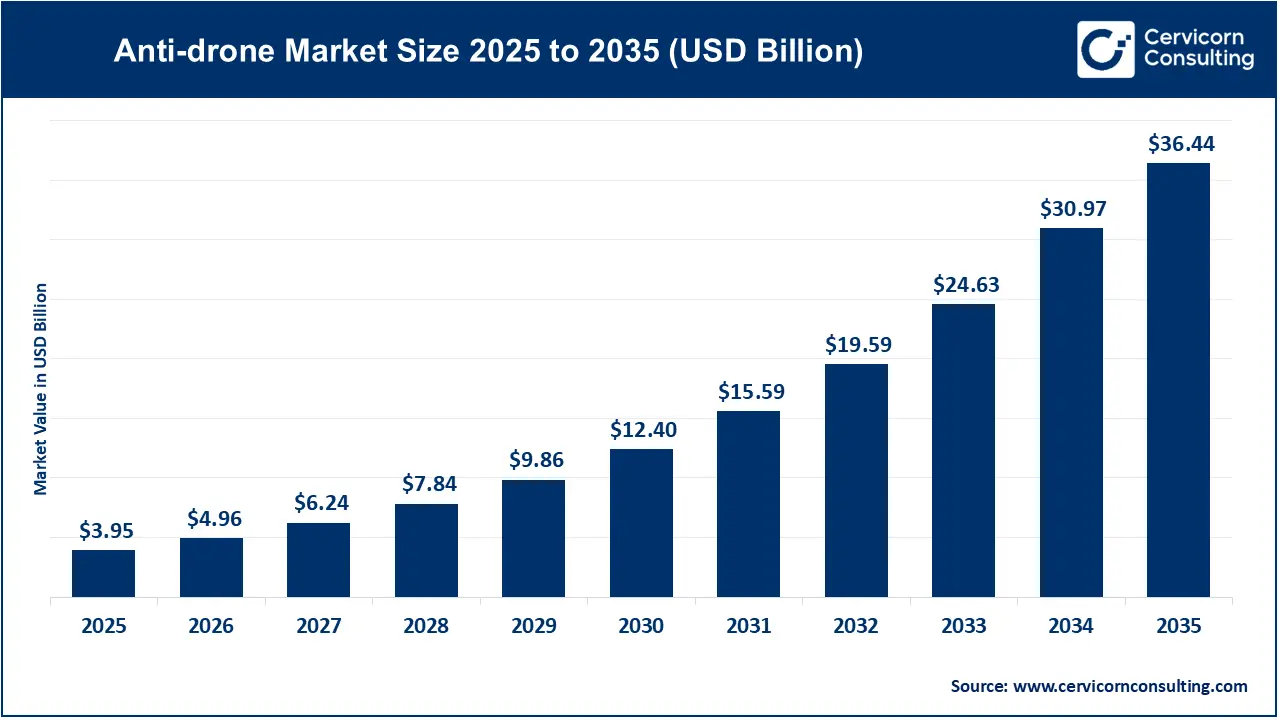
The global anti-drone market was valued at approximately USD 3.95 billion in 2025 and is projected to reach nearly USD 36.44 billion by 2035, growing at a CAGR of 24.88%.
Anti-Drone Market Growth Factors
The anti-drone market is experiencing rapid expansion due to the increasing adoption of unmanned aerial vehicles (UAVs) across commercial, industrial, and military sectors, coupled with growing concerns regarding unauthorized drone activities. Rising incidents involving drones near airports, military bases, government buildings, critical infrastructure, stadiums, and public events have accelerated investments in counter-drone technologies worldwide. Governments are strengthening border security, implementing advanced surveillance systems, and funding defense modernization programs that incorporate anti-drone solutions. Technological advancements in artificial intelligence (AI), radar systems, radio frequency (RF) detection, electro-optical sensors, acoustic sensors, and electronic warfare are improving drone detection and neutralization capabilities.
Additionally, the increasing use of drones for smuggling, espionage, cyberattacks, and terrorism has encouraged law enforcement agencies and private organizations to deploy comprehensive counter-UAS systems, further fueling market growth.
Get a Free Sample: https://www.cervicornconsulting.com/sample/2701
What is the Anti-Drone Market?
The anti-drone market, commonly referred to as the Counter-Unmanned Aircraft System (C-UAS) market, consists of technologies, software, and integrated solutions designed to detect, identify, track, classify, and neutralize unauthorized or potentially hostile drones.
Unlike traditional air defense systems that focus on aircraft and missiles, anti-drone solutions specifically address the unique challenges posed by small, low-flying UAVs. Modern anti-drone systems combine multiple technologies such as:
- Radar surveillance
- Radio Frequency (RF) detection
- Electro-optical and infrared (EO/IR) cameras
- Acoustic sensors
- Artificial Intelligence-based threat analysis
- GPS spoofing
- RF jamming
- High-energy lasers
- Directed-energy weapons
- Drone interception systems
These technologies work together to create layered security capable of protecting sensitive locations from aerial threats.
The market serves numerous industries including:
- Defense
- Homeland Security
- Airports
- Critical Infrastructure
- Energy
- Government Facilities
- Smart Cities
- Public Safety
- Industrial Facilities
- Large Sporting Events
As drone technology becomes increasingly affordable and accessible, organizations worldwide are investing heavily in sophisticated counter-drone systems.
Why is the Anti-Drone Market Important?
The importance of the anti-drone market has increased significantly over the past decade due to the widespread availability of commercial drones.
Protecting National Security
Military organizations require advanced anti-drone technologies to defend troops, military installations, naval fleets, and strategic assets against hostile UAVs.
Airport Safety
Unauthorized drones near airports have caused numerous flight delays and temporary airport shutdowns worldwide. Counter-drone technologies help ensure passenger safety and uninterrupted aviation operations.
Critical Infrastructure Protection
Power plants, oil refineries, nuclear facilities, communication towers, water treatment plants, and data centers increasingly depend on anti-drone systems to prevent sabotage or surveillance.
Border Surveillance
Border patrol agencies use anti-drone systems to detect drones involved in:
- Drug trafficking
- Illegal immigration
- Weapons smuggling
- Contraband delivery
Public Event Security
Governments deploy counter-drone systems during:
- Olympic Games
- Political summits
- Concerts
- International sporting events
- National celebrations
These systems help prevent unauthorized aerial surveillance or potential attacks.
Major Companies Operating in the Anti-Drone Market
| Company | Specialization | Key Focus Areas | Notable Features | Estimated 2025 Revenue | Estimated Market Share | Global Presence |
|---|---|---|---|---|---|---|
| Advanced Radar Technologies S.A. | Radar-based drone detection | Military surveillance, border security | High-resolution tactical radar systems | Approx. USD 45–60 Million | Niche player | Europe, Middle East, Asia |
| Airbus SE | Integrated defense and C-UAS systems | Defense, aerospace, homeland security | Multi-layered counter-drone solutions integrated with military systems | Approx. USD 78 Billion | Strong global presence | Europe, North America, Asia-Pacific, Middle East |
| Blighter Surveillance Systems | Electronic scanning radar | Border surveillance, critical infrastructure | Long-range drone detection radar | Approx. USD 35–50 Million | Specialized provider | Europe, Middle East, Asia-Pacific |
| Dedrone | AI-powered drone detection software | Commercial security, airports, enterprises | AI-driven RF detection and sensor fusion platform | Approx. USD 140–170 Million | Leading commercial C-UAS provider | North America, Europe, Asia-Pacific |
| DeTect, Inc. | Radar surveillance solutions | Aviation safety, wildlife monitoring, defense | HARRIER radar technology for drone detection | Approx. USD 55–70 Million | Specialized provider | North America, Europe, Latin America |
Note: Revenue and market share values are industry estimates based on publicly available information and company activities, as many private companies do not disclose detailed segment revenues.
Leading Trends Shaping the Anti-Drone Market
Artificial Intelligence Enhancing Threat Detection
Artificial intelligence has become one of the most significant technological advancements in anti-drone systems. AI algorithms rapidly analyze radar signatures, RF signals, and camera feeds to distinguish drones from birds, aircraft, or environmental objects. This reduces false alarms while enabling faster threat response.
Impact
- Improved detection accuracy
- Faster response time
- Reduced operator workload
- Automated threat classification
Multi-Sensor Fusion Systems
Manufacturers increasingly integrate radar, RF sensors, EO/IR cameras, and acoustic sensors into unified platforms. Multi-sensor fusion enhances detection reliability under varying weather and environmental conditions.
Impact
- Better situational awareness
- Higher tracking accuracy
- Continuous surveillance
- Reduced blind spots
Growth of Directed Energy Weapons
Several governments are investing in high-energy laser systems capable of neutralizing hostile drones without conventional ammunition.
Impact
- Lower operational costs
- Unlimited magazine capability
- Reduced collateral damage
- Rapid engagement
Expansion of Mobile Counter-Drone Systems
Portable anti-drone solutions are becoming popular among military forces, border security agencies, and law enforcement units.
Impact
- Greater deployment flexibility
- Rapid emergency response
- Lower infrastructure costs
- Enhanced tactical operations
AI-Based Drone Identification
Machine learning software continuously improves its ability to classify drone models and identify flight behavior.
Impact
- Enhanced predictive security
- Faster interception
- Lower false positive rates
- Improved operational efficiency
Cybersecurity Integration
Counter-drone platforms increasingly integrate cybersecurity capabilities to defend against network-based drone attacks and encrypted communication channels.
Impact
- Secure communications
- Protection from cyber threats
- Enhanced resilience
- Better command-and-control security
Successful Examples of Anti-Drone Deployments Around the World
Ukraine
The conflict in Ukraine has significantly accelerated innovation in anti-drone technologies. Military forces deploy radar systems, RF jammers, electronic warfare equipment, and AI-based surveillance to counter reconnaissance and attack drones. The experience has driven rapid advancements in mobile and battlefield-ready counter-UAS solutions.
United States
The U.S. Department of Defense has implemented layered anti-drone systems across military bases, training facilities, and strategic infrastructure. Airports and federal agencies are also testing advanced AI-enabled drone detection technologies.
United Kingdom
Following several disruptive drone incidents near major airports, the UK strengthened investments in radar surveillance and counter-drone technologies. Airports, government facilities, and defense installations now deploy integrated C-UAS systems to improve aviation safety and national security.
Israel
Israel has become one of the world’s leaders in counter-drone innovation. Defense companies have developed sophisticated radar, electronic warfare, and laser-based systems capable of intercepting multiple drone threats in complex operational environments.
Saudi Arabia
Saudi Arabia has expanded deployment of anti-drone systems to protect oil infrastructure, airports, and strategic energy facilities against UAV attacks, combining radar surveillance with electronic countermeasures.
India
India continues strengthening indigenous counter-drone capabilities through government-backed research programs and defense procurement initiatives. Anti-drone systems are increasingly deployed to secure borders, military installations, airports, and high-profile public events.
Global Regional Analysis
North America
North America remains the largest anti-drone market due to significant defense spending, continuous technological innovation, and increasing investments in homeland security.
Market Drivers
- High military modernization budgets
- Advanced AI research
- Increasing airport security requirements
- Protection of critical infrastructure
Government Initiatives and Policies
The United States has established dedicated Counter-UAS strategies to enhance national security. Federal agencies continue expanding research, procurement, and testing programs for drone detection and mitigation technologies. Government collaboration with defense contractors supports the development of next-generation electronic warfare, radar, and directed-energy systems. Regulatory agencies are also working to define legal frameworks governing counter-drone deployment around airports and sensitive facilities.
Canada is similarly investing in drone surveillance capabilities for border security, critical infrastructure, and public safety applications.
Europe
Europe represents one of the fastest-growing anti-drone markets due to increasing geopolitical tensions and stronger investments in defense technologies.
Market Drivers
- Border protection
- NATO modernization
- Airport safety
- Infrastructure security
Government Initiatives and Policies
The European Union supports research programs focused on unmanned aerial systems and counter-UAS technologies through collaborative defense initiatives. Several member states are strengthening procurement of radar-based surveillance systems, AI-powered detection platforms, and electronic warfare capabilities. European aviation authorities continue refining regulations governing drone operations and airport safety while promoting standardized approaches for counter-drone deployment.
Countries including Germany, France, the United Kingdom, Poland, and Italy continue expanding investments in integrated air defense and counter-drone technologies.
Asia-Pacific
Asia-Pacific is expected to witness the fastest market growth due to rising defense expenditures and increasing drone adoption across commercial and military sectors.
Market Drivers
- Territorial disputes
- Border surveillance
- Smart city development
- Airport modernization
Government Initiatives and Policies
China continues investing heavily in domestic counter-drone technologies through military modernization and industrial innovation programs. India has introduced policies encouraging indigenous defense manufacturing while supporting the development of anti-drone technologies under national self-reliance initiatives. Japan, South Korea, and Australia are also increasing procurement of advanced surveillance systems to secure airports, public infrastructure, and military installations.
Governments throughout Southeast Asia are implementing stricter drone regulations and investing in airport security technologies to address growing UAV-related risks.
Latin America
The Latin American anti-drone market is steadily expanding due to increasing concerns regarding border security, organized crime, and infrastructure protection.
Market Drivers
- Drug trafficking
- Border monitoring
- Critical infrastructure security
- Public event protection
Government Initiatives and Policies
Several governments are strengthening surveillance capabilities by adopting drone detection technologies for customs enforcement, law enforcement, and military operations. Public-private partnerships are supporting modernization of airport security infrastructure, while aviation authorities continue updating drone operation regulations.
Countries such as Brazil, Mexico, Chile, and Colombia are gradually expanding investments in counter-UAS technologies.
Middle East & Africa
The Middle East & Africa represents one of the most strategically important anti-drone markets due to regional security challenges and protection of critical energy infrastructure.
Market Drivers
- Oil and gas facility protection
- Military modernization
- Border security
- Counter-terrorism operations
Government Initiatives and Policies
Governments across the Gulf region continue investing in sophisticated counter-drone technologies to safeguard airports, refineries, power plants, and military installations. National defense modernization strategies emphasize integrated air defense systems capable of detecting and neutralizing UAV threats. Israel remains a global innovation hub for counter-drone technologies, while several African nations are strengthening border surveillance capabilities with support from international security partnerships.
Growing defense budgets, increased adoption of AI-enabled surveillance, and continued investments in homeland security are expected to support long-term market expansion across the region.
Future Outlook for the Anti-Drone Market
The anti-drone market is expected to witness sustained growth as drone technology becomes more advanced and accessible. AI-powered detection platforms, autonomous response systems, directed-energy weapons, and integrated multi-sensor architectures will define the next generation of counter-UAS solutions. Increasing collaboration between governments, defense organizations, and private technology providers will accelerate innovation while expanding deployment across airports, smart cities, industrial facilities, and critical infrastructure worldwide. As regulations evolve and drone-related risks continue to rise, demand for scalable, intelligent, and interoperable anti-drone systems is expected to remain strong throughout the coming decade.
To Get Detailed Overview, Contact Us: https://www.cervicornconsulting.com/contact-us
Read Report: Manufacturing Execution System (MES) Market Revenue, Trends, and Strategic Insights by 2035