3D Printing in Cosmetic Market Revenue, Trends, and Strategic Insights by 2035
3D Printing in Cosmetic Market Size
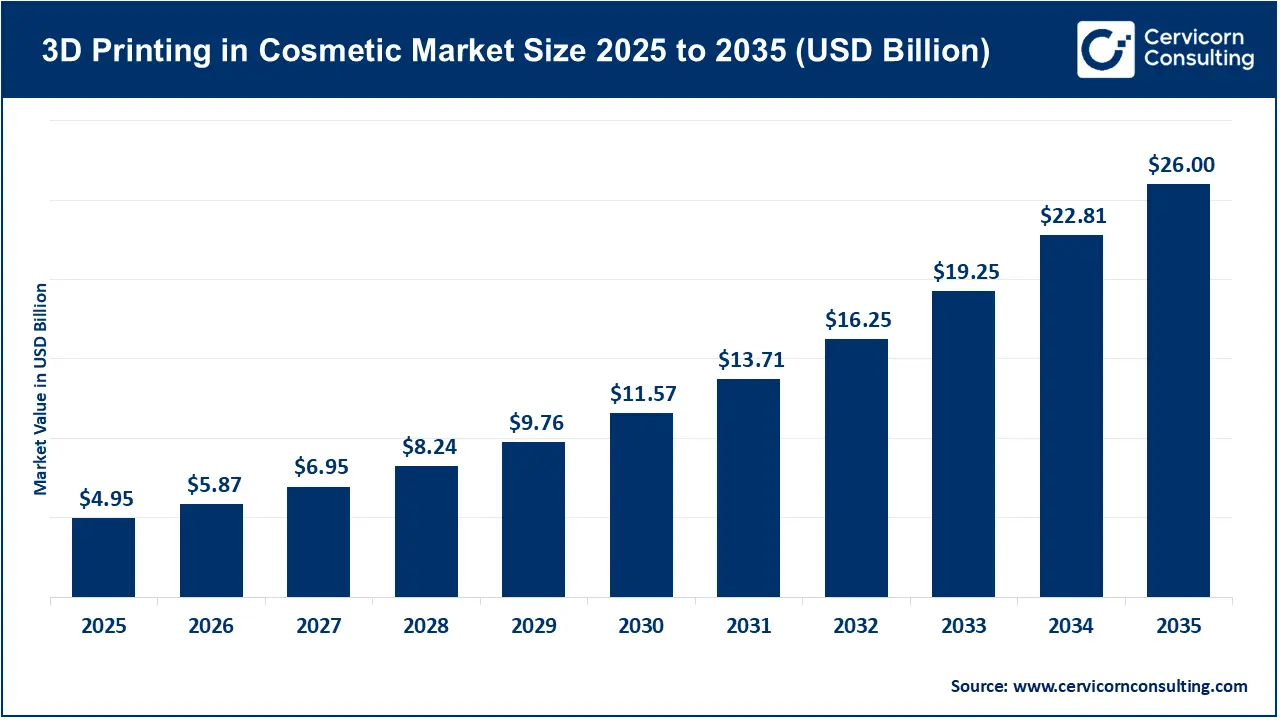
The global 3D printing in cosmetic market was valued at approximately USD 4.95 billion in 2025 and is projected to reach USD 26.00 billion by 2035, expanding at a CAGR of 18.04% during the forecast period.
3D Printing in Cosmetic Market Growth Factors
Major growth factors include rising consumer demand for hyper-personalized skincare and color cosmetics, growing adoption of 3D-printed applicators and packaging, faster product prototyping, the development of customized facial masks, increasing interest in sustainable manufacturing, reduced material waste, advances in bioprinting and artificial skin models, and the integration of AI and digital beauty diagnostics. The technology also allows brands to manufacture complex geometries that are difficult to achieve through conventional molding and supports rapid experimentation with product shapes, textures, applicators, and packaging. As beauty consumers increasingly expect products tailored to their skin characteristics, facial geometry, preferred colors, and individual routines, 3D printing is moving from an experimental technology toward an important tool for product development, personalization, premiumization, and digital beauty experiences.
Get a Free Sample: https://www.cervicornconsulting.com/sample/2722
What Is the 3D Printing in Cosmetic Market?
The 3D printing in cosmetic market refers to the use of additive manufacturing technologies to design, prototype, customize, and manufacture products and components used in the beauty and personal-care industry. Unlike conventional manufacturing, where products are generally produced through molding, machining, casting, or large-scale filling systems, 3D printing creates physical objects by depositing or processing material layer by layer from a digital design.
In cosmetics, applications extend beyond simply “printing makeup.” The technology can be used for personalized skincare masks, cosmetic applicators, mascara brushes, packaging prototypes, customized product shapes, color cosmetics, artificial skin models, testing platforms, and specialized beauty devices.
The market includes technologies such as stereolithography (SLA), selective laser sintering (SLS), material jetting, and other additive manufacturing methods. Depending on the application, materials can include polymers, resins, waxes, biocompatible materials, hydrogels, and other specialized compounds.
One of the most important characteristics of the technology is its connection with digital personalization. A consumer’s face can be scanned, converted into a digital model, and used to create a product with a more precise fit. Similarly, digital color data can potentially be converted into customized cosmetic shades. This creates a direct connection between digital consumer data and physical product manufacturing.
Why Is 3D Printing Important for Cosmetics?
3D printing is important because it addresses several limitations associated with traditional cosmetic manufacturing.
Personalization is one of its strongest advantages. Conventional cosmetics are generally manufactured in standardized shades, sizes, and shapes. 3D printing can support products designed around individual facial contours, skin requirements, color preferences, or application patterns.
Faster product development is another important benefit. Cosmetic packaging and applicators normally require molds and multiple rounds of tooling. Additive manufacturing enables designers to create and modify prototypes digitally before committing to expensive mass-production tooling. Industry packaging specialists have highlighted the ability of 3D printing to accelerate design development and reduce the need for multiple pilot molds.
The technology can also support complex product geometries. Honeycomb structures, micro-cavities, customized surfaces, and intricate applicator designs can be produced without the same tooling constraints associated with conventional manufacturing.
Sustainability is another factor. Additive manufacturing can reduce material waste in suitable applications because material is deposited or processed according to a digital design rather than removing large amounts of material. It can also support localized and on-demand manufacturing, potentially reducing inventories and unnecessary transportation.
Finally, 3D printing is important for cosmetic research and testing. Bioprinting can create skin-like tissue models that help researchers evaluate cosmetic products, ingredients, and skin responses. L’Oréal, for example, has explored bioprinted skin models as part of its broader effort to develop advanced beauty research and reduce reliance on conventional testing approaches.
Leading Companies in the 3D Printing in Cosmetic Market
| Company | Specialization | Key Focus Areas | Notable Features | 2025 Revenue* | Market Share* | Global Presence |
|---|---|---|---|---|---|---|
| L’Oréal | Beauty technology, skincare and cosmetics | Personalized beauty, bioprinting, digital beauty devices | Strong R&D capabilities and investment in beauty technology | €44.05 billion | 3D-cosmetic-specific share not publicly disclosed | 150+ countries |
| Neutrogena | Skincare and personalized beauty | 3D facial masks, skin diagnostics, personalized skincare | MaskiD combined facial analysis with 3D micro-printing | Kenvue: $15.1 billion | 3D-cosmetic-specific share not publicly disclosed | Global consumer-health distribution |
| Mink Beauty (Luxe) | 3D-printed color cosmetics | On-demand makeup and personalized shades | Portable makeup printing concept using digital color data | Not publicly disclosed | Niche/emerging; exact share unavailable | Primarily U.S.-based with international technology visibility |
| Chanel via Erpro 3D Factory | Luxury beauty applicators | 3D-printed mascara brushes and premium product design | Printed 10 million Chanel mascara brushes in 2018–2019 | $19.3 billion | 3D-cosmetic-specific share not publicly disclosed | Global luxury network |
| Shiseido | Advanced skincare and beauty technology | Personalized beauty, skincare research and digital innovation | Strong R&D ecosystem and global beauty portfolio | Official FY2025 results reported; 3D-specific revenue not disclosed | 3D-cosmetic-specific share not publicly disclosed | Japan, China, Asia-Pacific, Americas and EMEA |
*Revenue figures represent company or parent-company revenue rather than revenue generated specifically from 3D-printing activities. Public financial filings generally do not separately disclose revenue or market share for 3D-printing cosmetic applications. L’Oréal reported €44.05 billion in 2025 sales, while Kenvue reported $15.1 billion in 2025 net sales and identified Neutrogena within its Skin Health and Beauty portfolio. Chanel reported $19.3 billion in 2025 revenue. Shiseido maintains FY2025 annual financial reporting and an integrated reporting framework, although 3D-printing revenue is not separately reported.
L’Oréal
L’Oréal is one of the most technologically active companies in the beauty industry. Its activities extend from conventional cosmetics into artificial intelligence, digital beauty tools, biotechnology, advanced skin modeling, and personalized beauty.
A notable area is 3D bioprinting and skin-model development. L’Oréal has explored advanced skin models to improve cosmetic research and develop more sophisticated approaches to testing. It has also experimented with technologies such as the 3D Shu:brow, which uses facial recognition and 3D-printed inkjet technology to improve brow application precision.
The company’s scale provides a major advantage because it can connect 3D printing with its extensive R&D, brand, retail, and digital ecosystem. In 2025, L’Oréal generated €44.05 billion in sales, with skincare representing 37% of group sales and makeup representing 19%.
Neutrogena
Neutrogena has been an important early example of personalized 3D printing in skincare. Its MaskiD concept introduced personalized facial masks produced using 3D micro-printing. The system was designed to combine facial measurements with different skincare ingredients so that different areas of the mask could address specific skin needs. Neutrogena described MaskiD as a personalized face mask using 3D micro-printing to place ingredients where needed.
The brand is part of Kenvue’s Skin Health and Beauty segment. Kenvue reported $15.1 billion in total net sales for fiscal 2025, while its Skin Health and Beauty segment generated approximately $4.1 billion.
Mink Beauty
Mink Beauty represents the consumer-facing side of cosmetic 3D printing. Founded by Grace Choi, the company introduced a concept that allowed consumers to transform digital colors into physical makeup products.
The Mink printer was designed around the idea that users could select colors from digital images and produce cosmetics from those colors. The technology was positioned around personalized makeup, convenience, social-media-driven inspiration, and on-demand beauty.
The concept later evolved into a portable makeup printer that could use an image to create cosmetic colors on demand.
Mink demonstrates how 3D printing can potentially shift cosmetics from a mass-produced model toward a consumer-controlled manufacturing model, although commercialization and regulatory, formulation, cost, and scalability challenges remain important considerations.
Chanel via Erpro 3D Factory
Chanel provides one of the clearest commercial examples of 3D printing in luxury cosmetics. Through its collaboration with Erpro 3D Factory, Chanel developed the Le Volume Révolution de Chanel mascara brush.
Erpro reports that the brush was produced using selective laser sintering (SLS) and biosourced PA11 polyamide. Importantly, Erpro states that 10 million brushes were printed between 2018 and 2019, demonstrating that additive manufacturing can move beyond prototypes into significant production volumes.
The brush incorporates a highly engineered structure designed to improve the way mascara is picked up and distributed. This is an important commercial lesson for the industry: 3D printing does not have to compete with traditional manufacturing solely on cost. It can create functional geometries and consumer experiences that are difficult to reproduce using conventional methods.
Shiseido
Shiseido is another major beauty technology company with extensive capabilities in skincare research, product safety, formulation science, digital beauty, and personalized consumer experiences.
Although publicly available reporting does not identify a separate 3D-printing revenue stream, the company maintains a broad innovation infrastructure spanning research, product development, safety technologies, and digital beauty. Its 2025 reporting also highlights its regional operations across Japan, China, Asia-Pacific, the Americas, and EMEA.
Shiseido’s technology strategy is particularly relevant to 3D printing because personalized beauty requires the integration of consumer data, skin science, digital diagnostics, formulation expertise, and manufacturing technologies.
Leading Trends and Their Impact
1. Hyper-Personalization
The biggest trend is the shift from standardized beauty products toward individualized cosmetics. Consumers increasingly want products that match their skin tone, facial structure, skin condition, lifestyle, and aesthetic preferences.
3D printing enables personalization at the physical manufacturing level. Instead of producing one standardized mask or applicator for millions of consumers, brands can theoretically manufacture products based on individual digital profiles.
2. AI and 3D Printing Convergence
Artificial intelligence is making 3D printing more useful by analyzing facial images, skin characteristics, consumer preferences, and product-performance data.
AI can identify a consumer’s needs, while 3D printing can translate the resulting digital instructions into a physical product. This combination could create automated workflows in which scan → analyze → design → print becomes part of the beauty-consumer journey.
3. Sustainable Cosmetic Packaging
Packaging companies are increasingly using 3D printing to test unusual shapes and reduce the time required for design iteration. The technology can enable rapid prototyping without requiring a complete production mold for every design variation.
For premium beauty brands, this is especially valuable because packaging is an important part of brand differentiation.
4. 3D-Printed Applicators
Mascara brushes, cosmetic applicators, and specialized tools are among the most commercially practical applications because they benefit from complex geometries.
Chanel’s experience demonstrates that 3D printing can create applicators with intricate structures while supporting large-scale production. Erpro’s reported production of 10 million Chanel brushes provides evidence that additive manufacturing can be commercially scaled in beauty applications.
5. Bioprinting and Artificial Skin
Bioprinting is creating a bridge between cosmetics, biotechnology, and laboratory research. Printed skin models can potentially help companies evaluate ingredients and formulations in more biologically relevant environments.
L’Oréal’s work on bioprinted skin illustrates how 3D printing can support research rather than only consumer-facing products.
6. On-Demand Manufacturing
Mink’s approach illustrates the potential for consumers to produce makeup when and where they need it. The broader impact could be a reduction in inventory requirements, especially for highly customized colors and limited-edition products.
However, regulatory compliance, cosmetic formulation stability, printer reliability, ingredient compatibility, and quality assurance remain critical barriers.
Successful Examples of 3D Printing in the Cosmetic Market Around the World
Chanel’s 3D-Printed Mascara Brush — France
The Chanel–Erpro collaboration is one of the strongest examples of industrial-scale 3D printing in cosmetics. The Le Volume Révolution brush used SLS technology and biosourced PA11 material, with 10 million units printed between 2018 and 2019.
The success demonstrates that 3D printing can be commercially attractive when the printed geometry provides a clear product advantage.
Neutrogena MaskiD — United States
Neutrogena’s MaskiD used facial analysis and 3D micro-printing to develop customized sheet masks. The system was designed to tailor ingredients to different facial areas, demonstrating how digital diagnostics and additive manufacturing can be combined to deliver personalized skincare.
Mink 3D Makeup Printer — United States
Mink demonstrated a radically different model in which consumers could select colors from digital content and convert them into physical makeup. Its concept showed how social media, digital imagery, personalization, and 3D printing could converge within color cosmetics.
Amorepacific Tailored 3D Mask — South Korea
South Korea has emerged as an important innovation center for beauty technology. Amorepacific’s IOPE Tailored 3D Mask used facial scanning to create a hydrogel mask corresponding to facial dimensions and could customize ingredients for different areas of the face.
This example is important because it demonstrates how 3D printing can become part of an in-store beauty service, rather than simply a manufacturing technology.
L’Oréal Bioprinted Skin — Europe
L’Oréal’s bioprinting research demonstrates the use of additive manufacturing for cosmetic research and testing. Advanced skin models can potentially improve the ability of researchers to study skin responses and evaluate cosmetic technologies.
Global Regional Analysis
North America
North America remains a major innovation hub because of its strong technology ecosystem, venture-capital environment, cosmetics industry, biotechnology capabilities, and advanced manufacturing infrastructure.
The United States has supported additive manufacturing through public-private initiatives such as America Makes, which NIST describes as the nation’s leading public-private partnership for additive manufacturing technology and education. The broader Manufacturing USA network is also designed to accelerate technology commercialization, workforce development, supply-chain resilience, and advanced manufacturing adoption.
For cosmetics, this ecosystem supports experimentation with personalized makeup, skincare devices, bioprinting, packaging, and digital beauty technologies.
Europe
Europe is particularly important because France is home to major luxury and cosmetics companies, while Germany and other European countries have strong additive manufacturing capabilities.
The European Commission identifies additive manufacturing as a key component of advanced manufacturing and has been supporting stakeholder collaboration, workshops, policy recommendations, and industrial adoption. The EU also emphasizes digital and green manufacturing, areas that align closely with 3D printing’s potential benefits.
The European 3D Printing Optimised Production (3DoP) initiative further demonstrates the region’s focus on converting additive manufacturing innovation into industrial applications. The project involved 33 partners across eight European countries and generated more than €42.5 million in follow-on investment, public funding, private investment, and sales linked to its innovations.
For cosmetic companies, these policies can strengthen access to advanced manufacturing infrastructure, materials research, digital manufacturing platforms, and sustainability-focused innovation.
Asia-Pacific
Asia-Pacific is expected to remain one of the most important regions for 3D printing in cosmetics because of its strong beauty culture, large consumer populations, advanced electronics ecosystem, and technology-oriented beauty companies.
Japan has established additive manufacturing as part of its broader manufacturing technology agenda. Japan’s Ministry of Economy, Trade and Industry has emphasized additive manufacturing as a technology capable of supporting manufacturing competitiveness, economic security, skills development, and industrial applications.
South Korea is particularly significant for customized skincare and beauty technology. Companies such as Amorepacific have demonstrated customized 3D facial-mask applications, connecting facial scanning with personalized skincare.
China has also treated additive manufacturing as a strategic manufacturing technology. Its Additive Manufacturing Industry Development Action Plan identified 3D printing as an important disruptive manufacturing technology and connected the sector with the broader objectives of advanced industrial development and China Manufacturing 2025.
India is building its additive manufacturing ecosystem through the National Strategy on Additive Manufacturing, released by the Ministry of Electronics and Information Technology in 2022. The strategy aims to promote indigenous AM materials, machines, software, products, skills, research, and public-private collaboration.
India’s strategy also targets domestic value addition and reduced import dependence while encouraging global AM companies to establish manufacturing bases in the country. By 2024, government reporting indicated that seven centers were serving as hubs for AM technology deployment and development.
Latin America
Latin America represents an emerging opportunity. Adoption is currently more concentrated around prototypes, customized manufacturing, healthcare applications, education, and industrial components, but growing beauty consumption and digital commerce could create opportunities for personalized cosmetic packaging and beauty devices.
Brazil and Mexico are particularly relevant because of their large consumer markets and established cosmetics industries. Greater access to affordable printers, digital design platforms, and locally produced materials could help the region move from experimentation toward commercial applications.
Middle East & Africa
The Middle East and Africa represent developing markets for cosmetic 3D printing. Adoption is likely to be driven initially by luxury beauty, customized packaging, premium retail experiences, and specialized beauty devices.
The region’s luxury retail ecosystem is well suited to 3D printing because brands can use customized objects and limited-production designs to create differentiated consumer experiences. Over time, localized manufacturing could also reduce dependence on imported prototypes and enable faster customization for regional markets.
Government Initiatives and Policies Shaping the Market
Government policy is becoming increasingly important because 3D printing depends on advanced materials, digital manufacturing, intellectual property, technical standards, workforce development, product safety, and industrial infrastructure.
In the United States, Manufacturing USA and America Makes provide public-private structures for advancing additive manufacturing research, workforce development, commercialization, and industrial adoption. NIST’s 2026 Manufacturing USA strategic plan specifically includes additive manufacturing among its technology areas.
In the European Union, the European Commission recognizes additive manufacturing as part of advanced manufacturing and supports activities designed to accelerate industrial adoption. Policy discussions emphasize access to finance, standards, ecological footprint measurement, digital transformation, and commercialization.
In Japan, METI’s manufacturing technology programs identify additive manufacturing as an important technology for maintaining industrial competitiveness and strengthening manufacturing capabilities.
In India, the National Strategy on Additive Manufacturing focuses on indigenous materials, machines, software, printed products, skills, R&D, and domestic manufacturing capabilities. Government initiatives also emphasize public-private partnerships and the development of an ecosystem that can serve domestic and international markets.
In China, national additive manufacturing initiatives have positioned 3D printing as a strategic manufacturing technology, with policy support directed toward technological development, industrial applications, and ecosystem creation.
For the cosmetics sector, these policies matter because the future of 3D printing will depend not only on printer technology but also on material safety, cosmetic regulations, quality standards, digital manufacturing certification, intellectual-property protection, sustainability requirements, and skilled technical labor.
As these frameworks mature, cosmetic companies are likely to move progressively from experimental 3D printing projects toward scalable applications in personalized skincare, color cosmetics, applicators, packaging, beauty devices, and bioprinted testing models.
To Get Detailed Overview, Contact Us: https://www.cervicornconsulting.com/contact-us
Read Report: Low-Carbon Construction Material Market Revenue, Trends, and Strategic Insights by 2035