Warehousing Market Revenue, Trends, and Strategic Insights by 2035
Warehousing Market Size
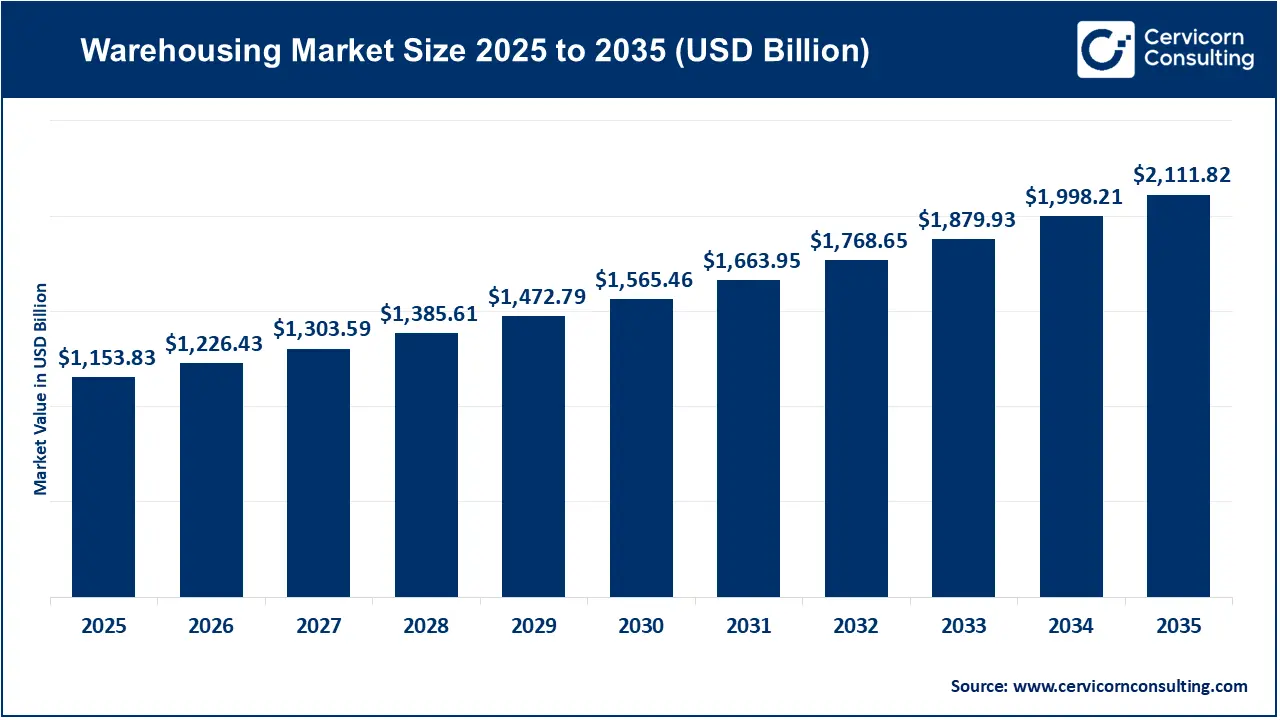
The global warehousing market was valued at approximately USD 1,153.83 billion in 2025 and is projected to reach USD 2,111.82 billion by 2035, expanding at a CAGR of 6.23% during the forecast period.
Warehousing Market Growth Factors
Key growth factors include the rapid expansion of online retail, rising consumer expectations for same-day and next-day delivery, increasing outsourcing to third-party logistics providers (3PLs), greater adoption of warehouse management systems (WMS), robotics, automated storage and retrieval systems (AS/RS), autonomous mobile robots (AMRs), artificial intelligence (AI), Internet of Things (IoT) sensors, cloud computing, and real-time inventory visibility. The growth of pharmaceutical, healthcare, food and beverage, cold-chain, automotive, electronics, and renewable-energy supply chains is also increasing demand for specialized warehousing.
At the same time, companies are holding more strategically positioned inventory to improve resilience against geopolitical disruptions, transportation bottlenecks, labor shortages, and demand volatility. Government investments in multimodal transportation infrastructure, logistics corridors, digital freight platforms, industrial parks, and supply-chain modernization are further supporting warehouse development. Sustainability is another important driver, with businesses investing in energy-efficient buildings, rooftop solar, electric material-handling equipment, smart lighting, low-emission logistics, and optimized warehouse layouts to reduce operating costs and environmental impact.
What Is the Warehousing Market?
The warehousing market encompasses the facilities, infrastructure, technologies, equipment, and services used to receive, store, manage, process, pick, pack, and distribute goods throughout a supply chain. It includes traditional storage facilities as well as modern fulfillment centers, distribution centers, cold-storage warehouses, automated warehouses, bonded warehouses, e-commerce fulfillment centers, and specialized facilities designed for industries such as pharmaceuticals, chemicals, food, automotive, and electronics.
Modern warehousing has evolved far beyond simple product storage. A contemporary warehouse operates as a technology-enabled supply-chain node where inventory is continuously received, tracked, moved, processed, consolidated, and dispatched. Warehouse operators increasingly use barcode scanning, RFID, WMS platforms, AI-based demand forecasting, automated conveyors, robotic picking systems, AMRs, AS/RS, computer vision, digital twins, and cloud-based analytics.
The market therefore includes both warehouse infrastructure and the broader services surrounding it. Third-party logistics companies, contract logistics providers, freight forwarders, fulfillment companies, transportation companies, and specialized warehouse operators all participate in the ecosystem.
Get a Free Sample: https://www.cervicornconsulting.com/sample/2720
Why Is the Warehousing Market Important?
Warehousing is a critical component of modern commerce because it connects production with consumption. Manufacturers cannot always produce goods at the exact moment customers need them, while retailers need inventory close enough to consumers to support fast delivery. Warehouses bridge this gap.
One of the most important functions is inventory management. Businesses can maintain safety stock, consolidate shipments, reduce stockouts, and respond to seasonal fluctuations more efficiently.
Warehousing is also essential for e-commerce. Online consumers increasingly expect accurate inventory information, rapid fulfillment, flexible delivery options, and straightforward returns. This has transformed warehouses into high-speed fulfillment centers where orders may be processed within minutes of receipt.
Another important function is supply-chain resilience. Companies are increasingly diversifying suppliers and strategically positioning inventory in multiple regions. Warehouses enable businesses to hold critical products closer to manufacturing facilities, ports, distribution hubs, and end consumers.
Warehousing also creates economic value by supporting manufacturing, retail, international trade, employment, transportation, and regional development. Large distribution centers frequently stimulate demand for roads, rail connections, industrial real estate, technology services, and logistics labor.
Key Companies in the Warehousing Market
| Company | Specialization | Key Focus Areas | Notable Features | 2025 Revenue | Market Share | Global Presence |
|---|---|---|---|---|---|---|
| Deutsche Post AG / DHL Group | Contract logistics, fulfillment, supply-chain management | Warehousing, e-commerce, healthcare, automotive, technology | Large global logistics network, automation, digital supply-chain solutions | €82.9 billion group revenue | Warehousing-specific share not publicly disclosed | Global |
| BrightKey, Inc. | Fulfillment, warehousing, distribution and logistics support | Inventory management, fulfillment, kitting, direct mail | Customized fulfillment and integrated logistics services | Not publicly disclosed; third-party estimates around US$15 million | Not publicly disclosed | Primarily U.S. |
| GEODIS | Contract logistics, freight forwarding, distribution and road transport | Warehousing, fulfillment, healthcare, retail, industrial logistics | Approximately 975 sites and 166-country network in 2025 | €10.6 billion | Warehousing-specific share not publicly disclosed | 166 countries |
| NIPPON EXPRESS HOLDINGS, INC. | Integrated logistics and transportation | Warehousing, contract logistics, freight forwarding, supply-chain management | Large Japanese-origin global logistics network | ¥2.575 trillion | Warehousing-specific share not publicly disclosed | Global |
| FedEx | Express transportation, logistics, fulfillment and supply-chain services | Distribution, fulfillment, e-commerce logistics, warehousing | Integrated transportation and logistics network serving 220+ countries and territories | US$87.9 billion | Warehousing-specific share not publicly disclosed | 220+ countries and territories |
Note: The figures above refer to total company/group revenue rather than warehousing-only revenue unless specifically identified. Because most diversified logistics companies do not separately report global warehousing revenue, company-level warehousing market shares are generally not publicly disclosed. BrightKey is privately held, so its revenue is not available from a comparable audited public annual report; a third-party database estimates annual revenue at approximately US$15 million.
Deutsche Post AG / DHL Group
DHL Group is one of the world’s largest integrated logistics companies, with warehousing and contract logistics forming an important component of its Supply Chain business. Its activities span warehousing, fulfillment, transportation management, inventory management, and industry-specific supply-chain services.
DHL is increasingly investing in automation, robotics, AI, digital supply-chain platforms, and sustainable logistics infrastructure. Its 2025 annual report specifically highlights agentic AI, automation and robotics, healthcare logistics, and new-energy logistics as strategic growth themes.
DHL Group reported €82.855 billion in 2025 revenue, compared with €84.186 billion in 2024. Its scale provides a significant advantage in serving multinational customers requiring standardized warehousing and fulfillment across multiple markets.
BrightKey, Inc.
BrightKey is a U.S.-based fulfillment and logistics services provider specializing in warehousing, inventory management, fulfillment, kitting, mailing, and distribution services. The company is particularly relevant to organizations seeking customized rather than purely standardized logistics solutions.
Its capabilities can support businesses that require inventory storage combined with order processing, assembly, packaging, distribution, and customer-specific fulfillment workflows. Since BrightKey is privately held, detailed 2025 audited revenue and market-share figures are not publicly available. A third-party business database currently estimates its annual revenue at approximately US$15 million, but this should be treated as an estimate rather than an audited figure.
GEODIS
GEODIS is a major international logistics company with extensive contract-logistics and warehousing capabilities. Its operations cover international freight forwarding, global contract logistics, distribution and express transportation, and European road transportation.
GEODIS reported €10.6 billion in revenue in 2025, served 166 countries, and operated through approximately 975 sites. Its global network also includes millions of square meters of warehouse capacity.
Its strategic focus increasingly combines operational efficiency with digitalization, sustainability, supply-chain optimization, and industry-specific logistics.
NIPPON EXPRESS HOLDINGS, INC.
NIPPON EXPRESS HOLDINGS is one of Japan’s major integrated logistics groups. Its capabilities span transportation, warehousing, contract logistics, international freight forwarding, and supply-chain services.
The company reported consolidated revenue of ¥2.574826 trillion for fiscal year 2025 and employed approximately 77,925 people at the end of December 2025.
Its extensive Japanese and international infrastructure positions it strongly in manufacturing-oriented warehousing, automotive logistics, industrial supply chains, international distribution, and contract logistics.
FedEx
FedEx combines transportation, express delivery, logistics, fulfillment, and supply-chain services. Its global network allows warehousing and fulfillment operations to be integrated closely with transportation services.
FedEx reported US$87.9 billion in fiscal 2025 revenue and serves more than 220 countries and territories.
Its major competitive advantage is network integration: goods can move from warehouse inventory through fulfillment and transportation networks with fewer handoffs. This model is particularly valuable for e-commerce, healthcare, high-value products, and time-sensitive shipments.
Leading Warehousing Market Trends and Their Impact
1. AI-Powered Warehouses
AI is changing warehousing from a reactive operation into a predictive system. AI algorithms can analyze order patterns, inventory levels, transportation schedules, labor availability, and customer demand to improve warehouse planning.
Impact: Businesses can reduce stockouts, improve labor allocation, optimize picking routes, and increase throughput.
2. Robotics and Warehouse Automation
Robotic picking systems, AMRs, autonomous forklifts, conveyors, robotic palletizers, and AS/RS technologies are becoming increasingly important.
Automation is particularly valuable where warehouses face labor shortages or operate around the clock. Research into machine-learning-based warehouse picking also shows the potential of AI to improve picking efficiency and reduce errors.
Impact: Higher productivity, faster order processing, improved workplace safety, and greater scalability.
3. Growth of E-Commerce Fulfillment
E-commerce continues to reshape warehouse design. Traditional warehouses designed for pallet-level distribution are increasingly supplemented by facilities optimized for individual-item picking and direct-to-consumer shipments.
Impact: More fulfillment centers are being located near large population centers, transportation hubs, and urban areas, increasing demand for smaller regional distribution facilities.
4. Micro-Fulfillment Centers
Micro-fulfillment centers place inventory closer to consumers. Retailers can use compact automated facilities in urban or suburban locations to accelerate delivery.
Impact: Faster delivery times and reduced last-mile transportation distances, although real-estate and automation costs can be significant.
5. Cloud-Based Warehouse Management Systems
Cloud WMS platforms provide real-time inventory visibility and integrate warehouses with transportation systems, enterprise resource planning platforms, e-commerce marketplaces, and customer-order systems.
Impact: Better data synchronization, easier scalability, improved inventory accuracy, and greater visibility across geographically distributed facilities.
6. Sustainable Warehousing
Sustainability has become a strategic priority. Warehouse operators are installing solar power, energy-efficient HVAC systems, LED lighting, electric forklifts, smart energy-management systems, and low-carbon transportation solutions.
The European Union is also placing greater emphasis on zero-emission urban freight and sustainable urban logistics planning.
Impact: Lower energy consumption, reduced emissions, compliance with environmental requirements, and potentially lower long-term operating costs.
7. Cold-Chain Warehousing
Demand for temperature-controlled warehousing is rising because of pharmaceuticals, vaccines, biologics, fresh food, frozen products, and other temperature-sensitive goods.
Impact: Greater investment in refrigerated facilities, monitoring sensors, temperature validation, specialized packaging, and automated cold-storage systems.
8. Warehouse-as-a-Service
Companies increasingly outsource storage and fulfillment rather than investing in their own facilities. 3PL providers can offer flexible warehouse capacity based on customer demand.
Impact: Lower capital expenditure for manufacturers and retailers and greater flexibility during seasonal demand fluctuations.
Successful Examples of the Warehousing Market Around the World
Amazon’s Highly Automated Fulfillment Network
Amazon provides one of the most visible examples of modern warehousing. Its fulfillment centers integrate robotics, software, inventory management, automated movement systems, and high-speed order processing.
The broader lesson is that warehouses can become technology-intensive fulfillment platforms rather than passive storage facilities. Automation enables operators to manage very large product assortments while supporting rapid order fulfillment.
DHL’s Global Contract Logistics Model
DHL demonstrates how warehousing can be integrated with global supply-chain management. Its operations cover multiple industries, allowing manufacturers and retailers to outsource warehousing, inventory management, transportation, and fulfillment.
Its current strategic emphasis on automation, robotics and AI illustrates the movement toward digitally orchestrated warehouses.
Japan’s Logistics Productivity Transformation
Japan has been a particularly important market for warehouse modernization because labor availability and logistics productivity have become major concerns. The country’s government has introduced measures addressing the so-called 2024 logistics problem, including initiatives aimed at improving logistics efficiency and productivity.
This environment is accelerating interest in automation, warehouse optimization, standardized processes, and better coordination between shippers and logistics providers.
India’s Integrated Logistics Development
India represents another important example. PM GatiShakti and the National Logistics Policy are designed to integrate infrastructure, logistics services, digital systems, and multimodal transportation.
The Indian government states that PM GatiShakti focuses on multimodal and first- and last-mile connectivity, while the National Logistics Policy addresses logistics services, technology adoption, process reforms, and human-resource development.
This creates favorable conditions for modern warehouses located around logistics parks, highways, ports, rail terminals, airports, and manufacturing clusters.
Global Regional Analysis Including Government Initiatives and Policies
North America
North America remains one of the most mature warehousing markets, supported by large consumer markets, sophisticated retail networks, extensive e-commerce adoption, and high 3PL penetration. The United States represents a major center for fulfillment centers, distribution hubs, cold-chain facilities, and automated warehouses.
The region is experiencing strong demand for facilities close to major population centers. E-commerce, reshoring and nearshoring, advanced manufacturing, healthcare logistics, and inventory-resilience strategies are influencing warehouse location decisions.
Automation is particularly important because labor availability and wage pressures encourage operators to invest in robotics and AI-enabled systems.
Government infrastructure investment also supports the sector by improving roads, ports, rail networks, and intermodal connectivity. These infrastructure improvements can increase the value of strategically located warehouse facilities.
Europe
Europe has a highly developed logistics ecosystem supported by dense transportation infrastructure, major ports, cross-border trade, and sophisticated manufacturing industries. Germany, France, the Netherlands, the United Kingdom, Italy, Poland, and Spain are important warehousing markets.
The EU’s Trans-European Transport Network (TEN-T) provides a framework for developing coherent multimodal transportation infrastructure connecting roads, railways, ports, airports, inland waterways, and urban nodes. The revised TEN-T framework also emphasizes resilience and reducing environmental impacts.
Europe is simultaneously pushing sustainable urban freight. The EU encourages cities to integrate freight considerations into Sustainable Urban Mobility Plans and develop sustainable urban logistics plans.
Impact on warehousing: European warehouses are increasingly being designed around rail connectivity, low-emission delivery, energy efficiency, urban consolidation, and proximity to multimodal transport corridors.
Asia-Pacific
Asia-Pacific is expected to remain one of the fastest-growing warehousing regions. Rapid industrialization, e-commerce growth, manufacturing expansion, population growth, and supply-chain diversification are increasing demand for logistics infrastructure.
China is one of the world’s largest logistics and manufacturing economies. Its warehouse ecosystem increasingly incorporates automation, robotics, smart logistics platforms, and standardized logistics-center operations. China’s GB/T 22126-2025, which became effective in August 2025, establishes a general specification for logistics-center operations, illustrating continued attention to standardized logistics practices.
Japan is emphasizing productivity improvements in response to logistics labor constraints. Its government has encouraged shippers and logistics companies to implement voluntary action plans for logistics optimization and productivity improvement.
India is another high-potential market. The country’s National Logistics Policy, launched in 2022, aims to build a technologically enabled, integrated, resilient, sustainable, and cost-efficient logistics ecosystem. It targets reducing logistics costs toward global benchmarks and improving India’s logistics performance.
In March 2025, the Indian government also announced the ADB-funded Strengthening Multimodal and Integrated Logistics Ecosystem (SMILE) Program, which includes objectives related to multimodal logistics, warehouse standardization, digitalization, and low-emission logistics.
Latin America
Latin America offers substantial long-term warehousing opportunities as e-commerce penetration increases and manufacturers expand regional supply chains. Brazil and Mexico are particularly significant because of their large consumer bases and manufacturing ecosystems.
Mexico is benefiting from nearshoring as manufacturers seek to establish production closer to the U.S. market. This trend creates additional requirements for industrial warehouses, cross-border distribution centers, and inventory-management facilities.
Brazil’s large domestic market creates demand for regional distribution centers and fulfillment infrastructure. However, logistics costs, infrastructure gaps, urban congestion, and regulatory complexity remain important challenges.
Impact: Warehousing investment is increasingly concentrated around major metropolitan areas, ports, manufacturing zones, and trade corridors.
Middle East & Africa
The Middle East is emerging as an important logistics and warehousing hub because of its strategic position between Asia, Europe, and Africa. The United Arab Emirates, Saudi Arabia, and other Gulf markets are investing heavily in ports, airports, logistics zones, free zones, e-commerce infrastructure, and multimodal transportation.
The UAE’s transportation policy framework includes strategies aimed at developing the country’s transportation sector and supporting infrastructure modernization.
Dubai and Abu Dhabi are particularly important for regional distribution because of their proximity to major trade routes and their integration of air cargo, maritime transportation, road networks, and logistics parks.
Africa offers significant long-term potential because of urbanization, population growth, expanding digital commerce, and improvements in regional trade infrastructure. However, inconsistent infrastructure, energy availability, financing constraints, and fragmented logistics networks can limit near-term development.
Government Initiatives and Policies Shaping the Global Warehousing Market
Government policy is increasingly influencing warehouse development because warehousing is closely linked with transportation, trade, manufacturing, urban planning, energy consumption, and employment.
In India, PM GatiShakti and the National Logistics Policy are encouraging multimodal connectivity, logistics digitization, infrastructure integration, warehouse standardization, and private-sector participation. India has also developed digital platforms such as ULIP and the Logistics Data Bank to improve supply-chain visibility.
In the European Union, TEN-T supports multimodal transportation infrastructure, while urban logistics policies increasingly encourage lower-emission freight operations.
In Japan, government-led initiatives addressing the logistics productivity challenge encourage shippers and logistics companies to improve transportation efficiency and operational productivity.
In China, logistics-center operating standards are helping establish more consistent operational practices across the sector.
Across major markets, policy priorities are converging around five themes: multimodal connectivity, digitalization, automation, sustainability, and supply-chain resilience. These priorities are expected to shape where warehouses are built, how they operate, what technologies they deploy, and how they connect with transportation networks.
The result is a structural transformation of the warehousing industry. The warehouse of the future is increasingly a connected node within a broader digital supply chain, capable of receiving real-time demand information, dynamically allocating inventory, coordinating robots and workers, optimizing energy consumption, and integrating directly with transportation networks. As e-commerce, manufacturing, healthcare, food, pharmaceuticals, and international trade continue to evolve, companies that combine strategically located facilities with automation, intelligent software, sustainability, and integrated logistics services are likely to capture a growing share of future warehousing demand.
To Get Detailed Overview, Contact Us: https://www.cervicornconsulting.com/contact-us
Read Report: Consumer Healthcare Market Revenue, Trends, and Strategic Insights by 2035