U.S. Value-Based Healthcare Service Market Revenue, Trends, and Strategic Insights by 2035
Table of Contents
ToggleU.S. Value-Based Healthcare Service Market Size
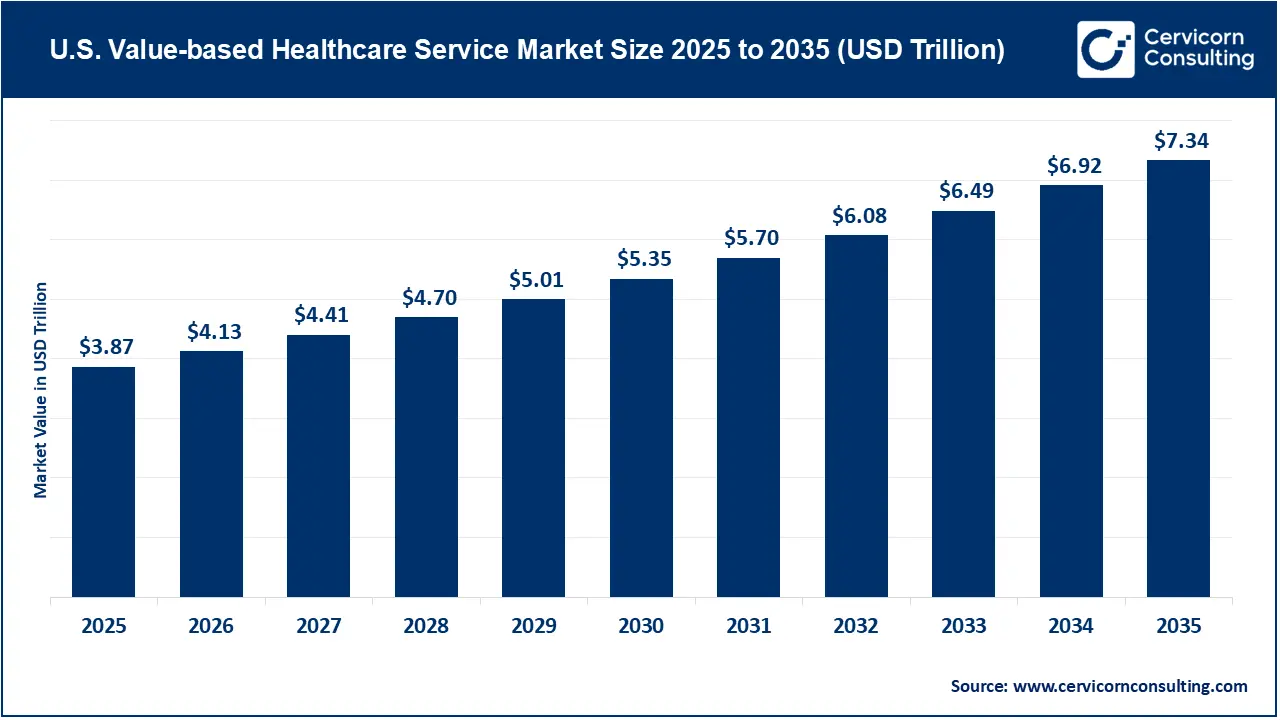
The U.S. value-based healthcare service market was valued at approximately USD 3.87 trillion in 2025 and is projected to reach USD 7.34 trillion by 2035, expanding at a CAGR of 6.61% during the forecast period.
U.S. Value-Based Healthcare Service Market Growth Factors
The U.S. value-based healthcare service market is expanding rapidly due to the increasing burden of chronic diseases, rising healthcare expenditure, strong government support through Medicare and Medicaid value-based reimbursement programs, widespread adoption of accountable care organizations (ACOs), growing use of artificial intelligence and predictive analytics in care management.
Increasing focus on preventive healthcare, greater demand for patient-centric services, expansion of telehealth and remote patient monitoring, integration of electronic health records (EHRs), growing partnerships between healthcare providers and insurance companies, improved interoperability of healthcare systems, increasing employer-sponsored value-based care initiatives, and continuous investments in digital healthcare infrastructure aimed at improving clinical outcomes while reducing overall healthcare costs.
Get a Free Sample: https://www.cervicornconsulting.com/sample/2711
What is the U.S. Value-Based Healthcare Service Market?
The U.S. value-based healthcare service market consists of healthcare organizations, insurance providers, technology companies, physician groups, hospitals, and care management organizations that deliver healthcare under reimbursement models focused on patient outcomes rather than service volume.
Unlike the traditional fee-for-service system, where providers receive payment for every consultation, test, or procedure, value-based healthcare links reimbursement to measurable improvements in quality, efficiency, patient satisfaction, and long-term health outcomes.
Common value-based healthcare models include:
- Accountable Care Organizations (ACOs)
- Patient-Centered Medical Homes (PCMHs)
- Bundled Payment Programs
- Shared Savings Programs
- Pay-for-Performance Models
- Capitated Payment Systems
- Population Health Management Programs
Healthcare providers receive incentives for preventing illness, reducing readmissions, improving chronic disease management, coordinating care across multiple providers, and delivering better patient experiences.
Why is the U.S. Value-Based Healthcare Service Market Important?
Healthcare spending in the United States continues to rise every year, making affordability and efficiency major priorities for policymakers and healthcare organizations. Value-based healthcare addresses these challenges by aligning financial incentives with patient outcomes instead of service quantity.
Its importance includes:
- Improving quality of patient care
- Reducing unnecessary medical procedures
- Lowering healthcare expenditure
- Preventing avoidable hospital admissions
- Encouraging preventive care
- Enhancing chronic disease management
- Increasing patient engagement
- Improving physician accountability
- Supporting data-driven clinical decision making
- Reducing healthcare disparities through coordinated care
For patients, value-based care often results in better health outcomes and fewer complications. For providers, it creates opportunities to improve operational efficiency while receiving financial rewards for delivering high-quality care.
Major Companies Operating in the U.S. Value-Based Healthcare Service Market
| Company | Specialization | Key Focus Areas | Notable Features | 2025 Revenue | Estimated Market Share |
|---|---|---|---|---|---|
| Optum | Integrated healthcare services and population health | Value-based physician networks, analytics, care coordination | Largest physician organization in the U.S., advanced AI-driven healthcare management | Approximately USD 280 Billion | 18–20% |
| CVS Health (Aetna & Oak Street Health) | Integrated payer-provider healthcare services | Primary care, Medicare Advantage, home health, pharmacy integration | Extensive retail clinic network and value-based primary care expansion | Approximately USD 390 Billion | 17–19% |
| Cigna | Health insurance and care management | Employer healthcare, behavioral health, pharmacy benefits | Strong focus on integrated healthcare and preventive care | Approximately USD 250 Billion | 10–12% |
| Anthem (Elevance Health) | Health benefits and population health | Managed care, digital health, Medicaid, Medicare | Extensive value-based reimbursement partnerships | Approximately USD 190 Billion | 9–11% |
| Humana | Medicare Advantage and senior healthcare | Home-based care, primary care, chronic disease management | Industry leader in senior-focused value-based care | Approximately USD 125 Billion | 8–10% |
Market Evolution
The U.S. healthcare industry has experienced several major reimbursement transformations.
Fee-for-Service Era
Historically, providers earned revenue based solely on the number of services delivered, often encouraging higher utilization rather than better outcomes.
Quality-Based Reimbursement
Programs introduced by Medicare began linking payments to hospital quality metrics and patient satisfaction.
Accountable Care Organizations
ACOs emerged to coordinate patient care while reducing unnecessary costs and sharing savings among providers.
Population Health Management
Healthcare organizations increasingly use analytics to monitor entire patient populations, proactively identifying high-risk patients.
Digital Value-Based Care
Artificial intelligence, predictive analytics, wearable devices, remote monitoring, and virtual healthcare are now supporting highly personalized value-based care delivery.
Leading Trends and Their Impact
Artificial Intelligence in Population Health
Healthcare organizations increasingly use AI to predict disease progression, identify high-risk patients, and optimize treatment pathways.
Impact
- Earlier disease intervention
- Reduced hospitalizations
- Lower healthcare costs
- Better clinical outcomes
Expansion of Medicare Advantage
Medicare Advantage plans continue expanding value-based reimbursement agreements with physicians and hospitals.
Impact
- Better coordinated senior care
- Higher preventive screening rates
- Improved chronic disease management
Home-Based Healthcare
Patients increasingly receive treatment at home instead of hospitals.
Examples include:
- Hospital-at-home
- Home nursing
- Remote monitoring
- Virtual physician visits
Impact
- Lower readmission rates
- Reduced inpatient costs
- Improved patient satisfaction
Digital Health Integration
Electronic Health Records (EHRs), cloud computing, and healthcare interoperability platforms continue improving care coordination.
Impact
- Faster clinical decisions
- Better information sharing
- Improved physician collaboration
Predictive Analytics
Healthcare providers leverage machine learning models to forecast disease risks and optimize preventive care.
Impact
- Reduced emergency visits
- Better resource utilization
- Lower treatment costs
Behavioral Healthcare Integration
Mental health services are increasingly incorporated into primary care under value-based payment arrangements.
Impact
- Improved whole-person care
- Better treatment adherence
- Reduced healthcare utilization
Remote Patient Monitoring
Wearables and connected medical devices continuously monitor patients with chronic conditions.
Impact
- Better disease management
- Earlier intervention
- Fewer hospital admissions
What Are Some Successful Examples of Value-Based Healthcare Around the World?
Although the United States remains the largest adopter of value-based healthcare, several countries have implemented successful outcome-based healthcare systems.
Netherlands
The Netherlands has implemented integrated care pathways that emphasize coordinated treatment, preventive care, and bundled payments. Hospitals and physicians collaborate closely to improve long-term outcomes while controlling costs, resulting in high-quality care and strong patient satisfaction.
Sweden
Sweden has pioneered outcome-based reimbursement for orthopedic procedures, particularly hip and knee replacements. Providers are evaluated on patient recovery, complication rates, and long-term performance rather than procedure volume, helping improve surgical outcomes and resource efficiency.
United Kingdom
The UK’s National Health Service (NHS) has introduced integrated care systems that encourage collaboration among hospitals, primary care providers, and community health organizations. These initiatives focus on prevention, chronic disease management, and population health improvement while reducing avoidable hospital admissions.
Singapore
Singapore combines strong preventive healthcare policies with data-driven population health management. Government-supported digital health infrastructure and coordinated chronic disease programs have improved efficiency and helped contain healthcare costs despite an aging population.
Australia
Australia has expanded value-based care through primary healthcare networks, chronic disease management programs, and coordinated care models. Increased use of telehealth and multidisciplinary care teams has improved access to healthcare, particularly in rural and remote communities.
Government Initiatives and Policies Shaping the Market
Government policy has been instrumental in accelerating the shift toward value-based healthcare in the United States. Several initiatives have encouraged providers and payers to adopt outcome-focused reimbursement models while improving care quality and reducing unnecessary spending.
Medicare Shared Savings Program (MSSP)
The Centers for Medicare & Medicaid Services (CMS) established the Medicare Shared Savings Program to support Accountable Care Organizations (ACOs). Participating providers are rewarded when they deliver high-quality care while lowering total healthcare costs for Medicare beneficiaries. This program has driven widespread adoption of coordinated care, preventive services, and data-driven population health management.
Medicare Advantage Value-Based Payment Expansion
Medicare Advantage plans have increasingly incorporated value-based contracts with hospitals, physician groups, and primary care organizations. These agreements emphasize preventive care, chronic disease management, reduced hospital readmissions, and improved patient satisfaction, particularly for older adults with complex healthcare needs.
CMS Innovation Center (CMMI)
The Center for Medicare & Medicaid Innovation develops and tests alternative payment models designed to improve healthcare quality while reducing expenditures. Initiatives such as bundled payment programs, accountable care models, and primary care transformation projects have encouraged providers to innovate in care delivery and adopt more efficient reimbursement structures.
Bundled Payments for Care Improvement (BPCI)
The Bundled Payments for Care Improvement initiative provides a single payment for an entire episode of care rather than reimbursing each individual service. This encourages hospitals, physicians, and post-acute care providers to coordinate treatment, reduce unnecessary services, and improve patient outcomes across the full continuum of care.
Merit-based Incentive Payment System (MIPS)
MIPS evaluates eligible clinicians based on quality, cost efficiency, interoperability, and improvement activities. Providers demonstrating strong performance receive financial incentives, while lower-performing providers may face payment reductions. This program promotes continuous quality improvement and greater accountability across healthcare practices.
Accountable Care Organization REACH Model
The ACO Realizing Equity, Access, and Community Health (REACH) model strengthens value-based care by emphasizing health equity, patient-centered care, and coordinated services for underserved populations. Participating organizations are encouraged to address social determinants of health while improving clinical outcomes and reducing disparities.
State-Level Medicaid Value-Based Programs
Many U.S. states have expanded value-based reimbursement within Medicaid through managed care organizations and provider partnerships. These programs focus on improving maternal health, behavioral healthcare integration, chronic disease management, and preventive care while controlling long-term healthcare expenditures.
Interoperability and Digital Health Policies
Federal initiatives promoting electronic health record interoperability and secure health information exchange have improved care coordination among providers. Enhanced data sharing supports more informed clinical decision-making, reduces duplicate testing, and enables better management of patient populations under value-based care arrangements.
Telehealth and Remote Care Reforms
Regulatory changes have expanded reimbursement for telehealth and remote patient monitoring services, particularly following the COVID-19 pandemic. These policies have increased access to care, improved chronic disease management, and supported value-based care models by enabling continuous patient engagement outside traditional clinical settings.
Health Equity and Social Determinants of Health Initiatives
Government agencies increasingly encourage providers to incorporate health equity measures into value-based payment programs. By addressing factors such as housing stability, food security, transportation access, and community resources, these initiatives aim to improve outcomes for vulnerable populations while reducing long-term healthcare costs.
Future Outlook
The U.S. value-based healthcare service market is expected to remain one of the fastest-evolving segments of the healthcare industry as providers, payers, employers, and policymakers continue prioritizing quality, efficiency, and patient-centered care. Advances in artificial intelligence, predictive analytics, digital therapeutics, interoperability, and home-based care will further strengthen value-based delivery models. As reimbursement increasingly shifts toward measurable outcomes, organizations capable of integrating technology, coordinated care, and preventive health strategies will be well positioned to improve patient outcomes while achieving sustainable cost savings.
To Get Detailed Overview, Contact Us: https://www.cervicornconsulting.com/contact-us
Read Report: Hyperscale Computing Market Revenue, Trends, and Strategic Insights by 2035