Solar Hydrogen Panel Market Outlook: Technology Validation, Hydrogen Production Costs, System Durability, and Commercial Scale-Up
Solar Hydrogen Panel Market: 6 Decisions Companies Should Make to Improve Efficiency and Commercial Viability
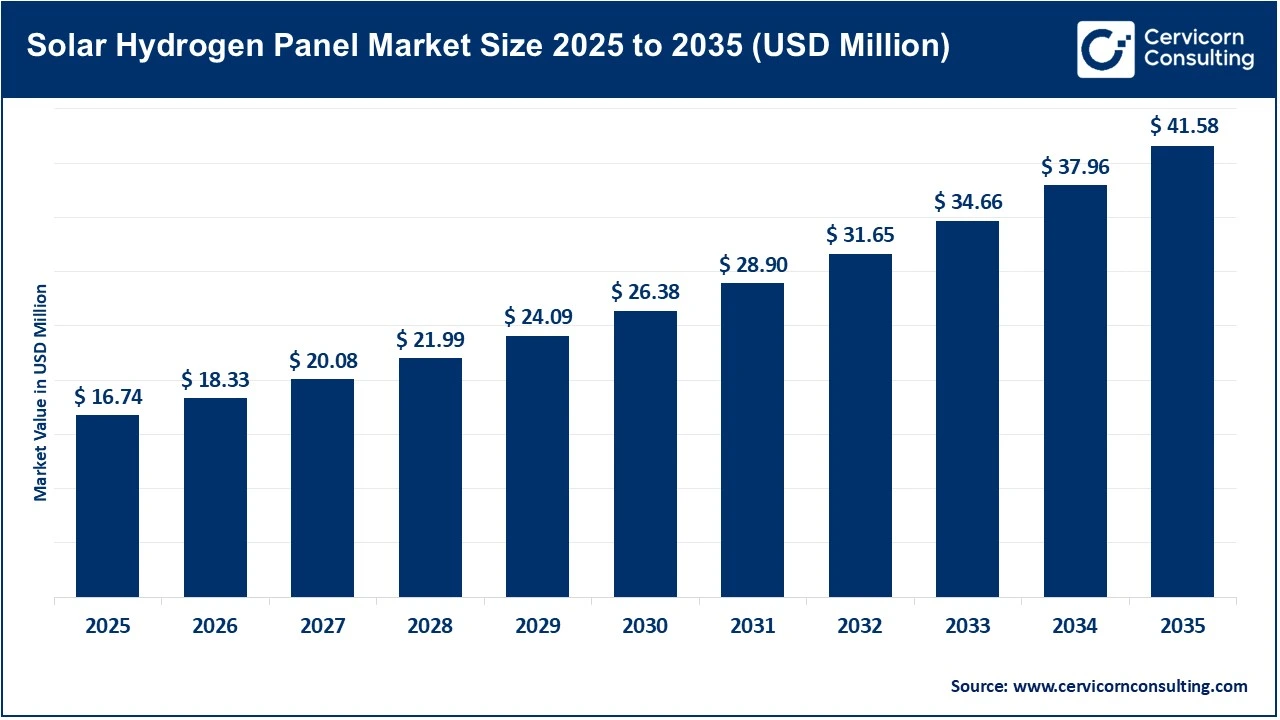
The global solar hydrogen panel market was valued at USD 16.74 million in 2025 and is projected to reach USD 41.58 million by 2035, growing at a CAGR of 9.5% from 2026 to 2035. Growth is supported by rising interest in green hydrogen, industrial decarbonization, and technologies that can produce hydrogen directly from sunlight and water. However, the commercial opportunity depends on whether manufacturers and project developers can overcome efficiency, durability, manufacturing, and cost challenges.
Unlike conventional solar photovoltaic (PV) systems that generate electricity for a separate electrolyzer, direct solar hydrogen panels integrate light absorption and hydrogen production through technologies such as photoelectrochemical and photocatalytic water splitting. This approach could reduce system complexity and enable decentralized hydrogen production, but commercial deployment remains challenging. The International Energy Agency (IEA) identifies solar water-splitting technologies as being largely at the demonstration stage, making technology validation and project economics critical considerations for businesses.
For manufacturers, energy companies, industrial hydrogen buyers, and investors, the central question is not simply how quickly the market will grow. It is which technologies, applications, and commercialization strategies can deliver reliable hydrogen at a competitive cost.
1. Which Solar Hydrogen Technology Offers the Best Commercial Potential?
Technology selection will determine conversion efficiency, material costs, manufacturing complexity, and the pace at which a company can move from demonstration to commercial production. Solar hydrogen panels encompass different approaches, including photoelectrochemical systems, photocatalytic materials, and integrated solar-to-hydrogen architectures.
Companies should assess each technology according to its demonstrated performance rather than its theoretical efficiency or laboratory results alone.
Key considerations for decision-makers:
- Solar-to-hydrogen efficiency: Compare independently verified conversion efficiency under realistic operating conditions, including variations in sunlight and temperature.
- Material availability: Assess the cost, supply security, and scalability of catalysts, semiconductors, protective coatings, and other critical materials.
- Manufacturing readiness: Determine whether the technology can be manufactured consistently using scalable production processes.
- System integration: Evaluate gas separation, hydrogen collection, water management, and safety requirements.
- Technology differentiation: Establish whether the proposed design offers measurable advantages over conventional PV-powered electrolysis.
The technology decision should also reflect the company’s capabilities. A materials specialist may be better positioned to commercialize advanced catalysts or semiconductor components, while an energy project developer may prioritize integrated modules that can be deployed at industrial sites.
Business implication: Companies should prioritize technologies that demonstrate a credible pathway from laboratory performance to repeatable field results. A lower-cost technology with stable output may offer better commercial prospects than a high-efficiency design that requires expensive materials or complex manufacturing.
Get a Free Sample: https://www.cervicornconsulting.com/sample/2969
2. How Should Companies Evaluate Hydrogen Production Costs?
Hydrogen production economics will influence whether solar hydrogen panels can compete with established hydrogen production methods. The market’s projected expansion does not automatically guarantee profitability for individual manufacturers or projects.
The relevant metric is the levelized cost of hydrogen (LCOH), which estimates the total cost of producing hydrogen over a system’s operating life per kilogram of hydrogen produced.
For solar hydrogen panels, the calculation should account for equipment investment, manufacturing costs, installation, water treatment, maintenance, replacement of degraded components, and actual hydrogen output. Companies should also include costs associated with compression, storage, purification, and delivery where applicable.
Six cost variables deserve particular attention:
- Capital expenditure: Calculate the installed cost per unit of expected hydrogen production capacity.
- Conversion performance: Estimate output using realistic solar conditions rather than peak laboratory measurements.
- Operating life: Model how component degradation affects cumulative hydrogen production.
- Capacity utilization: Account for daily and seasonal changes in solar availability.
- Downstream infrastructure: Include hydrogen handling, storage, and transportation where these are required.
- Financing assumptions: Test how interest rates, project duration, and the cost of capital affect the final hydrogen price.
A comparison with conventional electrolyzers powered by renewable electricity is essential. Although direct solar-to-hydrogen systems may reduce the need for separate electricity-generation and electrolysis equipment, they must demonstrate that any savings outweigh differences in efficiency, durability, maintenance, and system performance.
Companies should develop base-case, downside, and upside cost scenarios before approving large capital investments.
Business implication: Investment decisions should be based on cost per kilogram of usable hydrogen over the system’s lifetime, not panel manufacturing cost or peak efficiency alone.
3. Should Companies Target Industrial Buyers or Decentralized Applications First?
The choice of end-use market influences system size, sales cycles, product specifications, infrastructure requirements, and the evidence required to secure customers.
Industrial facilities represent an important potential market because hydrogen is already used in applications such as chemical manufacturing, refining, and fertilizer production. However, these buyers generally require predictable supply, defined purity levels, reliable operating performance, and competitive costs.
Decentralized applications may provide a different route to commercialization. Smaller systems could be evaluated for research facilities, remote industrial sites, demonstration projects, and locations where on-site hydrogen production offers operational advantages.
Companies should assess three potential customer groups:
- Industrial hydrogen users: Prioritize production reliability, hydrogen purity, integration requirements, and cost per kilogram.
- Distributed energy and remote facilities: Examine site-specific solar resources, water availability, storage requirements, and the value of avoiding hydrogen deliveries.
- Technology developers and research institutions: Consider pilot modules, evaluation systems, component supply, and collaborative demonstrations as early commercial opportunities.
The best initial market may not be the segment with the largest theoretical hydrogen demand. It may be the segment where a company can demonstrate a measurable operational benefit and secure a repeatable purchasing process.
Before selecting a target segment, companies should interview prospective buyers to establish current hydrogen procurement costs, consumption profiles, purity requirements, and willingness to adopt emerging production technologies.
Business implication: Begin with applications where on-site production, modularity, or reduced dependence on external hydrogen supplies can justify the technology’s current cost and performance limitations.
4. How Can Manufacturers Improve Durability and System Reliability?
Durability is one of the most important commercialization challenges for solar hydrogen panels. A system that performs well during a short demonstration may not deliver competitive economics if its active materials degrade rapidly or its hydrogen output declines under real-world conditions.
Exposure to sunlight, moisture, heat, chemical reactions, and repeated operating cycles can affect semiconductors, catalysts, protective layers, and other system components. Degradation can increase maintenance requirements and reduce lifetime hydrogen production.
Companies should therefore treat reliability as a product-development priority rather than a problem to address after commercialization.
Four areas require systematic evaluation:
- Material stability: Test whether photoactive materials and catalysts maintain performance during prolonged operation.
- Protective engineering: Assess coatings, seals, and component designs that prevent corrosion, leakage, and contamination.
- Environmental resilience: Evaluate operation under changing temperatures, humidity, solar intensity, and water quality.
- Serviceability: Design modules that allow inspection, component replacement, and maintenance without excessive downtime.
Pilot projects should track hydrogen output, conversion efficiency, degradation rates, maintenance events, and operating hours. Results should be compared across different environmental conditions to establish realistic performance expectations.
Manufacturers should also define warranties and performance guarantees based on validated operating data. Overly optimistic lifetime assumptions can undermine project economics and create commercial liabilities.
Business implication: Companies that demonstrate predictable performance and transparent degradation data can reduce buyer uncertainty and improve their prospects of securing long-term supply agreements.
5. Which Markets and Partnerships Should Companies Prioritize?
Geographic expansion should be based on more than hydrogen policy announcements or renewable energy potential. Companies must determine whether local conditions support commercially viable deployment.
Cervicorn Consulting’s market assessment identifies Europe as the largest regional market in 2025, with an estimated 38.5% share, followed by North America at 27.8% and Asia-Pacific at 24.6%. These figures describe the solar hydrogen panel market assessment; they should not be interpreted as shares of the broader green hydrogen industry.
Europe may offer opportunities through industrial decarbonization initiatives and established clean-energy programs. North America provides potential access to industrial hydrogen users and clean-energy investment networks. Asia-Pacific offers opportunities associated with renewable energy expansion, manufacturing capabilities, and national hydrogen strategies.
India is also worth evaluating for companies seeking to develop local technology capabilities or serve emerging hydrogen applications. However, national hydrogen targets and installed solar capacity do not, by themselves, establish demand for direct solar hydrogen panels. Project-level economics and customer requirements must be assessed separately.
Partnerships can help companies address gaps in commercialization capabilities:
- Research institutions: Validate efficiency, material stability, and system performance.
- Industrial hydrogen consumers: Provide real-world operating environments and potential offtake.
- Engineering and manufacturing partners: Improve module design, production consistency, and deployment readiness.
- Renewable energy developers: Support site assessment, solar-resource analysis, and project integration.
- Hydrogen infrastructure providers: Address purification, compression, storage, and downstream delivery.
Rather than entering several regions simultaneously, companies should select markets where technical capabilities, customer demand, policy conditions, and potential partners align.
Business implication: Prioritize markets with identifiable pilot customers and a credible route to commercial deployment. Partnerships should contribute specific capabilities or reduce a defined commercialization risk.
6. When Should Companies Scale Manufacturing and Commercial Deployment?
Scaling too early can lock companies into expensive production processes before efficiency, reliability, and customer demand are sufficiently established. Waiting too long, however, can leave technology developers without manufacturing capacity when commercial demand emerges.
A stage-gated investment strategy can help balance these risks.
Stage 1: Technology validation
Establish independently verified efficiency, hydrogen output, safety performance, and initial durability. Identify the principal technical barriers and determine whether the technology offers a meaningful advantage over competing systems.
Stage 2: Pilot demonstration
Operate pilot modules under relevant environmental and customer conditions. Measure actual hydrogen output, maintenance needs, degradation, and the cost of producing usable hydrogen.
Stage 3: Commercial validation
Secure customer participation, validate offtake requirements, establish performance expectations, and assess project financing. Determine whether buyers will pay for the demonstrated benefits.
Stage 4: Manufacturing readiness
Evaluate production yield, equipment requirements, supplier reliability, quality control, and the cost of scaling production. Identify which processes can be standardized and which still require specialized engineering.
Stage 5: Capacity expansion
Increase manufacturing capacity when technical performance, customer demand, supply-chain readiness, and project economics meet predefined investment criteria.
Management should establish explicit go/no-go thresholds at each stage. These could include minimum verified efficiency, maximum acceptable degradation, target production cost, confirmed customer demand, and expected manufacturing yield.
Companies should also assess intellectual property, freedom to operate, product certification, hydrogen safety requirements, and access to critical materials before committing to large-scale deployment.
Business implication: Scale according to validated technical and commercial milestones rather than market growth forecasts alone. This approach can limit capital exposure while preserving the ability to expand when the technology becomes commercially competitive.
Conclusion: Turning Solar Hydrogen Potential Into Commercial Opportunity
The solar hydrogen panel market is developing at the intersection of renewable energy, advanced materials, and green hydrogen production. Its projected growth from USD 16.74 million in 2025 to USD 41.58 million by 2035 signals an emerging commercial opportunity, but the sector’s relatively early technology maturity means that growth will depend on measurable progress in performance, durability, manufacturing, and cost.
For companies evaluating this market, six decisions deserve priority: selecting a commercially viable technology, establishing realistic hydrogen production costs, choosing the right initial customers, improving durability, targeting suitable markets and partnerships, and defining evidence-based manufacturing scale-up milestones.
The companies best positioned to benefit will be those that connect technological innovation with clear customer requirements and disciplined investment decisions. In the near term, credible demonstrations, reliable operating data, and well-defined commercial use cases are likely to matter more than manufacturing capacity alone.
As direct solar-to-hydrogen technologies progress toward wider deployment, companies that validate their competitive advantages early will be better equipped to determine where to invest, which partnerships to pursue, and when to move from pilot projects to commercial production.
To Get Detailed Overview, Contact Us: https://www.cervicornconsulting.com/contact-us
Read Report: Hydrogen Blending Market Outlook: Infrastructure Readiness, Cost Considerations, and Decarbonization Pathways