Recycled PET Market Revenue, Trends, and Strategic Insights by 2035
Recycled PET Market Size
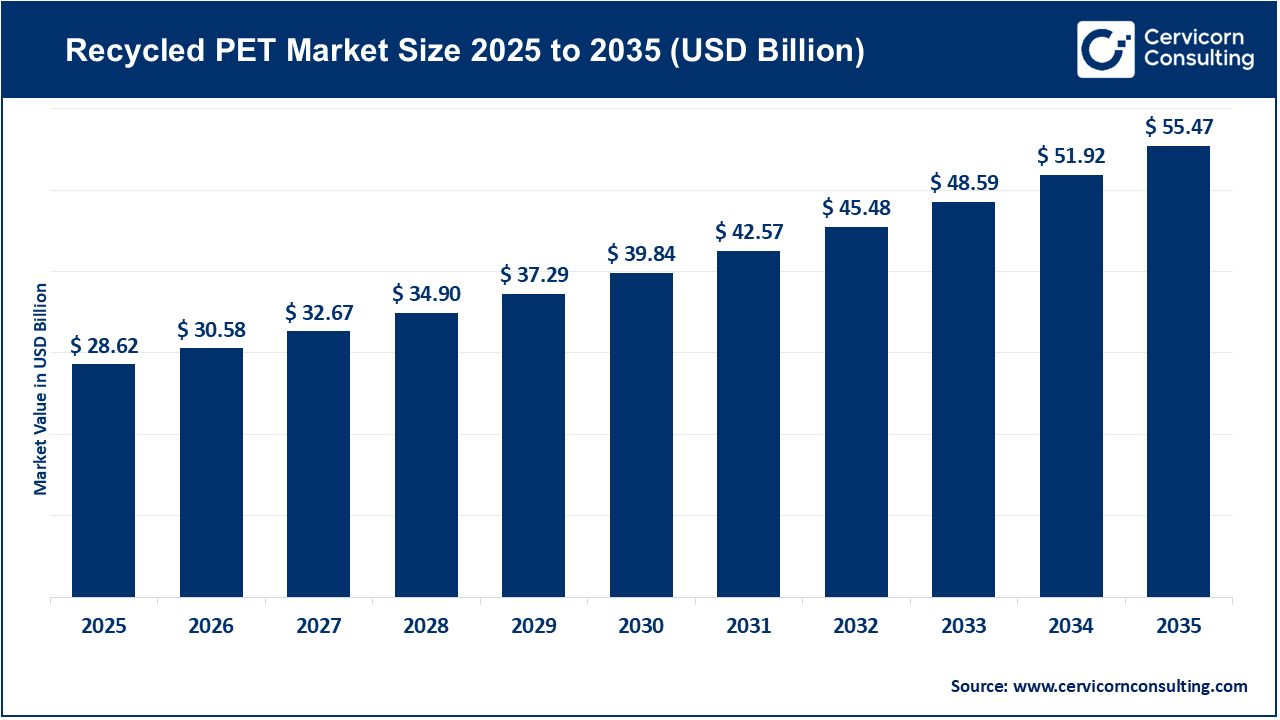
The global recycled PET market size was worth USD 28.62 billion in 2025 and is anticipated to expand to around USD 55.47 billion by 2035, registering a compound annual growth rate (CAGR) of 6.8% from 2026 to 2035.
Recycled PET Market Growth Factors
The growth of the recycled PET (rPET) market is driven by a convergence of regulatory, environmental, technological, and commercial factors. Governments across major economies are implementing strict regulations and recycled content mandates to reduce plastic waste and carbon emissions, compelling manufacturers to incorporate rPET into packaging and consumer products. Rising environmental awareness among consumers is pushing brands to adopt sustainable materials, while global corporations are committing to ambitious sustainability and carbon-neutral targets that rely heavily on recycled plastics. Technological advancements in mechanical and chemical recycling processes have significantly improved the quality, purity, and performance of rPET, enabling its use in food-grade and high-value applications.
Additionally, growing demand from industries such as textiles, automotive, construction, and consumer goods is expanding rPET’s application base beyond bottles, further strengthening long-term market growth.
What Is the Recycled PET Market?
The recycled PET (rPET) market encompasses the collection, sorting, processing, and re-manufacturing of polyethylene terephthalate plastics into reusable polymer materials. PET is one of the most widely used plastics globally, primarily found in beverage bottles, food containers, and packaging films. Instead of disposing of these materials after a single use, rPET processing transforms waste PET into flakes, pellets, or fibers that can be reused in manufacturing new products.
rPET is produced mainly through mechanical recycling, which involves washing, shredding, melting, and re-pelletizing PET waste. In recent years, chemical recycling technologies have gained attention for their ability to break PET down into its molecular components, allowing for the production of near-virgin-quality recycled resin. The rPET market plays a pivotal role in closing the plastics loop, reducing dependence on fossil-based raw materials, and promoting sustainable industrial practices.
Get a Free Sample: https://www.cervicornconsulting.com/sample/2876
Why Is the Recycled PET Market Important?
The importance of the rPET market extends far beyond waste management. It is a cornerstone of global sustainability strategies and circular economy frameworks. By diverting plastic waste from landfills and oceans, rPET reduces environmental pollution and conserves natural ecosystems. Producing rPET requires significantly less energy than manufacturing virgin PET, resulting in lower carbon emissions and reduced resource consumption.
From a regulatory perspective, rPET enables compliance with evolving plastic waste legislation, recycled content mandates, and extended producer responsibility programs. For businesses, rPET enhances brand value by aligning products with eco-conscious consumer preferences and sustainability commitments. Economically, the rPET market creates jobs across collection, sorting, and processing value chains while stimulating investment in recycling infrastructure and innovation.
Key Companies in the Recycled PET Market
Ergis Recycling
Company Overview:
Ergis Recycling is part of the Ergis Group, a prominent European plastics processor and recycler with operations primarily in Poland and Germany.
Specialization:
Production of recycled PET pellets and flakes for packaging films, industrial materials, and strapping applications.
Key Focus Areas:
Industrial recycling solutions, sustainable packaging materials, and integration of recycled content into flexible packaging products.
Notable Features:
Strong emphasis on circular economy initiatives and internal recycling loops within the group’s manufacturing operations.
2024 Revenue:
The Ergis Group generates revenues exceeding USD 250 million, reflecting strong regional performance.
Market Share:
Moderate but influential share within the Central and Eastern European rPET market.
Global Presence:
Primarily Europe, with products distributed across multiple EU countries.
BariQ
Company Overview:
BariQ is a large-scale PET recycling company specializing in transforming post-consumer PET bottles into high-quality rPET pellets.
Specialization:
Bottle-to-bottle and food-grade rPET resin production.
Key Focus Areas:
Sustainable packaging, export-oriented rPET supply, and circular economy development.
Notable Features:
Recycles over one billion PET bottles annually and exports 100% of its production to international markets.
2024 Revenue:
Estimated to exceed USD 100 million, driven by strong export demand.
Market Share:
Significant supplier within the global food-grade rPET supply chain.
Global Presence:
Exports primarily to Europe and North America.
Phoenix Technologies
Company Overview:
Phoenix Technologies is a U.S.-based company specializing in the production of recycled PET resins.
Specialization:
High-quality rPET pellets for food, beverage, textile, and industrial applications.
Key Focus Areas:
Advanced recycling technologies, quality control, and customized resin solutions.
Notable Features:
Proprietary processing systems designed to meet stringent application requirements.
2024 Revenue:
Privately held; estimated in the tens of millions of USD.
Market Share:
Recognized player in the North American rPET market.
Global Presence:
Primarily North America, with supply relationships extending internationally.
Clear Path Recycling LLC
Company Overview:
Clear Path Recycling LLC is a major North American recycler specializing in rPET flake and pellet production.
Specialization:
Bottle-to-flake and bottle-to-pellet rPET processing.
Key Focus Areas:
Textile-grade and food-grade rPET production, large-scale recycling operations.
Notable Features:
One of the largest PET recycling facilities in North America, known for operational scale and efficiency.
2024 Revenue:
Estimated at over USD 200 million following expansion and acquisitions.
Market Share:
Strong presence in the U.S. rPET market.
Global Presence:
North America, supplying global consumer brands.
Libolon
Company Overview:
Libolon is a Taiwan-based manufacturer and recycler specializing in recycled PET fibers and textiles.
Specialization:
rPET yarns, fibers, and functional textiles.
Key Focus Areas:
Sustainable textile manufacturing, circular polyester solutions.
Notable Features:
Certified recycled materials and close partnerships with global apparel brands.
2024 Revenue:
Estimated to exceed USD 150 million.
Market Share:
Notable share within the global recycled polyester textile segment.
Global Presence:
Asia-Pacific with exports to Europe and North America.
Leading Trends and Their Impact on the Recycled PET Market
Sustainability and Circular Economy Adoption
Governments and corporations are increasingly embedding circular economy principles into business strategies. Mandatory recycled content targets are accelerating demand for rPET across packaging and consumer goods.
Advancements in Recycling Technologies
Innovations in chemical recycling, AI-based sorting systems, and advanced decontamination technologies are improving rPET quality and enabling food-grade applications.
Expansion Beyond Packaging
rPET usage is growing in textiles, automotive interiors, construction materials, and industrial strapping, diversifying demand and reducing reliance on packaging alone.
Corporate Sustainability Commitments
Global brands are committing to high percentages of recycled content in packaging, driving long-term rPET procurement agreements and investments.
Successful Examples of the Recycled PET Market Worldwide
Several regions and companies have successfully integrated rPET into their industrial ecosystems:
- Beverage brands introducing 100% rPET bottles in select markets
- Large-scale textile manufacturers using recycled PET fibers in sportswear and fashion
- National deposit-return schemes achieving high PET collection rates
- Public-private partnerships building advanced recycling infrastructure in emerging economies
These examples demonstrate the scalability and commercial viability of rPET when supported by policy, technology, and industry collaboration.
Global Regional Analysis Including Government Initiatives and Policies
Asia Pacific
Asia Pacific dominates the global rPET market due to high plastic consumption, expanding recycling infrastructure, and supportive government policies. Countries like China and India are promoting recycled plastics through national plastic waste management rules, recycled content targets, and incentives for recycling facilities.
Europe
Europe leads in regulatory enforcement and collection efficiency. Government initiatives such as extended producer responsibility schemes, deposit-return systems, and mandatory recycled content targets are driving consistent rPET demand across packaging and textiles.
North America
The rPET market in North America is supported by corporate sustainability commitments and state-level recycled content regulations. Investment in recycling infrastructure and private-sector innovation continues to strengthen regional capacity.
Latin America
Latin America is an emerging rPET market, with increasing focus on waste management reforms, recycling targets, and collaboration with global brands to improve PET collection and processing.
Middle East & Africa
While still developing, the region is witnessing growing interest in rPET driven by sustainability goals, international investments, and pilot recycling initiatives aimed at improving plastic waste management.
To Get Detailed Overview, Contact Us: https://www.cervicornconsulting.com/contact-us
Read Report: Generative AI 2.0 Market Revenue, Trends, and Strategic Insights by 2035